
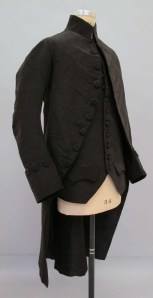
 In considering menswear, I found this suit at the Met. Incredibly plain, it reminds me of classic Balenciaga: all about fabric and drape. It also reminded me of Hogarth’s Analysis of Beauty, and the serpentine line.
 You could also call it the Ogee curve, and it’s found in the serpentine legs of 18th century tables, and does not come from, “Oh gee, that soldier’s got nice legs.”
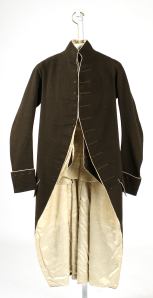 In this variation on the theme, the contrasting lining emphasizes the lapel line, but the overall effect is less elegant. It’s about materials, too, not just cut. There’s so much to learn just by looking, really looking, at clothes and paintings from the past. There are subtleties we miss as we rush past, and miss because we haven’t read enough to understand what we’re being told.
So much hides in plain sight, because we don’t see the world the way the tailors and painters and engravers saw it. I don’t pretend to have the key to that world, but it’s worth looking for, mostly just by looking.
 Kitty Calash
Great photos! Thanks!
I have a question, though, about those contrast facings and how they were worn — how did they keep the tails, (assuming that facing was a cotton drill, or some kind of wool gab) from clinging to the fabric of the seat of the pants? Also, what did they do about the lack of “slip” in the torso? I have a couple of period tailcoats, but both of them are lined in heavy silk.
Thanks!
Best,
Nancy N
The second jacket with the contrast lining appears to have a silk lining. Silk linings and facings are found in 18th & early 19th century garments, so that would keep those tails from sticking to the breeches.
At work, we have a lovely frock coat with tails lined in glazed (calendered) plain weave wool. (I wonder…but it is shiny) The glaze of calendaring would make the plain weave wool lining slip more easily over the corduroy breeches said to have been worn with the coat.
In a few weeks, I’ll have a costume expert in our storerooms. I have a million questions for him, and this is one to ask! He also has extensive experience wearing the most authentic clothes, so might have first hand experience. My Mr S doesn’t have the wardrobe yet to tell us…I’d better get right on that!!
Oh, this is so fun & informative! Military uniforms have always interested me — especially those 18th century ones, with the WHITE PANTS. I mean, HELLO! why didn’t they just paint targets on themselves? I can’t imagine they were anything but mud (or blood)-colored after a good 4 hour march and a bivouac! I do remember some European commander changing from white to dark uniforms after he saw the disastrous effect it had on morale when those soldiers saw their comrades splattered on the battlefield…
I never heard of “calendering” — is it like waxing the fabric? What happens when the wool gets wet? Did any of the wool jackets get pre-laundered (or boiled) so they wouldn’t shrink from exposure to the elements?
Have a great week, and enjoy catching Mr. S up on his uniform,
Nancy N
So, about those pants.
You can bleach or boil white, and I think that might be part of the appeal to the army. Wash could be done –when it was done– by boiling clothes in iron kettles, and then spreading them to dry on the grass or hanging them from clotheslines.
A lot of sins come out in the iron kettle wash; that’s the cleanest my shift has ever been, and the softest.
Style would have been a factor too; it’s a great question, though. When did the white overall come into style for the British troops, and when it did go out of style? I have an expert coming on on December 14, so I will add this to the long list of questions I want to ask him!