
Tags
Henry Sargent, historic interiors, interpretation, John Brown House Museum, Museum of Fine Art Boston, Museums, paintings, Research, social life and customs, tea party, The Tea Party
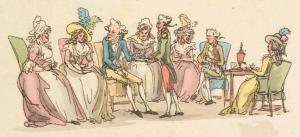
Detail, Picturesque studies and scenes of everyday life. Handcolored etching by Thomas Rowlandson, 1790. Royal Collection Trust. RCIN 810396
Hat tip to Jane Austen’s World for the image at left, which helped me start visualizing another program I’m involved with, this time ‘at home’ in Providence.
When we started reinterpreting the house museum, we began going back through primary sources to figure out how rooms might have been used, and furniture arranged (we don’t have inventories, so we read the house and diaries and letters– but that’s for another post).

Detail, The Tea Party. Oil on canvas by Henry Sargent, 1824. MFA Boston, 19.12
One of the things I remember most vividly was the description of the uncomfortable tea parties Providence women gave, where the guests sat in chairs against the walls of the rooms, balancing a tea cup in one hand and plate in another. Several hard drives later, I’m not sure where that primary source is (the hunt begins tomorrow) but it conjured images of every hostess in Providence a Hyacinth Bucket, and every guest a quivering Elizabeth Next Door.
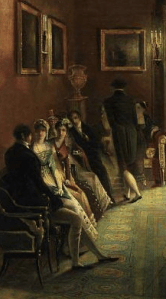
Detail, The Tea Party. Oil on Canvas by Henry Sargent, 1824. MFA Boston, 19.12
Surely that couldn’t be true? I thought I must be making it up, but then the Rowlandson turns up on the interwebs and there they are, in a row. More famously and closer to home, Henry Sargent’s painting of a Boston tea party in 1824. (The catalog description is rather nice.)
Here’s an 1824 tea party in Boston. While this is later than the tea party we’ve planned at work, it is still full of useful hints about how early, formal tea parties were conducted. We think– or I do, anyway– of ladies in frilly hats seated a tables with cakes heaped on stands and floral tea pots. I hear “tea party” and I think “doilies,” but this is not your grandmother’s tea party. It’s a different kind of social occasion, both more formal and more relaxed.
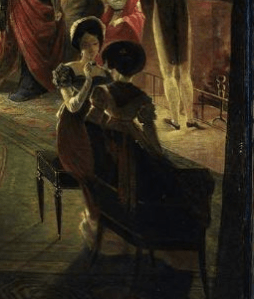
Detail, The Tea Party, oil on canvas by Henry Sargent, 1824. MFA Boston, 19.12
There’s not a central table to sit around, but instead chairs lined up against the wall, groups of guests, chatting. Others guests stand close to the fireplace, and a pair of ladies have taken a settee and a stool for their close conversation. We can just make out the tiny tea cup in the lady’s gloved hand.
In many ways, this depiction reminds me more of contemporary cocktail parties or open houses with the guests in small, changing groups, and no place to put your cup. Of course, most of us don’t have waiters (that’s who you see in the detail above with his back to us) or fabulous houses on the Tontine Crescent in Boston.
In so many ways, the social customs, habits and mores of the past are lost to us, and as we try to recreate them, the we excavate them from a combination of unlikely sources. Accounts, paintings, diaries, and etiquette manuals serve as sources, but it’s easier to recreate the economics of tea than the structure of a tea party. And once we do have an approximation, will it be a party anyone wants to go to?
 Kitty Calash
I imagine, given that most of the figures in both artists works are women, that tea drinking was what the women did, while the men had something stronger? And that the tiny cup was a reflection of the expense of the tea itself? If so, what would they think of us, as we order our venti chai lattes??
Thanks for this–I particularly love the glimpses of the hats!
Nancy N
The men seem to have taken tea, and not spirits, in these mixed parties. There were certainly parties where both sexes drank spirits—and a very frisky party in Providence involving cherry cordial or brandy– but so far tea parties seem to have been just that. The tea ritual itself is awfully different from the venti chai latte (yes, please) but I suppose each age has the ritual it wants. Or supports.
KC
Dear Kitty Calash,
Fanny Burney writes a good bit about taking tea and about parties in her diaries. Before she became Second Keeper of the Robes to Queen Charlotte, she gadded about a good bit in upper-crust British society. She talks repeatedly of “the circle”, in which guests at a party sat in a circle to socialize. One could get up and go to a window seat, etc,, for a private conversation, but the main affair was the circle. I forget the name of the socialite who bucked the convention — Mrs. Montague, maybe? — but she arranged chairs casually, mixed them up around the room, and guests found the change disorienting and conversation fodder.
Tea was sometimes served during the circle parties, if I remember aright, but you’d have to read.
Later, at Court, she presided daily at a tea table where she had the honor of serving the tea to a repeating cadre of men and women. How they sat is a little unclear, but it was either a line or a circle, because she always speaks of finding a chair next to someone, and of people getting up and sitting down…no big table in the way. Foods minimal.
This period included the 1770s to the early 1790s.
If and how how this differed in portions of the U.S., sure wish I knew, like you.
Very best,
Natalie
Natalie,
Thank you so much for your comment! I will keep looking. So far, all the diaries say is, “Took tea with Mrs B.” or “Alice had a large party to tea.” Not so helpful.
Still looking and reading….
Kitty
Pingback: Shopping at Dobyns and Martin | Kitty Calash