• Home
  • Completed Costumes/Impressions
  • Emma and Her Dresses
  • Free Patterns and Instructions

Kitty Calash

~ Confessions of a Known Bonnet-Wearer

Kitty Calash

Tag Archives: historic house museums

Glaciers in the House

19 Thursday Mar 2015

Posted by kittycalash in History, Museums

≈ 6 Comments

Tags

historic house museums, historic interiors, history, interpretation, museum practice, Museums

IceDamFeb2015

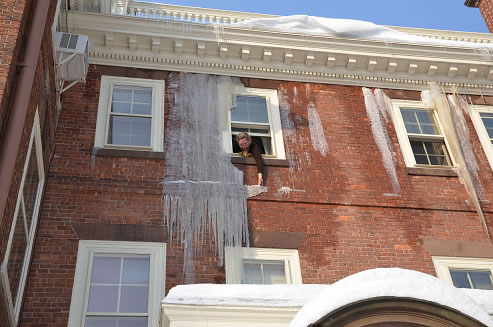
I don’t mean the ice dams and icicles that plagued the house and streaked the service ell’s windows as they melted: I mean change.

I’m reading The Half Has Never Been Told (it kept selling out, so I only just got a copy), and thinking about the representation of a past that people would rather forget, and sometimes actively deny in the North– and the South, as you will tell from reading African-American History Fail.

Change in historic houses can be glacially-paced, as staff and docents alike resist changes to interpretation. Resistance to change is usually about comfort and confrontation, especially when the change is large.

I get that: Oh no, new stuff to learn. What was wrong with what we did before? But docents and staff get comfortable and loose sight of the context of the content they present. They say some interesting stuff.

Most jaw-dropping of all: Sometimes I like to pretend I’m Mrs Owner of the House. That one was creepy, to me. But it did give me some insight into the “ooh, wish I lived here” backwardly aspirational tour motivation.

How would you feel if living here meant you owned and traded slaves? Defended the slave trade in Congress? If a small girl had the care of your horses? We don’t ask those specific questions, but I think we need to. Slavery is slavery.

In the 1790 census of Rhode Island, there are 948 slaves, representing 1.3% of the population. That would be 13,000 people of Rhode Island’s total population today, less than the city of Central Falls (19,383 in the last census, and one of our smallest towns).

We think it’s a small number, but to those 948 people, being enslaved was everything. I don’t necessarily want to make our visitors feel personal guilt about slavery– that’s up to them–but I do want to them to think about what slavery meant, and what it did, as an economic system.

I want visitors to understand that the beauty of the house they see is built in part on the ugly and forced exploitation of a class of people. If they relate that to the rest of the world they inhabit today, even better. I think we owe at least this much to every site where enslaved people worked or lived.

Share this:

  • Click to share on Facebook (Opens in new window) Facebook
  • Click to share on Pinterest (Opens in new window) Pinterest
  • Click to email a link to a friend (Opens in new window) Email
  • Click to share on X (Opens in new window) X
Like Loading...

The Museum of Crap

24 Monday Nov 2014

Posted by kittycalash in Collecting, Museums, personal, Research, Uncategorized

≈ 1 Comment

Tags

anarchist guide to historic house museums, antiques, collecting, exhibits, historic house museums, historic houses, interpretation, museum collections, Museums

After an intense three days spent thinking about museums, we went to the antique mall on Sunday. It did not disappoint, being stuffed with a variety of material goods.
image

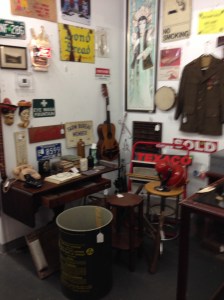
We had not gone past the first round of booths when it occurred to me that what I was walking past a series of touchable period rooms or installations, a kind of non-judged science fair of historical displays, each one trying to convince me to literally buy its message.

This came home when I saw the booth on the left, arranged much the way a period room in a museum is arranged, with the desk suggesting that someone has just walked away from it.

I’d seen this at a house in Boston, and I’ve seen it at home: it’s not enough. At least at antique mall, you can touch everything. At the museum, unless that desk and room are jam-packed*, we are not going far enough.

image

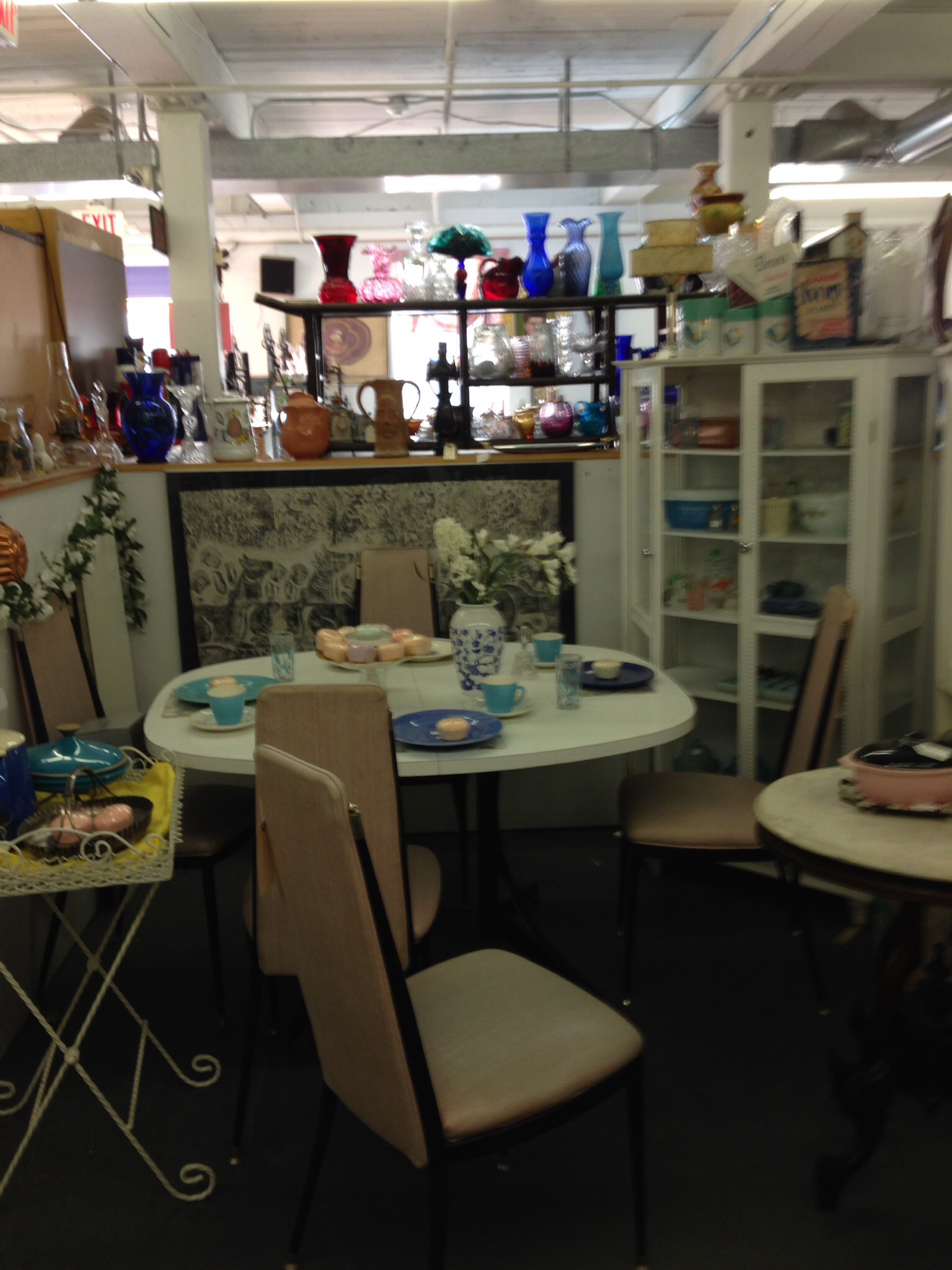
In this vignette, you can step into a dinette and sit at the table. Feel the linens, touch the dishes (I’d avoid the glittery cupcakes, myself) and pretend you are home.

This kind of interactivity is reserved for children’s museums, with varying degrees of success, often oversimplified based on an assumption that children need streamlined displays to “get” the exhibit message. Sometimes I feel a similar lack of sophistication in the presentations at the Museum of Crap, a lack of deep consideration– it is, after all, just a booth at a mall.

image

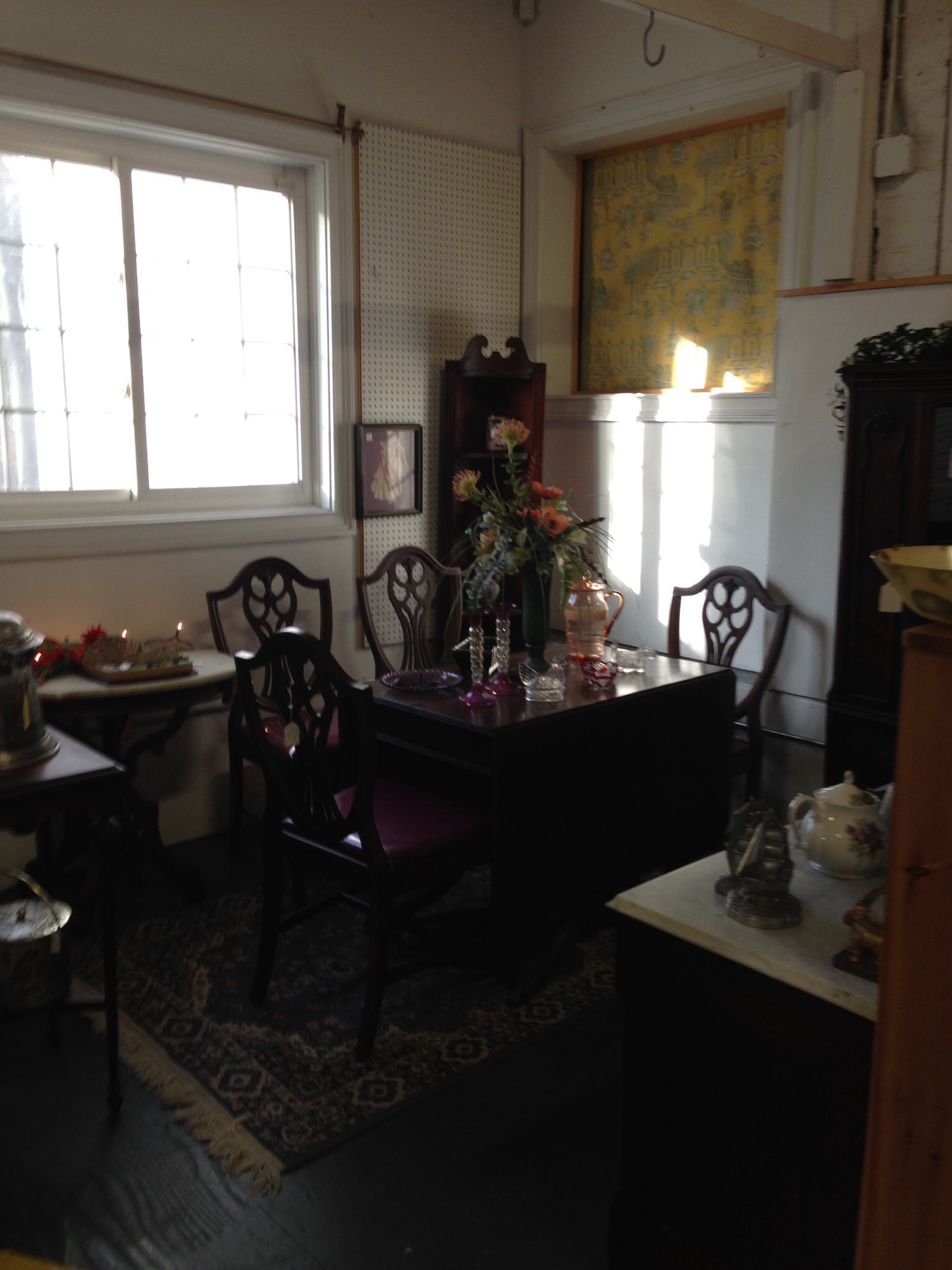
There are also the booths that really capture the deathly “Sunday dinner with the stiff relatives” feeling of some historic house museums and bad summer vacation memories, or perhaps for you it’s “tense Thanksgiving dinner with the in-laws,” or even “happy birthday tea with auntie,” and it’s a pleasant memory.

Antique malls clearly offer an array of display techniques, just as an major (large) museum with a variety of galleries.

Martha Stewart Living taught us about sorting things by color back in the 1990s, and it also taught us about the power of similarity: grouping like with like can create powerful visual displays and be quite attractive. Here’s the Gallery of Green. There was even an faux spongeware cat figurine, with a green sponge glaze. Details matter: difference stands out: that’s why the teddy bears pop in this booth.

image

image

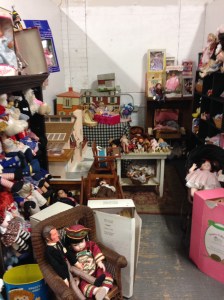
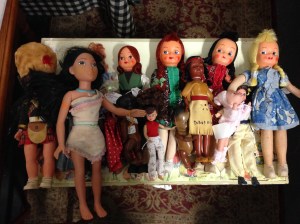
Perhaps you prefer the natural history museum, or a medical museum? There are doll morgues for you folks. This proved quite popular with women of a certain age, thankfully still a little older than I.
image

There are displays for (almost) every taste. Couples go through these emporia, often at a similar pace (Mr S and I usually split up, and come together only occasionally to compare and share reactions) but not necessarily in unison.


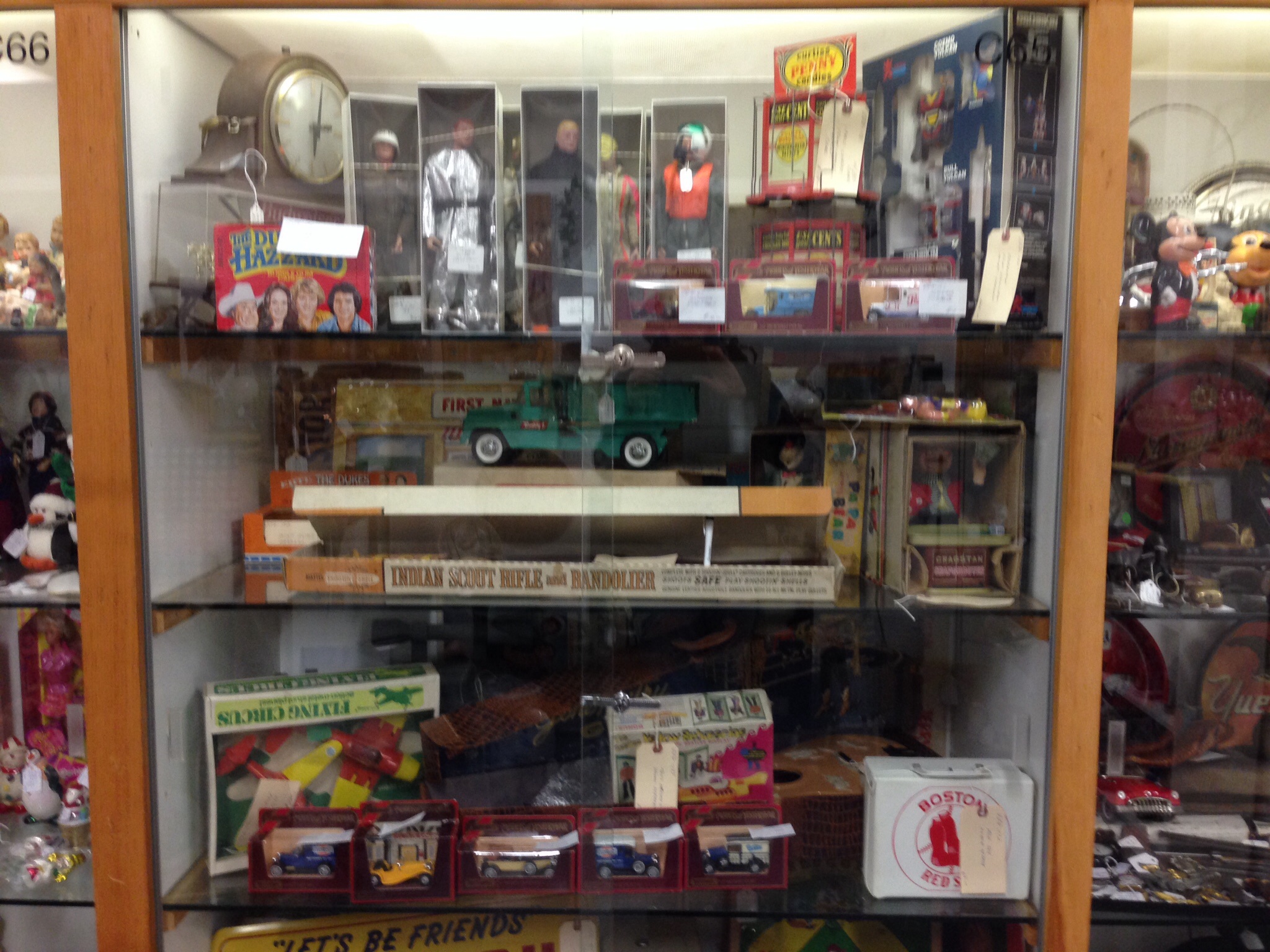
Here’s an entire case that might come to life in an episode of Futurama, but it’s full of stuff for nostalgic guys: G.I. Joe in Crash Team suit, Planet of the Apes figures, Captain Kirk, and the Indian Scout Rifle and Bandolier. Cars, trucks, a flying circus: here’s a man’s past for him to admire without the responsibility of keeping it up. These are social experiences, where people wander through and talk about their objects, the things they owned, or coveted, the memories they have, the future they imagine.

image

We’re consumers: our lives are all about stuff these days (having it, getting it, curating it, getting rid of it– even minimalists are about stuff) and whether you think that’s sad or not, it’s true. We express ourselves through things. Antique malls give us access to the things of the past in immediate, tangible ways. We can talk, remember, and play in these compendia in ways that we cannot in museums.

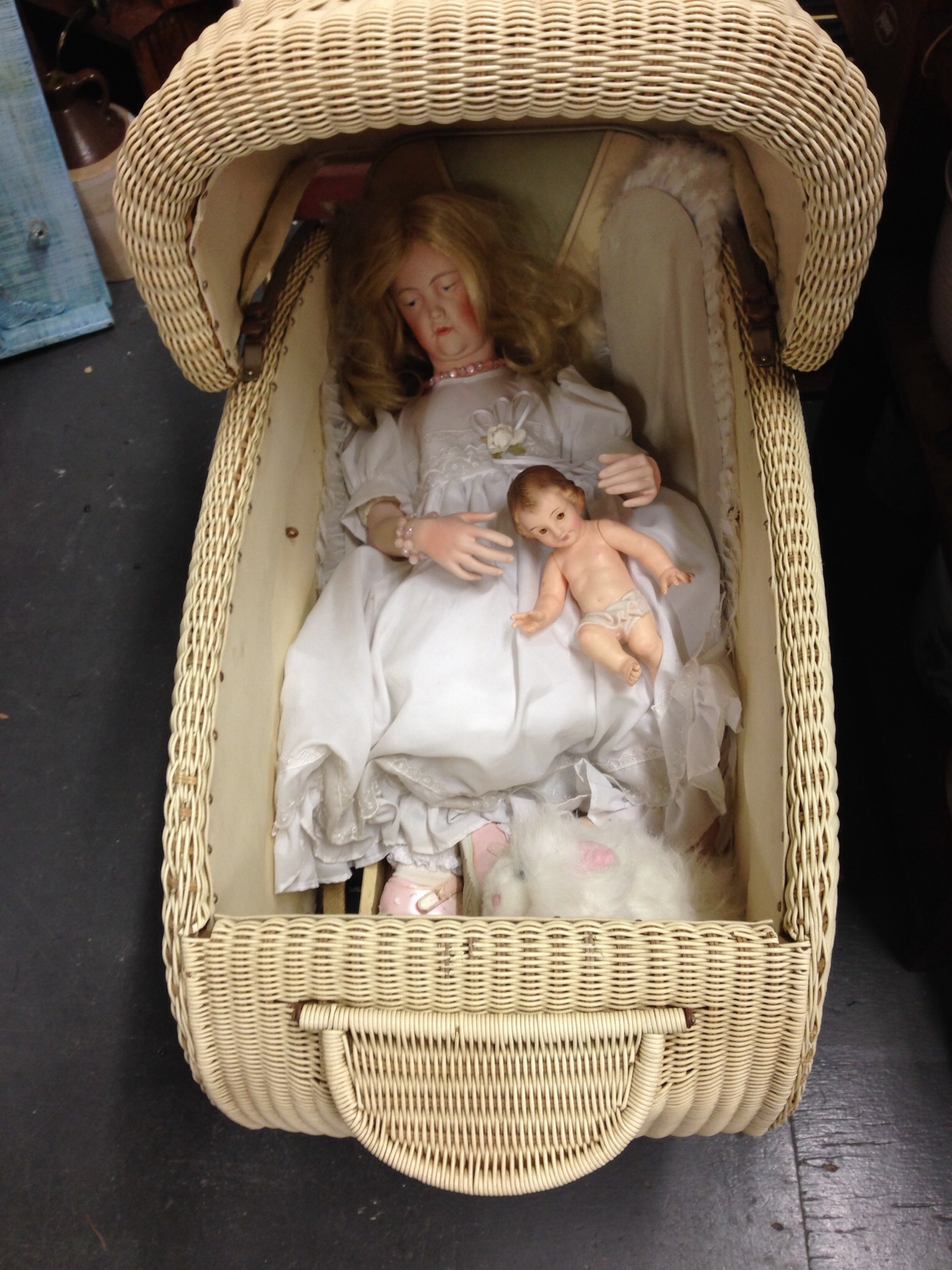
There are some unlikely display techniques. This is not an arrangement I would have come up with, but I enjoy it. It caught my attention. I can imagine that I know some folks who would have come up with this display, and had they done so in a museum under my purview, I would have undone it. Maybe that wouldn’t be right. It certainly stopped me and Mr S, and we both made certain the other saw it.

image

The carriage, while heavy, had an amazingly smooth suspension system unlike any pram I’ve ever pushed at home or elsewhere. I couldn’t tell you what Mary and Jesus and a plush Persian cat were doing in a pram, but I do recognize the care with which they have been arranged, and the whiteness of the display, which speaks perhaps to the universal innocence of this trio. Someone chose this, deliberately. This isn’t art, or hipsterism, this is as genuine as the doo-wop songs on the 1950s radio station chosen by the antique mall.

It’s all so sincere: the nostalgia, the Everly Brothers crooning through the ceiling speakers in the converted mill, the soft, smoothing touches of consumers handling the goods. As sincere as we are in museums, we’re missing something by keeping all of our collections out of reach, and by cloistering all of our galleries in silence.

I’m a huge fan of silence, but what would happen if we did play music in galleries? Would removing the silence allow people to talk more, between their companions and even strangers? I get the marketing spin of doo-wop soundtrack, and I get how wrong it would sound in Nathan Hale’s homestead…but wouldn’t it be interesting to try it now and then? Exile on Main Street resounding in the halls of the period mansion is how the staff sometimes experience it, and we love the places where we work. Why not show the public how we see the houses sometimes, instead of insisting on a false, and silent, objectivity?

*Exceptions made for displays of minimalist architects’s homes, with documentation. What would Corbu’s house musuem look like?

Share this:

  • Click to share on Facebook (Opens in new window) Facebook
  • Click to share on Pinterest (Opens in new window) Pinterest
  • Click to email a link to a friend (Opens in new window) Email
  • Click to share on X (Opens in new window) X
Like Loading...

Preservation or Petrification?

22 Saturday Nov 2014

Posted by kittycalash in History, Living History, Museums, Philosophy

≈ 5 Comments

Tags

anarchist guide to historic house museums, historic house museums, Historic House Trust of New York, historic houses, historic interiors, interpretation, living history, museum practice, Museums

For almost ten years, I’ve been working on the re-interpretation and re-presentation of the HHM that is part of my employer’s stable of properties. We’ve had mixed results: guides who refuse to look me in the face, guides who quit because a piano got moved, guides who hissed “hedonism!” at the site of a lounging mannequin, and guides who were made incredibly sad by the representation of a sick (dying) child.

James, recovering from a party the night before

James, recovering from a party the night before, angered some guides (2007)

Me, I consider all those things successes.
The people who had to deal directly with that fall out, maybe not so much.

Change is hard and scary, and every one has a different tolerance for risk. As you have probably guessed, mine’s fairly high. I blog, I go out into the world in some pretty funny clothes, and inhabit characters I am not. I expect to fail regularly: it’s a reliable way of learning.

Change is hard to maintain, it’s hard to continually evolve and push an interpretation forward. It takes time, focus, and money; it takes cross-disciplinary collaboration and communication between curators, educators, and docents or guides.

Taking risks in spaces full of very expensive furniture is particularly daunting, but especially rewarding when you see how a house looks, inhabited and, to a degree, used.

Alice receives the mantua maker's letter

They’re sitting in real, accessioned chairs. (2014)

The job of museums is to preserve, but we sometimes seem determined to petrify, to freeze a perfect moment in amber, to freeze our visitors with fear of touching, photographing, asking, and to freeze and understanding, all in a fluid world.

If we reject the beautiful and untouchable past to embrace the messy human past, we can juxtapose the fine mahogany-furnished rooms of the merchant elite with the work to create those rooms and make the picture more whole by including slaves, servants, workmen and tradesmen.

More of us would have been working than lounging

More of us would have been working than lounging (2006)

Most of us would not have lived the way the merchants did: to a degree, our historic house visits are backwardly aspirational, as we wish for nostalgia that is more false than most nostalgia.

I am not advocating favoring the smelly past, or descriptions of unpleasantness, over exultations about carvings and upholstery—except that I am—because I see these pendulum swings as a part of the process of creating more complete and honest representations and recreations of the past, in museums, at historic sites, and in living history presentations.

It’s past time for me to work again on re-imagining the house under my care: I acknowledge that. Synthesizing what I learn in living history with the work I do in museums, and vice-versa, will improve and enhance the public experience of history inside and out.

Share this:

  • Click to share on Facebook (Opens in new window) Facebook
  • Click to share on Pinterest (Opens in new window) Pinterest
  • Click to email a link to a friend (Opens in new window) Email
  • Click to share on X (Opens in new window) X
Like Loading...
Newer posts →

Archives

wordpress statistics

Creative Commons License
Kitty Calash blog by Kirsten Hammerstrom is licensed under a Creative Commons Attribution-NonCommercial-ShareAlike 4.0 International License.

Website Built with WordPress.com.

  • Subscribe Subscribed
    • Kitty Calash
    • Join 621 other subscribers
    • Already have a WordPress.com account? Log in now.
    • Kitty Calash
    • Subscribe Subscribed
    • Sign up
    • Log in
    • Report this content
    • View site in Reader
    • Manage subscriptions
    • Collapse this bar
 

Loading Comments...
 

    %d