
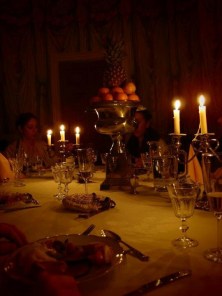
 I am chasing two things at once these days: late 18th century high-style table settings, and late 18th century life after dark. They’re related topics, but in a way they’re not.
Setting aside the table, for I have diagrams and dishes and silver service identified and am down to questions of exact napkin folding and placement, how did people spend their time in the 18th century? We assume life was more tuned than ours to diurnal rhythms ( see Circles and Lines) but was it always?
There were differences between the days of servants, slaves and masters, and one good place for resources on those differences is Colonial Williamsburg. Like OSV, CW has placed some of their research papers online. For the house where I work, the Daily Schedule for a Young Gentry Woman is very helpful:
“From about 8:30 p. m. until 10 or 11 p.m. she, members of her family, and guests socialize at home or with neighbors. Their evening activities include conversation, toasting friends, singing or listening to music, reading aloud, playing cards or board games such as backgammon, dancing, and taking moonlight strolls. … “Kate read the Vicar of Wakefield to me this evening and highly entertained me” (Robert Hunter journal, 1786). … “We play’d whist from 9 to 11. Capt. Clopper & myself, Mr. Harris & Munroe” (Ruth Henshaw Bascom diary, 1802).”
These observations of Virginia pastimes coincide with how we know Providence residents spent their evenings in the late 18th century. How late people stayed up was determined in part by need: was there work still to be done writing a sermon? was a family member ill? and in part by access: were there candles by which to work or read?
Fun to think and read about, but for now, I must put it aside. Fort Lee is tomorrow, and I have mending to do or we will all be cold. It will be an early bed for us all tonight, since we are driving down tomorrow morning. Photos on Sunday, as long as I remember the camera.
 Kitty Calash