Tags
19th century, bust darts, details, dress, Events, fashion, museum collections, patterns, sewing, Spencer

Spencer ca. 1800. MMS 1991.239.2
It all started out so well, in the muslin, but in the wool, not so much. I cut up a remnant, proving that a yard and a quarter of 60” fabric is enough for a Spencer, even for my arm length (but not less, thanks to that arm length and a respect for the grain).
The pattern I’m using has bust darts, which I haven’t sewn in years. They took some tweaking with the steam iron.
In 18th century clothing, one doesn’t see bust darts; there are some above the bust, shaping gowns at the robings, but for the most part they aren’t needed. Think cones, thanks to the stays. And later in the 18th century, a lot of work is done by gathers and drawstrings, as in the white and black ca. 1800 French spencer at the Met.
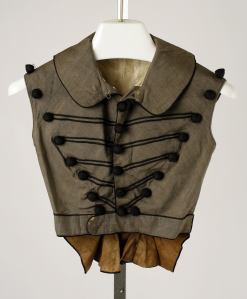
Spencer ca. 1818-1819. MMA 1982.132.3
But if you’ve got an endowment of the non-fiscal kind, and you want your military-inspired garment to fit smoothly over your endowment, what do you do?
In this example, you hide the bust dart under braid and buttons. Check out that diagonal seam—and that the fabric appears to have been cut on the bias.
Brilliant, right? Gain ease by using the stretchy quality of the bias and hide the shaping under decorative elements.

Spencer, 1813. MMA C.I.39.13.48
In the garment below, of wool, three bust darts of the same length help shape the front. And again, decorative braid hides the shaping.
It’s only cataloged as “wool,” with no weave given. There is a detail image of the darts and braid as well; I think that might be serge, and not superfine broadcloth. Still, three bust darts help achieve a smooth fit.
The Swedish Spencer at the museum in Lund has but one grainy photo: it’s hard to imagine that it doesn’t have bust darts, but the photo leaves much to the imagination.
 Kitty Calash
I’ve seen a lot of spencers with bust darts. It makes sense given the shape of many people’s bust and that gathers would be bulky, especially in the warmer fabrics like wool. Sometimes the darts are hidden, but often you can see them. Sometimes they’re even top stitched with little stitches so they look decorative and intentional. Here’s to hoping your darts behave!
Best,
Quinn
The bust darts were better once I pressed them on the ham, and more so after I attached the sleeves.
I completely get why they’re needed, but the fitting is really different from what I usually do! The trickiest bit will be trying this in broadcloth…which is why I thought I’d start with the lighter weight remnant. Pictures soon!
KC
That brown spencer military front looks like they’re princess seams, not just darts. Possible? And I love the bias cut there. Boy I bet that sucker fit!
Nancy, they’re darts. If you zoom way in, there’s a little pucker at the top of the dart. http://www.metmuseum.org/collections/search-the-collections/105284?img=0#fullscreen It’s a long dart, so yes, it must have fit amazingly well.
KC
Interesting article! There are all kinds of fronts in bodices. One dart to three darts, stitched from the left side or decorative top stitching, often the overlapping spencers do not have them and are regulated simply with the curved side piece cutting and overlapping (I just finished a piece without darts)…those cut on the bias often have darts on the lining for the shape…I suppose bias cut was much more common than we actually practise. Looking forward to seeing your spencer finished 🙂
I love the new Spencer jacket you just finished, and the painting! I’m really curious about how to fit without darts, so the curved side piece will be very important as I think about broadcloth.
Cutting on the bias was a revelation to me: now I’ll have to try it!