• Home
  • Completed Costumes/Impressions
  • Emma and Her Dresses
  • Free Patterns and Instructions

Kitty Calash

~ Confessions of a Known Bonnet-Wearer

Kitty Calash

Author Archives: kittycalash

Requiems and Reenactments

17 Wednesday Apr 2013

Posted by kittycalash in Events, Living History, Reenacting

≈ 15 Comments

Tags

battles, commemoration, discussion, living history, Patriots Day 2013, Reenacting, Revolutionary War

Warning: Long reenactor-heavy content ahead.

Evan McGlinn for the NY Times. Click for slide show.

Evan McGlinn for the NY Times. Click for slide show.

My friend wrote on Tuesday about battle reenactments, and whether or not they’re appropriate or even, well, decent, in a way; she has been thinking about the Battle Road event, Patriots Day, and the Battle at Lexington Green in light of the explosions at the Boston Marathon.

She helped me remember the reading and thinking I had done this past fall when people at work asked if reenactments (and even museum exhibitions) glorified war, and when I started to wonder why, exactly, I was in this hobby. I read Vanessa Agnew on “History’s Affective Turn: Historical Reenactment and its Work in the Present” in Rethinking History 11:3, 299-312 (2007) and “Mobile Monuments: A view of historical reenactment from inside the costume cupboard of history” by Stephen Gapps, also in Rethinking History 13:3, 395-409 (2009). I’m still working my way through “Mimic Toil: Eighteenth-Century Preconditions for the Modern Historical Reenactment” by Simon During, again from Rethinking History, 11:3, 313-333 (2007). There’s a good bibliography at the University of York, but getting at these takes JSTOR or ProjectMUSE access; check with your local public or university library. For list of books about commemoration, History, Memory, and Monuments: An Overview of the Scholarly Literature on Commemoration by Kirk Savage is an excellent starting place. To find out more about why reenactments differ on different sites, and to discover more about the sometimes-fraught relationship between the NPS and reenactors, you can read this on the role of reenactors at National Parks.

The article that resonated most was Gapps. He wrote about a variety of reenactment types, but what made sense to me as a member of two military reenactment groups, both part of the Brigade of the American Revolution, was his writing about the military reenactments. Gapps focuses on Civil War reenacting, and that is an area in which I’m not interested, but his central tenet rang true to me:

…the performance of history has been largely dismissed by cultural critics as a form of nostalgia, but … it actually has a significant role to offer – particularly as a form of public commemoration of shared remembrance of historical events.

Mr S between the Adjutant and the Dollmaker. Thanks to JacobMar1ey on flickr.

Public commemoration is a large part of the reenactments I’m involved with, but they work differently for participants and spectators, and for different kinds of participants. For a recent example, Mr S and I spent Monday morning in Concord at the North Bridge ceremony, and had two very different experiences.

He came back from the bridge and said, “I was really scared. For a moment there, crossing the bridge and seeing all the British forces, I had a sense of what it must have been like.”

On the North Bridge. Thanks to JacobMar1ley at flickr.

While he had been on the bridge, I was in the gardens with the public thinking, Those poor British soldiers, while I listened to the crackle of candy wrappers and people giggling about their dogs. The crowd spread out on the hill that leads to the Concord River, festival-style, and I was appalled that they came for entertainment to what I thought of as a truly ceremonial and commemorative event. The NPS rules about engagements and casualties suddenly made a lot of sense.

My friend wrote specifically about how reenactments can never portray the reality of fear and horror that is war. She is right. NPS agrees: Even the best-researched and most well-intentioned representations of combat cannot replicate the tragic complexity of real warfare. The activity and logistical support for modern battle reenactments is inconsistent with providing a memorial atmosphere. There is something about reenactments that I cannot fully embrace even as I love them. I have a difficult relationship with “patriotism,” as I have a difficult relationship with America, and much as I have a difficult relationship with my family and friends, whom I also love dearly, though rarely demonstratively.

Naked Raygun, Chicago.

I have been grappling with the concept of America and history and the meaning of American symbols—semiotics—since I started making art. I came of age in the punk years in Chicago, stapling photocopied collages to telephone poles. Reagan was president, nuclear war seemed imminent. I made sculpture and installations about American architecture and literature, as a way to explore American history. I remain skeptical about the political process, even as I engage in it.

So why am I a reenactor? It isn’t always easy. Sometimes it’s uncomfortable, personally—intellectually—it can be difficult to fully embrace sometimes. Recently, with online discussions of gun control and the relationship between rifle/black powder clubs, the NRA, and reenactors, it has been difficult to grapple with all of the different points of view and to be true to one’s beliefs. Most of the time people don’t air their opposing views. Some of us do, as one writer noted, hold our noses and pay our dues. I knew this going in.

But reenacting, in a way, is an art form for me, a very personal one, one that this blog is part of.

Another friend avoids the military reenactments and sticks to living history through museum work. Mr S enjoys the farm work as much as the battles, because he likes working hard. He likes the physical experience of both; he likes the people, too, and whether he’s chopping wood with the hat maker or crossing the bridge with the adjutant, the shared experiences mean a lot to him. For me, the most profound experiences of women’s history have come at the farm, probably because that is the truest means of reaching the past for a woman I have yet to discover. Can I find that moment in military reenacting? Perhaps, by working hard at recreating the army follower experience.

Unlike monuments, reenactments have the potential to create more open ended and contextual historical commemorations. (Gapps, abstract)

One thing I do not like about the battles is the public. I stand on the public side of the rope line, and think, “Those are my people out there, on the field.” The public—the predatory photographers, the hooting guys, the texting teens, the snacking people—seem so out of place to me. I know it’s entertaining, but it’s somewhere between real and not real, and I can’t forget that it is often about something that was real.

Photo by Evan McGlinn for NY Times. Click for slide show.

Photo by Evan McGlinn for NY Times. Click for slide show.

Mr S hears spectators yell, Get those British bastards! but that doesn’t mean he likes to hear it. It’s not just because we have friends among those enemies, but because they represent men who, just like the Americans, were scared and wounded, hungry and dying. They were here doing their jobs in a place claimed by the British Crown. Does that yell miss the point of the reenactment as commemoration? Is it simple boorishness? Does the comment show the relationship between reenactment and spectator to be too close to blood sport?

Or is the problem that some of the military reenactments fail to adequately contextualize the ‘battle’ as a commemoration or demonstration? Does narration help? We discussed this in the car on the way home from Battle Road: amplified narration and role-playing can deepen the experience for visitors and reenactors alike. What are the better ways to present history for the public? (We’re not suggesting narration for Battle Road: we were comparing notes on different events, and the different perspectives we have from two sides of the rope line.)

I think it’s encouraging when reenactors, even some who might be stereotyped from a distance as old guys who’ll never change, ask themselves questions about what they do, and how, and why. Questions are where we start, and conversations. I’m glad my friend started a conversation. We won’t all like or agree with every statement, but we have to keep talking.
Share this:

  • Share on Facebook (Opens in new window) Facebook
  • Share on Pinterest (Opens in new window) Pinterest
  • Email a link to a friend (Opens in new window) Email
  • Share on X (Opens in new window) X
Like Loading...

Boston.

16 Tuesday Apr 2013

Posted by kittycalash in Uncategorized

≈ 1 Comment

Tags

Boston, Patriots Day 2013

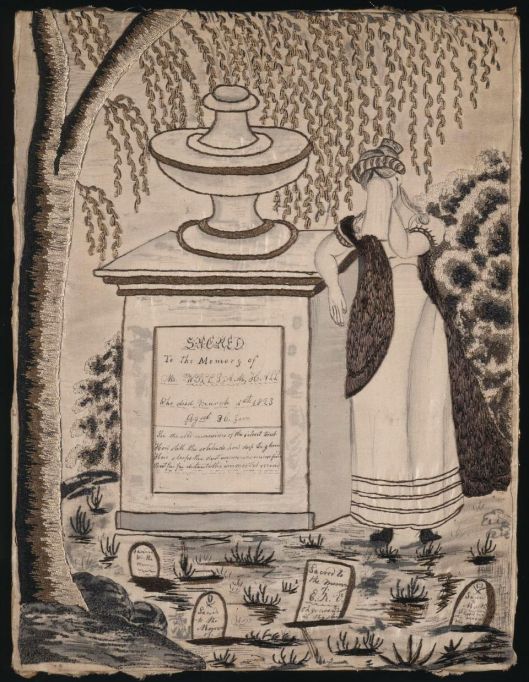
Embroidered mourning picture, 1823. MFA Boston, 42.643

Embroidered mourning picture, 1823. MFA Boston, 42.643

Share this:

  • Share on Facebook (Opens in new window) Facebook
  • Share on Pinterest (Opens in new window) Pinterest
  • Email a link to a friend (Opens in new window) Email
  • Share on X (Opens in new window) X
Like Loading...

Notes on a Brown Gown

15 Monday Apr 2013

Posted by kittycalash in Clothing, Reenacting

≈ 2 Comments

Tags

18th century clothes, Clothing, common dress, living history, silly cat photos

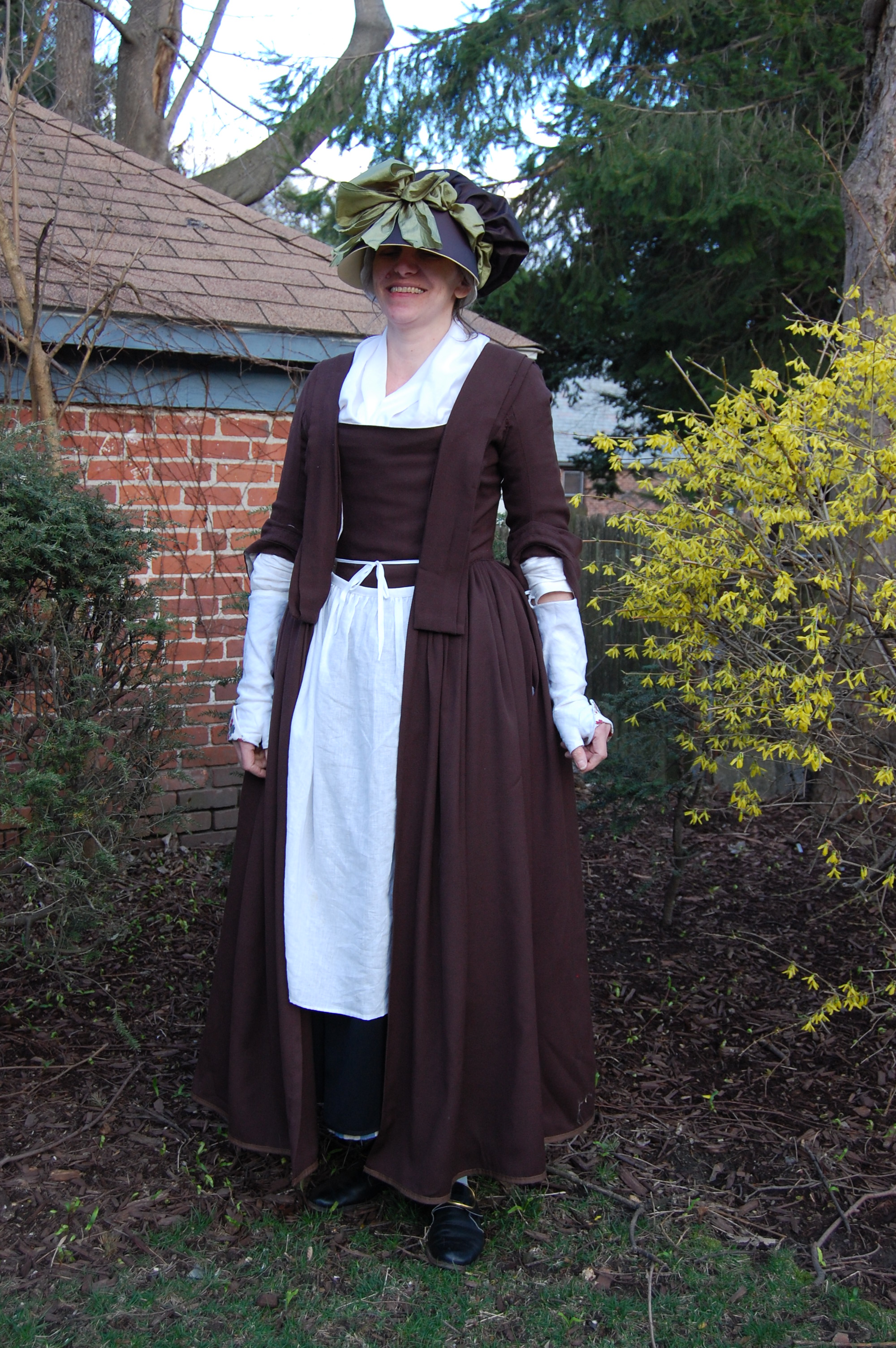
The Brown Gown, which I do actually like

The Brown Gown, which I do actually like

So after twelve hours in it, what do I think? Did I learn anything?

Yes! I need new pins. My friend had some from At The Eastern Door (their website is down today, but you can find them on Facebook) and I’ll be placing an order pronto. The stomacher and the robings do not wish to stay married, they have irreconcilable differences and need space. Space to flash the bodice lining, from what I can tell. I am less and less convinced that working women put up with stomachers and pins on a daily basis, and more convinced that I need to spend time looking at images of working (i.e. moving around, bending, twisting and reaching) women. There must be clues to this. Also, the popularity of closed front gowns makes a lot of very real sense now.

What else? Bonnets are distracting. They’re disorienting, a bit, but hide your face nicely. I have not had the full-on experience described and cautioned about elsewhere, but I will aver that bonnets do disorient you and you must be cautious. Especially around horses and crowds.

Run away! He got garters, too, which helped.

Garters! I was warned about them falling down, and they did, each one, once. The first went down in a wet tunnel (It’s like walking into a whale, Brian said) as some British officers passed. My short-jacketed farm laborer may not be able to maintain my sartorial splendors, you know…but he recovered the garter and I re-tied it. The other slipped down at the National Heritage Museum; both, after retying, remained in place. The first one took 6 hours to come down, so I’d say we did alright.

The mitts worked out well, too, and now have nice grime and grass stains, so they’ll need a little hand washing. It’s time to go back into the stash for another, longer pair, but even the linen blocked the wind and kept me warmer.

Meow! This kitten never loses his mittens.

From the soreness of my ribs, I’d say a new set of stays are in my future. I’m too tired to think about it now, but the soreness makes me realize the boning must not be running in the right direction in the right place now that the size isn’t right (they stretched). But that’s a winter’s project…for now, two paws lazy-way-up for good lessons learned and good, if long, day in Lexington.

Share this:

  • Share on Facebook (Opens in new window) Facebook
  • Share on Pinterest (Opens in new window) Pinterest
  • Email a link to a friend (Opens in new window) Email
  • Share on X (Opens in new window) X
Like Loading...

After Battle Road

14 Sunday Apr 2013

Posted by kittycalash in Events

≈ 10 Comments

Tags

18th century clothes, Battle Road 2013, Clothing, common dress, Events, The Public

Nooning on the field at Hartwell Tavern

Nooning on the field at Hartwell Tavern

In short: we enjoyed it, and yet we didn’t. Battle Road is the kind of event where those of us who come from Rhode Island and are on the fringes of the organization are not fully integrated into the event. Mr S  fielded in the morning, but the Young Mr could not, again, though he had been told at inspection that something would be found for him to do. He recovered pretty well, but there is a lot of waiting.

So lovely!

So lovely!

I was very grateful to have friends, new members of the Regiment, to chat with while we waited and watched the action. When you can’t participate, it’s fun to pick out your friends in the columns marching past. Sorry, no photos: authenticity standards.

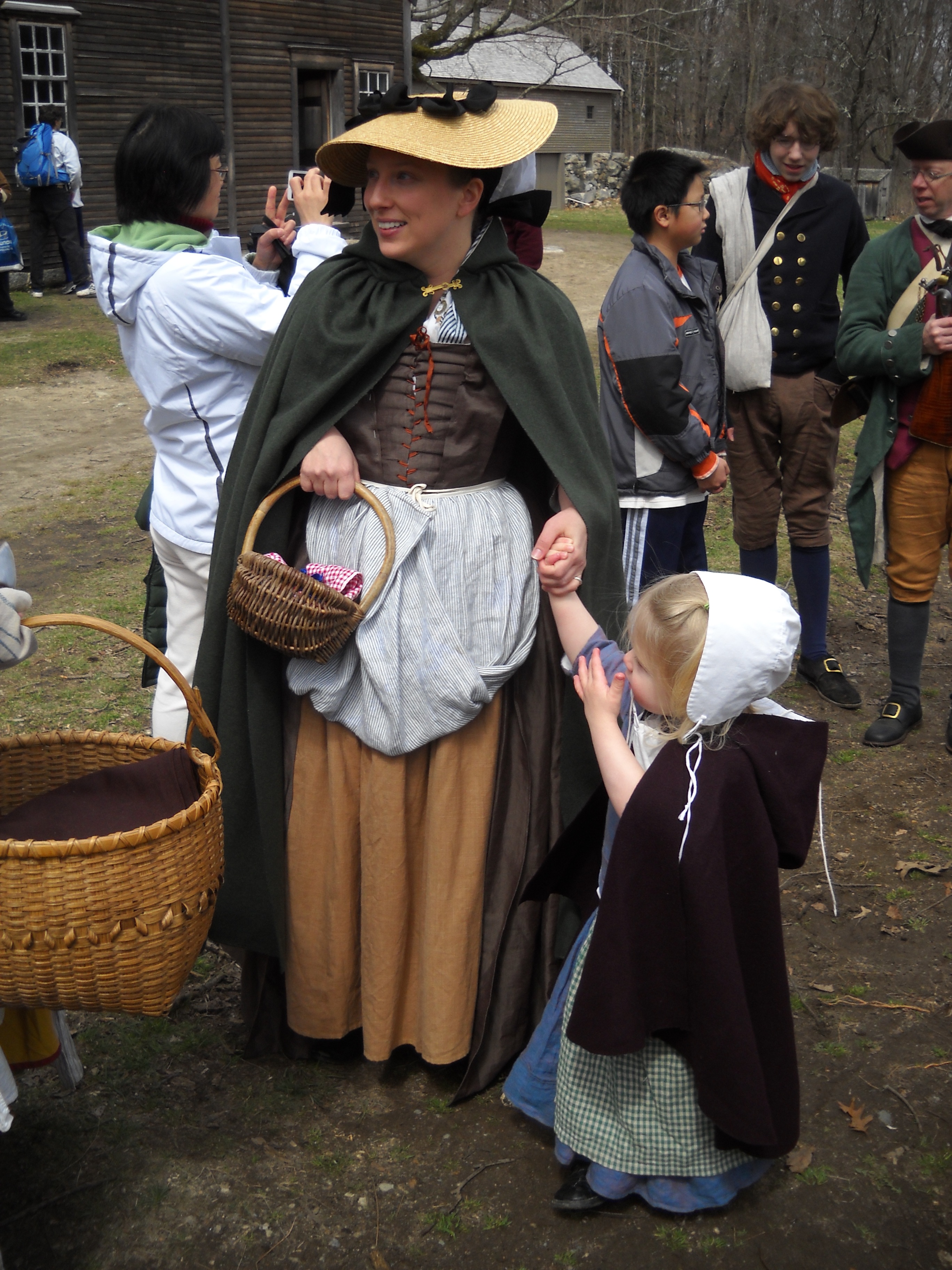
Afterwards, we had lunch, and saw more friends. That gown is a copy of one in the Newport Historical Society. It has robings and front lacing–what an amazing artifact! I would love to get my fingers on the original’s front to find out how many layers there are.

At this point, though, my claustrophobia began to kick in. In the photo of my friend and her daughter you can see tourists taking photos of the Young Mr (by his buttons you shall know him) and Brian Jean of the 2nd Helpings.

The line to see Hartwell Tavern snaked through the yard, and the road was getting full of people, and dogs, and bicycles. We fled.

This is often my view. Good thing I'm tall.

This is often my view if I want space to breathe. Good thing I’m tall.

We slipped up to the MMNHP Visitors Center (flush toilets!) and watched the presentation on April 19, 1775.  When we walked out of the theatre, the ranger said, “Welcome to chaos.”  The Center was packed full of people, all talking, many pushing: we found a way through the crowd and snuck up to the National Heritage Museum (more flush toilets and a Coke machine!), which had a nice map exhibit. I had some ideas at the time about mixing maps and objects in a thematic exhibition, and vaguely, they remain.

I'm usually looking for where the arrow is pointing: The Kid.

I’m usually tracking the animal the arrow is pointing to: The Kid.

Here’s where the not-so-great part started for me. At Tower Park, I got left alone on the public side of the rope line. (We rode up with Brian, so my ‘getting around and doing things’ options were pretty limited.) To be a living exhibition with one other person is good; to be a living exhibition with a normally-dressed companion is bearable; to be alone is annoying.

Hands to yourselves, people, please. Also, those are my friends and family out there on the field, and I would like to see them, too.

I had a moment at Tower Park where I thought, Really, the hell with the public. This kind of reenacting is not for me; I’ll stick to something more personal, something for reenactors/living historians alone. But what I think I really wanted was a friend or a larger zone of personal space–you’d think petticoats and a cloak would help, but they don’t–a way for people to understand No Touching. Also, I like to be able to keep My Kid in view to manage my anxiety levels. Superstitious Mother Tricks…

The Brown Gown, which I do actually like

The Brown Gown, which I do actually like, 12 hours on

I was a lot crankier about it last night, which was probably the result of being rather tired (getting up at 5 to lace yourself into a new gown after a week of insomniac-style sleep and intense work is not how most folks start “vacation”), hungry, and cold (it settled inside my stays mid-morning and I will feel it for a while to come).

Will I do it all again? Yes. Will I try to make better afternoon plans? Yes…though I’m not sure yet what they will be.

Share this:

  • Share on Facebook (Opens in new window) Facebook
  • Share on Pinterest (Opens in new window) Pinterest
  • Email a link to a friend (Opens in new window) Email
  • Share on X (Opens in new window) X
Like Loading...

To Lexington, Tomorrow

12 Friday Apr 2013

Posted by kittycalash in Events, Food, Living History

≈ Comments Off on To Lexington, Tomorrow

Tags

Battle Road 2013, food, living history, preparations, Reenacting

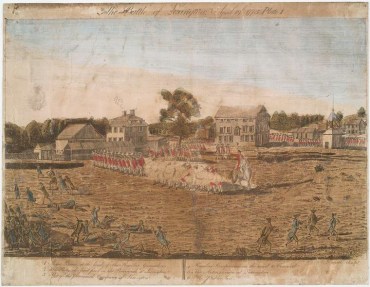
The Battle of Lexington, 1775. Engraving by Ralph Earl. NYPL Digital Library

The Battle of Lexington, 1775. Engraving by Ralph Earl. NYPL Digital Library

We’re as done as we’re going to be. Buttonholes are stitched, the Young Mr’s garters are in process, so the last thing to do would be to replace the green ribbon on my bonnet with black, just because I feel picky and want to change it.

That, and pressing clothes and making lunches.

Mr S completed two hand-sewn market wallets so that the boys can have their own lunches and I do not have to be the walking buttery.

Clara Peeters (fl. 1607–1621) [Public domain], via Wikimedia Commons

On the menu? A Cheshire pork pie or pasties (apple and pork), apples, water, and gingerbread cakes. I may pick up a loaf of bread (I ran out of flour this morning and barely eked out enough for the gingerbread, so rising time is out of the question) and bring some cheese as well. It’s a long day outdoors, and we are likely to be hungry. When my family gets too hungry, we get weird. By the time we are done, I expect to be this tired, so I am considering making Saturday night’s dinner tonight.

The modernized recipes for gingerbread cakes and the pork pie are from the History is Served website, but this week I found a wonderful site from the Westminster City Archives, The Cookbook of Unknown Ladies. Almond puddings are not portable, but they look fun to try.

Share this:

  • Share on Facebook (Opens in new window) Facebook
  • Share on Pinterest (Opens in new window) Pinterest
  • Email a link to a friend (Opens in new window) Email
  • Share on X (Opens in new window) X
Like Loading...
← Older posts
Newer posts →

Archives

wordpress statistics

Creative Commons License
Kitty Calash blog by Kirsten Hammerstrom is licensed under a Creative Commons Attribution-NonCommercial-ShareAlike 4.0 International License.

Website Built with WordPress.com.

  • Subscribe Subscribed
    • Kitty Calash
    • Join 621 other subscribers
    • Already have a WordPress.com account? Log in now.
    • Kitty Calash
    • Subscribe Subscribed
    • Sign up
    • Log in
    • Report this content
    • View site in Reader
    • Manage subscriptions
    • Collapse this bar
 

Loading Comments...
 

    %d