• Home
  • Completed Costumes/Impressions
  • Emma and Her Dresses
  • Free Patterns and Instructions

Kitty Calash

~ Confessions of a Known Bonnet-Wearer

Kitty Calash

Category Archives: Reenacting

All Cleaned Up

23 Monday Apr 2012

Posted by kittycalash in Events, History, Museums, Reenacting

≈ 1 Comment

We arrived at 8, and started cleaning at 10. We finished a little after 4, with three rooms and two light fixtures cleaned. Along the way, we learned a few things and answered some questions.

Following the advice of Hannah Glasse and Susanna Whatman, we began with the fireplace, and then started high and worked our way down. Dana pulled the logs from the formal parlor fireplace and cleaned the andirons, while I covered the sofette with a cloth and began to dust the looking glass. It soon became clear that no one had cleaned the looking glass in some time. I whisked the upholstered furniture (with reproduction fabric) while Dana polished the mahogany. These 18th century techniques definitely worked.

Using an 18th century cleaning solution of vinegar infused with lavender, we cleaned the glassware and china, and saw visible dirt residue on the rags we used to wipe, rinse, and dry the objects. We applied the same solution to the marble fireplace with similar success. We swept the floor with the round broom-corn brooms of the period and discovered just why the housekeeping guides suggested the use of damp sand, “thrown down hard onto the floor,” before dusting began. While we could collect piles of dust bunnies and dirt, they fled before the wind from our moving skirts and were hard to sweep up. Damp sand would have kept the dirt down and allowed us to sweep it up more easily—but that’s not how the floors Marsden Perry installed in the house were cleaned, so we used damp rags instead.

When we were finished, I noticed that although we had not swept the floors with herbs and sweet grasses, the formal parlor did have the faint odor of sweet broomcorn and lavender. The daily sweeping and cleaning a house with herbs, grasses, corn brooms and lavender would have been an excellent means of keeping the less pleasant smells of the 18th century at bay.

About our clothing, we were asked that most-often-asked question of re-enactors, Aren’t you hot in those clothes?

No, we’re not. We wear linen shifts next to our skin, under the stays and petticoat, dress and apron, and once the shift is damp with sweat, you tend to stay cool. If you stop moving, you can feel chilled. We began the day in jeans and t-shirts, and felt much cooler once we’d changed into 5 layers of linen and cotton.  (This is true inside and out; I have certainly felt cooler on an 80+ degree day at Old Sturbridge Village in 1775 dress than I have in modern blouse and skirt.)

When I got home, I discovered that the diagonal bones in my stays had worked their way through the linen binding—another argument for using the earlier method of binding stays with leather, and not with linen. The busk, or flat wooden panel running down the front of my stays to provide separation and support, was wet and warped. I didn’t notice the twist in the wood until I had loosened the stay laces, and then the front of my stays started twisting! The back of the busk was wet, and the front smelled slightly of vinegar, which I must have spilled. Now that the busk is dry, it has pretty much regained its original shape, with a slight twist along its long axis.  Baleen might have greater staying power than oak, but I will compare the busk I have with some in the collection to see if they, too, have twists from use.

~Kitty Calash

Share this:

  • Share on Facebook (Opens in new window) Facebook
  • Share on Pinterest (Opens in new window) Pinterest
  • Email a link to a friend (Opens in new window) Email
  • Share on X (Opens in new window) X
Like Loading...

Crazy Corsets

23 Friday Mar 2012

Posted by kittycalash in Clothing, Reenacting

≈ 1 Comment

Technically, it’s not a corset. The garment driving me mad is a set of stays patterned from an original in the Connecticut Historical Society  (CHS 1963.42.4). I’ve re-measured and re-cut the front panels twice, the cups three times and even the back once, because it showed under the test bodice. I’ve given up, and will start over with a different kind of stay.

Women in the 18th century usually bought their stays from a professional stay maker, just as most women today do not make their own bras. But like a well-fitted bra, a set of well-fitted stays is integral to achieving proper garment fit. This is real infrastructure.

Well-fitted in the 18th century really did mean well-fitted, for high-fashion and middling garments alike. To the left,  Betsey Jenkins, painted in 1748 (1905.6.2). The slim, conical shape of her torso and her incredibly erect posture are thanks to her stays. The fit of the bodice of her gown depends on the stays: these truly are foundation garments. Without the stays, the gown wouldn’t fit.

This portrait of Eleanor Cozzens Feke (1947.4.2), painted in 1750-51 by her husband, Newport painter Robert Feke, is one of my favorite paintings in the RIHS collection. The wide robings on the front of her silvery satin gown and the shadowy back in the image make it slightly tricky to see, but she’s wearing a well-fitted gown over stays, again, that give her the straight-backed posture typical of 18th century women’s portraits. Even women who look like they’re not wearing stays probably are. John Smibert painted Mrs. Browne in 1734, (1891.2.2), and her pose suggests she’s in stays.  The articulation of her breasts suggests she may not be, but the drape of the silk around her side hints that she is. There’s a conical shape under that drapery.

Contrary to some beliefs, the fully boned stays of the 18th century are comfortable.  The ones I have feel comforting in the same way swaddling might be for an infant. Bending and squatting and sitting the ground are all challenging. I’ve sat on the grass in stays and gown and provided plenty of entertainment for a regiment when I made my way up off the ground (not that they helped me).

But in getting ready to clean the John Brown House Museum, I decided I needed a new set of stays. At the short gown workshop at the ALHFAM  conference in Bristol in early March, someone asked if I really did, and perhaps I don’t. But I’d like the early 19th century gown I’m making, and the short gown I’ve made, to fit properly, and they simply won’t without the correct foundation.

Julia Treadwell Pinckney (1984.8.1) was painted (1797-1845) around 1817, but the gown she’s wearing is of a style that lasted decades, so the high waist and long slender skirt are typical of the styles that would have been worn in Providence around 1800. The silhouette, even in this half-length portrait, is visibly different—radically different—from the silhouette of the mid- to late-18th century. We interpret the John Brown House to about 1790-1810, and we know that John Brown’s daughters followed the fashions of the times: servants, maids, “help,” would not have. We have no evidence of what John Brown’s servants or slaves or maids wore,  but I would expect that in a port town like Providence, fashions would not have lagged twenty years behind, even for working women. St. Louis, far from the east but in communication with New Orleans, showed fashionably dressed Creole women in 1818. MHS 1953.158.0037

Based on these images, I believe that I would most likely not have worn my ca. 1770 stays in 1800 or 1810, if I could have avoided it. And by the means of used clothing merchants, employment, or my own skills, I would have acquired the new, softer, stays that created the raised bust silhouette. And today, with my own skills, I’m trying to do just that.

~Kitty Calash

Share this:

  • Share on Facebook (Opens in new window) Facebook
  • Share on Pinterest (Opens in new window) Pinterest
  • Email a link to a friend (Opens in new window) Email
  • Share on X (Opens in new window) X
Like Loading...

An Experiment in Housecleaning

16 Friday Mar 2012

Posted by kittycalash in Events, Museums, Reenacting

≈ 1 Comment

Eighteenth and 21st centuries meet at the John Brown House Museum when RIHS Director of Collections Kirsten Hammerstrom and Registrar Dana Signe Munroe get the museum ready for spring in the 18th century manner. Dressed in period-appropriate clothing, we will discover what it takes to make the John Brown House ready for spring. With buckets, cloths, and brooms, we will start with the formal parlor and demonstrate for visitors domestic work described in Hannah Glass’s “The Servants Directory, Improved, or, House-Keepers Companion,” published in 1762 and Susannah Whatman’s Housekeeping Book (1776-1800).

20120313-193805.jpgTo prepare for this day’s event, in addition to researching historic housekeeping methods and the Brown family servants, we have been hand-sewing clothing suitable for servants in the 1795-1803 period. Although we do not know exactly who worked for the Browns at the cusp of the 19th century, we do know that they, like other wealthy Rhode Island families, employed servants and owned slaves. In this program, we will not interpret specific servants, but instead explore the work and methods that servants or slaves would have used, wearing clothing typical of the period.

The house may seem insurmountably large, a vast Sahara of dust and dirt, to a woman wearing jeans and equipped with a vacuum cleaner. Taking on spring cleaning in late 18th century stays and long dress and petticoat, knowing that we will climb ladders (fortunately modern) to reach woodwork, will be daunting. But the experience will provide us with first-hand knowledge of what a day was like for a house maid who followed Hannah Glass’s exhortation to “Be up very early in a morning, as indeed you are first wanted; lace on your stays, and pin your things very tight about you, or you never can do work well. Be sure always to have very clean feet, that you may not dirty your rooms, and learn to walk softly, that you may not disturb the family.”

The methods outlined in these period books are surprisingly similar to today’s conservation cleaning methods outlined in the Manual of Housekeeping published in by the National Trust of Britain in 2006. Fortunately, recently completed construction has provided us with a house full of dust ready for cleaning. Join us on Saturday, April 21, from 10 to 4:00. The program is free with the regular house tours at 10:30, 12:00, 1:30 and 3:00.

Follow dress making progress and research updates, as well as a report of the day’s findings, here on the blog using the housecleaning tag.

~Kitty Calash

Share this:

  • Share on Facebook (Opens in new window) Facebook
  • Share on Pinterest (Opens in new window) Pinterest
  • Email a link to a friend (Opens in new window) Email
  • Share on X (Opens in new window) X
Like Loading...

On Exhibit

07 Sunday Aug 2011

Posted by kittycalash in Events, Reenacting

≈ Comments Off on On Exhibit

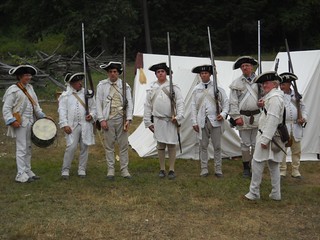
I only have photos of the aftermath, because I was part of the display. You’re asked not to use cameras when you’re the animal in the zoo, so nothing of Tom fishing with a boy from another regiment, nothing of the battle (we sat in camp, as women did), and nothing of me, either, though I know people took photos of me sewing and talking to the “Bourbonnais priest” under a tree. He’s really a librarian at a local college and we were talking in a very meta way about history and interpretation, and in a chatty way about vacations. But it makes me wonder about the stories people tell themselves about the things they see.

I sat on a stone wall and felt a breeze cool my sweat-drenched stays, watched overweight tourists trudge past in shorts and tank tops, their backs soaked with perspiration, and wondered about the experience of watching and being watched. A troop of tourists walking through your camp is a curious thing; they come right up and into your space–no ropes, as David said–and want to touch your things and play with your companion’s baby.

They take photos, and we’re literally on opposite sides of fence. We’re eating and they’re watching, even as we’re clearly trying to get some “Off display” time, to eat our 21st-century sandwiches. This is not to say that, costumed, one does not invite this, for are we not asking to be looked at in these curious clothes? But the visitors are rude and don’t seem to know how to behave. Smith’s Castle’s people had the best notion, I think, with a structured display and demonstration set up inside a fence. They had a barrier that we, in camp, under an apple tree, did not have.

Another time, I would do it differently. Tent, fly, camp kitchen: a table barrier between us and them, and a place to go and hide.

Not to say the visitors weren’t rude no matter where we were: I took Thomas up to a shop to get him a treat (candy and a quill pen; he likes to write that way) and the tourists were as odd there as anywhere, cutting in line for one thing, but also clearly not knowing what to do with the people dressed so funny. The OSV staff–they didn’t care. Everybody’s money spent the same.

Share this:

  • Share on Facebook (Opens in new window) Facebook
  • Share on Pinterest (Opens in new window) Pinterest
  • Email a link to a friend (Opens in new window) Email
  • Share on X (Opens in new window) X
Like Loading...
Newer posts →

Archives

wordpress statistics

Creative Commons License
Kitty Calash blog by Kirsten Hammerstrom is licensed under a Creative Commons Attribution-NonCommercial-ShareAlike 4.0 International License.

Website Built with WordPress.com.

  • Subscribe Subscribed
    • Kitty Calash
    • Join 621 other subscribers
    • Already have a WordPress.com account? Log in now.
    • Kitty Calash
    • Subscribe Subscribed
    • Sign up
    • Log in
    • Report this content
    • View site in Reader
    • Manage subscriptions
    • Collapse this bar
%d