 I made the time today to finish something I’d started back in June at Dress U. I was fortunate enough to be in Sharon Burnston’s Fine Sewing class, and got started on an apron. Even before I started reenacting and sewing 18th century clothes for myself, I admired Sharon Burnston’s work and the fantastic Fitting and Proper, which I ordered for the library at work several years ago. Ms. Burnston is the living definition of a stitch counter or thread counter in the very best way, and here’s why: she counts threads, and that counts.
 One of the key points I learned was the relationship between the threads and the stitches– essentially 2 x 2 for this project. Using a traditional New England fabric makes it easy–with a linen check, you can just about “cut on dotted line” and know you’re set.
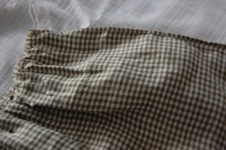
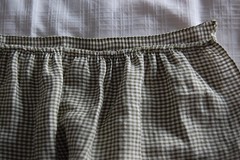
We started by hemming each side of the apron for a couple of inches, just to get started. Stitch two over, in little crosses. Then, at the top of the rectangle, we gathered. The gathers were the illuminating part: Stroke gathers. Using the check as a guide, we ran even gathering stitches twice along the top.
 I used the every-other check pattern, so the gathers were small. Ms. Burnston suggested that the best way to think of stroke gathering was as proto-smocking, and to make an evenly spaced running stitch with cotton quilting thread. The top row of gathers will be buried in the waistband, the bottom row gets pulled. Just make sure the replicate the top row exactly!
When you pull the threads, the fabric makes lovely even gathers. Pulling them down with a needle or pin–stroking them–makes them lie down even more evenly and nicely.
Then its on to the waistband and finishing with linen tape ties.
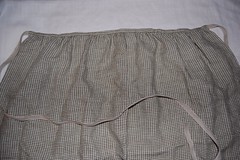
So, at last, finished object, green and white check. Along the Connecticut River valley, the predominate check was blue and white, but I look at this and think, maybe that’s what they mean by “bad color” in the runway ads– a kind of end-of-vat green.
 ETA: Thread! I forgot the thread part. Fine stitches are achieved by using a fine needle and thread–obvious, right? Size 12 needles, if they suit your hands, and a fine linen thread. When I got home, I used 80/2 white linen thread. It worked really well, with infrequent breaks. Use plenty of beeswax, and the thread will break far less frequently–if at all–especially if you use shorter lengths. Since you need to run the gathering thread the entire width of the linen, cotton or even cotton/poly is best used for the gathers. My hands are really big, but even so I use fine quilting needles from England and manage pretty small stitches. I’ve used John James and Richard Hemming & Sons, but both had to be ordered online. Dritz applique needles can be found at Jo-Ann, if you’re in a hurry, or, like me, discover all your favorite needles are bent, blunt, or stuck in a crack in the floorboards…

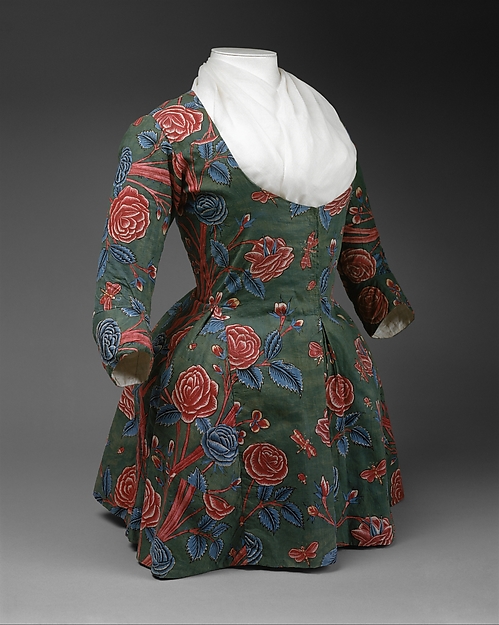
 Many thanks to Becky Fifield (The Still Room Blog) for revisiting the article she published last year on her amazing Runaway Clothing Database (RCD). It is available now as a downloadable PDF from the publisher’s website. I devoured it for its systematic look at classifying–cataloguing, really–not just the runaways themselves, but their articles of clothing.



 Kitty Calash