• Home
  • Completed Costumes/Impressions
  • Emma and Her Dresses
  • Free Patterns and Instructions

Kitty Calash

~ Confessions of a Known Bonnet-Wearer

Kitty Calash

Tag Archives: 18th century clothes

The Wind From the Hudson

20 Tuesday Nov 2012

Posted by kittycalash in Clothing, Events

≈ 2 Comments

Tags

18th century clothes, Clothing, common dress, Reenacting, Revolutionary War, weather

Looking East from Fort Lee Historic Park

The cold on the Palisades was not as bitter this past weekend as it was last year; there must have been at least an 8 degree (F) difference. There was a rumour of 37F/2C but I think it was about 45-50F (7-10C). Where there was sun, it was quite pleasant, as the wind was gentle.

So what did we wear? Mr S and the Young Mr had long underwear under their uniforms (white so it would not show under the overalls), and long stockings, too; the Young Mr has a wool waistcoat, and is still so wiggly that I don’t know how much he feels the cold yet.
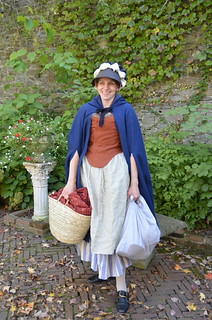
Layers are your friend

I wore my 1780s wool jacket, two linen petticoats and a wool petticoat, my still-unfaced cloak, and wool stockings, and was comfortable enough at nooning to take off my cloak. It’s a long cloak, based on one in the collection at work, but blue broadcloth and not drab (the extant cloak is drab, but both drab or dun and blue appear in RI runaway ads).

So what’s the key to keeping warm? Then, as now, (or now dressing as then) it does seem to be layers. The wool petticoat makes an effective barrier against cold, and the wool jacket is warm. I tried patterning mitts, but my hands are so large relative to my wrists that I tore the muslins at the thumb or had very baggy wrists.

These chintz mitts from the Met (C.I.39.13.185a–d) seem to have a similar tendency to width at the wrist, and might work better than the pair I was following from Costume Close Up. It was late and I was tired, so a fresh start might work to keep my hands warm.

Post-war women with long sleeves would have been able to avoid that chill wind on the forearms, and I look forward to wearing my new long-sleeved wool dress.

Share this:

  • Share on Facebook (Opens in new window) Facebook
  • Share on Pinterest (Opens in new window) Pinterest
  • Email a link to a friend (Opens in new window) Email
  • Share on X (Opens in new window) X
Like Loading...

Fine Sewing

20 Friday Jul 2012

Posted by kittycalash in Clothing, Reenacting

≈ 10 Comments

Tags

18th century clothes, apron, Clothing, DressU, Making Things, sewing

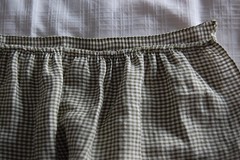
20120720-211927.jpgI made the time today to finish something I’d started back in June at Dress U. I was fortunate enough to be in Sharon Burnston’s Fine Sewing class, and got started on an apron. Even before I started reenacting and sewing 18th century clothes for myself, I admired Sharon Burnston’s work and the fantastic Fitting and Proper, which I ordered for the library at work several years ago. Ms. Burnston is the living definition of a stitch counter or thread counter in the very best way, and here’s why: she counts threads, and that counts.

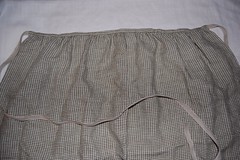
20120720-212029.jpgOne of the key points I learned was the relationship between the threads and the stitches– essentially 2 x 2 for this project. Using a traditional New England fabric makes it easy–with a linen check, you can just about “cut on dotted line” and know you’re set.

We started by hemming each side of the apron for a couple of inches, just to get started. Stitch two over, in little crosses. Then, at the top of the rectangle, we gathered. The gathers were the illuminating part: Stroke gathers. Using the check as a guide, we ran even gathering stitches twice along the top.

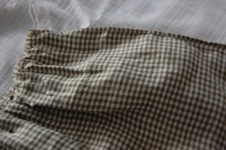
20120720-212120.jpg I used the every-other check pattern, so the gathers were small. Ms. Burnston suggested that the best way to think of stroke gathering was as proto-smocking, and to make an evenly spaced running stitch with cotton quilting thread. The top row of gathers will be buried in the waistband, the bottom row gets pulled. Just make sure the replicate the top row exactly!

When you pull the threads, the fabric makes lovely even gathers. Pulling them down with a needle or pin–stroking them–makes them lie down even more evenly and nicely.

Then its on to the waistband and finishing with linen tape ties.

So, at last, finished object, green and white check. Along the Connecticut River valley, the predominate check was blue and white, but I look at this and think, maybe that’s what they mean by “bad color” in the runway ads– a kind of end-of-vat green.

ETA: Thread! I forgot the thread part. Fine stitches are achieved by using a fine needle and thread–obvious, right? Size 12 needles, if they suit your hands, and a fine linen thread. When I got home, I used 80/2 white linen thread. It worked really well, with infrequent breaks. Use plenty of beeswax, and the thread will break far less frequently–if at all–especially if you use shorter lengths. Since you need to run the gathering thread the entire width of the linen, cotton or even cotton/poly is best used for the gathers. My hands are really big, but even so I use fine quilting needles from England and manage pretty small stitches. I’ve used John James and Richard Hemming & Sons, but both had to be ordered online. Dritz applique needles can be found at Jo-Ann, if you’re in a hurry, or, like me, discover all your favorite needles are bent, blunt, or stuck in a crack in the floorboards…

Share this:

  • Share on Facebook (Opens in new window) Facebook
  • Share on Pinterest (Opens in new window) Pinterest
  • Email a link to a friend (Opens in new window) Email
  • Share on X (Opens in new window) X
Like Loading...
Newer posts →

Archives

wordpress statistics

Creative Commons License
Kitty Calash blog by Kirsten Hammerstrom is licensed under a Creative Commons Attribution-NonCommercial-ShareAlike 4.0 International License.

Website Built with WordPress.com.

  • Subscribe Subscribed
    • Kitty Calash
    • Join 621 other subscribers
    • Already have a WordPress.com account? Log in now.
    • Kitty Calash
    • Subscribe Subscribed
    • Sign up
    • Log in
    • Report this content
    • View site in Reader
    • Manage subscriptions
    • Collapse this bar
 

Loading Comments...
 

    %d