Tags
1800 event, 18th century clothing, bib and tucker, fashion, John Brown House Museum, patterns of fashion, Rhode Island, Rhode Island Historical Society, style, What Cheer Day
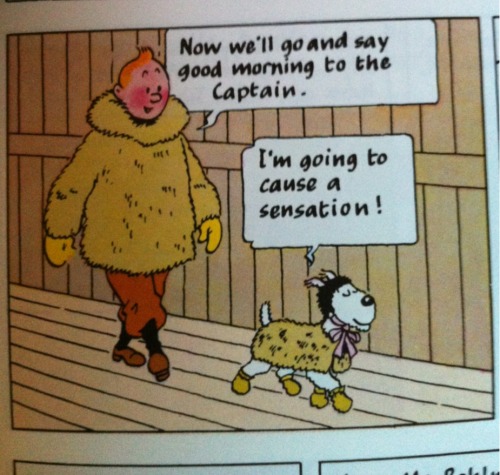
The Shooting Star: Snowy in his “best bib and tucker.”
Chemisette or tucker? By the time The Shooting Star was published in 1941-42, “bib and tucker” had wandered away from their original meanings. Tuckers were worn under women’s and girl’s bodices, taking on the role of neck handerchiefs or fichus, and what some people like to call “modesty pieces,” though the phrase always makes me think of the front panel of desks.
Janet Arnold includes chemisettes in Patterns of Fashion I, and you can buy a very nice one indeed from Cassidy at her Etsy store. (Reviewed here, and modeled, too!) But can you have one in Rhode Island in 1800? That is, of course, the question.

Hannah Weaver Peckham, RIHS 1953.8.2
Turns out you probably can. Scrolling through the miniatures gallery, there was Hannah Weaver Peckham in her best tucker, and Miss Rhodes, while later, is also sports a chemisette or tucker. (Mrs Peckham looks a bit cranky, doesn’t she? Perhaps her busk is poking her.)
What you’d call it remains an open question.
The 1933 Oxford dictionary we have in the office defines “tucker” as “A piece of lace or the like, worn by women within or around the top of the bodice of the 17-18th C.”
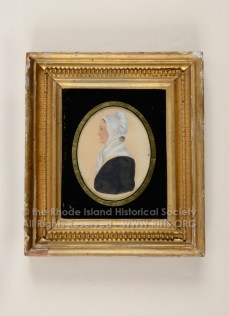
Phoebe Smith Rhodes, RIHS 1918.3.6
The same dictionary tells me “chemisette” is 1807, from the French, diminutive of chemise. “1. A bodice, more or less like the upper part of a chemise. 2. An article, usually of lace or muslin, made to fill in the open front of a woman’s dress 1844.”
While I think that one could, in Rhode Island in 1800, wear a garment that filled in the upper part of a bodice, I’m not sure what one wold call that garment. The simplest thing to do is to wear a white kerchief like Phoebe Smith Rhodes. Have I ever settled for the simplest thing? Not if I can help it.
 Kitty Calash