
• Home
  • Completed Costumes/Impressions
  • Emma and Her Dresses
  • Free Patterns and Instructions

Kitty Calash

~ Confessions of a Known Bonnet-Wearer

Kitty Calash

Tag Archives: blue

This is That

24 Friday Aug 2018

Posted by kittycalash in History, Living History, Museums

≈ Comments Off on This is That

Tags

blue, emotions, Mark Rothko, Museums, Napoleon, Virginia Museum of Fine Art, VMFA

Mark Rothko: another suicidal abstract bad-boy painter from the middle of the last century, so what?
This is what: a day at the museum when then the last painting in the Napoleon exhibit is presented in such a way that it was, in effect, the same as the last painting I happened to see.

Napoleon on his Death Bed
Untitled (Primary Title) oil on canvas by Mark Rothko, 1970. VMFA

Rothko wasn’t one of my top-ten favorite artists, but he was the top of the list of color-field painters I liked when I was studying art. He’s the kind of artist who grows on you as you mature, the way eating habits change with experience. The article I’m reading now compares his work to Roman villa murals, and that makes sense when you encounter his work. It’s color and not color, depth and surface, immersive. Simply immersive. Rothko creates a world that exists within your own head; his paintings invite you into his mind, which then occupies yours. It’s not always comfortable, given Rothko’s own dark visions. It remarkably effective in its apparent simplicity, the colors hovering over one another, creating depth with saturated color.

Red, Orange, Orange on Red oil on canvas by Mark Rothko, 1962. St. Louis Art Museum, 129:1966
No. 22 (Untitled), 1961, oil and acrylic on canvas by Mark Rothko, 1961. Collection Albright-Knox Art Gallery, Buffalo, New York, Gift of The Mark Rothko Foundation, Inc., 1985 1985:9

The first Rothko I saw must have been in Chicago, though the first one I remember is Red, Orange, Orange on Red in St. Louis; I must have seen the Albright Knox’s not long after they acquired it– the red and black are more familiar and more comfortable, in a way, than the orange and red.

But this is a history blog, you say, a costume blog. Why are we talking about Rothko? We’re talking about Rothko because seeing a Rothko– standing in front of an actual Rothko, taking a breath and looking— is an experience. An emotional experience. Reader, I wept.*

Just as the projected waves washed the walls of the final gallery in the Napoleon exhibit, so too did the blues of this untitled painting move. They vibrated with emotion, and I was immersed in blue, a kind a symphony of color, as close as I will ever come to synesthesia.

And that’s what good exhibits do, what good history does, what accuracy does. It renders the past visible, tactile, sensible, immersive. It catches us, and we fall down. Art, history, culture: if we are sucked into that otherness, hooked by feeling, we are more likely to learn something.

As stood before the Rothko, I noticed a Cornell– and a teenager noticing the Cornell. Joseph Cornell’s boxes were my first obsession, when I skipped school to go to the Art Institute of Chicago to spend my day surrounded by Cornell’s tiny universes, transported to another place.
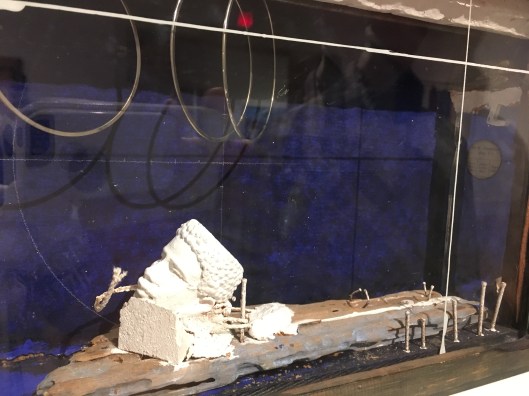
Untitled (Primary Title), painted and papered wood and glass box, with wood, plaster pipe, metal rings, nails, and string by Joseph Cornell, probably 1950s. Virginia Museum of Fine Arts, 96.41

Isn’t that what we’re trying to do, every time we dress in these funny clothes, visit historic sites, reenact the past? Aren’t we all seeking some sublime moment, when this solid present becomes the ether of the past? Sometimes the way to understand that most readily is to study something else entirely– like a Rothko. Or a Cornell. Sometimes the way into a thing is sideways, when understanding and inspiration come from an unfamiliar place, when me make connections we don’t expect.

L’Empereur Napoléon Ier sur son lit de mort, oil on panel by Denzil O. Ibbetson, 1821.

Death and Napoleon and Rothko and Cornell all seem obviously connected to me– and not just through the symbolism of the rich cobalt blues.

*I do this in museums: when I walked into the Kaufman Gallery at the NGA, tears welled in my eyes at the sight of so much beauty.

Share this:

  • Click to share on Facebook (Opens in new window) Facebook
  • Click to share on Pinterest (Opens in new window) Pinterest
  • Click to email a link to a friend (Opens in new window) Email
  • Click to share on X (Opens in new window) X
Like Loading...

HSF# 17 Robes & Robings

28 Wednesday Aug 2013

Posted by kittycalash in Clothing, Historical Sew Fortnightly, Living History, Making Things, Research

≈ 3 Comments

Tags

blue, check, common dress, fashion, Historical Sew Fortnightly, open robe, prints, robings, style

I started on the HSF#15 Color Challlenge: White, but haven’t finished the white petticoat yet. It’s a bit short, and pieced in the back, but having seen Sew18thCentury’s  curtain along petticoat online, I wanted a bordered petticoat. (There are extant examples in museum collections, and one in Fitting and Proper, if you’re keeping score.) Now that I’ve seen the petticoat in person, I will definitely stick it out for a border….all in good time.

Native Meltons: she's out there in plain and colored lithographs

Native Meltons: she’s out there in plain and colored lithographs

I did originally think that I might get this gown completed for HSF # 15, but I did not. I came close, became disheartened, and stopped work on it for a time. Not only did I think I could not adequately document the fabric, I worried about style, fit, and fabrication. At some point, though, I rallied, and finished the gown. Yes, it looks a lot like Emily’s, because it is based on the same print.

I know, you’re here for The Facts.

The Challenge:  HSF #17: Robes & Robings

Finished! Another garment in the “Am I Blue” Ocean State Line

Fabric:
Indigo Cross Bar Light-Weight Check Irish Linen from Burnley & Trowbridge.
I collected images of checks and “plaids” on a Pinterest board. Remember that plaid doesn’t mean the same thing in the 18th century, but I used the term to help people know what the board included.

Pattern:
My own, based on a fitted lining and draped to the dummy, tried on and tweaked. You can see some construction progress here. Yes, that’s a center-finding ruler. Yes, it has extra pleats. Call it bling for the linen-wearing.

Matching crossbars is crazy, but fun.

Year:
Let’s call it 1760. It’s an open robe with robings and cuffs suitable for 1765, but I’m old enough to keep wearing that style. Actually, the double-lapped robings (which I really like the look of) are earlier– see this Pinterest board–but I like the way the fold creates a decorative element in linen and wool. The probable 1750s date for the double lapped robing caused another round of heartache in the documentation land. Oh, well. Carrying on wearing the older style…

Notions:
Does thread count? That’s all this takes.

Bowers_check

Newport Mercury, 7/11/1774

Geyer_checks

Boston Post Boy, 3/11/1771

How historically accurate is it?
Well…In the right circles, one could argue that for some time. Is that not the circle one wishes to be in? Consider this, then: The gown is hand-sewn using period techniques as much as I can muster. It is based on pictorial examples from the 1750s through the 1760s. I have found newspaper advertisements for “CHECKS” in Newport (Newport Mercury, July 11, 1774) and “checks of all wedths” in Boston (Boston post Boy, March 11, 1771). Wedths means of fabric in all likelihood, not widths of the checks, so while one can find evidence of people wearing what we’d call plaid, mostly silk but the oyster seller is likely linen or cotton…we don’t know exactly what  every “checks of all wedths” fabric looked like.  I’ll go with 75% accurate and 25% conjecture and choose my wearing venue with care. Yes, I can over-think and rationalize anything.

Hours to complete:

I did this many, many times. It’s like being a carpenter with fabric and pins.

Actual sewing? 16 to 18 hours, I think; it’s a lot of hemming. The body of the gown, the draping and the lining were constructed in about a day while the guys were out doing musket-related things. The agonizing and over-thinking consumed more time. Documentation took, on the whole, perhaps 2 or 3 hours of museum collections and newspaper searching.

First worn: 
Not yet! I’m not sure when I will, now that the weather has turned. I meant to have this done for Sturbridge but despaired of the design and fabric. It’ll be wool for Saratoga, so who knows? I’d like a photo, though.

Total cost: 
Mental agony? Priceless.
Fabric? $60.

Share this:

  • Click to share on Facebook (Opens in new window) Facebook
  • Click to share on Pinterest (Opens in new window) Pinterest
  • Click to email a link to a friend (Opens in new window) Email
  • Click to share on X (Opens in new window) X
Like Loading...

Archives

wordpress statistics

Creative Commons License
Kitty Calash blog by Kirsten Hammerstrom is licensed under a Creative Commons Attribution-NonCommercial-ShareAlike 4.0 International License.

Website Built with WordPress.com.

  • Subscribe Subscribed
    • Kitty Calash
    • Join 621 other subscribers
    • Already have a WordPress.com account? Log in now.
    • Kitty Calash
    • Subscribe Subscribed
    • Sign up
    • Log in
    • Report this content
    • View site in Reader
    • Manage subscriptions
    • Collapse this bar
 

Loading Comments...
 

    %d