• Home
  • Completed Costumes/Impressions
  • Emma and Her Dresses
  • Free Patterns and Instructions

Kitty Calash

~ Confessions of a Known Bonnet-Wearer

Kitty Calash

Tag Archives: sewing

Put a Lid on It!

24 Tuesday Jul 2012

Posted by kittycalash in Clothing, Reenacting

≈ 3 Comments

Tags

bonnets, Clothing, common dress, Making Things, Reenacting, sewing, taffeta
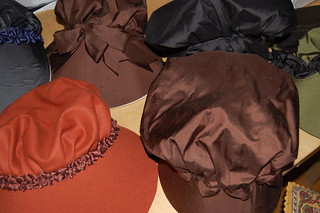
Yes, I have a bonnet problem.

I don’t know how I find all the sites and blogs I find, but I came across another interesting one today while waiting for data to load: An American Seamstress, finishing a waistcoat and struggling with a bonnet.

Have I fought with bonnets! I love bonnets, and I come by this honestly: my grandmother had a shoes thing and a hat thing, and the hat thing came with “hat face,” a particularly foxy-grandma face she make when trying on hats. So while I thought I ought to write about tent research, or the cool ad I found for a shop in Newport selling dry goods and haberdashery, now I think the heck with all that. Bonnets!

Here’s what I’ve learned, and what I’ve used. (for all images, click for a larger version)

Buckram. What they sell at Jo-Ann’s is not what you want. It is too thin to be much use unless you glue it to chip board (today’s equivalent of paste board). For more on chip board, see Kannik’s Korner on bonnets. I buy mine at Utrecht because  they’re in town. Dick Blick has it, buy the single ply.

Better buckram. I ordered a kit from Timely Tresses just to get my hands on a proven pattern and real millinery supplies. They’re hard to find in real life, and ordering online when you can’t touch stuff is hard. I did find some very sturdy buckram locally at Ryco, a mill store selling quilting fabrics, and lots of other stuff.

Millinery wire. Accept no substitutes in wire. Just trust me. I have successfully used cane originally purchased for stays. I had left overs, it curves, it worked when stitched to buckram.

Silk. The difference between taffeta and dupioni is visible and tangible (dupioni left, taffeta right). Use taffeta. I don’t always, and I still like my dupioni bonnet but most of why it works is its size and the fact that my impression is middling-trending-lower. (And saucy. I sometimes think a raised eyebrow and a loud handkerchief can make up for a lot, especially crooked petticoat hems.) But the runaway ads include stuff (wool) and linen bonnets, so read them closely for ideas.

Make a muslin first: we all know, it applies here, too. For cauls, bigger is usually better for the 18th century. For some of the bonnets, I use the lighter weight buckram to sew an insert between the caul and the lining to keep the crown more erect and poufy. At the end of the day, you might deflate, but why should your fabulous bonnet?

Trim it up. I often use strips of self fabric folded over and looped to make “bows,” because that’s how the Williamsburg bonnet looks to me. I’ve also used ribbon, so this: use silk. Less silk is better than more poly, really really, it will handle and feel and look better, and so will you. I use Burnley & Trowbridge  and Wm Booth Draper silk ribbons, and bought some from a sutler who sold herbs and hand-dyed silk ribbon.

My next bonnet will be a black silk lined with red with the red-hand dyed silk ribbon trim, based on a runaway ad. Will it be done by OSV? Probably not, but once you have it down, a nice hand-sewn bonnet is about a day’s work.

Share this:

  • Share on Facebook (Opens in new window) Facebook
  • Share on Pinterest (Opens in new window) Pinterest
  • Email a link to a friend (Opens in new window) Email
  • Share on X (Opens in new window) X
Like Loading...

Fine Sewing

20 Friday Jul 2012

Posted by kittycalash in Clothing, Reenacting

≈ 10 Comments

Tags

18th century clothes, apron, Clothing, DressU, Making Things, sewing

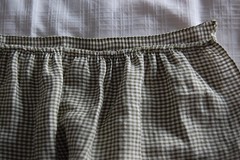
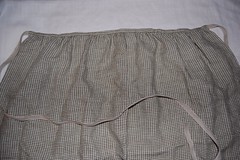
20120720-211927.jpgI made the time today to finish something I’d started back in June at Dress U. I was fortunate enough to be in Sharon Burnston’s Fine Sewing class, and got started on an apron. Even before I started reenacting and sewing 18th century clothes for myself, I admired Sharon Burnston’s work and the fantastic Fitting and Proper, which I ordered for the library at work several years ago. Ms. Burnston is the living definition of a stitch counter or thread counter in the very best way, and here’s why: she counts threads, and that counts.

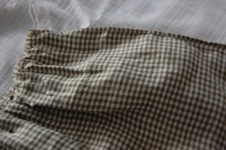
20120720-212029.jpgOne of the key points I learned was the relationship between the threads and the stitches– essentially 2 x 2 for this project. Using a traditional New England fabric makes it easy–with a linen check, you can just about “cut on dotted line” and know you’re set.

We started by hemming each side of the apron for a couple of inches, just to get started. Stitch two over, in little crosses. Then, at the top of the rectangle, we gathered. The gathers were the illuminating part: Stroke gathers. Using the check as a guide, we ran even gathering stitches twice along the top.

20120720-212120.jpg I used the every-other check pattern, so the gathers were small. Ms. Burnston suggested that the best way to think of stroke gathering was as proto-smocking, and to make an evenly spaced running stitch with cotton quilting thread. The top row of gathers will be buried in the waistband, the bottom row gets pulled. Just make sure the replicate the top row exactly!

When you pull the threads, the fabric makes lovely even gathers. Pulling them down with a needle or pin–stroking them–makes them lie down even more evenly and nicely.

Then its on to the waistband and finishing with linen tape ties.

So, at last, finished object, green and white check. Along the Connecticut River valley, the predominate check was blue and white, but I look at this and think, maybe that’s what they mean by “bad color” in the runway ads– a kind of end-of-vat green.

ETA: Thread! I forgot the thread part. Fine stitches are achieved by using a fine needle and thread–obvious, right? Size 12 needles, if they suit your hands, and a fine linen thread. When I got home, I used 80/2 white linen thread. It worked really well, with infrequent breaks. Use plenty of beeswax, and the thread will break far less frequently–if at all–especially if you use shorter lengths. Since you need to run the gathering thread the entire width of the linen, cotton or even cotton/poly is best used for the gathers. My hands are really big, but even so I use fine quilting needles from England and manage pretty small stitches. I’ve used John James and Richard Hemming & Sons, but both had to be ordered online. Dritz applique needles can be found at Jo-Ann, if you’re in a hurry, or, like me, discover all your favorite needles are bent, blunt, or stuck in a crack in the floorboards…

Share this:

  • Share on Facebook (Opens in new window) Facebook
  • Share on Pinterest (Opens in new window) Pinterest
  • Email a link to a friend (Opens in new window) Email
  • Share on X (Opens in new window) X
Like Loading...

Dutch Treat

13 Friday Jul 2012

Posted by kittycalash in Clothing

≈ 9 Comments

Tags

Clothing, Costume, fashion, Reenacting, Research, servant girls, sewing, style

I started thinking about calico jackets, short gowns, and bed gowns because OSV is around the corner, and it will be hot. At Dighton, I took off my jacket and worked in my stays because it was cooler, and at OSV I may wish to do the same thing cooking or washing. And what better thing to make than a jacket or short- or bed gown which takes little fabric and not much time.

For short gown/bed gown patterns, I’d been looking at Duran Textiles’ Newsletter, even though it is European. The general principles are the same, and I need to tweak my pattern as I don’t like the fit over the petticoat in the back.

And then I looked at images of women in bed gowns, and the paintings by Chardin, (above, 1738, right, 1747) show women in short garments over petticoats. Lovely. The rich solid of the brown with madder and the print are both attractive and practical, and I have a madder petticoat and pink striped petticoat. I could easily be a Chardin.

To get more grounded, North American Colony-based ideas, I looked through my Vogue for the Lower Sorts, Wenches Wives and Servant Girls, and found a woman running away in a Dutch calico jacket or short gown. She is a Dutch bound servant, but Catharine Mum takes off in New York with “a callicoe short gown, a green camblet gown, two striped camblet petticoats, a Dutch chintz jacket, one white and some ozenbrig aprons, a black bonnet…” and is described in an ad in the New York Gazette, 17 January 1774 (WWSG, p. 69). In Pennsylvania, a Dutch servant girl takes off in a Dutch jacket and a striped lincey petticoat (Pennsylvania Gazette, 30 March 1774, WWSG, p. 74).

Dutch chintz? Interesting–could the white ground bed gown/short gown be made of Dutch chintz? Browsing the Snowshill Collection, I found this:

Place of origin? Holland.

Is this Dutch chintz? Snowshill calls this a caraco, 1780-1800. Is it? It is a jacket? Is it a gown that is short? Is the blue Dutch jacket blue chintz, or is the style Dutch?

What are the links between the 1747 Chardin, the woman running away in 1774 New York wearing Dutch chintz, and the ca. 1780 Snowshill garment? Maybe there aren’t any, but it seems like there is a thread of some kind, though it may be a twisted and evolving thread.

None of this answers or solves my very local working fashion dilemma, except that I feel more confident that a short, skirted garment made of patterned cotton is a reasonable garment to make. I chose some kalam kari fabric and we shall see what I can make.

But first, a muslin.

Share this:

  • Share on Facebook (Opens in new window) Facebook
  • Share on Pinterest (Opens in new window) Pinterest
  • Email a link to a friend (Opens in new window) Email
  • Share on X (Opens in new window) X
Like Loading...

Hot Mess

09 Monday Jul 2012

Posted by kittycalash in Clothing, Reenacting

≈ Comments Off on Hot Mess

Tags

2nd Rhode Island, Clothing, Making Things, patterns, Revolutionary War, sewing

Hand sewn, except for basting for fitting

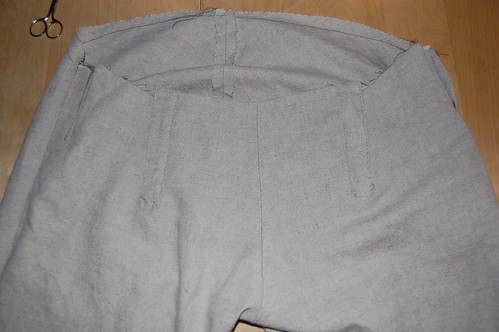
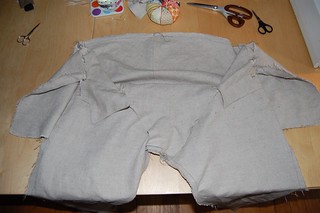
Overalls: the devil’s clothing item, even more evil than the worst multi-part replica sleeve  (that’s right sleeves, I mean you!). First there are the fiddly fall bits. Then there is the question of overall inseam length, then the shape of the leg must match the contours of the wearer, and lest we forget, the evil tongue. All of this is followed by 15-20 buttonholes.

Why did Mr. S not join a kilted regiment? Pleats and hems, easy-peasy. Overalls, not so much. The current overall score is Overalls 1, KittyCalash, 0, Draw, 1. The current pair have conquered me, but I may yet prevail but turning them into breeches with a swift amputation of the lower extremity. The first pair I made were finally overcome last fall with a new tongue piece, but they are too baggy to be correct. We’ll call that a draw.

Many moving parts

Fitting the beasts is awful, because so much sewing has to be done up at the waist, but somehow I will have to come up with a muslin and drape the legs to the subject. Once that is done, I can make a more permanent pattern that accounts for shorter than average femurs, larger than average calves, long shins, high arches, and small feet. (Most of the 2nd Helping Regiment guys have very small feet. The Young Mr is the exception, with his 12s. Obviously, his shoes will be the first to be eaten on a march to Quebec: more leather, better broth.)

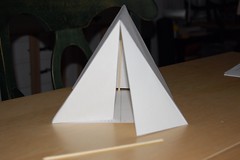
Then there is the question of a tent. Locally, a very fine hemp linen “other ranks” tent has been made, with ash tent pegs and hewn tent poles. The Young Mr and I made up a scale model last night (sans bell) to test the dimensions we worked out using math, Once school is out, all math must be real-world tested. From this, I began calculating yardage requirements, based on 57″ wide hemp linen available from a few sources. At $17/yard, it looks like $187 for a tent without a floor or mudflaps or a bell. 11 yards! That is a lot of fabric, and a lot of sewing.

Tiny little tent!

Perhaps tonight we’ll try out a slightly smaller version, with a bell. If we start this fall, we might have a tent done for next season…if the guys would only learn to sew!

Share this:

  • Share on Facebook (Opens in new window) Facebook
  • Share on Pinterest (Opens in new window) Pinterest
  • Email a link to a friend (Opens in new window) Email
  • Share on X (Opens in new window) X
Like Loading...

Overall Objectives

07 Saturday Jul 2012

Posted by kittycalash in Events, Reenacting

≈ Comments Off on Overall Objectives

Tags

2nd Rhode Island, Events, Revolutionary War, sewing

When in doubt, hand sew: it’s good for the brain and the soul.

Thinking about reenacting in terms of mission worked in sorting out my Trouble with Ticonderoga.  The Fort’s Defiance and Independence event is meant to further their mission to “ensure that present and future generations learn from the struggles, sacrifices and victories that shaped the nations of North America,” and the BAR’s mission is to recreate the life of the common soldier of the AWI, and my family’s mission is to have fun while recreating the life of the common soldier of the AWI, if some part of an event doesn’t seem like fun, it doesn’t further our mission. And if it doesn’t seem like fun, don’t do it. It’s just that simple.

Another way of looking at this is to recognize that not every event is for every reenactor. Obviously you don’t take a Charleville to Gettysburg, but more importantly, if an event is primarily to recreate a military action, but you and your family are looking for a shared reenacting experience, you are likely to be disappointed.

I also thought about it all in terms of priorities: family first, then Regiment, and so on up the line. Better by far to hone what we have to interpret the Regiment’s history first, and to get ready for Redcoats & Rebels at Old Sturbridge Village.

This event has more tangled into it than you’d think. Last year was not so great. The Captain didn’t seem happy, Mr. S’s overalls did not pass muster in foot-related fit, the Young Mr. pouted for a half a day, and I was stuck in camp with a blowsy woman talking about babies while the public tramped across our blankets. This year, we’ll camp over and entertain Mr. S’s parents, who are determined to see one of the reenactments. OSV offers the most opportunities for them and for us. There’s the Village itself to entertain and feed them, and surrounding areas with antiques and sight-seeing. We will be “stuck” minding camp and won’t be free to entertain or feed them in the evenings, and if they stay for the twilight camp tours, there will be a curfew. There is much to like about this arrangement for us.

So in preparation, I’m making new overalls for Mr. S, who has lost enough weight that last year’s are just too big. For myself, I’m cruising bedgown images like The Provider. Chardin is a favorite painter, and while I can’t have a pinner apron, I have a blue and white striped petticoat. The white concerns me, though it would definitely get dirty fast, and there’s a lot to like about that, too.

No matter what we choose to do in the future, the sewing helps now.

Share this:

  • Share on Facebook (Opens in new window) Facebook
  • Share on Pinterest (Opens in new window) Pinterest
  • Email a link to a friend (Opens in new window) Email
  • Share on X (Opens in new window) X
Like Loading...
← Older posts
Newer posts →

Archives

wordpress statistics

Creative Commons License
Kitty Calash blog by Kirsten Hammerstrom is licensed under a Creative Commons Attribution-NonCommercial-ShareAlike 4.0 International License.

Website Built with WordPress.com.

  • Subscribe Subscribed
    • Kitty Calash
    • Join 621 other subscribers
    • Already have a WordPress.com account? Log in now.
    • Kitty Calash
    • Subscribe Subscribed
    • Sign up
    • Log in
    • Report this content
    • View site in Reader
    • Manage subscriptions
    • Collapse this bar
 

Loading Comments...
 

    %d