• Home
  • Completed Costumes/Impressions
  • Emma and Her Dresses
  • Free Patterns and Instructions

Kitty Calash

~ Confessions of a Known Bonnet-Wearer

Kitty Calash

Tag Archives: winter

A Cloak for the Cold

04 Saturday Jan 2014

Posted by kittycalash in Clothing, Living History, Making Things

≈ 4 Comments

Tags

18th century clothes, 18th century clothing, cloak, common dress, fashion, living history, Rhode Island, sewing, short cloak, style, winter, wool

January 11

January 11, 1777. Providence Gazette

We’ve had a bit of snow and cold, which kept me at home (when there’s a parking ban, most businesses have to close, as most parking is on the street here). We have plans in another century this evening, so I thought a second cloak would be in order. The first cloak I made was based on one in the collection at work as well as on a Rhode Island runaway advertisement.
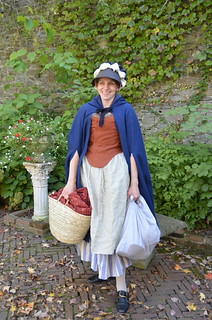
Long blue cloak, in 2012

Although I’m not displeased with the cloak, the length can be annoying and I knew that the blue cloak for a runaway was not what I wanted to wear with the sacque. So I sacrificed some yardage from the Strategic Fabric Reserve, read up on cloaks, and got out my scissors. A cloak is a fairly simple thing to make, so I don’t know why it took all day, beyond getting distracted, making dinner, shoveling, re-learning high school geometry, and trying to do a very careful job.

Hood, with lining, pinned to the body of the cloak

Because I’m tall and have long arms, I made the new cloak a little longer than I would have for a true short cloak: it is easier to trim than to add, though this is pieced on the fronts and on the hood and on the hood lining.
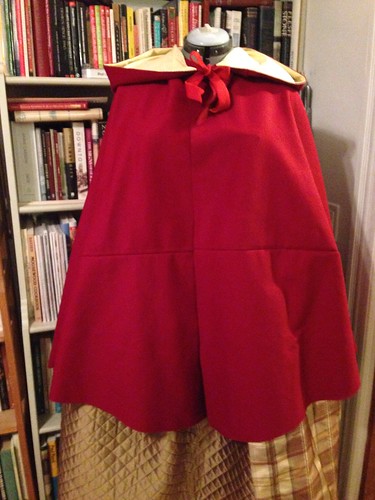
Pieced across the front.

The front piecing is more noticeable than I really like, but that’s how this came out and how cloaks often work out. I won’t really care, as long as I am warm and able to move my arms. When it’s really cold, as it is today, I can wear both red and the blue cloaks with a wool gown and petticoats and wool kerchief. Or perhaps I should just wear a sheep.
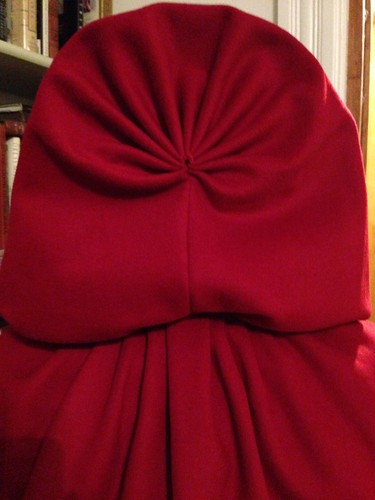
Back pleats. By a third cloak, I might get them really right.

I found the trick to getting the pleats/gathers on the hood to flip correctly was to work from the outside, or right side, once the back seam had been sewn up partway. It took three tries to figure that out, but somehow working the pleats/gathers from the right side worked. I did backstitch the pleats/gathers on the inside to hold them in place.

Inside the hood. with lining in place.

In all, this took less than a yard of yellow silk Persian, about half a yard of red wool twill tape, and two yards of crimson broadcloth, all from Wm Booth, and all but the Persian purchased as remnants. There’s a fair amount of broadcloth left, so a yard and a half with aggressive piecing might work, especially if you want a shorter cloak, and are not as tall as I am.

Share this:

  • Share on Facebook (Opens in new window) Facebook
  • Share on Pinterest (Opens in new window) Pinterest
  • Email a link to a friend (Opens in new window) Email
  • Share on X (Opens in new window) X
Like Loading...

Light & Night

04 Friday Jan 2013

Posted by kittycalash in History

≈ 1 Comment

Tags

fine art, light, lighting, museum collections, Museums, paintings, resources, seasons, winter

Morland: Woman Reading by a Paper-Bell Shade: YCBA

Winter’s hard for me. I don’t like the lack of light, I don’t like the shortness of the days and how the sky is pale and stretched in these months. But this is a good time to think about basic needs, like light and heat and warm clothing.

The New York Times came to my rescue this morning with the article by Holland Cotter (and others) on “Artworks That Shine in New York Museums.” Cotter is one of my favorite critics and writers, and he, along with Karen Rosenberg, Roberta Smith, and other NYT critics, have selected some interesting pieces.

De La Tour: Penitent Magdalen, MMA

Ken Johnson leads with Georges De La Tour’s Penitent Magdalen. It’s earlier than my usual era but I was attracted to the image of the flame in the mirror; it’s not just a lighting device, of course, it’s a metaphor, but the rendering of the candlelight, and the use of the mirror to boost that light, tells us about how 17th and 18th century painters saw light, and how light was manipulated. We know from our simple experiments at work that mirrors really do amplify light, and that large stately rooms would only glitter with lots of candles and lots of mirrors. Light gives us a window on economy and wealth, as a precious commodity that cost money or labor to have.

Vermeer: Mistress and Maid, The Frick

Vermeer: Mistress and Maid, The Frick

Cotter looks at Vermeer’s Mistress and Maid at the Frick, and notes the lack of obvious natural light or other light sources, and the overall dark mood of the scene. But Cotter’s writing shines, as he concludes the little essay: Whatever Vermeer’s anxious thoughts, light stayed on his mind. It scintillates in the pearls the woman wears in her hair and shines in the butter-yellow silk of her jacket. And the blacked-out space the women occupy turns out to have sunlit windows after all. We see them reflected in glassware on the writing table as tiny lozenges of light, far in the distance, as if at the end of a tunnel, but there.

Writing like that is its own kind of light, a joy to have in the daily newspaper on a cold, short day. In all, four critics look at five paintings each from a range of cultures and time periods. It’s enough to make one want to hop a train south.

Share this:

  • Share on Facebook (Opens in new window) Facebook
  • Share on Pinterest (Opens in new window) Pinterest
  • Email a link to a friend (Opens in new window) Email
  • Share on X (Opens in new window) X
Like Loading...

Light, or Lack of It

15 Thursday Nov 2012

Posted by kittycalash in History

≈ 4 Comments

Tags

history, light, Research, resources, weather, winter

The Tea Party, 1824, MFA Boston

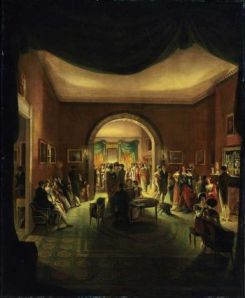
On Saturday evening, we drove up to Old Sturbridge Village for their “Evening of Illumination” tour. The village is by no means as fancy as the house depicted at left, but the gentle quality of the candlelight captured by Henry Sargent reminds me of the evening. I took no photos, because I just wanted to enjoy the experience…and learn from it.

Candles used in New England were usually home made, dipped, and of tallow. (See here for one reference.) The Browns of Providence had a spermaceti candle manufactory, and people in cities and towns often bought candles–by the pound, not by the stick. Spermaceti supposedly burns brighter than beeswax or tallow, but the only spermaceti candles I know of are accessioned museum objects and will never be lit.

In thinking about upcoming programs at two different sites, I’ve been thinking about what it was like to live in the dark, and to work mostly within the sun’s hours, and then judiciously by candle light. Sharon Burnston says, “Sew by daylight, knit by candlelight,” and if you think about process, you can imagine that  in low light, even the fine thread of sock knitting is far more manageable than fine sewing.

Large fireplaces provided both heat and light, and candles are surprisingly bright. I suspect that an evening by a fireplace, reading aloud by candlelight while a friend or sibling knit, was pleasant enough in a wool gown, or with a shawl over muslin. The trip to bed would have been another matter, and getting up something else indeed.

It is also well to remember that class difference would have created comfort differences: a servant would have been colder getting up than the master, for the servant would rise in a cold room and be expected to light a fire in the master’s bedroom. Rural workers would also have risen in a cold room, to cold or frozen water.

These are some of the things I’m thinking about as I read and look and get ready for programs, and for winter.

Share this:

  • Share on Facebook (Opens in new window) Facebook
  • Share on Pinterest (Opens in new window) Pinterest
  • Email a link to a friend (Opens in new window) Email
  • Share on X (Opens in new window) X
Like Loading...
Newer posts →

Archives

wordpress statistics

Creative Commons License
Kitty Calash blog by Kirsten Hammerstrom is licensed under a Creative Commons Attribution-NonCommercial-ShareAlike 4.0 International License.

Website Built with WordPress.com.

  • Subscribe Subscribed
    • Kitty Calash
    • Join 621 other subscribers
    • Already have a WordPress.com account? Log in now.
    • Kitty Calash
    • Subscribe Subscribed
    • Sign up
    • Log in
    • Report this content
    • View site in Reader
    • Manage subscriptions
    • Collapse this bar
 

Loading Comments...
 

    %d