
Tags
18th century, engravings, food, kettles, milk, milk maids, museum collections, pewter, tin, weather

Sandby: A Milkmaid. ca. 1759, YCBA

Pyne: Milk Woman, 1805, MoL
What do pewter and tin have to do with costuming? Well, aside from the many expensive buttons Mr S and the Young Mr wish to sport, I got interested in the milk maids’ pails because of their similarity to the tinned kettles used by RevWar reenactors. The uses converged in December in a conversation I had with a colleague about Carl Giordano’s beautiful kettles. (He made my wash basin, but my kettles came from Missouri because I needed them very quickly; the fur trade & rendezvous reenactors have similar material culture interests and needs, because of time period & culture overlap.)
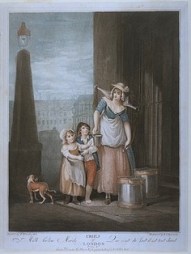
Milk Below Maids, 1793, V&A
The milk pails look like tin, don’t they? One from ca. 1759, the other from 1805, and both appear to be carrying shiny, seamed metal buckets with brass details at the base and rim. The captions call them pewter, though. So I went to the V&A and the Museum of London looking for pails, but only found more milk maids.
I began to wonder: if the pails were really made of pewter, wouldn’t they be awfully heavy? And wouldn’t there be extant examples? Pewter is highly collectible. There’s a George II pewter milk pail on Worthpoint, but it looks nothing like the pails in the images. Is pewter ever so…shiny? And I’ve never seen seams in pewter the way they appear in the Pyne illustration.
Here’s something that reminds me of that George II milk pail. I think I trust the Met more than I trust an online seller. On the right is a “bucket carrier” from the National Trust (UK) Collections.

Mid-18th century dinner pail with cover, MMA

Mid-19th century bucket carrier, NTC (UK)
Google defines pewter thus:
pew·ter
/ˈpyo͞otər/
|
Noun
|
|
|
Synonyms
|

178, Collet: The Sailor’s Present, LWL

1785: Spring & Winter, LWL
Synonym: tin? That’s pretty interesting, even though I don’t trust Google with etymology. But don’t these tin kettles look a great deal like the milk maids’ buckets?

Carl Giordano Tinsmith: Kettles
The Giordano tin kettles can be made with brass ears (that’s the part the bail, or handle, goes through). Look at the ears in the photo, and at this detail from “Spring and Winter:”
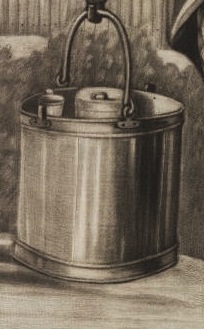
Detail, Spring & Winter, 1785, LWL
The ears may be the best lead to follow. There are plenty of ears (handle attachments) if you search the Met for bucket or pail and limit the search the metalwork… but they’re bronze, and Roman. The National Trust (UK) doesn’t turn up much, or the Museum of London (yet).
ca. 1750: Silver cream pail, MFA
There’s a silver cream pail at the MFA, and it sort of looks like its handle attaches with ears, but not in the riveted-on kind of way, but in a purposeful and elegant way. This is just about where I start to ask myself why I care, but then a number of other questions present themselves, like:
- Where are the milk pails? Are there really no milk pails in museum collections? (Yes, this could be true)
- Was this pewter milk pail with attached measures specific to London, as my colleague thinks?
- How does milk taste when it spends quality time in pewter (or tin)?
- How heavy would a pewter milk bucket be?
Things to ponder as we prepare for heavy snow… In this state, that means dashing out for “French toast supplies.” I’m not originally from here, and I solemnly swear we are legitimately out of bread, eggs, and milk.
 Kitty Calash
Was busy looking at the images (sorry…will go back & read it all, I promise), but then saw the question, “was pewter really that shiny?” Yes, it was. But for some odd reason, most people, including reproducers of period utensils, sutlers of same, etc. think that it should be dull ‘n dingy. Perhaps it’s just another of those long-standing-everyone-assumes-it-to-be-true myths. Also, the Worthington pail…maybe it’s more of a lunch pail? Why would a milk pail have a lid that becomes/can be used as a plate when turned over? Okay. Going to read it all now. See what else I find! LOL
Carolina
http://www.historiccookery.com
I’m starting to think I need to buy some pewter and polish it olds-school. I can’t polish the collection at work, ethically, and everything has a soft sheen, but not the high gloss, that you get from tin. But because no one polishes pewter….well, we think it’s grey. Time for more painting searches!
Also, pewter is soft. I have pewter table spoons (have even made one), and there’s a reason you don’t use them in cooking (only for eating or measuring): they’re soft and thus, bend and break easily. Also, I would think a pewter milk pail would have to be all one piece. Otherwise, how do you solder together two pewter halves? I’d think the whole thing would melt from the heat of being soldered in no time! Tin probably makes more sense? And yet, all the tin makers say to not leave food in them for long. But, food used to be sold in tin cans (pre-modern aluminum), so…. Hmmm, maybe I’ll contact a tinsmith I know. Oh, on the Worthington milk pail and the dinner pails…those gotta be for carrying food out and away from home (or wherever it was prepared), and then taken to work, on a coach or other means of travel, for a picnic, etc. IMO
Carolina
http://www.historiccookery.com
That’s the main thing I think about: those seams! Those are tin/copper/brass seams. Not that I haven’t seen copper kettles and vessels without seams, because I have. But the porringers, ewers, chalices, tea pots, etc. have no seams.
And the Worthington thing must be just plain wrong. Nothing I can find for milk looks like that–it’s a dinner pail. The more I look at the Met pail’s lid, the more I want to go into the storeroom at work and look at some basins. Are they basin-lids that have lost their pails? Maybe.
So far I have not seen any primary documentation to suggest that the small tin kettles made by Carl Giordano Tinsmith existed in this shape & size. Can you please direct me to such information?
Regards, Keith.
Mr G. states that his kettles sizes are “thoroughly documented,” so I should think he would be the one to ask about his kettles.