• Home
  • Completed Costumes/Impressions
  • Emma and Her Dresses
  • Free Patterns and Instructions

Kitty Calash

~ Confessions of a Known Bonnet-Wearer

Kitty Calash

Category Archives: Clothing

The Lower Sorts Crash a Party, Again

05 Tuesday Jun 2012

Posted by kittycalash in Clothing, Events

≈ Comments Off on The Lower Sorts Crash a Party, Again

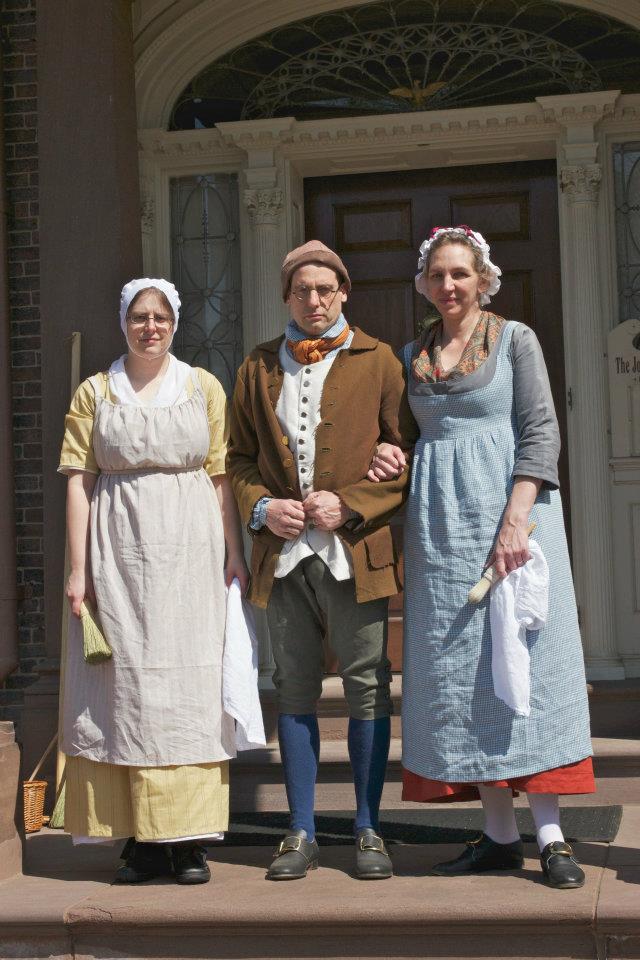
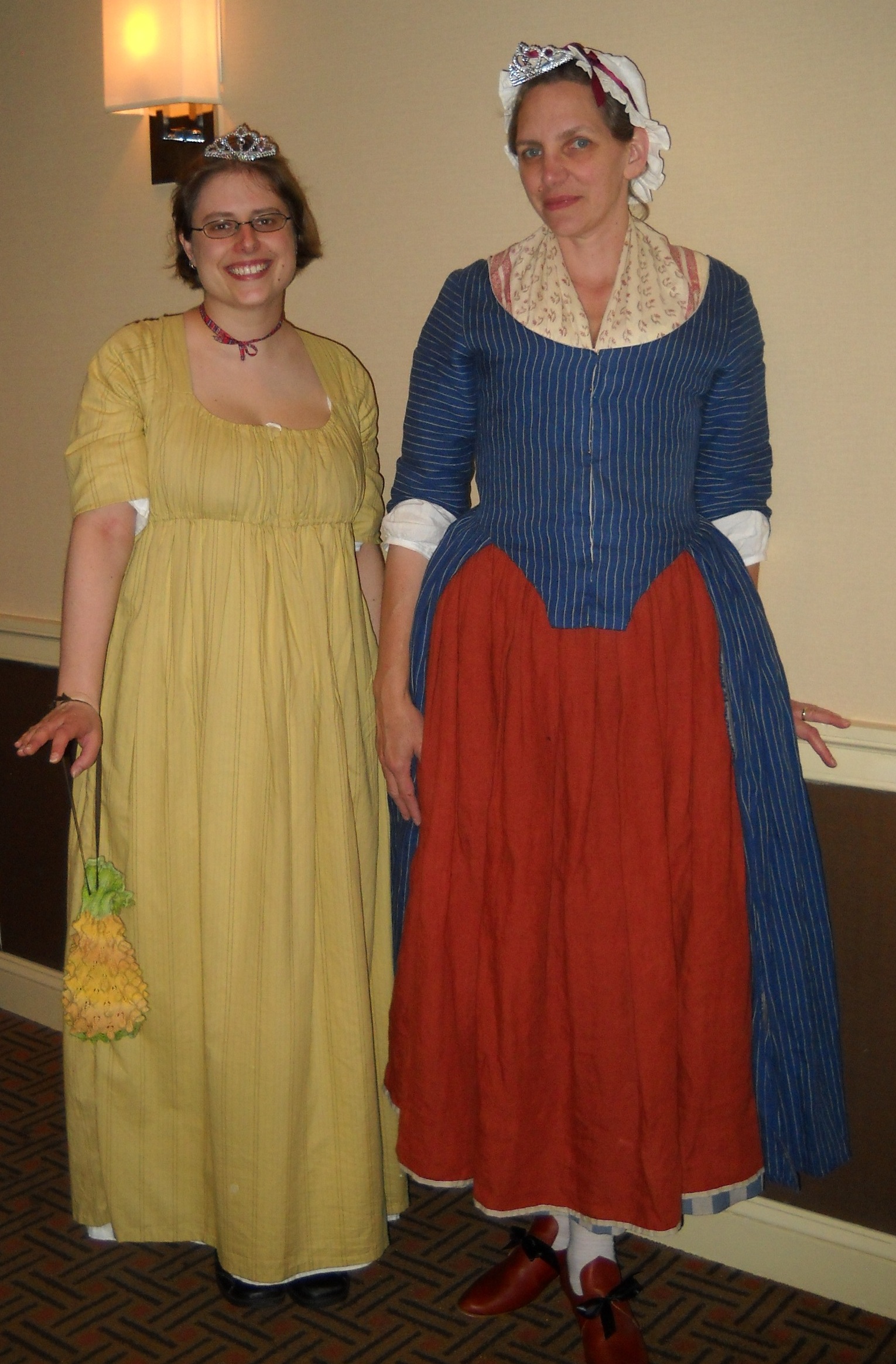
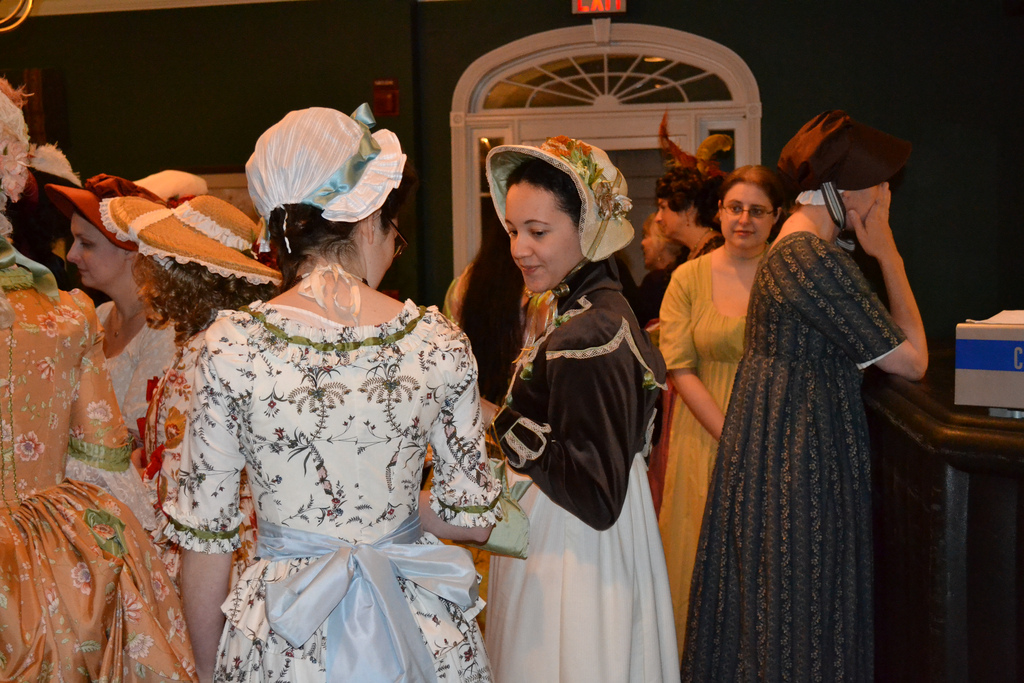
See the two women at the right? The one in the brown bonnet with a hand at her face is me, exhausted after driving to Malvern from Providence; the young lady in yellow stripes is Dana. We are in our best dresses, the Past Patterns 1796-1803 front-closing gown.

That wasn’t the party where we felt the most like country mice, but we did feel like country mice much of the time, and that’s because we are. (That’s my husband, veteran of the 2nd RI Reg’t, standing beside me.) Someone needs to represent the lower sorts, and honestly, at the reenactments I go to, I’m often the best-dressed woman, the recent ran-away-from-Newport. The excuse I can use for wearing Indian print cottons is that I am from a port city (Newport or Providence) and that I can afford small pieces, or second-hand items. Certainly in the Colonies there is economic churning, and Styles suggests that the common people are not forgoing style and fashion as a concern in clothing acquisition.

I know what a servant or housewife might wear for working: The short gown, certainly, is the most comfortable and easy option, and uses so little fabric that it can be easily and relatively affordably made in prints.

But how might a servant, or a soldier’s (or, in 1796, farmer’s or blacksmith’s) wife have dressed for a party?

Share this:

  • Share on Facebook (Opens in new window) Facebook
  • Share on Pinterest (Opens in new window) Pinterest
  • Email a link to a friend (Opens in new window) Email
  • Share on X (Opens in new window) X
Like Loading...

What I Learned at Dress U 2012

04 Monday Jun 2012

Posted by kittycalash in Clothing, Events

≈ Comments Off on What I Learned at Dress U 2012

Tags

Clothing, Costumes, Events, vacation

Some of us who re-enact the lower sort had to go to a party like this:
But before that, I learned a lot.
The Basics

  1. I am a better seamstress than I think I am
  2. There are some classes I could teach
  3. I’m going to need another hip replacement
  4. I need to learn to have fun!

The most important statements are probably the first and the last; I do actually know what I’m doing, more or less, enough to know that I learned a few other important things.

The Fine Print

  1. My 1790-1810 stays need to be re-done completely; they’re too long.
  2. I need a new 1750-1770 short gown pattern
  3. My black bonnet rocks
  4. I want a shiny party dress
  5. O.M.G., I met Sharon Burnston!! She was fantastic and I so enjoyed both of her classes. I learned the most in both of them.

Those stays have been troublesome since I began, what with tossing out the very first pair I attempted, and the wriggling and riding up with wear of the second pair. It was in Jenny LaFleur’s Fitting Yourself class that I figured out (slow, I know) that I should put my pair next to Dana’s. Dana is long-waisted, I am  not. Dana’s stays and mine were the same length. Light dawned: If our stays are the same length, mine are too long.

Sigh. Starting over… Oh, well. New stays will fit without irritating me, I can get the cup right and the busk will stop trying to meet new people, and when they’re done, I can make lovely dresses that will fit and that I will not fuss with.

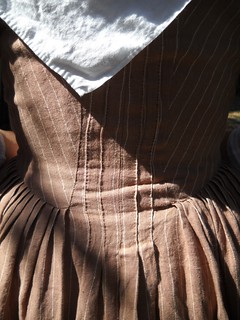
I could even make something like this, and have a real party dress for the next time I go away.

Share this:

  • Share on Facebook (Opens in new window) Facebook
  • Share on Pinterest (Opens in new window) Pinterest
  • Email a link to a friend (Opens in new window) Email
  • Share on X (Opens in new window) X
Like Loading...

Vogue for the Lower Sorts

01 Friday Jun 2012

Posted by kittycalash in Clothing, Reenacting

≈ Comments Off on Vogue for the Lower Sorts

Tags

ads, Clothing, common dress, newspapers, Research, Rhode Island

How does a reenactor know what to wear? There’s a wide range of choices for any decade, so how do you know what’s right?

Well, you don’t, not without documentation. This is where it can be nice to be a soldier. There’s griping in my house about “plain old white linen grumble frocks grumble waistcoat grumble” but really, the man and boy know who they are and what to put on. (Doesn’t stop them wanting regimentals, and I know they’re casting sidelong covetous glances at British coats.)

What about the women? The range is vast, from Mr. and Mrs. Ralph Izard

to the  Oyster Seller.

Both are ca. 1775, though the original Oyster Seller was probably earlier, but here’s the thing: how differently would she have dressed in 1775 than she would have in 1765?

It’s a point taken up, to a degree, in The Dress of the People, which I devoured in the orthopedist’s waiting room yesterday.

So if you know you’re not Alice Delancey Izard, but you’re not really an oyster seller, either, what do you do?

You check the ads.

I search runaway ads for Rhode Island to check my choices. That’s how I came to make a blue wool cloak, because I found Lucy, who ran away in December 1776 in a “blue Baize cloak.” There was Polly Young, who ran away in June, 1777, in a “black skirt petticoat and a short calico gown with long sleeves.” What did that short gown look like? I wish I knew. But it does place short gowns in Rhode Island (Lucy wore a short striped Dark Flannel gown when she ran away). Now, if only we knew what “short gown” meant in New England.

Share this:

  • Share on Facebook (Opens in new window) Facebook
  • Share on Pinterest (Opens in new window) Pinterest
  • Email a link to a friend (Opens in new window) Email
  • Share on X (Opens in new window) X
Like Loading...

Stitch Counting

29 Tuesday May 2012

Posted by kittycalash in Clothing, Reenacting

≈ 3 Comments

There are other derisive terms for the authenticity snobs, but stitch counter will do well enough for me.

I didn’t mean to turn out this way, but I did. It might have something to do with being interested in historical costume for as long as I can remember, or spending summer afternoons at the Chicago Historical Society, or a grandmother who could turn fabric and thread into anything. But inauthentic clothing and gear grates on me, and that’s one reason I’m incredibly unlikely to trail along with the “colonial” women behind a militia unit in a local parade. I just can’t trot along next to a woman wearing Hush Puppies and a short gown made of fabric last seen on Bob Ross’s couch.

This is not to say that I’m perfectly authentic—I have problems with gear and clothing, mostly revolving around fit and using a sewing machine on some long seams, or seams that get stressed, and let’s not get into what I carry in my sewing basket. But I keep trying to learn more, and trying to figure out what would fit my persona of the past. Here’s what I do know:

Like my grandmother, I’m picky. I would never have given up stays unless my child would starve if I didn’t sell them.

And like Elsa, I care about my appearance—I’m just less successful in presentation. So how my clothes went together would have mattered to me.

Shoes. Guaranteed, we would have managed shoes, since my great-great grandmother made her own.

As much as I try to get into a real lower-sorts place, I can’t. Tidy, orderly, as clean as possible. That’s just part of who I am.

So what about those women in their upholstery-like prints, plastic glasses and little cotton caps plopped atop modern haircuts? What to do about them–and their men? One man asked us yesterday where we’d gotten Dave’s uniform–where’d we find the hunting frock and overalls?

I made them, I said. By hand.

Share this:

  • Share on Facebook (Opens in new window) Facebook
  • Share on Pinterest (Opens in new window) Pinterest
  • Email a link to a friend (Opens in new window) Email
  • Share on X (Opens in new window) X
Like Loading...

Clothing Criticism

08 Tuesday May 2012

Posted by kittycalash in Clothing, Reenacting

≈ Comments Off on Clothing Criticism

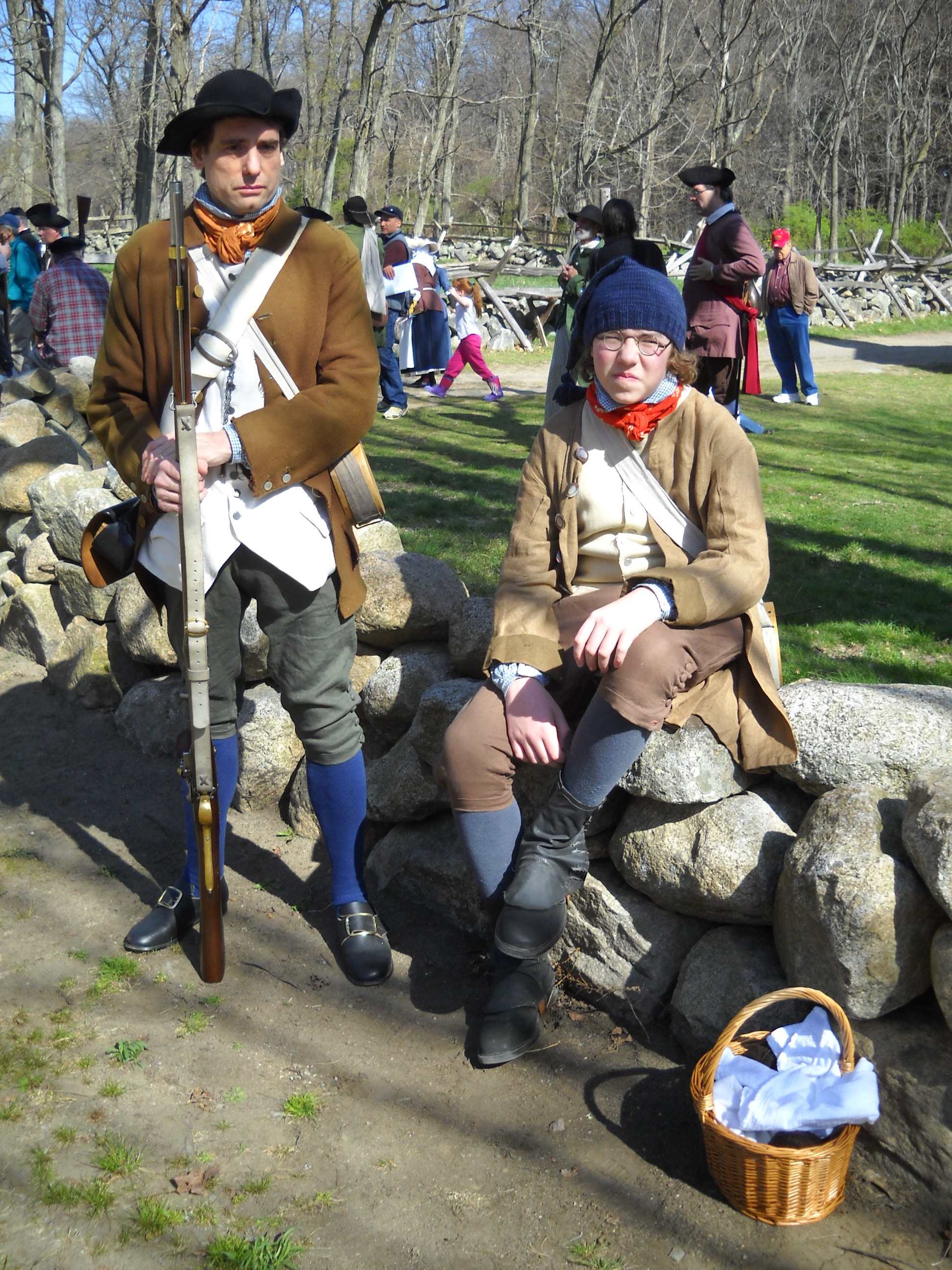
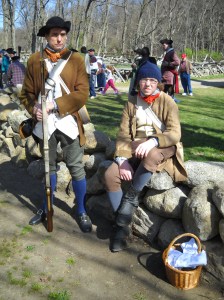
Boys at Battle Road.

Standards, people. The list serves erupt at least quarterly on the subject of authenticity in reenacting. We must have standards.

Yes, we must. We must do the best we can to recreate the past, and to share the best history we possibly can. But that does not give us a license to hurt others with words.

The Captain told me Saturday that “It used to be so bad in the Brigade, and in the Continental Line, too, that women would come up to a newcomer like you,”—here he fingered my cloak, all hand-sewn, of Wm Booth 100% wool broadcloth in a color documented to a RI runaway, and patterned after a period cloak in a RI museum—“and say, ‘Is that machine stitched?’ and proceed to criticize what the woman was wearing. The woman would never come back.  She’d take her husband with her, and we’d lose a soldier forever.”

I had to tell him they still do that, just now they do it behind people’s backs, on list serves and on blogs. “I know,” I said, “because they’ve written about me.”  After that, I hunted up the documentation for the specific little fabric trick I’d done, and date it to 1785. Oops, OK, not appropriate to a Brigade event, being two years after the end of the war.

And then again, I’ve seen similar handling of fabric in a ca. 1760 child’s frock coat from RI…. But the stinger was in, and the gown, my favorite of but two gowns, is relegated to non-Brigade events.

So where does this leave us? I can be as bad a stitch counter as the next person, able to discern a machine-stitched pocket welt at 20 paces. Sometimes I can tell a seam is machine-stitched, too. And yet…

I will confess: Machine-stitched breeches were worn by my men at Battle Road. It was that or not go at all. The buttonholes are all hand-finished, as are the eyelets. Thank goodness Dana helped me with Thomas’s breeches, or I would not have slept at all that Friday night. Two pairs of breeches had to be made, a dozen eyelets and 30 buttonholes in total. The buttons were cheaters, too, fabric-covered, but for most I used the metal blanks fitted with metal backs. For some I used rings and gathered fabric around the ring to form the shank.

Those are the least of the problems with the breeches. Despite muslin fittings on squirming boys, the legs are too long and should be shortened. Dave’s are too loose at the knee, and his waistcoat is also too loose, now. Thomas ought to wear leather-soled shoes, and the gaiters he had were too small. His breeches, too, are too long, the knee band too tight.

I know all these things. Will I fix them? Not necessarily. Their overalls are in greater need of replacement, battles loom, and time is limited. Perhaps next winter I will be able to re-fit their breeches. Until then, we’ll muddle through with what we have, upgrading the necessary, and avoiding the egregious.

For the rest of the state where we live, I hope to emulate The Hive and create workshops to help educate museum staff members in the fine art of not dressing like a tavern wench. Educating is surely better than criticizing without offering alternatives.

Share this:

  • Share on Facebook (Opens in new window) Facebook
  • Share on Pinterest (Opens in new window) Pinterest
  • Email a link to a friend (Opens in new window) Email
  • Share on X (Opens in new window) X
Like Loading...
← Older posts
Newer posts →

Archives

wordpress statistics

Creative Commons License
Kitty Calash blog by Kirsten Hammerstrom is licensed under a Creative Commons Attribution-NonCommercial-ShareAlike 4.0 International License.

Website Built with WordPress.com.

  • Subscribe Subscribed
    • Kitty Calash
    • Join 621 other subscribers
    • Already have a WordPress.com account? Log in now.
    • Kitty Calash
    • Subscribe Subscribed
    • Sign up
    • Log in
    • Report this content
    • View site in Reader
    • Manage subscriptions
    • Collapse this bar

Loading Comments...

    %d