• Home
  • Completed Costumes/Impressions
  • Emma and Her Dresses
  • Free Patterns and Instructions

Kitty Calash

~ Confessions of a Known Bonnet-Wearer

Kitty Calash

Category Archives: Food

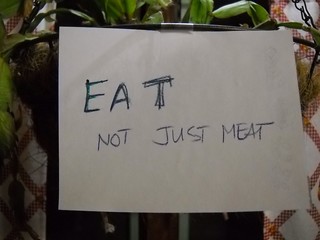
Eat, Not Just Meat

22 Friday Feb 2013

Posted by kittycalash in Food

≈ 1 Comment

Tags

18th century, food, history, vegetables

Good advice for every day, if you’re not t-rex

The Young Mr has been  unsupervised some of this week (he’s old enough but not always as mature as one might prefer) and I have left him notes to help him with some basics, as he does prefer to rise long after I’ve left for work. In the bathroom, BRUSH YOUR TEETH is affixed to the mirror (should’ve added + HAIR). In the kitchen, another note is taped to the Christmas Cactus above the sink.

My coworkers, many of whom have known the Young Mr since he was in a stroller and had nicknames like Possum Baby and Seal Monkey (he just shivered a small death when you read those names), found this note hilarious. The kid has a reputation as a one-human plague of locusts: he once ate a third of a pound of ham in a 20-minute span while his father and I went to the grocery store. He will eat a large head of lettuce in the hours between when he gets home from school and I get home from work. Entire tins of Altoids vanish suddenly, and all I get is a sulky, guilty look.

So I found this blog  post, What’s For Supper? very interesting, as I had been thinking of late, How would I feed the kid in the 18th century winter?

Fantastic Hairdress with Fruit & Vegetable Motif, 65.692.8, MMA

Fortunately, there would have been vegetables. And whether the beds were hot with manure or straw, there would have been some greens. At the farm we had salad in January; would it make it to February, or March? Don’t know, but I love the idea of spinach. Parsnips store well (scrub hard) and are delicious, and apples, too.

I think we forget we did not invent the larger world: it was big before we got here, with ships circumnavigating the globe and caravans crossing mountains long before container ships began losing sneakers on the ocean.

Share this:

  • Share on Facebook (Opens in new window) Facebook
  • Share on Pinterest (Opens in new window) Pinterest
  • Email a link to a friend (Opens in new window) Email
  • Share on X (Opens in new window) X
Like Loading...

Blame the Milk Maid

07 Thursday Feb 2013

Posted by kittycalash in Food, History, Living History

≈ 6 Comments

Tags

18th century, engravings, food, kettles, milk, milk maids, museum collections, pewter, tin, weather

Sandby: A Milkmaid. ca. 1759, YCBA

Sandby: A Milkmaid. ca. 1759, YCBA

Pyne, Milk Woman, 1805, MoL

Pyne: Milk Woman, 1805, MoL

What do pewter and tin have to do with costuming? Well, aside from the many expensive buttons Mr S and the Young Mr wish to sport, I got interested in the milk maids’ pails because of their similarity to the tinned kettles used by RevWar reenactors. The uses converged in December in a conversation I had with a colleague about Carl Giordano’s beautiful kettles. (He made my wash basin, but my kettles came from Missouri because I needed them very quickly; the fur trade & rendezvous reenactors have similar material culture interests and needs, because of time period & culture overlap.)

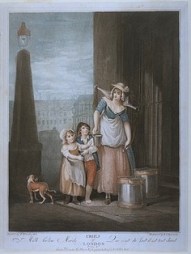
1793: Milk Below Maids, V&A

Milk Below Maids, 1793, V&A

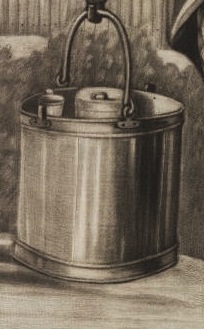
The milk pails look like tin, don’t they? One from ca. 1759, the other from 1805, and both appear to be carrying shiny, seamed metal buckets with brass details at the base and rim. The captions call them pewter, though. So I went to the V&A and the Museum of London looking for pails, but only found more milk maids.

I began to wonder: if the pails were really made of pewter, wouldn’t they be awfully heavy? And wouldn’t there be extant examples? Pewter is highly collectible. There’s a George II pewter milk pail on Worthpoint, but it looks nothing like the pails in the images. Is pewter ever so…shiny? And I’ve never seen seams in pewter the way they appear in the Pyne illustration.
Here’s something that reminds me of that George II milk pail.  I think I trust the Met more than I trust an online seller. On the right is a “bucket carrier” from the National Trust (UK) Collections.

Mid-18th century dinner pail with cover, MMA

Mid-19th century bucket carrier, NTC (UK)

Mid-19th century bucket carrier, NTC (UK)

Google defines pewter thus:

pew·ter

/ˈpyo͞otər/

Noun
  1. A gray alloy of tin with copper and antimony (formerly, tin and lead).
  2. Utensils made of this.
Synonyms
tin
178, Collet: The Sailor's Present, LWL

178, Collet: The Sailor’s Present, LWL

1785: Spring & Winter, LWL

1785: Spring & Winter, LWL

Synonym: tin? That’s pretty interesting, even though I don’t trust Google with etymology.  But don’t these tin kettles look a great deal like the milk maids’ buckets?

Carl Giordano Tinsmith: Kettles

Carl Giordano Tinsmith: Kettles

The Giordano tin kettles can be made with brass ears (that’s the part the bail, or handle, goes through). Look at the ears in the photo, and at this detail from “Spring and Winter:”

Detail, Spring & Winter, 1785, LWL

Detail, Spring & Winter, 1785, LWL

The ears may be the best lead to follow. There are plenty of ears (handle attachments) if you search the Met for bucket or pail and limit the search the metalwork… but they’re bronze, and Roman. The National Trust (UK) doesn’t turn up much, or the Museum of London (yet).

ca. 1750: Silver cream pail, MFA

There’s a silver cream pail at the MFA, and it sort of looks like its handle attaches with ears, but not in the riveted-on kind of way, but in a purposeful and elegant way. This is just about where I start to ask myself why I care, but then a number of other questions present themselves, like:

  • Where are the milk pails? Are there really no milk pails in museum collections? (Yes, this could be true)
  • Was this pewter milk pail with attached measures specific to London, as my colleague thinks?
  • How does milk taste when it spends quality time in pewter (or tin)?
  • How heavy would a pewter milk bucket be?

Things to ponder as we prepare for heavy snow… In this state, that means dashing out for “French toast supplies.” I’m not originally from here, and I solemnly swear we are legitimately out of bread, eggs, and milk.

Share this:

  • Share on Facebook (Opens in new window) Facebook
  • Share on Pinterest (Opens in new window) Pinterest
  • Email a link to a friend (Opens in new window) Email
  • Share on X (Opens in new window) X
Like Loading...

Winter Holidays

24 Monday Dec 2012

Posted by kittycalash in Food, History

≈ Comments Off on Winter Holidays

Tags

18th century, museum collections, Museums, paintings, portraits

NGA-The Skater

NGA-The Skater

Family’s here (OK, my mother; we’re a small family) and it’s time to pay attention to the people in the room instead of writing. So to celebrate winter, and the shorter days (tell that to a child waiting for Christmas), here’s one of my favorite paintings by Rhode Island native Gilbert Stuart.

NGS- The Skating Minister

NGS- The Skating Minister

It has a cousin here, by Sir Henry Raeburn. The selection of Raeburn’s portraits online (there are 25 in the National Galleries of Scotland) is stunning. What a treat for wintery days in these dark but luminous works.

Share this:

  • Share on Facebook (Opens in new window) Facebook
  • Share on Pinterest (Opens in new window) Pinterest
  • Email a link to a friend (Opens in new window) Email
  • Share on X (Opens in new window) X
Like Loading...

Consider the Chicken

04 Tuesday Dec 2012

Posted by kittycalash in Food, Living History

≈ 6 Comments

Tags

cooking, david foster wallace, food, history, living history, Museums, recipe, weekend, work

https://i0.wp.com/farm9.staticflickr.com/8311/7995409969_f925f8a7eb_n.jpg

Nobody puts Dumber in a pot

With apologies to the late David Foster Wallace

The majority of us do not consider the chicken. We may consider whether the package of chicken we purchase is free range, organic, cage-free, grain fed, cruelty free. But we are unlikely to think about the implications for the physical being, the essence of chicken-ness, that the chicken’s conditions create for it.

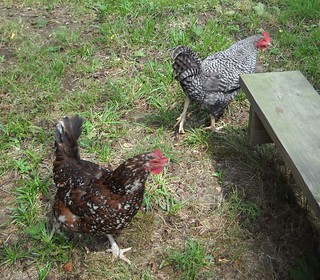
And I am here to tell you that the cage-free, organic, free-range chickens and chicken parts that you purchase at Whole Foods or your other large vendors bear little to no relationship to the actual free-range, catch-as-catch can, ne’er-do-well chicken of the historic barn yard. For one thing, living history chicken is ripped.

https://i0.wp.com/farm9.staticflickr.com/8205/8243387583_072e352ff9_n.jpgIt’s well-developed physically, with strong, sturdy bones and robust ligaments. Its musculature is tight: this is not a bird in need of a personal trainer. Its meat, when cooked, is not white. It is dark meat, not so dark meat, and sort-of white meat. Its taste was described to me as gamey, but I disagree. It was chicken, but earthy, sweet and fresh and rich.

But all that came after the meeting of human, knife, and chicken.

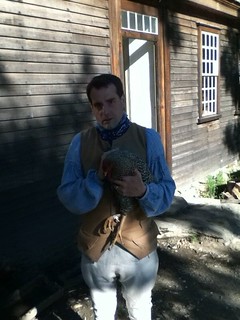
Disassembling the chicken fell to me; I declined rubbing butter into flour having prevented a fall down cellar stairs by putting my hand in fresh goose guano, so I after I washed my hands, I addressed the chicken in its bowl, and took up a knife.

Dumber & Friend

By this time, post-carrots, -parsnips, -squash, -string, -tallow and -suet, the knife lacked the purest essence of knife, that is, sharpness. But it functioned well enough for the task, with some persuasion. The skin was much thicker and more resilient than a store-bought chicken, and greasier, though not in an unpleasant way at first. The muscles were well-developed, and pink. Rosy pink, deep pink, dark like wine. There were no large slabs of the shiny, flaccid, pale meat you find on the chickens in the store. Those aren’t chickens any more: those are products.

The process of quartering the chicken took strength and pressure on the knife, and the strength of my hands. I did have to rip joints apart, and break the carcass’s back. All of this had a sound, and a mild smell of chicken, mixed with the melting tallow. But it was the sound that, with the greasy, slick knife, and the grease that soon covered my hands and wrists, that kept bringing me back to what I was doing, and that, when the bird was broken apart and in the pot and my hands washed, again (they itched), send me outside and up the hill for air and sky.

We boiled the chicken in a kettle we’d already boiled crook neck squash in; later, we added sage, thyme, parsnips and carrots. It was delicious. The broth was incredible, and the whole meal very simple. That’s the whole of the recipe: boil a chicken, add herbs and root or fall vegetables, boil until done, serve. Use any uneaten broth and bones/meat for  stew, pie or other dishes. That’s it.

The product chickens from the market are bred to fall apart. They haven’t got what a running, pecking, eating everything chicken’s got in muscle, ligament, and tendon.

On Sunday, after we came home, I looked at the food in our cupboards. There were boxes, cardboard, plastic, layers of packaging. The cheese was square. These things came from the good market, but were they food, or were they products? I felt like a passenger on the ship in Wall*E, and I was appalled.

Share this:

  • Share on Facebook (Opens in new window) Facebook
  • Share on Pinterest (Opens in new window) Pinterest
  • Email a link to a friend (Opens in new window) Email
  • Share on X (Opens in new window) X
Like Loading...

Baking with the Cursing Sewing Mommy

16 Tuesday Oct 2012

Posted by kittycalash in Events, Food, History

≈ 1 Comment

Tags

food, lavender, recipes, tea bread

Meet the cursing baking mommy! On Friday last, she started a full day of work that included a reenacted regiment backing out of the major event at work, a panic attack during her physical, a camera crisis during the visit of an Ambassador, as well as the full complement of broken things, paperwork, Section 106 reviews, and requests for meetings. So of course she came home with a plan to bake, in addition to packing up a full kit of 18th century camping equipment and finishing buttonholes and hems on overalls and that devil dress.

I did bake, actually. I tried a recipe I found on Let’s Burn Something, lavender tea bread.

Nooning with the Reg’t. They enjoyed the tea bread.

The recipe is pretty simple; the cursing part came in when I discovered that baking distracted has its dangers. Yes, I forgot to chop the lavender blossoms before steeping them in the milk. I did it after wards, and then tipped them back into the milk. You’d think the final result would look like, well, a loaf of pound cake with mouse excrement baked in, but it doesn’t. The little flowers look like seeds, so if you’re OK with a Rich Seed Cake, this will be fine, too.

Oh, I also used too much butter. Fortunately, that turned out to be fine, as too much butter usually is. And no, I don’t know my cholesterol levels, but let’s eat some more cake before the test results come back!

The Receipt, from Mom’s a Witch , via Let’s Burn Something :

Lavender Tea Bread

Ingredients:

  • 3/4 cup milk
  • 2 Tbsp. dried lavender flowers, finely chopped, or 3 Tbsp. fresh chopped flowers
  • 2 cups all-purpose flour
  • 1 1/2 tsp. baking powder
  • 1/4 tsp. salt
  • 6 Tbsp. butter, softened
  • 1 cup sugar
  • 2 large eggs

Method:

  • Grease a 9x5x3 inch loaf pan.
  • Preheat oven to 325 degrees.
  • Heat milk with lavender almost to a boil, then steep until cool.
  • Mix flour, baking powder and salt together in bowl.
  • In another bowl cream butter and gradually add sugar, then eggs, one at a time, beating until light and fluffy.
  • Add flour mixture alternately with lavender milk, in three parts. Mix until batter is just blended, do not overbeat.
  • Pour into prepared pan and bake for 50 minutes, or until toothpick inserted in center comes out clean. Let cool in pan 5 minutes, then remove to a wire rack to cool.
  • When completely cool, drizzle with a simple sugar glaze or sprinkle with confectioners’ sugar. Garnish with sprigs of fresh lavender.

I skipped both the sugar glaze and the confectioners’ sugar on the basis of sugar being expensive in the 18th century, and because I thought the final result would be less conducive to transport. It seemed fine, though with white linen uniforms, you wouldn’t notice the powdered sugar if it spilled. It’s just be the informal markings of the Second Helping Regiment.

Share this:

  • Share on Facebook (Opens in new window) Facebook
  • Share on Pinterest (Opens in new window) Pinterest
  • Email a link to a friend (Opens in new window) Email
  • Share on X (Opens in new window) X
Like Loading...
← Older posts
Newer posts →

Archives

wordpress statistics

Creative Commons License
Kitty Calash blog by Kirsten Hammerstrom is licensed under a Creative Commons Attribution-NonCommercial-ShareAlike 4.0 International License.

Website Built with WordPress.com.

  • Subscribe Subscribed
    • Kitty Calash
    • Join 621 other subscribers
    • Already have a WordPress.com account? Log in now.
    • Kitty Calash
    • Subscribe Subscribed
    • Sign up
    • Log in
    • Report this content
    • View site in Reader
    • Manage subscriptions
    • Collapse this bar
 

Loading Comments...
 

    %d