• Home
  • Completed Costumes/Impressions
  • Emma and Her Dresses
  • Free Patterns and Instructions

Kitty Calash

~ Confessions of a Known Bonnet-Wearer

Kitty Calash

Category Archives: History

Framing a Plan

10 Monday Sep 2012

Posted by kittycalash in Clothing, Events, History, Making Things, Museums, Reenacting

≈ 2 Comments

Tags

Clothing, common dress, Costume, Events, Making Things, Reenacting, weekend, work

cross-posted from A Lively Experiment, all images copyright RIHS.

This coming weekend, I’ll be joining in at the Coggeshall Farm Harvest Fair, along with my co-worker who helped clean the museum 18th-century style. She will be helping with cleaning and laundry and ironing (must remember to pack the lavender and vinegar solution), while I will tackle a quilted petticoat.

At first glance you might think I’ll have the easier weekend, and in some ways, I will, sitting in a parlor with a quilting frame. On the other hand, I booked myself a weekend with worries that have pestered me since we were invited in mid-August. Is the fabric I’ve chosen going to work? Do I know enough about the quilted petticoats in the RIHS collections? What kind of quilting frame is correct? And where did I stash the batting?

Research is always the place to start. I compiled a Pinterest board of quilted petticoats  in other collections to build my visual literacy, and tracked down articles by Lynne Zacek Bassett in PieceWork[i] and in the  Textiles in New England  II: Dublin Seminar for New England Folklife Proceedings[ii].  From the Textiles in New England proceedings, I learned that September is the second-most common month for quilting mentions in diaries for the late 18th and early 19th century in New England (May is the most often mentioned, Octobe is third). This was a relief as I wondered if quilting in September was even appropriate. With that resolved, I was able to move on to aesthetics.

New England and Rhode Island quilted petticoats share some general characteristics: the overall skirt is quilted in a diamond or diaper grid of about 1” square. Below this is a decorative band or border, usually about 12” deep. The top of this is set off from the grid by a cyma curve or wave pattern. Some examples use an undulating feather border, and others have a stylized arc and clam shell border.  The background of the border is stitched in diagonal lines. Sometimes the direction is set from center front, and lines radiate to the left and right, and in other cases the lines radiate to left and right from the center line of each arced segment.

Within the border, floral and animal motifs are quilted. Animals seem prevalent in New England quilts—there is even a mermaid in Connecticut—but none of our quilts have a mermaid. We have sunflowers, pomegranates, and carnations similar in form to the stylized flowers that appear in samplers and embroideries of this time period. Animals include deer, lions, squirrels and a creature that looks like an oryx but may be an elk. Birds are represented as well, peacocks and stylized songbirds as well as an owl, and even what seem to be roosters.

I drew these conclusions not only from reading, but from examining two quilted petticoats in the RIHS Collection, the lighter one made ca. 1745 by Alice Tripp [Casey], accession number 1985.7.1, and the darker one made in 1770 by Anna Waterman [Clapp], accession number 1982.76.3. In the catalog record, the images for 1985.7.1 are incorrect–they are for 1982.76.2, and the confusion testament to cataloging and linking records in a building several blocks from where the petticoats are stored. Now, at least, we can work on correctly them.

The quilted petticoat that I plan to make will use the typical Rhode Island elements. The top portion will be quilted with an overall diamond pattern, while a feather border will set off the bottom band. Within that, I will quilt squirrels, chickens, and probably an owl and a cat, because they are favorite creatures in my household. I’ll also quilt in my initials, just as Anna Waterman did in her quilt.

You can join us at Coggeshall Farm Museum this weekend, September 15 & 16, starting at 10 each day, and see RIHS staff members in action! We think it will be a good warm up for What Cheer! Day, coming to the RIHS on Saturday, October 13.


[i] “Sarah Halsey’s Mermaid Petticoat.” PieceWork. January/February 2003

[ii] ‘..a dull business alone’: Cooperative Quilting in New England, 1750-1850.” Textiles in New England II: Four Centuries of Material Life, The Dublin Seminar for New England Folklife Annual Proceedings 1999. Boston University Press, 2001.

Share this:

  • Share on Facebook (Opens in new window) Facebook
  • Share on Pinterest (Opens in new window) Pinterest
  • Email a link to a friend (Opens in new window) Email
  • Share on X (Opens in new window) X
Like Loading...

Some hat!

30 Thursday Aug 2012

Posted by kittycalash in History

≈ 2 Comments

Tags

Clothing, Museums, Research

I was looking for something else, and found instead Sally Sanford Pert, 1790. That is surely a fantastic hat, but the painting itself is quite interesting, too.  I was chasing Sanford Mason, which is how Sally came up in my search, though she was painted by Reuben Moulthrop (1763-1814).

She’s on display at the Met right now, and if I had the time, I’d get on the Acela and see her myself. Is she really that blue? Does her hair really look like she made a wig from a grenadier’s cap? What exactly is happening with the gown? And who, oh who, is shown in the portrait miniature she proffers? I’d guess her child, perhaps deceased, but it is only a guess. If you click through to the Met’s catalog record, you can zoom in on the portrait. The neck of the gown seems to be edged in printed or embroidered fabric different from that of the gown itself. It isn’t really a zone gown, and the “flaps” or “lapels” remind me of the robings of earlier gowns, or even a robe volant typical of the early 18th century.

Atop this all sits the hat, with its corkscrew ribbon ringlet, the whole thing looking like it was made of paper. In a way the painting raises more questions than it answers, about dress, painting style, the artist, and who Sally was. The best projects seem to start with a question. I don’t know where Sally might lead, but I’m glad I found her.

Share this:

  • Share on Facebook (Opens in new window) Facebook
  • Share on Pinterest (Opens in new window) Pinterest
  • Email a link to a friend (Opens in new window) Email
  • Share on X (Opens in new window) X
Like Loading...

A Digression on Springsteen

29 Sunday Jul 2012

Posted by kittycalash in History, Reenacting

≈ Comments Off on A Digression on Springsteen

I had to go to Woonsocket Wednesday to deliver some boxes to a museum so that they could be collected by yet another organization. On the way, I had company in form of our Assistant Registrar, and one of the things we talk about is music. I told him I’d been appalled by myself on Monday, by the stereotypical spectacle I’d made driving a Subaru Outback whilst listening to Bruce Springsteen turned way up with the windows rolled down: Soccer Mom Rocks out on Sunny Day. The only thing that saves me is that I am not, in fact, a soccer mom. I am Re-enactor Mom and Dungeons and Dragons Mom, but let’s not go there right now.

On Monday, I’d been at the Department of Motor Vehicles, where I passed the time reading the profile of Springsteen in the July 30 New Yorker. (Cars and roads! Songs about cars! and roads!). I was struck by Springsteen’s incredible focus–his bloody-minded obsession, you could call it, with music and with success. His life wasn’t easy or lovely, even if he never “worked” in the sense of having a laboring job, he worked hard at being a musician and a human being. And I found that enlightening, and I also found his wide-ranging musical interests enlightening.

This goes someplace relevant, I promise you.

When I was a teenager, the first music I listened to was my parents’. My father had a thing for stereo equipment, and I was lucky enough to get his HeathKit cast-offs. He and my mother had a collection of records, first issues of Bob Dylan and Flatt & Scruggs and Cream and classical, too. So the first album I remember really knowing was Blood on the Tracks, because I liked the stories. The politics of Dylan appealed to me, too, in the post-Nixon years with the Bomb still looming. After Dylan came Elvis, and then the other Elvis (Costello), who sounded strange and jarring and metallic and completely intriguing. From there, I went to punk.

Punk, and country. I saw the Replacements when I took a bus to the show, and they were hardly old enough to drive, and I remember vividly their cover of Hank Williams’ “Hey Good Lookin’.” We listened to country at home (in this era, it was disco or country or classical on the radio), Tanya Tucker and Loretta Lynn. And then there was the album a girl with an older brother in boarding school played for me, Born to Run.

I saw Springsteen, too, before I saw the Replacements. I remember buying Darkness on the Edge of Town, I remember buying The River, and I remember the concert. After that, it was all punk shows, 5 bands for 5 bucks at the Centro America Social Club on the North Side of Chicago. And all the while I still listened to Springsteen, Holiday in Cambodia followed by Nebraska.

By the time I got to college and had my own radio show, I knew enough not to tell people I liked Springsteen. It was the Reagan era, and Born in the USA had been co-opted. But in the art school studios, there was Kitty Wells and Patsy Cline and R.E.M. and I made work based on Faulkner’s Yoknapatawpha novels, shacks and houses and rooms on stilts because I was in a river city, with floods and flood plains and shot gun shacks.

What the heck does this have to do with reenacting or costumes? you ask. Bring on the bonnets! I know, I love bonnets too.

Here’s what it has to do with now: now I work in a history museum. I’m the keeper of the evidence room of the past, the very stuff of American history and identity. And I don’t listen to the Dead Kennedys anymore, though I do still listen to the Chicago punk bands. More than that, I listen to Wilco and R.E.M. and, yes, Bruce. I hear an American sound, a kind of universalism–and I know he doesn’t appeal to everyone, or speak for, or to, everyone.

But one of the things I think Springsteen gets at with his music is American identity, and American history. He’s listened to the blues, and listened to Guthrie, and you can hear that. He’s listened to people’s stories, and his best music tells other people’s stories. So do the best museums: they tell people’s stories, and make you listen, and make you care.

And that’s what the what the best re-enacting and best costuming does, too: it tells people stories, and makes them care, about the past we share.

Share this:

  • Share on Facebook (Opens in new window) Facebook
  • Share on Pinterest (Opens in new window) Pinterest
  • Email a link to a friend (Opens in new window) Email
  • Share on X (Opens in new window) X
Like Loading...

Runaway Styles

21 Saturday Jul 2012

Posted by kittycalash in Clothing, History

≈ 1 Comment

Tags

Clothing, Costume, newspapers, Research, resources

Many thanks to Becky Fifield (The Still Room Blog) for revisiting the article she published last year on her amazing Runaway Clothing Database (RCD). It is available now as a downloadable PDF from the publisher’s website. I devoured it for its systematic look at classifying–cataloguing, really–not just the runaways themselves, but their articles of clothing.

What Becky did with nearly 900 ads was to create catalog records for each woman who ran away, as well as her clothing. It’s a phenomenal project, and one that works well now, in an age of computer databases and improved cataloguing nomenclature. It is also a testament to dedication and love: the amount of time to construct the database and enter all the records is significant. That’s hours, tens of hours, of work before the fun part of analyzing the data can begin.

Kudos to Becky, for hard work and inspiration!

Share this:

  • Share on Facebook (Opens in new window) Facebook
  • Share on Pinterest (Opens in new window) Pinterest
  • Email a link to a friend (Opens in new window) Email
  • Share on X (Opens in new window) X
Like Loading...

Chintzy Follow Up

14 Saturday Jul 2012

Posted by kittycalash in Clothing, History

≈ Comments Off on Chintzy Follow Up

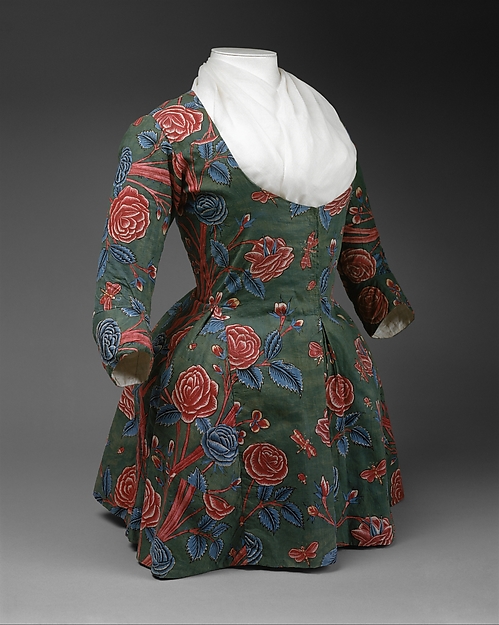
I was thinking about what one would want to know in order to get any clarity on what Dutch chintz or jackets (or short gowns) in the ads could mean. There’d be the question of where the runaway came from originally (Netherlands or one of the German states). What the writer of the ad meant by chintz. And jacket/short gown/gown-that-is-short/caraco, and what that might really mean. And what the provenance is (really) for extant garments. Chintz is the easiest part there. And the blue Dutch chintz could be something like the Den Haan and Wagenmakers: 

I don’t know enough to draw a conclusion any more spectacular or detailed than “clothing other than gowns was worn by working women, and it was sometimes of calico or chintz.”


The catalog record for the jacket/caraco at the Met doesn’t say who owned it or how they know the origin is the Netherlands. It would be helpful to know if that meant just fabric, or fabric and finished garment.

Laying out this jacket and the ones at Snowshill, and the other examples in collections, would be interesting and might be revealing. Same with the short gowns in the world, from Williamsburg to Genessee Country Village.

Over time, I hope to see and learn enough to get a little closer to understanding something, and it might be more about the origins of people in the early US, and not anything about clothing. It will depend on how hard I work at it, and where I look.

Share this:

  • Share on Facebook (Opens in new window) Facebook
  • Share on Pinterest (Opens in new window) Pinterest
  • Email a link to a friend (Opens in new window) Email
  • Share on X (Opens in new window) X
Like Loading...
← Older posts
Newer posts →

Archives

wordpress statistics

Creative Commons License
Kitty Calash blog by Kirsten Hammerstrom is licensed under a Creative Commons Attribution-NonCommercial-ShareAlike 4.0 International License.

Website Built with WordPress.com.

  • Subscribe Subscribed
    • Kitty Calash
    • Join 621 other subscribers
    • Already have a WordPress.com account? Log in now.
    • Kitty Calash
    • Subscribe Subscribed
    • Sign up
    • Log in
    • Report this content
    • View site in Reader
    • Manage subscriptions
    • Collapse this bar
 

Loading Comments...
 

    %d