• Home
  • Completed Costumes/Impressions
  • Emma and Her Dresses
  • Free Patterns and Instructions

Kitty Calash

~ Confessions of a Known Bonnet-Wearer

Kitty Calash

Category Archives: Museums

Sandby’s Women

11 Friday Jan 2013

Posted by kittycalash in Clothing, History, Museums

≈ 3 Comments

Tags

18th century, 18th century clothes, common dress, Costume, dress, fashion, fashion plates, museum collections, Museums, Paul Sandby, Research, resources, watercolors, Yale Center for British Art

20130109-061710.jpgSara Hough’s date of ca. 1805 piqued my curiosity and Cassidy was suspicious, too. So I went looking into Paul Sandby a little bit more.

Many of us know him for the sketches and watercolors of working people in mid-18th century England. They’re oft-used references for people doing Rev War reenacting as they’re full of the kinds of details seen in the watercolor of Sara Hough. I hadn’t thought of Sandby for later 18th century references, which shows how little I was thinking.
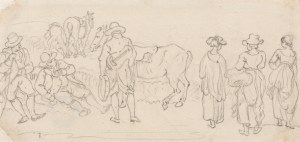
Sandby: Figure with Lute & Tamourine, YCBA

Sandby: Figure with Lute & Tamourine, YCBA

Thanks to the 18th Century Material Culture Resource Center, I found the Sandby “People and Places” presentation, which led me back to the Yale Center for British Art, and this image of musicians, horses and women. There’s no date in the record, though the presentation calls it ca. 1785. There seems to be a series or portfolio of Sandby sketches similar in size and type from about 1785, so it’s a reasonable assumption…with the usual caveat about assumptions, but no aspersions on the compiler of the presentation.
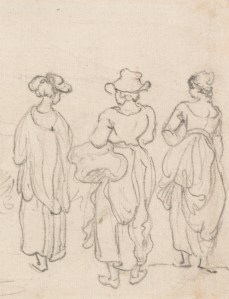
Sandby, detail, YCBA

Sandby, detail, YCBA

Sandby: Two Women and a Basket, YCBA

Sandby: Two Women and a Basket, ca. 1759 YCBA

Let’s look at a detail of the women in the drawing. Their waists are higher than we see in earlier Sandby drawings, and their profile slimmer, more classical, particularly the figure on the far right. Her bodice looks to me like a late 18th-century bodices.
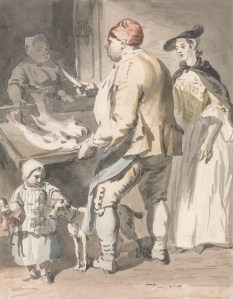
Sandby: A Fishmonger, YCBA

Sandby: A Fishmonger, ca. 1759 YCBA

Sandby had the skill to depict clothing with minimal gestures, as he does below in A Fishmonger, part of the London Cries series.

It’s that circa that gets you. I believe it for the ca. 1759, all the way. The figures fit into the visual continuum of Sandby’s mid-century work as I know it. (You’ll just have to trust me that I have a visual memory, and that, for once, the years of art school matter.)

And I kept wondering if he really had worked late into the 18th century, and then I found this:

Sandby: Family in Hyde Park, YCBA

Sandby: Family in Hyde Park, YCBA

Again, no date, but there are distinctive markers to tell us this is post-1780, even inching to the early 1790s. The waistcoats on the adolescent boys are shorter and double-breasted. The shape of the boy’s hats has changed: these aren’t cocked hats, and they’re not soft round hats. But look even closer and you’ll see the ties at the knees of their breeches, very typical and fashionable for the 1790s. All this before we’ve even gotten to the woman! Look at what she’s wearing: that’s certainly a plausible ensemble for 1794, isn’t it? The waist has moved up, the skirts are lighter, likely mull or muslin, and the skirt of what I interpret as an open robe, much like Sara Hough‘s, is trained on the ground. If this is a Sandby drawing, which I don’t doubt, then I think we definitely see him working into the mid-1790s.

And just for one final kick, I checked the Met again, where they have a Paul Sandby drawing dated 1798-1799. I wonder…but the coat collar and waistcoat might have it.

Sandby, Group of 4 Children and a Dog, MMA

I’m still not sold on ca. 1805 for Sara Hough (why no ‘h’ on Sara when the drawing is inscribed by Sandby, “Sarah Hough…”?) but I’d endorse 1795. The tricky part, as always, is the circa: so much depends on how a museum interprets ‘circa.’ For some, it’s 5 years either side of the date; for others, it’s 10. When I see a circa date, I get skeptical, and start doing math.

Share this:

  • Share on Facebook (Opens in new window) Facebook
  • Share on Pinterest (Opens in new window) Pinterest
  • Email a link to a friend (Opens in new window) Email
  • Share on X (Opens in new window) X
Like Loading...

Dresses and Evidence

09 Wednesday Jan 2013

Posted by kittycalash in Clothing, Museums

≈ 6 Comments

Tags

18th century, 18th century clothes, Clothing, Costume, dress, fashion plates, resources

Sandby: Sara Hough, YCBA

Here is Sara Hough, Mrs. T. P. Sandby’s Nursery Maid drawn by Paul Sandby ca. 1805, from the Yale Center for British art. She’s rather lovely, and though I’d tend to put her date earlier than 1805 based on the clothing, I don’t know enough (anything) about the Sandbys, and it may be that the dates of Sara’s employment fixed the date of the drawing. But doesn’t that robe and train look distinctly 1790s?

What I like about it is that here is a maid wearing an open robe and train–how impractical, especially in a nursery–so the drawing makes a third kind of evidence in addition to fashion plates and extant examples.

1794, V&A

1794, V&A

1795, MMA

1795, MMA

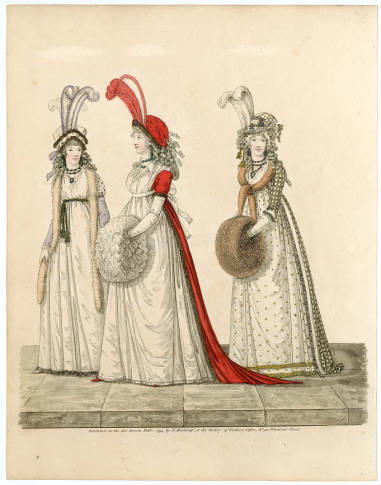
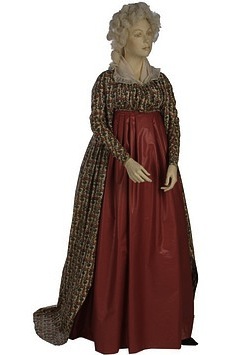
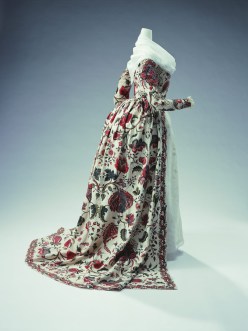
1794 and 1795 fashion plates from the V&A and the Met show similar robes, though the V&A is described as a walking dress, and the Met’s plate shows evening dress. Extant examples include the Kyoto chintz gown, and this chintz gown at the V&A.

1795-1800, V&A

1795-1800, V&A

1780s, KCI

1780s, KCI

I like how art once again blows up my expectations and makes me think more about the time frame when styles can be worn, and why: maids lag mistresses in style? Comfort and personal taste? or is the assigned date just not right? It’s an evasive “circa,” which can wiggle 5 to 10 years either way, depending on the collection’s standards. The drawing could be 1795, and it’s not later than 1809, when Sandby died.

Aside from the questions and quibbles over the date, the image gives us great information about how to wear an open robe with an apron, how to carry scissors, what watering cans looked like around 1800, the profile of shoes and caps, and how hair might be styled.

Share this:

  • Share on Facebook (Opens in new window) Facebook
  • Share on Pinterest (Opens in new window) Pinterest
  • Email a link to a friend (Opens in new window) Email
  • Share on X (Opens in new window) X
Like Loading...

What Pinterest Can Do, or, Asher Durand

22 Saturday Dec 2012

Posted by kittycalash in History, Museums

≈ 2 Comments

Tags

19th century, american art history, Asher B Durand, Asher Brown Durand, asher durand, museum collections, Museums, painting, pinterest, portraits, Research, resources

BRM-Landscape, Wood Scene

BRM-Landscape, Wood Scene

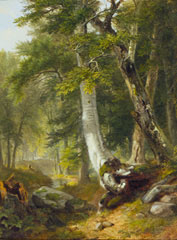
At the Brandywine River Museum, I saw an Asher B. Durand landscape and said, “I haven’t thought about Asher Durand in a long time.” My mother, ever the realist, muttered just-loud-enough, “Well, why would you?!” She studied art history for real, me, I only went to art school. It’s a wonder I can even feed myself.

Getting my stimulating-image fix last night on Pinterest: lo and behold, Asher B. Durand! Buddy! Good to see you! Even better, the side of Asher Durand you never get in those American Art History classes taught by a disheartened adjunct on a three-year contract trying to beat Manifest Destiny into you.

If you’re like me, Asher Durand’s the original Jersey Boy member of the Hudson River School, all Thanatopsis and metaphors, machine-in-the-garden, acolyte of Thomas Cole. But it’s better than that–he’s also Mr. Awesome Portrait.

MMA-Mrs Winfield Scott

Thanks to Cassidy, Mrs. Winfield Scott gazed calmly from the screen last night, lovely in her golden silk gown with fine silk over sleeves not even as heavy as butterfly wings. Lovely Mrs. Scott, against a backdrop of a…finely painted river scene, highly detailed and with a looming cloud… That painter guy seems to know what he’s doing, why, Asher B. Durand, you scamp! You worked landscape magic into the background of that money-making, pay-the-bills portrait.

Grey Collection-Summer Afternoon

Cows won’t pay for portraits of themselves, so the history and landscape painters of the past generally had to shill the portraits (G.C. Bingham did it, but without Asher B’s grace). Lucky for us, they were good at people, too, though I think you can tell their first love is landscape.

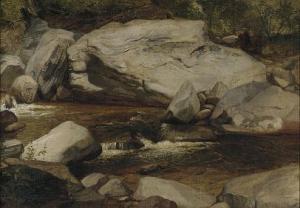
PAFA-Creek & Rocks

PAFA-Creek & Rocks

Art History Secrets Revealed: I have a friend who paints rocks in streams (and other things), but Ken’s paintings of rocks are incredibly beautiful. He studied at the Pennsylvania Academy of the Fine Arts, which is home to…did you guess? Asher B. Durand’s painting of rocks in a stream.

So while Pinterest can be home to horrors (go see for yourself, I’m not looking), it can lead you to places you didn’t expect to go, or back to things you’d forgotten about, like Asher B. Durand. He was useful to know about when I worked in the Midwest, photo editing a history journal.  I’m glad I’ve met him again.

Share this:

  • Share on Facebook (Opens in new window) Facebook
  • Share on Pinterest (Opens in new window) Pinterest
  • Email a link to a friend (Opens in new window) Email
  • Share on X (Opens in new window) X
Like Loading...

Portrait of a Waistcoat

21 Friday Dec 2012

Posted by kittycalash in Clothing, History, Museums

≈ Comments Off on Portrait of a Waistcoat

Tags

18th century clothes, Clothing, Costume, fashion, mercantile trade, museum collections, resources, robert jenkins, silk velvet

RIHS-Robert Jenkins

Meet Mr. Jenkins. There are references to a Robert Jenkins, Vestryman of Christ Church, Boston and merchant of Salem, MA and Newport, RI. A Robert Jenkins married Elizabeth Champlin of Newport, and we have a pendant portrait of Betsey Jenkins, suggesting stronger ties to Newport. The records are confusing, but one thing is clear: that’s his waistcoat and he’s happy to have you see it.

This 1748 portrait by John Greenwood shows a man associated with a port city, perhaps connected with shipping and mercantile trade (see the ships in the background), and who has made enough money to a) commission a portrait and b) either own that sweet silk velvet waistcoat or to have one painted. It is entirely possible that he owned it.

Met-Waistcoat

And it probably looked a lot like this 1750-1755 one from the Met, but without the sleeves. There is fragment (two fronts) of one very like this in the collection at work. It’s not Robert Jenkins’, but it is Rhode Island, so we know these kind of garments were available and worn. The last piece to track down would be an account book, to get some idea of what this might have cost.

What I like in particular about the Met’s waistcoat is the cuff detail. The sleeve, which would be heavy if fully made of velvet, is not. Only the cuff is the velvet, while the sleeve itself is lighter weight silk.

Share this:

  • Share on Facebook (Opens in new window) Facebook
  • Share on Pinterest (Opens in new window) Pinterest
  • Email a link to a friend (Opens in new window) Email
  • Share on X (Opens in new window) X
Like Loading...

Caps and Randomness

20 Thursday Dec 2012

Posted by kittycalash in Clothing, History, Museums

≈ Comments Off on Caps and Randomness

Tags

cataloging, museum collections, Museums, National Gallery of Art, Research, resources, zen cataloging

NGA- Lady Wearing a Large White Cap

NGA- Lady Wearing a Large White Cap

Sweet cap, right? It all started because it’s cold this morning here in RI and I thought about skating when I went out to get the Times, and that led to Gilbert Stuart, which led to the National Gallery.

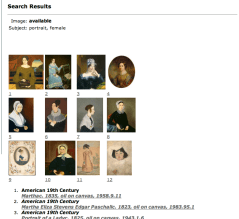
They have a fun search option, similar to the Tate Britain’s subject-search, but not quite as elegant.
You can start with a subject search, and then add a sub category. Results (stability not guaranteed) show you things you would not have otherwise expected, and that’s one more reason to love online catalogs & databases.

NGA Screenshot

NGA Screenshot

The results give you little unexpected galleries, and the juxtaposition or similarities of the thumbnails help you see the work differently. Black dresses and white collars are prevalent on this page: why? Is this fashion alone, or are these mourning garments? they’re earlier than the Civil War, but maybe it’s time to re-read This Republic of Suffering.

NGA- Sarah Cook Arnold knitting

NGA- Sarah Cook Arnold knitting

But wait–who is this? It’s Probably Sarah Cook Arnold, Knitting. (Probably is not her name, smartypants, it’s an adverb.)

She’s knitting in the round, by the way, on three incredibly tiny pins from an invisible ball of yarn, possibly swallowed by the cat hidden in her skirts. (I know a woman who can knit with these skinny quadruple-ought pins, but they are a hazard in my hands.)

I would not have found Sarah Cook Arnold knitting without using the random subject search, nor would I have found Fabulous Cap at the top. Sometimes you need to enjoy the journey as much as the destination.

Share this:

  • Share on Facebook (Opens in new window) Facebook
  • Share on Pinterest (Opens in new window) Pinterest
  • Email a link to a friend (Opens in new window) Email
  • Share on X (Opens in new window) X
Like Loading...
← Older posts
Newer posts →

Archives

wordpress statistics

Creative Commons License
Kitty Calash blog by Kirsten Hammerstrom is licensed under a Creative Commons Attribution-NonCommercial-ShareAlike 4.0 International License.

Website Built with WordPress.com.

  • Subscribe Subscribed
    • Kitty Calash
    • Join 621 other subscribers
    • Already have a WordPress.com account? Log in now.
    • Kitty Calash
    • Subscribe Subscribed
    • Sign up
    • Log in
    • Report this content
    • View site in Reader
    • Manage subscriptions
    • Collapse this bar
 

Loading Comments...
 

    %d