• Home
  • Completed Costumes/Impressions
  • Emma and Her Dresses
  • Free Patterns and Instructions

Kitty Calash

~ Confessions of a Known Bonnet-Wearer

Kitty Calash

Category Archives: Museums

Mourning Embroideries

11 Tuesday Sep 2012

Posted by kittycalash in History, Museums

≈ Comments Off on Mourning Embroideries

Tags

Research, resources, Rhode Island

As a rule, I dislike samplers. Sacrilege, I know, but the rows of letters and numbers and tidy stitches seem to me like running in place, instead of running to get somewhere.

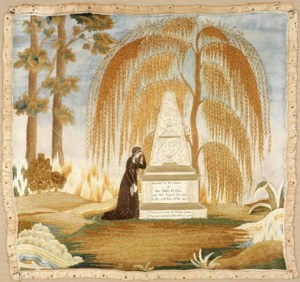
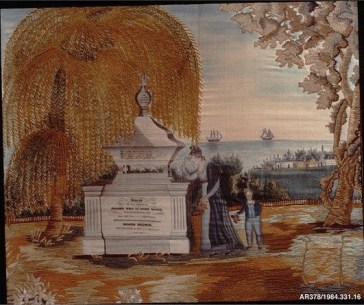
But I do like pictorial embroideries, and on this day, posting about a frothy bonnet in a painting in a Sotheby’s catalog seemed…well, too trivial. So instead, here’s a fantastic mourning picture from the Met. By Charlotte Brown, of Rhode Island, it memorializes Salome Brown and her husband Moses Brown, though not the Moses Brown.

Just because I’m not a fan doesn’t mean I don’t recognize types. In a google image search, I found this item, and knew immediately it was Rhode Island. Made in 1808, it lives at RISD, and a textile designer has done wonderful things based on it. Both RISD’s and the Met’s have the weeping woman, the weeping willow, the urn/cenotaph feature, the pastoral landscape.

But wait…the provenance of the Met’s picture is minimal: “Once property of the late Florence Maine, antiques dealer of Ridgefield and Wilton Connecticut. (Advertisement of embroidery in August 1953 Antiques magazine.)” So I started searching for Moses Brown and Salome Brown in the Rhode Island Historical Cemeteries Database, and I came up empty.

Yes, there are Moses Browns. There is no Salome Brown. But I can’t find a Moses with these dates. That doesn’t mean he didn’t exist, or that this isn’t a Rhode Island sampler; not every cemetery has been transcribed and not every headstone survived.  There is one Charlotte Brown with a date worth considering, and she is the daughter of Thomas and Rebecca Brown, and would have been 7 when this was made. Not impossible, but I’m not fully sold yet. I now have more questions about the one at the Met, and about the people memorialized. Those questions may well be answered in an accession file at the Met, but sitting on the public side of the catalog record, I have questions that only research can answer, and that I hope will one day be done as part of the Sampler Archive Project. 

For now, I think I’ll enjoy a sense of visual literacy in Rhode Island imagery, the lasting beauty of these memorials, and let it go at that.

Share this:

  • Share on Facebook (Opens in new window) Facebook
  • Share on Pinterest (Opens in new window) Pinterest
  • Email a link to a friend (Opens in new window) Email
  • Share on X (Opens in new window) X
Like Loading...

Framing a Plan

10 Monday Sep 2012

Posted by kittycalash in Clothing, Events, History, Making Things, Museums, Reenacting

≈ 2 Comments

Tags

Clothing, common dress, Costume, Events, Making Things, Reenacting, weekend, work

cross-posted from A Lively Experiment, all images copyright RIHS.

This coming weekend, I’ll be joining in at the Coggeshall Farm Harvest Fair, along with my co-worker who helped clean the museum 18th-century style. She will be helping with cleaning and laundry and ironing (must remember to pack the lavender and vinegar solution), while I will tackle a quilted petticoat.

At first glance you might think I’ll have the easier weekend, and in some ways, I will, sitting in a parlor with a quilting frame. On the other hand, I booked myself a weekend with worries that have pestered me since we were invited in mid-August. Is the fabric I’ve chosen going to work? Do I know enough about the quilted petticoats in the RIHS collections? What kind of quilting frame is correct? And where did I stash the batting?

Research is always the place to start. I compiled a Pinterest board of quilted petticoats  in other collections to build my visual literacy, and tracked down articles by Lynne Zacek Bassett in PieceWork[i] and in the  Textiles in New England  II: Dublin Seminar for New England Folklife Proceedings[ii].  From the Textiles in New England proceedings, I learned that September is the second-most common month for quilting mentions in diaries for the late 18th and early 19th century in New England (May is the most often mentioned, Octobe is third). This was a relief as I wondered if quilting in September was even appropriate. With that resolved, I was able to move on to aesthetics.

New England and Rhode Island quilted petticoats share some general characteristics: the overall skirt is quilted in a diamond or diaper grid of about 1” square. Below this is a decorative band or border, usually about 12” deep. The top of this is set off from the grid by a cyma curve or wave pattern. Some examples use an undulating feather border, and others have a stylized arc and clam shell border.  The background of the border is stitched in diagonal lines. Sometimes the direction is set from center front, and lines radiate to the left and right, and in other cases the lines radiate to left and right from the center line of each arced segment.

Within the border, floral and animal motifs are quilted. Animals seem prevalent in New England quilts—there is even a mermaid in Connecticut—but none of our quilts have a mermaid. We have sunflowers, pomegranates, and carnations similar in form to the stylized flowers that appear in samplers and embroideries of this time period. Animals include deer, lions, squirrels and a creature that looks like an oryx but may be an elk. Birds are represented as well, peacocks and stylized songbirds as well as an owl, and even what seem to be roosters.

I drew these conclusions not only from reading, but from examining two quilted petticoats in the RIHS Collection, the lighter one made ca. 1745 by Alice Tripp [Casey], accession number 1985.7.1, and the darker one made in 1770 by Anna Waterman [Clapp], accession number 1982.76.3. In the catalog record, the images for 1985.7.1 are incorrect–they are for 1982.76.2, and the confusion testament to cataloging and linking records in a building several blocks from where the petticoats are stored. Now, at least, we can work on correctly them.

The quilted petticoat that I plan to make will use the typical Rhode Island elements. The top portion will be quilted with an overall diamond pattern, while a feather border will set off the bottom band. Within that, I will quilt squirrels, chickens, and probably an owl and a cat, because they are favorite creatures in my household. I’ll also quilt in my initials, just as Anna Waterman did in her quilt.

You can join us at Coggeshall Farm Museum this weekend, September 15 & 16, starting at 10 each day, and see RIHS staff members in action! We think it will be a good warm up for What Cheer! Day, coming to the RIHS on Saturday, October 13.


[i] “Sarah Halsey’s Mermaid Petticoat.” PieceWork. January/February 2003

[ii] ‘..a dull business alone’: Cooperative Quilting in New England, 1750-1850.” Textiles in New England II: Four Centuries of Material Life, The Dublin Seminar for New England Folklife Annual Proceedings 1999. Boston University Press, 2001.

Share this:

  • Share on Facebook (Opens in new window) Facebook
  • Share on Pinterest (Opens in new window) Pinterest
  • Email a link to a friend (Opens in new window) Email
  • Share on X (Opens in new window) X
Like Loading...

A Digression on Cataloging

17 Friday Aug 2012

Posted by kittycalash in Museums

≈ 2 Comments

Tags

cataloging, Museums, Research

20120817-083421.jpg Sew 18th Century had a great comment about the striped linings on the quilted petticoats: are they linen? The catalog record doesn’t say. I think they are, and I remember feeling linen on the insides of the petticoats, but I lay awake wondering: what if those linings are linsey-woolsey? I know women are running away in “lincey” petticoats in 18th century Rhode Island, what if…what about that blue silk? Is that superfine wool in the lining?

To relieve my mind, I did some searches at the Met and the MFA and discovered a familiar inconsistency: quilted petticoats described as being made of silk. Silk and cotton. Silk, cotton, linen. Sometimes the lining was called out, sometimes not. The MFA Boston has some of the best catalog records: major thanks to the creator of the record calling out the ribs in the cotton and linen petticoat with polychrome crewel work.

What does all this mean? It means, when you are lucky enough to be able to ask the collections person for more detail, do! Because the records up in museum online catalogs are in process. Sometimes that process is drawn out over a series of years. The catalog record created for the calamanco petticoat in the RIHS collection was made in 2006 by a young woman working on a grant. her major interest was fine art, but she needed a job, was smart and conscientious, so I talked her into doing the textiles inventory. Along the way, the Registrar and I tried to help her, but the museum was draped in workmen, the Library in open revolt, the basement flooding, and I think that was the summer there were two serious accidents in the Registrar’s family–unless it was the summer she had mono. Not ideal conditions.

We were also cataloging in a home-made, twice-modified Access2003 database, so data entry was entirely manual. That requires even more will power on the part of the cataloger–you’re typing it twice. In the database we use now, the description can contain such lovely phrases as “calamanco exterior with wool batting and plain weave linen lining, pieced from two striped fabric lengths.” You can get poetic in the description. Then in materials you can select straightforward “fibre, wool,” and “fibre, linen” but you’re not typing it again. This makes me want to spend more time on the description, because I know that someone will get the basics in the material field.

So those petticoat records are early, based in some cases on information I know is not quite right, and they need to be edited. What I find so useful is knowing people are interested! That means that I can justify taking the time to go over a block of records, improve them, and upload them again. It won’t be as soon as I like, but I can think of this as a winter project that will give me great pleasure and make up for whatever super dull administrative tasks I have, and benefit a wider population.

As for the Curatorial Assistant, she’s teaching English and Art History at the high school level now, and it’s just me, the Registrar and the Assistant Registrar/Photographer, all of us only two days a week in the museum; the balance of time is at our library. We are responsible for all of the displays in the museum, all new exhibitions at the museum, temporary exhibits in our satellite museum, environmental monitoring, new gifts, old gift untangling, research and reference requests, disaster planning and response, loans, oversight of construction projects, actual hands-on gallery renovations, exhibit object preparation, mount making, and installation, database administration, collections digitization…some just for the 30,000 museum objects, some of that for all of the collections.

That’s an extreme case, but most museums have similarly pressed staffs and that’s reflected in the level of detail in the catalog records. When we’re finished with the NEH Sampler Archive Project, we’ll have the best sampler records ever–because the grant pays for us to spend the time counting threads in the backgrounds, and for new photography of all the samplers. It takes that level of commitment to get very high quality records with images for all objects.

Most of the time, I don’t get into this kind of discussion, because I don’t want to sound defensive or whinging. But the hard truth is that money talks, and we focus cataloging where there is money to support the cataloger, or the rehousing of cataloged objects, or the digitization of the objects. Priorities have to be set, and for now, they’re set by funding. As the man says in The Right Stuff, “No bucks, no Buck Rogers.”

Still, that doesn’t mean I won’t find a way to indulge my love of quilted petticoats come December, pull them from the drawers, and revise the records.

Share this:

  • Share on Facebook (Opens in new window) Facebook
  • Share on Pinterest (Opens in new window) Pinterest
  • Email a link to a friend (Opens in new window) Email
  • Share on X (Opens in new window) X
Like Loading...

Sleeves of Wonder

28 Saturday Jul 2012

Posted by kittycalash in Clothing, Museums

≈ 4 Comments

Tags

Clothing, Costume, Museums, Research

They’ll be evil sleeves as soon as I try making them, but check this out: Mrs. Cephas Smith, Jr. (Mary Grove) and child, about 1803, seen at the MFA today. (Online catalog photo at left)

The dress reminds me a lot of the brown silk Quaker dress at the MFA (early 19th century).

What doesn’t fully register until you can get close to the painting is the sleeve detail.

Drawstring waist, check. Probably front-closing and not a wrap dress. Probably earlier than the Quaker dress, but of similar materials. I can feel the taughtness of that shoulder and think a similar detail of the front is shown in a drawing in Arnold or Bradford. The neck is a little higher than I’d expect, but this is not a high-style gown like the ones shown in Arnold. It’s a dress worn in Rutland, VT.

But those sleeves–I’d venture to guess at embroidery in silk thread and buttons, based on the repeated motif at the neck.

Buttons? They look like they sit above the fabric, float, in a way that embroidery would not. But I think of buttons (aside from some stomachers and buttons for polonaise loops) as decorative elements on women’s clothes coming at least a decade, maybe two, later than this painting. Time to sit down with 19th Century Costume in Detail again.

Share this:

  • Share on Facebook (Opens in new window) Facebook
  • Share on Pinterest (Opens in new window) Pinterest
  • Email a link to a friend (Opens in new window) Email
  • Share on X (Opens in new window) X
Like Loading...

Watson Farm

03 Tuesday Jul 2012

Posted by kittycalash in History, Museums

≈ Comments Off on Watson Farm

Tags

farm, landscape, weekend

20120703-061241.jpg Sunday afternoon we decided to go to a farm, and chose Historic New England’s Watson Farm on Jamestown. It was a good choice, I think, and perhaps this will be the summer of historic farms and landscapes.

I always wanted to be Tasha Tudor when I was little, live in a historic house, wear historic clothes, eat historic foods, perform historic chores. We lived in a ca. 1875 house in Chicago, so of course I wanted 1875 clothes for my school, which was also ca. 1875, at least in part. Fortunately, I did not get them, children being even less tolerant in the Dark Ages of my youth than they are today.

So Watson Farm’s ca. 1790 date and traditional methods appealed to me, and appealed to Mr. S, who wanted just “farm,” and the Young Mr. was just stuck with the decision.

20120703-061408.jpg The farm is largely uninterpreted. HNE provides a brochure and map for a self-guided tour, and there are cows, sheep, chickens, ducks, and cats scattered about the landscape. The fields are pasture, with the farm managers maintaining a vegetable garden for their own use. In terms of learning, it was not a stellar experience and knowing what I do about the farm, I can see why. With 285 acres that need to remain untouched, you can’t plant signs everywhere despoiling the landscape and getting in the way of cattle. In terms of beauty, it was outstanding.

The brochure takes you on a roughly 2-mile walk through the fields and down to the shore of the island. (There is a shorter loop option.) The view was lovely and on Sunday, with weather coming in from the west, the sky was dramatic and it was just about like walking in a Thomas Hart Benton painting.

I think the best moment for me was hearing the cows eat. I don’t remember ever hearing a cow eat grass before, but it was a wonderful sound, “like eating a whole lot of celery, with a pillow over your head,” said Mr. S. Well, sort of. I wish I’d made a recording of it, because it is a sound very few people ever hear anymore. Even the most urban among us can encounter police horses snuffling in their feed bags, and reenactors can visit the dragoon’s horses at battles. But cows snuffling up and chewing grass–that’s another kind of almost-lost sound altogether.

And that’s the whole point of these historic landscapes, preserving the things that would otherwise be lost: not just the vista, the plants and the animals, but the sounds the animals make, the smell of hay toasting in the sun, the sandy prints of burrowing animals, and the truly otherworldly, out-of-time experience of stepping off the asphalt path.

Share this:

  • Share on Facebook (Opens in new window) Facebook
  • Share on Pinterest (Opens in new window) Pinterest
  • Email a link to a friend (Opens in new window) Email
  • Share on X (Opens in new window) X
Like Loading...
← Older posts
Newer posts →

Archives

wordpress statistics

Creative Commons License
Kitty Calash blog by Kirsten Hammerstrom is licensed under a Creative Commons Attribution-NonCommercial-ShareAlike 4.0 International License.

Website Built with WordPress.com.

  • Subscribe Subscribed
    • Kitty Calash
    • Join 621 other subscribers
    • Already have a WordPress.com account? Log in now.
    • Kitty Calash
    • Subscribe Subscribed
    • Sign up
    • Log in
    • Report this content
    • View site in Reader
    • Manage subscriptions
    • Collapse this bar
 

Loading Comments...
 

    %d