“warmest greatitude”

Tags

J. G. Burdette  at  Map of Time nominated me for a Versatile Blogger Award, for which I am grateful. It’s also quite suitable, since I may veer from 18th century bonnets to heating coils to cooking in a tin kettle in a short span of time. My friends tell me you get used it, so buckle in and enjoy the ride.

Accepting this honor means I need to follow the rules:

  1. Thank and link back to the person who nominated you (see paragraph 1)
  2. Paste the award to your blog (check)
  3. Tell 7 thing about yourself (OK, see below)
  4. Nominate 15 other blogs (I can manage 12, I don’t have time to really read more than that on a regular basis.)

So, 7 things about me:

  1. When I was a child, I had a fold-out paper Georgian house to color in, with paper furniture to assemble, and for which I made paper dolls. This is no way resembles my current work with furniture and mannequins in an 18th-century house.
  2. I had a hard hat when I was 8, and somewhere there’s a photo to prove it. It’s not lost, I just can’t find it right now.
  3. I played Samuel Adams in our 5th grade play, and insisted that my mother make me a frock coat with coordinating cuffs and waistcoat. Yes, I have always been this way.
  4. If I can’t read The New York Times daily, I start to experience withdrawal symptoms.
  5. William Faulkner is one of my favorite authors, followed by David Mitchell. I like words.
  6. For one brief shining moment three years ago, I truly understood dew point and relative humidity and felt really smart.
  7. Life’s short: buy a good hammer is a decent philosophy for living.

My favorite blogs:

  1. The Still Room Blog: a little of everything, every day, always well written.
  2. Kleidung um 1800 Beautiful handsewing
  3. Sew 18th Century, costume and local
  4. Mimic-of-Modes, on costume and other things
  5. Historic Cookery, yes, what it says
  6. Things I Vacuumed Today I feel you sister, and you had me at Vacuumed.
  7. Opus Anglicanum Historical textiles
  8. Hyaline Prosaic, historic sewing
  9. Serena Dyer, historic costume
  10. Researching Food History 
  11. Four Pounds Flour Historic Gastronomy
  12. FIDM Museum Blog more historic fashion & museum

Bonnets, buttonholes and boilers

Tags

, , , , ,

When all else fails, sew! The Harvest Fair at Coggeshall Farm Museum approaches and quite aside from the real work that’s gone into a quilting frame, and buttons on breeches, it’s been an excuse for a new bonnet.

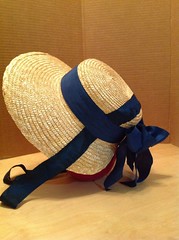
A few weeks ago, I found the modern, not-as-fine bonnet based on the KCI bonnet, and similar to one sold by Meg Andrews.

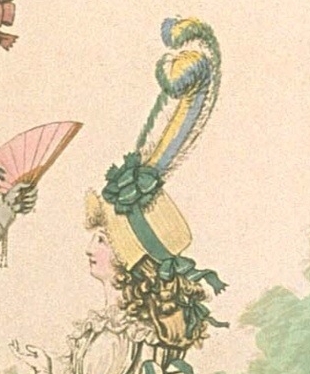
In a 1794 fashion plate, there is a similar bonnet with blue ribbons and an enormous feather. I don’t rate a feather as John Brown’s maid, or the Continental Army veteran’s wife, but blue ribbons seemed OK. Plus, I had them already.

The bows and the band and the strap don’t match, and my dress isn’t blue, but I think that’s all fine. The most I can say is that I’ve found two extant examples of this bonnet, and the fashion plate, which predates the farm’s interpretive year.

As a striving resident of Providence, Rhode Island’s busy port city, I’d have access to more goods than a Greenville woman. Bristol (where the farm is located) was also a thriving port, and again, boats from Rhode Island are sailing around the world bringing back china, silks, teas, spices, shawls and other goods, as early as 1787.

Now, pass me a boilermaker, please, because I’ll need a drink when the mechanical contractor tells me what the boilermaker will charge for a new Library boiler.


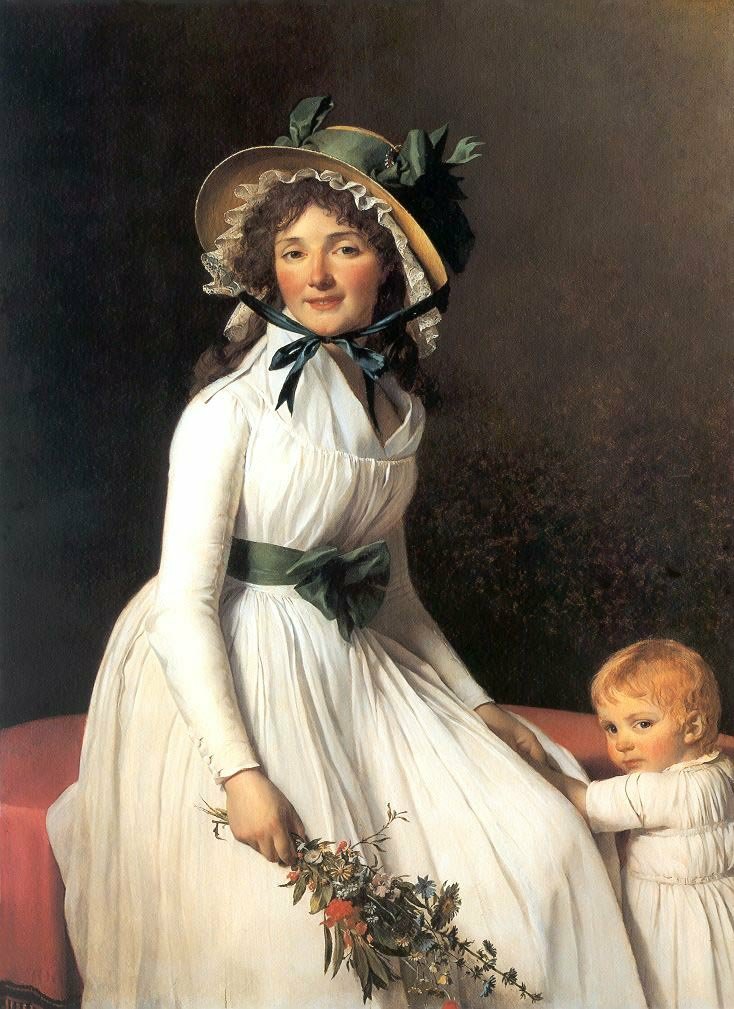
ETA: Aaand there’s this painting, Mme Seriziat, by David, 1795. Click for larger version, but she’s the reasoning behind the choice of blue ribbon.  The placement seemed to agree with the KCI and fashion plate ribbons, and joy! the color was in my ribbon box. I tried to get my ribbon to do what her ribbon is doing, but the bows and loops looked like sad blue silk dog ears– not so nice. So I switched them around to the back, based on the other images.


Some hat!

Tags

, ,

I was looking for something else, and found instead Sally Sanford Pert, 1790. That is surely a fantastic hat, but the painting itself is quite interesting, too.  I was chasing Sanford Mason, which is how Sally came up in my search, though she was painted by Reuben Moulthrop (1763-1814).

She’s on display at the Met right now, and if I had the time, I’d get on the Acela and see her myself. Is she really that blue? Does her hair really look like she made a wig from a grenadier’s cap? What exactly is happening with the gown? And who, oh who, is shown in the portrait miniature she proffers? I’d guess her child, perhaps deceased, but it is only a guess. If you click through to the Met’s catalog record, you can zoom in on the portrait. The neck of the gown seems to be edged in printed or embroidered fabric different from that of the gown itself. It isn’t really a zone gown, and the “flaps” or “lapels” remind me of the robings of earlier gowns, or even a robe volant typical of the early 18th century.

Atop this all sits the hat, with its corkscrew ribbon ringlet, the whole thing looking like it was made of paper. In a way the painting raises more questions than it answers, about dress, painting style, the artist, and who Sally was. The best projects seem to start with a question. I don’t know where Sally might lead, but I’m glad I found her.

Bonnet, found

Tags

, , , ,

Readers may recall that I have a bonnet problem. It’s a problem I think can only be solved by more bonnets!

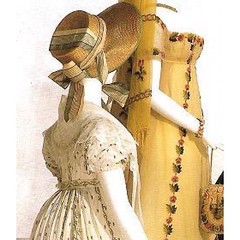
I’ve long admired and coveted the bonnet shown left in the Kyoto Costume Institute.

Well, see this bonnet? It’s called an 1812 Sun Bonnet over at HistoryHats.com. It is based on the KCI bonnet.

It is also similar to this ca. 1810 bonnet sold by Meg Andrews.

I’ll be spending time out in the sun in September, dressed for 1799. Black silk bonnet, yes, but, it could be hot and not so shady. Big plate of a straw hat? I guess so, but it’s a little too big for 1799. Straw bonnet? I wish….

But wait! Trapped on Amtrak, scrolling through Dames a la Mode,  what do I find? This! Check out that bonnet on the woman seated at right.

(Click through for larger version.) Similar cut out at the back of the neck to both the 1812 sunbonnet and the KCI bonnet. Interestingly, the woman in the straw ‘sun bonnet’ is wearing a dress with sleeves like those found on a chemise a la reine. She can’t be less fashionable than her companions, can she? How can that be in a fashion plate? I think this speaks to the persistence of fashion details longer than we might otherwise credit them. It only makes documentation trickier– or more fun, depending on who you are.

It’s 1794. By 1799, that bonnet might very well have made its way to Providence. We know girls and women were dismayed by the Jeffersonian embargoes, and driven to make their own straw hats in Providence. That means they had them, they’d seen them, and they’d seen fashion plates before the 1807 embargo.

Yes, I need a broadside or a newspaper ad to clinch the deal, but there’s an extant hat, a fashion plate in English, and I know by the early 1800s women are weaving straw for hats in Providence.

I think I might be able to have that hat after all…but I still have to finish that shirt I started for Mr. S. It simply will not sew itself!

A Digression on Cataloging

Tags

, ,

20120817-083421.jpg Sew 18th Century had a great comment about the striped linings on the quilted petticoats: are they linen? The catalog record doesn’t say. I think they are, and I remember feeling linen on the insides of the petticoats, but I lay awake wondering: what if those linings are linsey-woolsey? I know women are running away in “lincey” petticoats in 18th century Rhode Island, what if…what about that blue silk? Is that superfine wool in the lining?

To relieve my mind, I did some searches at the Met and the MFA and discovered a familiar inconsistency: quilted petticoats described as being made of silk. Silk and cotton. Silk, cotton, linen. Sometimes the lining was called out, sometimes not. The MFA Boston has some of the best catalog records: major thanks to the creator of the record calling out the ribs in the cotton and linen petticoat with polychrome crewel work.

What does all this mean? It means, when you are lucky enough to be able to ask the collections person for more detail, do! Because the records up in museum online catalogs are in process. Sometimes that process is drawn out over a series of years. The catalog record created for the calamanco petticoat in the RIHS collection was made in 2006 by a young woman working on a grant. her major interest was fine art, but she needed a job, was smart and conscientious, so I talked her into doing the textiles inventory. Along the way, the Registrar and I tried to help her, but the museum was draped in workmen, the Library in open revolt, the basement flooding, and I think that was the summer there were two serious accidents in the Registrar’s family–unless it was the summer she had mono. Not ideal conditions.

We were also cataloging in a home-made, twice-modified Access2003 database, so data entry was entirely manual. That requires even more will power on the part of the cataloger–you’re typing it twice. In the database we use now, the description can contain such lovely phrases as “calamanco exterior with wool batting and plain weave linen lining, pieced from two striped fabric lengths.” You can get poetic in the description. Then in materials you can select straightforward “fibre, wool,” and “fibre, linen” but you’re not typing it again. This makes me want to spend more time on the description, because I know that someone will get the basics in the material field.

So those petticoat records are early, based in some cases on information I know is not quite right, and they need to be edited. What I find so useful is knowing people are interested! That means that I can justify taking the time to go over a block of records, improve them, and upload them again. It won’t be as soon as I like, but I can think of this as a winter project that will give me great pleasure and make up for whatever super dull administrative tasks I have, and benefit a wider population.

As for the Curatorial Assistant, she’s teaching English and Art History at the high school level now, and it’s just me, the Registrar and the Assistant Registrar/Photographer, all of us only two days a week in the museum; the balance of time is at our library. We are responsible for all of the displays in the museum, all new exhibitions at the museum, temporary exhibits in our satellite museum, environmental monitoring, new gifts, old gift untangling, research and reference requests, disaster planning and response, loans, oversight of construction projects, actual hands-on gallery renovations, exhibit object preparation, mount making, and installation, database administration, collections digitization…some just for the 30,000 museum objects, some of that for all of the collections.

That’s an extreme case, but most museums have similarly pressed staffs and that’s reflected in the level of detail in the catalog records. When we’re finished with the NEH Sampler Archive Project, we’ll have the best sampler records ever–because the grant pays for us to spend the time counting threads in the backgrounds, and for new photography of all the samplers. It takes that level of commitment to get very high quality records with images for all objects.

Most of the time, I don’t get into this kind of discussion, because I don’t want to sound defensive or whinging. But the hard truth is that money talks, and we focus cataloging where there is money to support the cataloger, or the rehousing of cataloged objects, or the digitization of the objects. Priorities have to be set, and for now, they’re set by funding. As the man says in The Right Stuff, “No bucks, no Buck Rogers.”

Still, that doesn’t mean I won’t find a way to indulge my love of quilted petticoats come December, pull them from the drawers, and revise the records.