Tea Party Madness

Tags

, ,

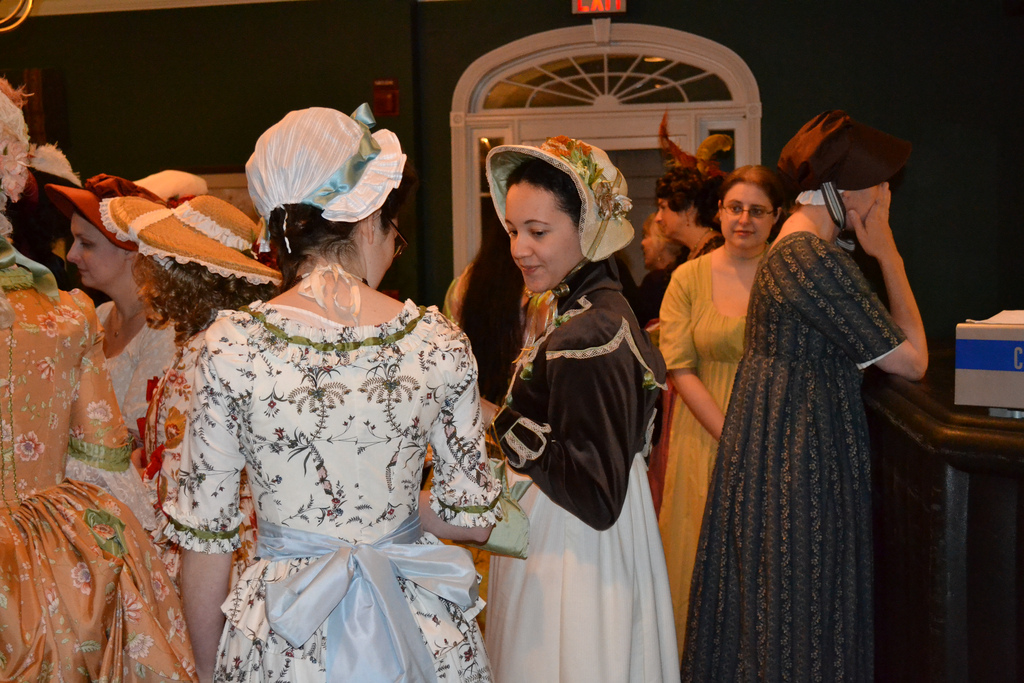
There they are, those lower sorts! We had tea, with delicious scones and excellent company in the form of booksellers from Brooklyn. We don’t get out to tea very often, and it was a pleasant introduction to more old-fashioned notions of parties.

This is a useful thing, because the known bonnet wearer must prepare cake and punch for an as-yet-unknown quantity of guests to include the Second Helping Regiment. Perhaps the historic recipes are not so far off in quantity after all..

The clip is from The Compleat Housewife: or, Accomplish’d Gentlewoman’s Companion. A similar recipe appears in The Art of Cookery Made Plain and Simple, by Hannah Glasse. You can find it on the Colonial Williamsburg website, along with a translation for the 21st century cook. I think I’ll try it, and I’ll have to start soon to get it right by the end of June.

Now for a punch recipe for an unknown quantity…

The Lower Sorts Crash a Party, Again

See the two women at the right? The one in the brown bonnet with a hand at her face is me, exhausted after driving to Malvern from Providence; the young lady in yellow stripes is Dana. We are in our best dresses, the Past Patterns 1796-1803 front-closing gown.

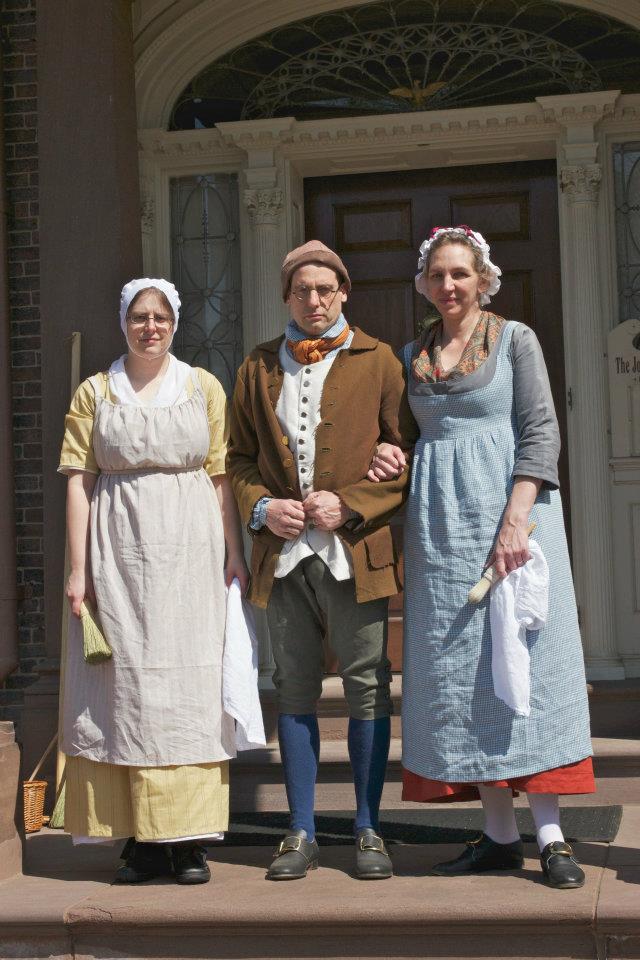
That wasn’t the party where we felt the most like country mice, but we did feel like country mice much of the time, and that’s because we are. (That’s my husband, veteran of the 2nd RI Reg’t, standing beside me.) Someone needs to represent the lower sorts, and honestly, at the reenactments I go to, I’m often the best-dressed woman, the recent ran-away-from-Newport. The excuse I can use for wearing Indian print cottons is that I am from a port city (Newport or Providence) and that I can afford small pieces, or second-hand items. Certainly in the Colonies there is economic churning, and Styles suggests that the common people are not forgoing style and fashion as a concern in clothing acquisition.

I know what a servant or housewife might wear for working: The short gown, certainly, is the most comfortable and easy option, and uses so little fabric that it can be easily and relatively affordably made in prints.

But how might a servant, or a soldier’s (or, in 1796, farmer’s or blacksmith’s) wife have dressed for a party?

What I Learned at Dress U 2012

Tags

, , ,

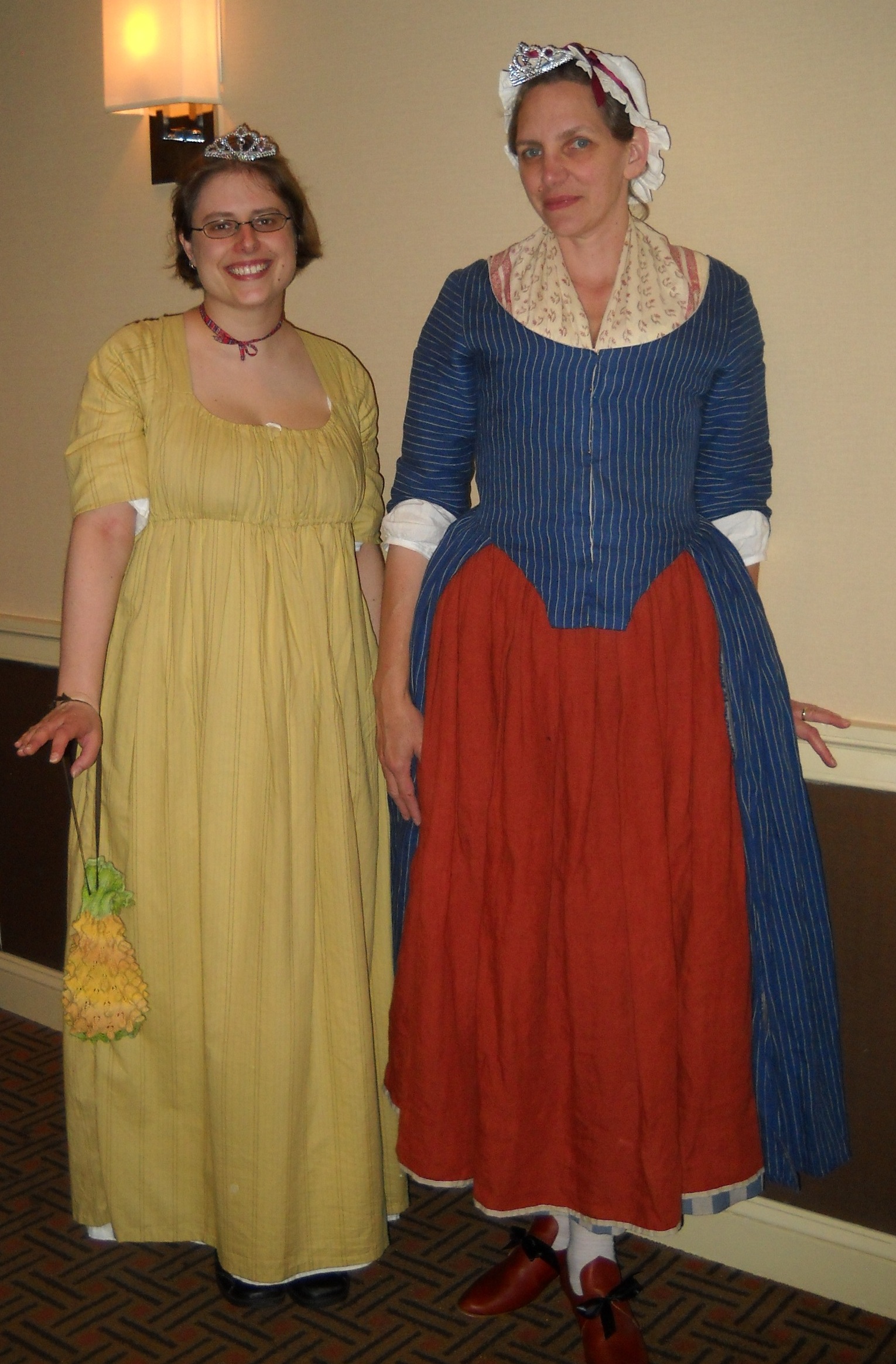
Some of us who re-enact the lower sort had to go to a party like this:
But before that, I learned a lot.
The Basics

  1. I am a better seamstress than I think I am
  2. There are some classes I could teach
  3. I’m going to need another hip replacement
  4. I need to learn to have fun!

The most important statements are probably the first and the last; I do actually know what I’m doing, more or less, enough to know that I learned a few other important things.

The Fine Print

  1. My 1790-1810 stays need to be re-done completely; they’re too long.
  2. I need a new 1750-1770 short gown pattern
  3. My black bonnet rocks
  4. I want a shiny party dress
  5. O.M.G., I met Sharon Burnston!! She was fantastic and I so enjoyed both of her classes. I learned the most in both of them.

Those stays have been troublesome since I began, what with tossing out the very first pair I attempted, and the wriggling and riding up with wear of the second pair. It was in Jenny LaFleur’s Fitting Yourself class that I figured out (slow, I know) that I should put my pair next to Dana’s. Dana is long-waisted, I am  not. Dana’s stays and mine were the same length. Light dawned: If our stays are the same length, mine are too long.

Sigh. Starting over… Oh, well. New stays will fit without irritating me, I can get the cup right and the busk will stop trying to meet new people, and when they’re done, I can make lovely dresses that will fit and that I will not fuss with.

I could even make something like this, and have a real party dress for the next time I go away.

Vogue for the Lower Sorts

Tags

, , , , ,

How does a reenactor know what to wear? There’s a wide range of choices for any decade, so how do you know what’s right?

Well, you don’t, not without documentation. This is where it can be nice to be a soldier. There’s griping in my house about “plain old white linen grumble frocks grumble waistcoat grumble” but really, the man and boy know who they are and what to put on. (Doesn’t stop them wanting regimentals, and I know they’re casting sidelong covetous glances at British coats.)

What about the women? The range is vast, from Mr. and Mrs. Ralph Izard

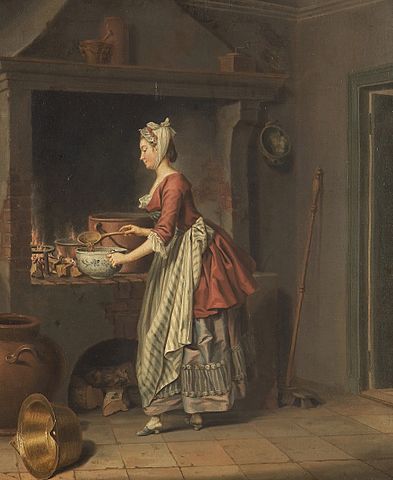
to the  Oyster Seller.

Both are ca. 1775, though the original Oyster Seller was probably earlier, but here’s the thing: how differently would she have dressed in 1775 than she would have in 1765?

It’s a point taken up, to a degree, in The Dress of the People, which I devoured in the orthopedist’s waiting room yesterday.

So if you know you’re not Alice Delancey Izard, but you’re not really an oyster seller, either, what do you do?

You check the ads.

I search runaway ads for Rhode Island to check my choices. That’s how I came to make a blue wool cloak, because I found Lucy, who ran away in December 1776 in a “blue Baize cloak.” There was Polly Young, who ran away in June, 1777, in a “black skirt petticoat and a short calico gown with long sleeves.” What did that short gown look like? I wish I knew. But it does place short gowns in Rhode Island (Lucy wore a short striped Dark Flannel gown when she ran away). Now, if only we knew what “short gown” meant in New England.

Pork Pies in Dighton

Tags

, ,

The weekend before Memorial Day, we spent two days in Dighton along the Segregansett River. It was a Continental Line event, and as such it was interesting to see that different organizations host reenactments with subtle differences.

The biggest difference for us was we got to day trip it from home since Dighton is so close, and that meant two different lunches. Day one, a variation on pasties. Day two, bread and cheese and fruit.

For the pasty variation, I cheated with store-brought crust. I figured the week my guy fell in a 12-foot-pit, I could cut a corner or two that did not involve safety, since I was getting home so much later.

Here’s how the filling worked, riffing on a Daily Mail recipe:

  • Some olive oil (a tablespoon, perhaps)
  • Half a medium sized onion, diced fine
  • A teaspoon of sage
  • Half to two-thirds of a pound of pork cutlet or boneless chop, whacked thin
  • One firm apple, sliced thin
  • One carrot, sliced thin, or a parsnip, or both, or neither
  • One medium potato, diced small
  • Tablespoon of flour
  • A tablespoon of lemon juice
  • Salt & pepper to taste
  • Small amount of water, as needed
  • 1 egg, lightly beaten

Heat the oil in a skillet; add the onion and sage, cook until soft.
Add the pork, cook until lightly browned.
Add potato, apple, and lemon juice; this is the time to add carrot/parsnip.
Sprinkle lighly with flour or cornstarch.
Cook until pork is browned and vegetables softening but not soft; add water as needed to create some juices.
Season with salt and pepper to taste.

It is best to let the filling cool before spooning it onto the crust.

Cut the circles of crust into halves. Divide the filling into four equal parts, and distribute among the half-circles. Fold the crust over, pinch closed. Brush with beaten egg to glaze, cut small slits for steam holes. Bake at 350 degrees until filling bubbles and crust is brown, about 30 minutes, depending on oven.