Whimsical Wednesday: Shoes.

Tags

, , , , ,

If you are a historic costumer, living history interpreter or enactor and tell me you don’t have a problem with shoes, and I will laugh at you. Even if you don’t have way too many shoes, chances are good you look at them in museum collections, even if you don’t order them. Shoes are basic to any impression.

I have history with shoes, myself. Not only have my feet always been generously proportioned, but my Grandmother possessed a singular fondness for, and an expansive collection of, shoes.

Shoes. Slippers.

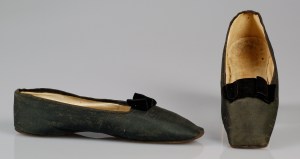
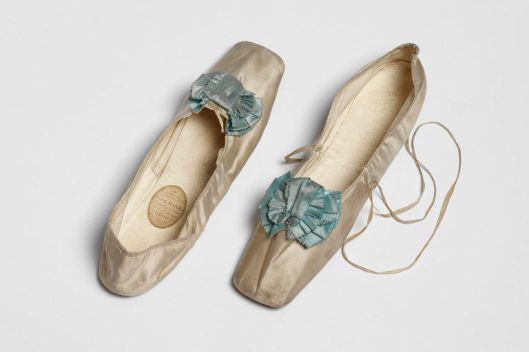
Pair of slippers. 1825-1849. Paul Hase, Paris. V&A 1153&A-1901

Pair of slippers. 1825-1849. Paul Hase, Paris. V&A
1153&A-1901

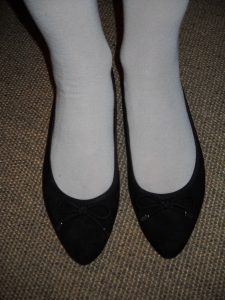
Call them what you will, when you hanker to dance, you need them. So, I find myself in the happily distracting position of needing (wanting) dance slippers for April. I thought my search might be fruitless, what with my pedal extremities, but reader: I was delighted and surprised. dscn4592

Yes: they fit! Now the tricky bit is to dye and decorate these slippers to achieve maximum eye-watering potential. There’s a length of silk headed my way that should provide plenty of inspiration.

For tamer times, classic black will always do. Whilst replacing my worn-out sneakers, I came upon a pair of slippers that seemed ready for alteration, so I bought them as a backup, in case the Brontes didn’t fit.

dscn4595

They were inexpensive enough that I didn’t mind taking them apart for modifications.

A grosgrain rosette and ribbon ties later, these will do well enough to extend the life of my irreplaceable Robert Land slippers. I looked at shoes last night, and drew inspiration from some examples through the first half of the 19th century. With the pointy toe, these clearly skew first decade of the 19th century, which is just right for most of what I do. The Brontes will work for later impressions– and I have those as well. All in all, a pleasant mid-week distraction.

Pair of women's shoes, 1801. Gift of Fred Taggart, 1986.31.1a-b. RIHS

Pair of women’s shoes, 1801. Gift of Fred Taggart, 1986.31.1a-b. RIHS

Women's slippers, 1790-1810. American. MFA Boston. 99.664.12a-b

Women’s slippers, 1790-1810. American. MFA Boston. 99.664.12a-b

Slippers, 1835-1850. American, wool, silk. Metropolitan Museum of Art. 66-20-1a-b

Slippers, 1835-1850. American, wool, silk. Metropolitan Museum of Art. 66-20-1a-b

Fitful Friday: Art Still Has Truth

Tags

, , , , , ,

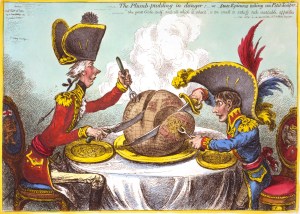
Pitt and Napoleon carve up the world.

Pitt and Napoleon carve up the world.

It’s been one of those weeks, hasn’t it? Up and down, emotionally, as we all prepare for change. Whig or Tory, these are turbulent times.

I’ve been surprised by recent fabric arrivals in the mail, disappointed when I waited a day too long to register for a dance, and now I’m at loose ends. What comes next?

Last weekend I cut out a black wool Spencer to line in lettuce green silk because why not? And teeny tiny backstitches later, I have one sleeve finished. Focus is hard to come by of late.

I meant to join the Historical Sew Monthly to give my sewing life some structure, and I still can, though I cannot seem to settle down. Clearly, I have Firsts & Lasts that could be made (not always in the time remaining, mind you, so I would have to choose wisely).Re-Make, Re-Use, Re-Fashion? Probably much there as well– at least if one counts the quilted petticoat worn at Princeton, which was remade and altered from its original form.

July: Fashion Plate, could become the shawl gown I’ve dreamt of for years, since, as you can see above, I’ve found one that might work, lured by a fair price on a sizable piece of wool– but wherever shall I wear it? Why can I not get past utility? The Dreamstress’ Kashmiri shawl gown and her research are there to emulate, and explain.

Oh, I have projects and events to research and plan, housework to complete, and plans to execute. But they all seem abstract and unreal at the moment when we hang on the pivot point between the future and the past. It’s been a strange year in many ways and places, and constructive projects help focus.

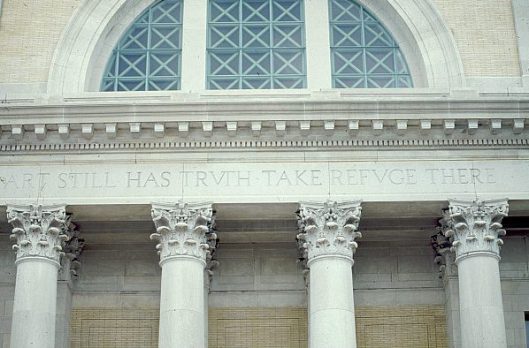
Art Still Has Truth Take Refuge There

Art Still Has Truth Take Refuge There

Long ago, in the first turbulent times I was old enough to understand, I lived in St. Louis. Then, as now, I think the Art Museum’s motto holds, and reminds those of us who work in or appreciate sometimes frivolous-seeming fields and hobbies that all our actions have meaning. I’ve thought for a long time about the utility of sewing historic clothing, cataloging objects, and running around recreating the past.

Getting outside one’s own experience is incredibly hard; it’s hard to have an open heart, and to encourage openness to others. But that’s one of the most important roles museums and libraries play: we help people develop imagination and empathy. I know it’s part of why I do the work I do. I like to think that ultimately, helping illuminate the complexity of the past will help us all understand the present and make a better future.

I came, I saw, I sighed

Tags

, , , ,

img_8909

Gunston Hall has been on my list of must-visit places for some time, and now I can cross it off my list. I was impressed by their Room Use Study and remain so. They’ve also done some decent work on slavery, and it shows on their website. So my hopes were high. You know where this is going, right? Yup.
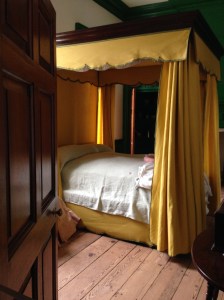
The room in which Martha Washington and Mrs Mason may have had a "chit-chat" about the two Georges.

The room in which Martha Washington and Mrs Mason may have had a “chit-chat” about the two Georges.

Pretty sure the guided tour is dead. Also pretty sure most museums need to look long and hard at the actual execution of their mission. Granted, this was another one of those January R&R visits, when it is entirely likely that the multiple “Out of Order” signs were a mere mid-winter fluke. But day-um, I was underwhelmed.

Granted, this house is older than “mine.” And smaller. And I didn’t ask any questions on the tour because I fear my tone will be far too telling. But there was a small, excited-in-a-good-way child on the tour, and several other adults. When asked by the docent what we were interested in, the group settled on “life.”

WHO touched that railing?

WHO touched that railing? THAT’S why I should care?

We ended up with the incantation of “many famous people have sat in this room.” “Many famous people have touched this stair rail.” I might have heard an audible intake of breath when we were told something was original; my right eyebrow shot up in an expression well known to my friends.

The house is lovely, of course, Georgian balance and all that, and nicely decorated, whether the chinoiserie paper in the dining chamber or the Virginia-Chesapeake Neat and Plain office. But why the default emphasis is on famous people touched this, stepped here, slept here, I do not know. My docents do it, too, sometimes. But what troubles me more is what I came away without: A sense of George Mason and his family.
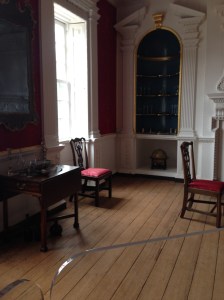
Red damask on the walls, because "they could have had it." Infelicitous phrasing.

Red damask on the walls, because “they could have had it.” Infelicitous phrasing.

Most troubling to me, being Of a Certain Age, was the statement that Mason’s second marriage, to Sarah Brent, was “for friendship and companionship.”

Really?

George and Sarah sign a marriage agreement several days before they are wed, protecting in a limited way Sarah’s individual property. Under the terms of this contract, Sarah gives ownership of her slaves to her husband for the length of her marriage, but regains possession of them should her husband die and there be no offspring between them. Under these same conditions, Sarah is promised as dower 400 acres of her husband’s land at Dogues Neck.

Over the years, it has been pointed out that the marriage agreement between Sarah and George indicates that their relationship was more business-like and convenient, rather than loving. However, the marriage compact also can be seen as a fair solution between two practical people who want to safeguard their property for future generations — Mason for his children and Sarah for the sons and daughters of her sister Jean in Dumfries. In Sarah’s will of 1794, she indeed does pass on to these children and one of their offspring the slaves she regains upon the death of her husband.

Really?

That looks to me like a sensible arrangement between two mature adults. The way that a 50-year-old approaches marriage and relationships in any century will be different. Even in the 18th century, a woman of 50 has an established identity, knowledge of the world, and experience in running a household, if not a business.

Why yes, I may well have some baggage, why do you ask?

Why yes, I do have some baggage, why do you ask?

To suggest that sensibility excludes or precludes sex is to miss the point of Jane Austen completely, and is ageist in the absence of evidence. In all likelihood, Sarah is peri-menopausal at least and menopausal at most (it varies widely; some 50-year-old women are still fertile, shocking though that may seem). That doesn’t mean she’s asexual, and while George Mason may well have (probably did) take sexual advantage of the women he owned, that doesn’t mean he’s not interested in, and expecting, a sexual relationship with his second wife.

What all of this suggests to me is a reluctance in museums to talk about sex, unless there are children from a marriage, in which case one can just assume the couple were busy in bed and not actually address it…all in all, a weird thing, and one that turns up in my own museum from time to time.

This is not to suggest that I didn’t enjoy the tour, the house, or the landscape. But I felt dissatisfied, as if the real meat of the place was not to be found on the tour. Exploring the upstairs on our own was much more fun– I would have liked some object labels up there, and downstairs, too– and had more of an air of exploration and discovery.

And that’s what the guided tour kills: discovering for yourself. It doesn’t have to be a full-blown you-paid-for-it Museum Hack bonding experience. It doesn’t need to be a handout with “How many squirrels can you find?”

img_8950

Exploring, reading labels, listening, smelling, touching: using our senses to learn about a place, a space, an object, a person, will be engaging enough.

With so much good, deep, content on the website, I know Gunston Hall has the material a great tour and historic house museum is made of. I know, from reading the labels about slavery at the site and reading the text about slavery on the web, that they know more, do more, and understand more about the enslaved people than their permanent exhibitions indicate.

Bang Bang Pew

Tags

, , , ,

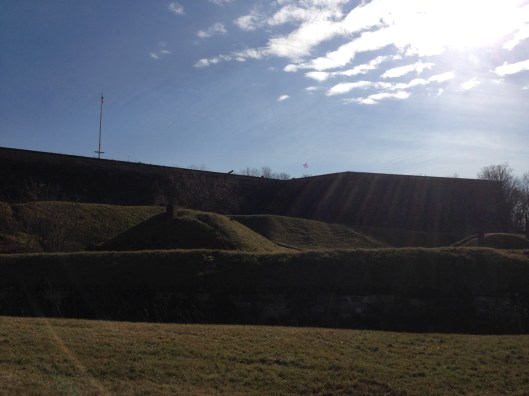
img_8896Like an energetic Golden Retriever, I need to be walked daily, almost without regard to weather, and I have a fondness for water that I fear makes me a questionable house guest-cum-nurse. Fortunately for me, Drunk Tailor has a granular knowledge of his surroundings that allows him to recalibrate his understanding of the places he likes to suit my needs: hence a Sunday trip to Fort Washington, Maryland. Plenty of room to wander, a wide* meandering river, defensive weapons installations.

It’s a large site and we only explored the main fort structure, the shore by the lighthouse, and the visitors’ center (I’ve seen plenty of Endicott batteries before, both on the Potomac and on Narragansett Bay). It started out well enough: the curious tripping stick figure sign warned us of the wooden bridge into the fort, and reminded me of a friend with a fondness for fonts and curious graphic design.

img_8890Guardhouse, batteries, masonry walls, stables, earthworks, former ditches, the remains of powder houses: all good stuff. The signs were what one comes to expect from the NPS: UV-damaged labels, slightly behind the times graphically, indicative of the slow pace and underfunding of the preservation of our national heritage.

img_8894

Drunk Tailor’s memories of Fort Washington include a first-person living history event set on the (literal) eve of the Civil War, with men portraying member of a Texas-based unit wondering how they would ever get home, and responding to a woman’s inquiries about General Lee and Grant with the suggestion that reading Harper’s would bring her up to date with current events. Now, we are in January and my expectations are low in the cultural heritage off-season: this is the time for maintenance, upgrades, rest and refurbishment.

img_8903

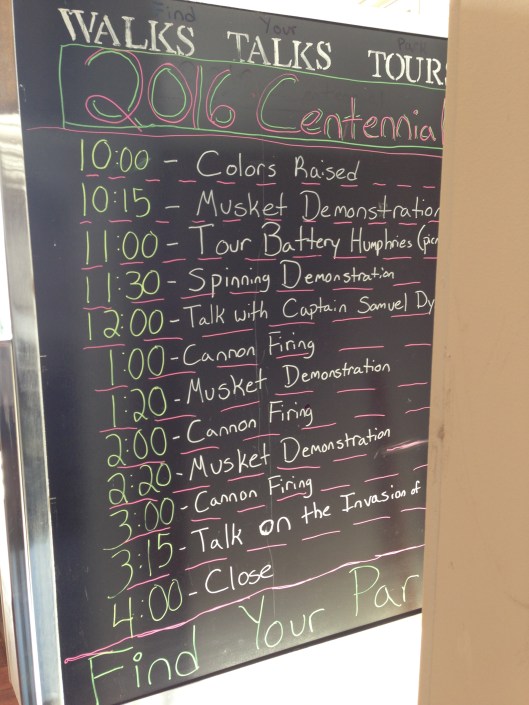
All the pew. Plus some spinning.

What I did not expect– though I should have– was the leftover daily event roster from some time in 2016.

Boom! Goes the cannon, et cetera. Because Boom! is easy. Add in a side of spinning and we are good to go, right? We got something for the ladies. (You know where this is going, right?)

The best thing I can say for Fort Washington is that I was spared endless racks of brown sticks displayed with only the barest of identifying labels and no interpretation**. But here we are at a site with over 200 years of history and just the vaguest hints in the visitor center of decades of use and change over time. And I like military history. I like weapons. But the more I visit the more I marvel at the way we underestimate our visitors’ capacity for understanding and interest in the past.

img_8889

Bigger Booms

As we drove away from Fort Washington, I began to think that once again, we are asking the wrong questions. Instead of questions that can be answered, “Guns Got Bigger,” why not ask some of the following:

  • What was daily life like for the men stationed here?
  • What material differences did officers and enlisted men experience?
  • Could enlisted men get married? Where were their wives?
  • How much did soldiers get paid?
  • What was the typical term of enlistment? Did that change over time?
  • Where were the stables? What were the horses used for?
  • How was the fort supplied? Where were the kitchens?
  • Where were the mess halls? What was a typical diet?
  • How did rations differ for men and officers?
  • Did any of the British officers or enlisted men remember the area around Washington, D.C. from their service in the Revolutionary War? To what degree might that have influenced the way the War of 1812 was fought?
  • What about that court martial, Captain Dyson? How was it run? What testimony did Dyson give?

Why did I have to go to the Fort Washington website to learn about the Adjutant General’s school, and the WAAC detachment? And why is it a PDF instead of a webpage?


Perhaps the most salient question to ask, on the Monday of inauguration week, is why do we care so little for our shared past that we accept the level of funding and staffing that gives us this level of interpretation? Don’t we, as a people, and our history, matter more than this?


*For the East Coast. The Potomac ain’t no Mississippi.

** I’m looking at you, West Point Museum.

My Life as a Chair, or, Warm in Winter

Tags

, , , , , , , ,

Can I get an “Aw, yiss” for being warm outdoors?

img_8826

After the aftermath. Photo by Drunk Tailor.

They may not be the most accurate <cough>machinestitchedoffabolt<cough> quilted petticoat and waistcoat, but they sure do make a difference.

These aren’t exactly base layers– a white wool flannel shift would not be amiss–but the quilted layers make a big difference to a day in the cold. When I added up the layers, I came to 8 without counting accessories like neck handkerchiefs and stockings:

  • Shift
  • Stays
  • Waistcoat
  • Lightweight Wool Petticoat
  • Heavy Wool Petticoat
  • Quilted Petticoat
  • Gown and Stomacher
  • Cloak

It isn’t always pretty, but in cold, wet weather, function trumps fashion (not that I’m not pretty pleased with this upholstery). The waistcoat ties on, so you have some adjustment should your weight or shape fluctuate. The petticoat, in this case, works like every other petticoat, with the sole exception of a short pocket slit on one side due to operator impatience (this was finished just a few days before it needed to be packed for Princeton).

img_8823

Thanks to Drunk Tailor for more patience.

The quilted fabric (originally intended, I am sure, for a bedspread) is lined with a plain weave wool for extra insulation and body; the waist band is bound with wool tape, as is the hem. Down in the basement, there’s a camblet- wool batting- linen lining sandwich on a frame, ready for quilting, if I only I would drag it up stairs and start, and I know it would be both more insulating and more accurate.

Does it all fit? Well…pretty much! An open robe with stomacher makes it easier to fit all these layer underneath, and, happily, I don’t have the best sense of my own size, so my clothes tend to be a little bigger than they must be. Fortunately, historical clothing generally involves adjustable closures that make fluctuations and layering easy to accommodate.

After Anna B’s and Anna K’s comments on the overview of the event, I was reminded that these are the confessions of a known bonnet-wearer, and I will humiliate self for history, so in case you are wondering: no, I didn’t wear drawers of any kind, or leggings, or long underwear. A pair of silk stockings under a pair of wool stockings kept my lower extremities warm, but my nethers were sometimes chilly, in a highly specific, localized, but small way. I think this may be where the wool shift comes in– or one that fits a bit better than my current garment, which is a tad too large.

On the porch at Morven, a range of head coverings. Photo by Matt White

On the porch at Morven, a range of head coverings. Photo courtesy Matt White

When it comes to ears, you can see that we adopted a range of solutions. Ear-covering caps under bonnets, under straw hats, and under kerchiefs, were worn by some. At far left, my cap perched on top of my head, so I tied my bonnet on with a kerchief and pulled my hood over all of that. Mistress V (at far right) wore a cap, a kerchief and a hat (which was summarily removed in the afternoon, by Mistress S at her left). Mistress F, holding the cream colored blanket with a wide black stripe, wore a wool hood over a cap and under her straw hat. Wear enough layers– and the right layers, meaning mostly wool and silk– and you will be warm, perhaps even sweaty if you’re active. Still, I might trade in my “Hobo Woman of Princeton” look for a quilted silk hood if the right one came along.