• Home
  • Completed Costumes/Impressions
  • Emma and Her Dresses
  • Free Patterns and Instructions

Kitty Calash

~ Confessions of a Known Bonnet-Wearer

Kitty Calash

Tag Archives: 18th century clothes

The Drama of the Hat, or….

09 Tuesday Apr 2013

Posted by kittycalash in Clothing, Making Things

≈ Comments Off on The Drama of the Hat, or….

Tags

18th century clothes, Costume, fashion, sewing

Lady Francis Scott and Lady Eliot, watercolor by Paul Sandy ca. 1770. YCBA, B1977.14.4410

Why a Riding or Shooting Coat Must be Made. A Diversion to take place in Several Acts, with Entertainments for All.

There was a bit of drama chez Calash following the March 23 inspection at Hartwell Tavern. There was a sense that a certain hat was not quite all it could be. There was a feeling that the hat might have been sat upon by the horse employed by the Captain to make the Regimental Garments. (Why else do they smell the way they do?)

The Matt Hat

The Matt Hat

So the favorite hat maker was contacted, and after negotiations, a hat was ordered. It was thought it would fit Mr S.

It does not.

It does, however, fit me, which means that in order to make use of the hat, I shall have to make myself a riding habit or shooting coat (the more likely item). Poor me, a tailoring exercise.

We could send the hat back, but instead I’ll knit another Monmouth cap, and put “civilian hat” on the birthday or Christmas list.

Share this:

  • Share on Facebook (Opens in new window) Facebook
  • Share on Pinterest (Opens in new window) Pinterest
  • Email a link to a friend (Opens in new window) Email
  • Share on X (Opens in new window) X
Like Loading...

Getting My Mitts On: HSF #7

08 Monday Apr 2013

Posted by kittycalash in Clothing, History, Making Things

≈ 5 Comments

Tags

18th century clothes, Battle Road 2013, Clothing, common dress, Costume, mitts, patterns, Research, resources, sewing

Mitts, 18th Century. MMA, C.I.44.8.9a, b

I got in a lather about not having mitts. I have been trying to knit a pair from the Mara Riley pattern for some time, as in well over a year. It’s just an unfortunate thing. I understand the pattern, I like the yarn I have, the needles are authentic enough for events, and yet: I cannot get these things done. As a result, I get cold. (I don’t mean that to sound whiny.)

There’s debate in some circles about whether or not knitted mitts were worn in New England, though there is a nice pair of black frame-knit mitts at the MFA, with a history of use in Lexington, MA. That’s a long way from what I can knit, a fair distance from what lower-middling Kitty would wear, and vastly unsuitable for a woman following the army. Still, I want mitts.

In the Fall, I tried to make myself a pair. It did not go well.

‘Camblet’ lined with linen, linen lined with cotton. More pix on flickr.

Fortunately I have developed more patience or bloody-mindedness since then. This allowed me to spend the time scaling up the pattern in Costume Close-Up. That’s where I started in the Fall, but things went better this time, and I actually have a pair of mitts.

Two pairs. I have problems, I try to solve them with sewing.

The Challenge: HSF # 7: Accessorize.

Fabric:
Left: Silk and wool “camblet,” lined with light-weight linen, both from Burnley & Trowbridge
Right: White linen from Fabric-Store.com, lined with printed cotton from Wm Booth Draper.

Pattern:
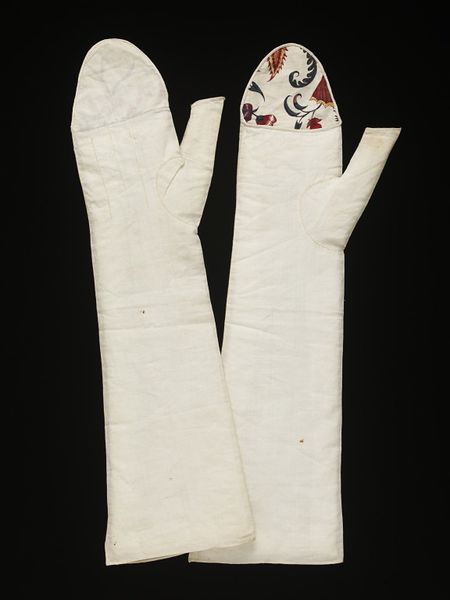
My own, scaled up from Costume Close-Up, available here for you if you have large hands,  print it at 100% on 11 x 17 paper. You will need to tweak the thumb placement. Make a muslin. Make two muslins. It’s worth the effort.

Year:
1750-1800. Narrower than that I cannot get, yet.

Notions:
None.
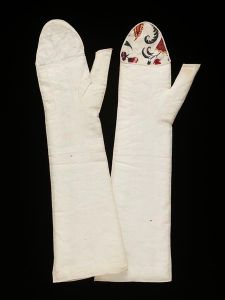
Mittens, 1790-1800. V&A,

Mittens, 1790-1800. V&A,

How historically accurate is it?
Say 8/10, since I have never examined a pair and don’t know exactly how they were made. Yes, I’ve read the descriptions in Costume Close-Up and Fitting and Proper, but at this foggy insomniac moment, I couldn’t tell you much about those descriptions.

Hours to complete:
The bulk of the time was in the patterning, which took a couple of evenings and 4 muslins. But once you have a pattern that works for you, finishing a pair from cutting to wearing is about 3 hours all by hand. You could cut that significantly using a machine instead of hand back-stitching, and add decorative embroidery, which I really cannot do. Really. Photos to come.

First worn:
To be worn April 13…probably the white linen pair.

Total cost:
Nothing, really, as all fabric was left over in the stash. The pretty printed scraps came in handy.

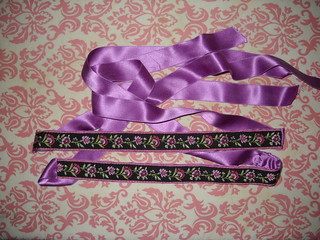
Garters! Jo-Ann plus Wm Booth Draper, but so far no implosion

Oh, I made some garters, too. Easy-peasy. Use the Pragmatic Costumer’s Ten Minute Tutorial. Completely makes up for whatever project you think you just screwed up. The main lilac ribbon is silk, the decorative ribbon is so not silk. These are better than no garters, but I expect my stockings will still droop around my ankles, as required by the laws of physics and reenacting.

Share this:

  • Share on Facebook (Opens in new window) Facebook
  • Share on Pinterest (Opens in new window) Pinterest
  • Email a link to a friend (Opens in new window) Email
  • Share on X (Opens in new window) X
Like Loading...

King of the Coats

29 Friday Mar 2013

Posted by kittycalash in Clothing, Living History, Museums

≈ 3 Comments

Tags

18th century clothes, Clothing, Costume, fabric, fashion, Making Things, menswear, sewing

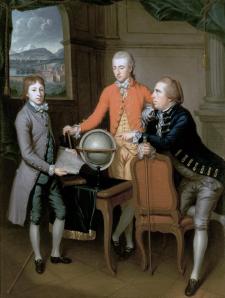
Douglas, 8th Duke of Hamilton on his Grand Tour, © National Museums Scotland A.1991.156

He’s hard to miss, the 8th Duke of Hamilton, in his red coat. I’d hazard it wool, because of the contrast with the sheen of the blue coat his physician, Dr John Moore (at right), is wearing. Dr Moore’s coat gleams like silk; the Duke’s looks dull and woolen. (Look at the way the light strikes the Dr’s shoulder; another clue is the way the button holes are worked.)

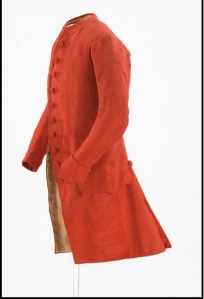
The coat below is a simpler, provincial relative of the Duke’s coat. This is the Amos King coat, owned by Colonial Williamsburg. I love the description:

“Wool plain weave fulled and napped “broadcloth”; twill worsted “shalloon” lining; tabby linen lining center back. Pocket flap lined with twill worsted; sleeves lined with tabby linen; right lower pocket is linen; left pocket is leather; inside pocket on left breast is linen, with broadcloth welt.”

Man's Coat, red broadcloth ca. 1770, CW 1953-59

Man’s Coat, red broadcloth
ca. 1770, CW 1953-59

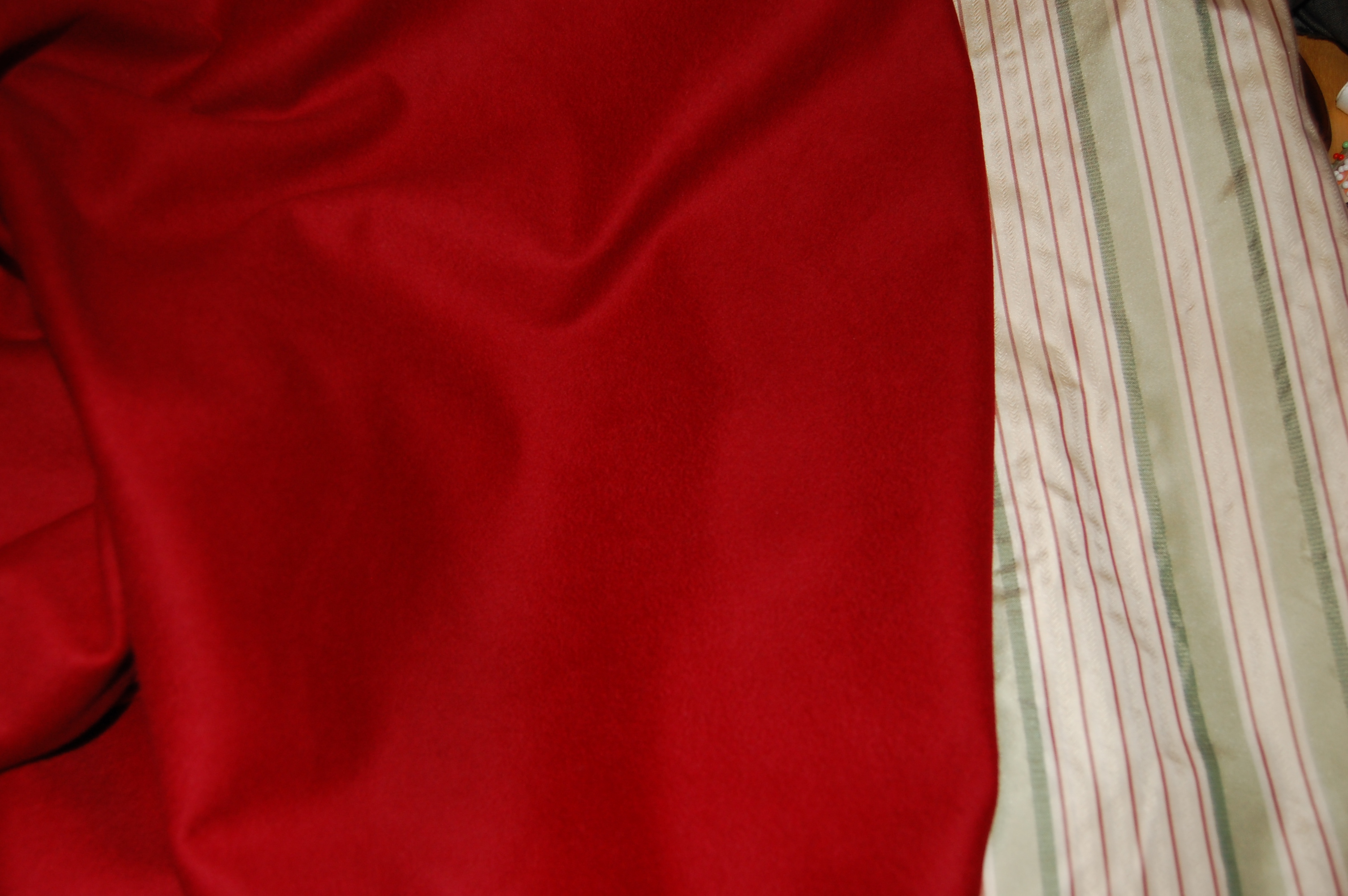
Shalloon. Tabby. Pocket leather. That paragraph is comprised of many of my favorite fabric and clothing words. And fabrics. And a leather pocket. As you may recall, I have a thing for fabric that is not at all about hoarding, and but rather about establishing reserves. When I see two yards of quality material at discount and purchase it, that yardage becomes part of the Strategic Fabric Reserve so vital to this nation’s safety. (We are all unsafe when a fabric addict is deprived of his or her fix. I’ve got a threaded needle, and I’m not afraid to use it!)

Part of this household's Strategic Fabric Reserve.

Part of this household’s Strategic Fabric Reserve.

Yardage arrived in the patriotic red, white and blue “if it fits, it ships” box on Wednesday, and when opened, we all proceeded to pet the lovely nap of the wool. Mr S wrapped himself in it, and I knew then that I would be making a red broadcloth coat of one kind or another.

It probably won’t be the “Quemans Pattern” coat John Buss mentions, not when I’ve got silk fabric for a waistcoat. The silk is from the remnant table at Artee Fabrics in Pawtucket. With careful cutting and a plain back for at least one waistcoat, there should be just enough to make both a 1770s and a 1790s waistcoat. We’ll get fancy around here eventually.

Share this:

  • Share on Facebook (Opens in new window) Facebook
  • Share on Pinterest (Opens in new window) Pinterest
  • Email a link to a friend (Opens in new window) Email
  • Share on X (Opens in new window) X
Like Loading...

Over(h)alls, Trousers, & Breeches, oh, my!

26 Tuesday Mar 2013

Posted by kittycalash in Clothing, History, Museums

≈ 3 Comments

Tags

10th Massachusetts, 18th century clothes, common dress, menswear, Research, resources, Revolutionary War, soldiers

Trousers, ca 1793. MMA,1988.342.3

Gentleman can agree to disagree on the attributed date of this garment, just as gentlemen might agree to differ on whether to call these trousers or overalls. It’s all in the crotch length, friends, and we’ll just back away.

But before I return a book of letters to the lender, I wanted to record some of the details that struck me.

Right from the start, the John Buss Letters, edited by Ed Nash, are filled with details. I got excited because, in a slightly random and not at all fabric-hoarding way, I purchased a remnant of grey striped woolen goods from Wm Booth, with the intention of making a jacket or trousers from the fabric.

This notion was rejected by my resident tenant farmer, who has particular ideas about his appearance and the quality of goods which should encase his limbs. Rebuffed from my historic fashion fantasy, I turned for solace to the John Buss letters, determined to make it all up by learning the history of the tenant farmer’s new regiment.

And lo, on page 9, in the very second letter, John writes home to his parents in Leominster, MA on October 1, 1776, saying that “my trowis has got very thin, I should be very glad if mother would make me a pare of striped wooling trowis as son as you can…” My tenant farmer was not impressed by my excitement.

Yes, all my fantasies are documented. But look: John Buss’s trousers are thin, not his breeches. And he’s clear about the difference between trousers, overhalls and breeches. In a February 22, 1778 letter from Valley Forge, Buss tells how he drawd from stores in Bennington “one frock, one Jacket, one Pare overhalls, one of stockings, one Pare of shoes and one shirt. Albany, October 25th., 1777, I drawd a  Red Jacket Quemans Pattern. November 5th., I drawd a pare of Braches and a pare of fresh shoes that was not worth tow shillings.”

Later, Buss requests lining (linen) to make breeches, as he is hot. So he draws clear distinctions between these garment forms. This is a costumer’s dream, really, and for me–oh, those striped wooling trowis! Now I have to make them. Look out, Young Mr…they’re headed your way. And lucky me, I have documentation for that red broadcloth remnant I bought in a random and utterly non-fabric-hoarding way.

Share this:

  • Share on Facebook (Opens in new window) Facebook
  • Share on Pinterest (Opens in new window) Pinterest
  • Email a link to a friend (Opens in new window) Email
  • Share on X (Opens in new window) X
Like Loading...

Trousering

25 Monday Mar 2013

Posted by kittycalash in Clothing, Living History, Reenacting

≈ 4 Comments

Tags

18th century clothes, Battle Road 2013, common dress, menswear, Research, resources

Looks like he’ll fall asleep any Minute, Man…it was late.

Nope, I did not attempt HSF # 6, stripes. I made some garters, so if the challenge was strips, I’d be set. Breeches mending, sewing gown sleeves and skirt hem,  and the kid’s jacket all took up my weekend, along with just plain living, so no pretty pictures.

I did think about how I choose what I wear, and how it’s a little tricky to sew for the guys, as they are engaged in a different way.

For one thing, they get told what to wear. 1778-1779 Rhode Island troops: you people are all set with your brighty-whities. You’re documented in your whitened towcloth overalls, shirts, and rifle shirts/hunting frocks. Happy marching in your thread stockings, you have broadsides and colonial records to tell you what to wear.

Would you trust these guys? I wouldn’t. 

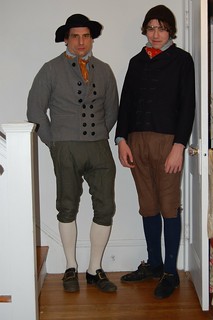
And then we roll back in time to Lexington and Concord, and for Battle Road, what do you wear? Well, they went off in what they had. (By the time they left, the Young Mr’s jacket had one row of buttons and Mr S had better-fitting, mended linen breeches.)

Of course, they were the only guys in short jackets, and they were the guys with the most “lower sorts” impression. To be honest, I do not know enough about the composition of the Rhode Island militia under the command of Nathanael Greene in 1775. Bearing in mind that no Rhode Islanders were at the actual events of April 19, 1775, how should these guys dress? What sort of men comprised the Lexington and Concord area militia, and what would they have worn?

The only way to know for certain is by doing research. What’s the difference between the men in the RI militia and the men who served in RI’s continental troops? Were the militia better off than later enlistees? To what degree did the composition of the troops change over time? And oops, there we went the rabbit hole of history.

Share this:

  • Share on Facebook (Opens in new window) Facebook
  • Share on Pinterest (Opens in new window) Pinterest
  • Email a link to a friend (Opens in new window) Email
  • Share on X (Opens in new window) X
Like Loading...
← Older posts
Newer posts →

Archives

wordpress statistics

Creative Commons License
Kitty Calash blog by Kirsten Hammerstrom is licensed under a Creative Commons Attribution-NonCommercial-ShareAlike 4.0 International License.

Website Built with WordPress.com.

  • Subscribe Subscribed
    • Kitty Calash
    • Join 621 other subscribers
    • Already have a WordPress.com account? Log in now.
    • Kitty Calash
    • Subscribe Subscribed
    • Sign up
    • Log in
    • Report this content
    • View site in Reader
    • Manage subscriptions
    • Collapse this bar
 

Loading Comments...
 

    %d