• Home
  • Completed Costumes/Impressions
  • Emma and Her Dresses
  • Free Patterns and Instructions

Kitty Calash

~ Confessions of a Known Bonnet-Wearer

Kitty Calash

Tag Archives: Costume

Framing a Plan

10 Monday Sep 2012

Posted by kittycalash in Clothing, Events, History, Making Things, Museums, Reenacting

≈ 2 Comments

Tags

Clothing, common dress, Costume, Events, Making Things, Reenacting, weekend, work

cross-posted from A Lively Experiment, all images copyright RIHS.

This coming weekend, I’ll be joining in at the Coggeshall Farm Harvest Fair, along with my co-worker who helped clean the museum 18th-century style. She will be helping with cleaning and laundry and ironing (must remember to pack the lavender and vinegar solution), while I will tackle a quilted petticoat.

At first glance you might think I’ll have the easier weekend, and in some ways, I will, sitting in a parlor with a quilting frame. On the other hand, I booked myself a weekend with worries that have pestered me since we were invited in mid-August. Is the fabric I’ve chosen going to work? Do I know enough about the quilted petticoats in the RIHS collections? What kind of quilting frame is correct? And where did I stash the batting?

Research is always the place to start. I compiled a Pinterest board of quilted petticoats  in other collections to build my visual literacy, and tracked down articles by Lynne Zacek Bassett in PieceWork[i] and in the  Textiles in New England  II: Dublin Seminar for New England Folklife Proceedings[ii].  From the Textiles in New England proceedings, I learned that September is the second-most common month for quilting mentions in diaries for the late 18th and early 19th century in New England (May is the most often mentioned, Octobe is third). This was a relief as I wondered if quilting in September was even appropriate. With that resolved, I was able to move on to aesthetics.

New England and Rhode Island quilted petticoats share some general characteristics: the overall skirt is quilted in a diamond or diaper grid of about 1” square. Below this is a decorative band or border, usually about 12” deep. The top of this is set off from the grid by a cyma curve or wave pattern. Some examples use an undulating feather border, and others have a stylized arc and clam shell border.  The background of the border is stitched in diagonal lines. Sometimes the direction is set from center front, and lines radiate to the left and right, and in other cases the lines radiate to left and right from the center line of each arced segment.

Within the border, floral and animal motifs are quilted. Animals seem prevalent in New England quilts—there is even a mermaid in Connecticut—but none of our quilts have a mermaid. We have sunflowers, pomegranates, and carnations similar in form to the stylized flowers that appear in samplers and embroideries of this time period. Animals include deer, lions, squirrels and a creature that looks like an oryx but may be an elk. Birds are represented as well, peacocks and stylized songbirds as well as an owl, and even what seem to be roosters.

I drew these conclusions not only from reading, but from examining two quilted petticoats in the RIHS Collection, the lighter one made ca. 1745 by Alice Tripp [Casey], accession number 1985.7.1, and the darker one made in 1770 by Anna Waterman [Clapp], accession number 1982.76.3. In the catalog record, the images for 1985.7.1 are incorrect–they are for 1982.76.2, and the confusion testament to cataloging and linking records in a building several blocks from where the petticoats are stored. Now, at least, we can work on correctly them.

The quilted petticoat that I plan to make will use the typical Rhode Island elements. The top portion will be quilted with an overall diamond pattern, while a feather border will set off the bottom band. Within that, I will quilt squirrels, chickens, and probably an owl and a cat, because they are favorite creatures in my household. I’ll also quilt in my initials, just as Anna Waterman did in her quilt.

You can join us at Coggeshall Farm Museum this weekend, September 15 & 16, starting at 10 each day, and see RIHS staff members in action! We think it will be a good warm up for What Cheer! Day, coming to the RIHS on Saturday, October 13.


[i] “Sarah Halsey’s Mermaid Petticoat.” PieceWork. January/February 2003

[ii] ‘..a dull business alone’: Cooperative Quilting in New England, 1750-1850.” Textiles in New England II: Four Centuries of Material Life, The Dublin Seminar for New England Folklife Annual Proceedings 1999. Boston University Press, 2001.
Share this:

  • Share on Facebook (Opens in new window) Facebook
  • Share on Pinterest (Opens in new window) Pinterest
  • Email a link to a friend (Opens in new window) Email
  • Share on X (Opens in new window) X
Like Loading...

Into the Breech(es)

09 Sunday Sep 2012

Posted by kittycalash in Clothing, Making Things, Reenacting

≈ 1 Comment

Tags

common dress, Costume, sewing

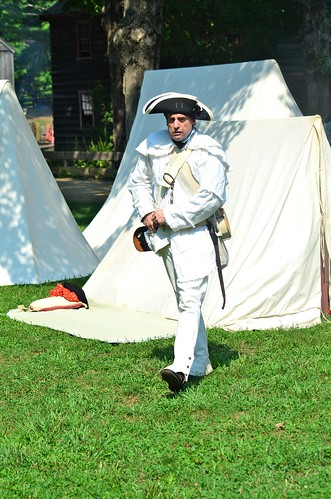
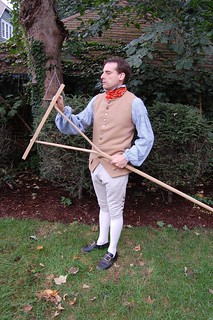
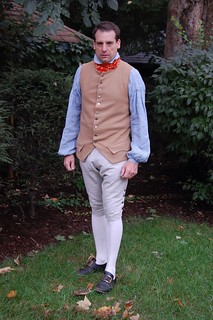
Not me, but Mr. S. I finished the last of 20 or so button holes on waistcoat and breeches, and got him to agree to get dressed and be photographed. He chose the rake, as he likes 18th century work. He hopes to  join in as a volunteer laborer at Coggeshall Farm this coming weekend, and these are his clothes.

The shirt, which he has had for a year, is from the Kannik’s Korner pattern, made in a blue and white check linen purchased from Wm Booth Draper. There was a check shirt in the clothing inventory of a 2nd RI soldier who died at the Battle of Monmouth, and this small blue and white check is found throughout New England at this time in shirts and aprons. The neck handkerchief is from Time Travel Textiles. He has another one in blue that he likes to wear with his uniform on hot days.

The waistcoat is adapted from a BAR pattern I got from the captain. The wool is a Wm Booth Draper remnant that was not enough to make a jacket for me. It just made the waistcoat for him, and is lined in a striped linen from Jo Ann fabrics that was lurking in the stash. The breeches are made from the Mill Farm pattern, which doesn’t have diagrams but has well-written instructions. I finally got pockets to work using that pattern the first time out! The fabric is a linen-cotton blend from a remnant table at the local mill store. The waistband is lined with a utility linen from Wm Booth Draper, as there was not enough for the waistband…because these started out as overalls. They became a hot mess because Mr. S has large, single-speed-bike up Providence Hills calves. Henry Cooke got a look at the man in shorts a few weeks ago, but still thinks he can fit them. I say, it will take Mr. Cooke’s skill. At least Burnley & Trowbridge stockings fit over them.

The last photo shows him at Redcoats & Rebels this year, striding across the common to join the 10th Massachusetts. Here as above, the shoes are Robert Land’s Williamsburg shoes, and the buckles are from G Gedney Godwin. I went with plainer buckles with rounded corners because that was called for by the uniform specifications in the Continental Army, so that the buckles would not wear through the tongues of the uniform overalls. Shoes & buckles were Mr S’s Christmas gifts. The tan waistcoat was supposed to be as well, but the buttonholes got the better of me. Once I get past the first two, they’re OK, but at the start of the buttonholes for a man’s waistcoat or breeches, I have a kind of Kubler-Ross reaction: denial, anger, bargaining, depression, and acceptance.

I’m so glad he likes reenacting. Buttonholes aside, it’s been a great learning experience sewing for him. Onward to a regimental, and to this: No farmer’s smock for him, thank you. Next year, his laborer intends to be well-dressed. At least with those big buttons, there won’t be that many button holes…though I bet the total area of button hole sewing is the same!

Share this:

  • Share on Facebook (Opens in new window) Facebook
  • Share on Pinterest (Opens in new window) Pinterest
  • Email a link to a friend (Opens in new window) Email
  • Share on X (Opens in new window) X
Like Loading...

Bonnets, buttonholes and boilers

07 Friday Sep 2012

Posted by kittycalash in Clothing, Making Things

≈ 1 Comment

Tags

bonnets, Clothing, common dress, Costume, Research, sewing

When all else fails, sew! The Harvest Fair at Coggeshall Farm Museum approaches and quite aside from the real work that’s gone into a quilting frame, and buttons on breeches, it’s been an excuse for a new bonnet.

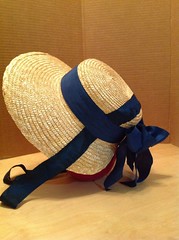
A few weeks ago, I found the modern, not-as-fine bonnet based on the KCI bonnet, and similar to one sold by Meg Andrews.

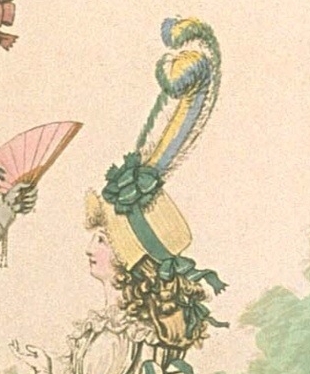
In a 1794 fashion plate, there is a similar bonnet with blue ribbons and an enormous feather. I don’t rate a feather as John Brown’s maid, or the Continental Army veteran’s wife, but blue ribbons seemed OK. Plus, I had them already.

The bows and the band and the strap don’t match, and my dress isn’t blue, but I think that’s all fine. The most I can say is that I’ve found two extant examples of this bonnet, and the fashion plate, which predates the farm’s interpretive year.

As a striving resident of Providence, Rhode Island’s busy port city, I’d have access to more goods than a Greenville woman. Bristol (where the farm is located) was also a thriving port, and again, boats from Rhode Island are sailing around the world bringing back china, silks, teas, spices, shawls and other goods, as early as 1787.

Now, pass me a boilermaker, please, because I’ll need a drink when the mechanical contractor tells me what the boilermaker will charge for a new Library boiler.


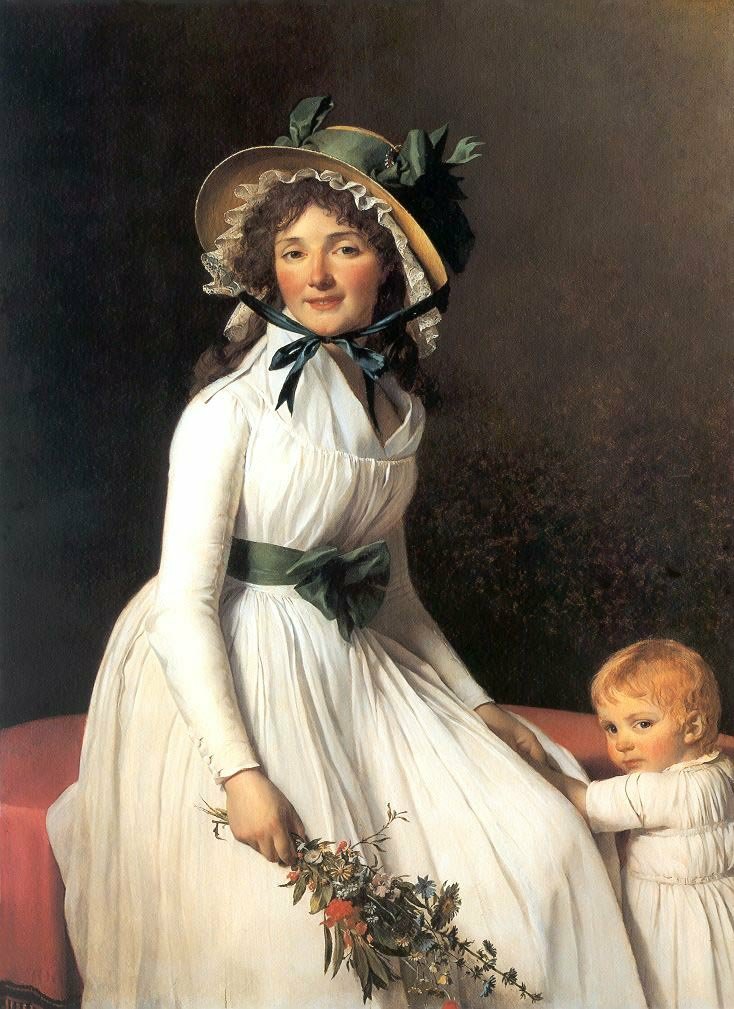
ETA: Aaand there’s this painting, Mme Seriziat, by David, 1795. Click for larger version, but she’s the reasoning behind the choice of blue ribbon.  The placement seemed to agree with the KCI and fashion plate ribbons, and joy! the color was in my ribbon box. I tried to get my ribbon to do what her ribbon is doing, but the bows and loops looked like sad blue silk dog ears– not so nice. So I switched them around to the back, based on the other images.


Share this:

  • Share on Facebook (Opens in new window) Facebook
  • Share on Pinterest (Opens in new window) Pinterest
  • Email a link to a friend (Opens in new window) Email
  • Share on X (Opens in new window) X
Like Loading...

Bonnet, found

25 Saturday Aug 2012

Posted by kittycalash in Clothing, Making Things, Reenacting

≈ 1 Comment

Tags

bonnets, Clothing, Costume, hats, Making Things

Readers may recall that I have a bonnet problem. It’s a problem I think can only be solved by more bonnets!

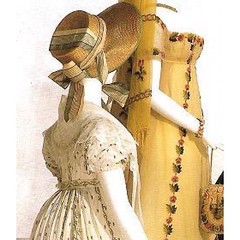
I’ve long admired and coveted the bonnet shown left in the Kyoto Costume Institute.

Well, see this bonnet? It’s called an 1812 Sun Bonnet over at HistoryHats.com. It is based on the KCI bonnet.

It is also similar to this ca. 1810 bonnet sold by Meg Andrews.

I’ll be spending time out in the sun in September, dressed for 1799. Black silk bonnet, yes, but, it could be hot and not so shady. Big plate of a straw hat? I guess so, but it’s a little too big for 1799. Straw bonnet? I wish….

But wait! Trapped on Amtrak, scrolling through Dames a la Mode,  what do I find? This! Check out that bonnet on the woman seated at right.

(Click through for larger version.) Similar cut out at the back of the neck to both the 1812 sunbonnet and the KCI bonnet. Interestingly, the woman in the straw ‘sun bonnet’ is wearing a dress with sleeves like those found on a chemise a la reine. She can’t be less fashionable than her companions, can she? How can that be in a fashion plate? I think this speaks to the persistence of fashion details longer than we might otherwise credit them. It only makes documentation trickier– or more fun, depending on who you are.

It’s 1794. By 1799, that bonnet might very well have made its way to Providence. We know girls and women were dismayed by the Jeffersonian embargoes, and driven to make their own straw hats in Providence. That means they had them, they’d seen them, and they’d seen fashion plates before the 1807 embargo.

Yes, I need a broadside or a newspaper ad to clinch the deal, but there’s an extant hat, a fashion plate in English, and I know by the early 1800s women are weaving straw for hats in Providence.

I think I might be able to have that hat after all…but I still have to finish that shirt I started for Mr. S. It simply will not sew itself!

Share this:

  • Share on Facebook (Opens in new window) Facebook
  • Share on Pinterest (Opens in new window) Pinterest
  • Email a link to a friend (Opens in new window) Email
  • Share on X (Opens in new window) X
Like Loading...

Quilting Plots

16 Thursday Aug 2012

Posted by kittycalash in Clothing, Making Things, Reenacting

≈ 2 Comments

Tags

Clothing, common dress, Costume, Making Things, petticoat

I’ve been planning and plotting a quilted petticoat for some time (since standing outdoors all day at Fort Lee in November, actually) and while the debate continues on the listserve, I know what was worn—and survived—in Rhode Island. There are quilted calamancoes and I think a black satin quilt that are run off with, either on the body or in the arms of the fleeing servant. So there were clearly wool and silk petticoats in the colony, and that fits with what I know lives in textile boxes in museum storage, where there are glazed wool domestic petticoats, blue silk satins from France, and a black silk satin with a murkier origin.

My favorites are really the woolen ones, scratchy as they are, and for some, it is replacement waists, or the linings, that are scratchy, and with multiple layers between wearer and wool, what would it have mattered? I love them best because they are in the color family that includes the “Providence Green” color that lies somewhere between gold/khaki and sinus infection, and I love them for their imagery.

The one I think I like best is this calamanco petticoat: 

The catalog decription says cream, but I don’t know, it really looks gold. The lining is definitely lighter in color, and the thread much clearer to see. What’s interesting as well is that many of the linings are pieced (it didn’t matter!) and they’re striped. 

I bought some of the last of the cinnamon “camblet” from Burney and Trowbridge last year, and did a fast quilting test on a sample.  I chose a squirrel because they’re in the wallpaper and the woodwork at work, and because they are hilarious. I keep thinking I’ve seen one in a quilted petticoat, but I can’t find it again. They are not the easiest objects to handle, either, so finding the rodent again has proved challenging. When I do quilt up squirrels and birds, it will be with a diaper background, not the vertical lines shown here. Overall, the silk-wool blend with wool batting and linen backing quilted up nicely, and should work out fairly well….I think…though it will be lighter than the ones in the boxes.

Now that I’ve got two days to spend down in Bristol, making a quilting frame and quilting up a petticoat (which would look like a quilt, and not a petticoat, on a frame, os could pass for a 1799 activity) seems like a winning proposition. All I have to do is find an appropriate pattern for a portable frame for Mr S to make. If I finish that shirt for him, he might look more favorably on that activity.

Share this:

  • Share on Facebook (Opens in new window) Facebook
  • Share on Pinterest (Opens in new window) Pinterest
  • Email a link to a friend (Opens in new window) Email
  • Share on X (Opens in new window) X
Like Loading...
← Older posts
Newer posts →

Archives

wordpress statistics

Creative Commons License
Kitty Calash blog by Kirsten Hammerstrom is licensed under a Creative Commons Attribution-NonCommercial-ShareAlike 4.0 International License.

Website Built with WordPress.com.

  • Subscribe Subscribed
    • Kitty Calash
    • Join 621 other subscribers
    • Already have a WordPress.com account? Log in now.
    • Kitty Calash
    • Subscribe Subscribed
    • Sign up
    • Log in
    • Report this content
    • View site in Reader
    • Manage subscriptions
    • Collapse this bar
%d