• Home
  • Completed Costumes/Impressions
  • Emma and Her Dresses
  • Free Patterns and Instructions

Kitty Calash

~ Confessions of a Known Bonnet-Wearer

Kitty Calash

Tag Archives: fabric

Book Notice: Wearable Prints, 1760-1860

29 Wednesday Jan 2014

Posted by kittycalash in Book Review, History, Living History, Research

≈ 7 Comments

Tags

books, fabric, fashion, history, prints, Research, resources, style

This just in, literally, from the mail carrier: Susan W. Greene’s long-awaited book, Wearable Prints, 1760-1860. It’s discounted (and out of stock) at Amazon, but should be shipping soon, since I have one right here on my desk.

It’s fair to call this book lavishly illustrated (1600 full-color images in almost 600 pages), and while I have access to a copy at work, I am seriously thinking of buying my own copy, based solely on about 10 minutes skimming the book. There are images not just of fabric samples but also of garments, paper dolls and illustrations that help put the fabrics into context. Images of garments from collections I can’t get into? Delicious! Information to help me understand how to use a printed cotton? Even better.

The book is organized in three main sections: Overview, Colors, and Mechanics. Appendices include timelines, prohibitions, price comparisons, print characteristics, and more, as well as a glossary and an extensive bibliography.

The photographs are amazing, and show a range of print designs of greater variety than we may have credited heretofore. Particularly useful is the section on evaluating and identifying printed dress fabrics, and the questions one should ask about fabrics. I think that the criteria could be used forensically on modern as well as historic textiles, and we could think more critically about the fabrics we use.

ETA: I wrote this while the downstairs room was being painted with oil paint, and it’s loopier than I expected. The book is still an excellent resource, and I highly recommend it. While it’s heavy for carrying to the fabric shops, it would be dead useful while shopping online. I have definitely seen bolts of fabrics very similar to those illustrated in Greene’s book. As Anna notes on her blog, Ms Greene’s collection is now at Genessee Country Village.  Wow. It’s amazing. If you can’t get there easily, well, the book will certainly help, and the images will you visual access to a plethora of collections. 

Share this:

  • Click to share on Facebook (Opens in new window) Facebook
  • Click to share on Pinterest (Opens in new window) Pinterest
  • Click to email a link to a friend (Opens in new window) Email
  • Click to share on X (Opens in new window) X
Like Loading...

…For the Approaching Summer

19 Friday Jul 2013

Posted by kittycalash in Clothing, Research

≈ 1 Comment

Tags

18th century clothes, authenticity, common dress, Costume, fabric, fashion, living history, Reenacting, The Public, weather

Summer is, of course, fully upon us and those of us on the eastern seaboard feel its oppressive and sticky heat. Ordinarily, my town isn’t terribly hot and cools off at night, but like everywhere else, this is not the case. Last weekend, I wore wool; technically a wool and cotton blend, but more problematically, burgundy in color. This is the price of gowns inspired by London watercolors.

Summer

This leads to constant questions: Aren’t you hot in those clothes? Aren’t you dying of the heat?

There is an underlying tone that suggests that perhaps the people of the 18th century didn’t know enough not to wear wool, or perhaps they only had winter clothes. I’ve heard “well, they didn’t know any better,” as if they never took their clothes off, and if only they had, 18th century men and women would have promptly abandoned their stays, gowns, waistcoats and breeches for tank tops, shorts, and wife beaters. Of course, history is not a Fiat commercial.

Well, what did “they” do?

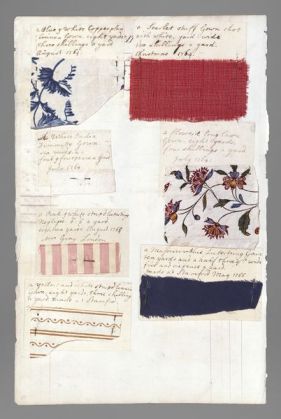
Barbara Johnson's book, 1764.

Barbara Johnson’s book, 1764.

They took their trade to James Green and merchants like him who offered “Piece Goods of every kind … suitable for all Seasons, but more particularly for the approaching Summer.” (Boston Post Boy, August 8, 1763.)

And what would be suitable? Cottons, fine linens, light silks, in light colors.

Barbara Johnson chose floral prints on white backgrounds in July and August of 1764, both could be “suitable for summer.”

And as you probably know, the answer to “Aren’t you hot?” depends on who you are, but is often, “Not really. Once my shift/shirt is soaked with sweat, I’m pretty comfortable.” This is true as long as your shift/shirt is made of linen; cotton and cotton/linen blends don’t wick as well as linen.

Share this:

  • Click to share on Facebook (Opens in new window) Facebook
  • Click to share on Pinterest (Opens in new window) Pinterest
  • Click to email a link to a friend (Opens in new window) Email
  • Click to share on X (Opens in new window) X
Like Loading...

Chintz? Check!

10 Friday May 2013

Posted by kittycalash in 1763 Project, Clothing, History, Research

≈ 4 Comments

Tags

18th century, 18th century clothes, advertising, fabric, newspapers, Providence, Rhode Island

Les Fleur d' Inde

Les Fleur d’ Inde: delicious!

Because I am prey to a pretty print as much as the next princess costume blogger tenant farmer’s wife, I thought I should go  looking for evidence before I launch into any cotton sacques, and to justify the use of the print remnant I’m stitching up into a jacket. (Apologies in advance to my friend who bought enough for a gown, because you know we’ll wear them to the same event…)

Providence Gazette and Country Journal, March 16, 1765

Providence Gazette and Country Journal, March 16, 1765

American Historical Newspapers to the rescue, once again. Here’s an ad for Alexander Black and Archibald Stewart, from the Providence Gazette and Country Journal of March 16, 1765.  Chintz and calico: it’s here in Providence in 1765. I knew there were merchants selling calicoes and chintzes in Providence in 1768 (including Samuel Young, who printed his broadside in red).

Chintz and chip hatsThree years later, Joseph and Wm. Russell at the sign of the Golden Eagle are selling (lately imported from London and Bristol) “A neat and genteel assortment of dark ground calicoes and chintz.” This ad runs to four columns in the Providence Gazette and Country Journal, 1768, April 9. It’s a tantalizing list, and no, I did not miss those chip hats and bonnets!

forks!

Digression: I was attracted to this bit about forks as I recall being told by a historic house tour guide once that “forks were not in common use until the Civil War.” It’s an early house, maybe he meant the English Civil War, but I think forks were here to stay and be bought for a variety of prices long before the American Civil War. How else to explain those archaeological finds that show forks of some kind at Rev War forts and camp sites? /Digression. New digression: OMG, knitting needles! /New digression.

William Eliot

Back to chintz: Here, in 1771, is William Eliot, selling chintzes in Providence, and advertising in the Providence Gazette and Country Journal of June 1, 1771. He also has “flowered and sprigged lawn in aprons,” and Kenting and check handkerchiefs.  (Kenting was a fine linen fabric)

In the limited search I ran (1754-1783 newspapers), plenty of references to chintz appear in Providence alone (there were 166 hits, but the ads repeat). This completely unscientific approach in which I stopped looking in 1771*, has turned up 5 merchants, if you count the RIHS Library’s broadside for Samuel Young. Chintzes and calicoes were everywhere. Dark grounds were “genteel,” checks and spots and stripes are popular and common.

Paul Sandby, London Cries: Black Heart cherries... ca. 1759. YCBA,  B1975.3.206

Paul Sandby, London Cries: Black Heart cherries… ca. 1759. YCBA, B1975.3.206

I begin to see 18th century Providence, if not all of the Colonies, as a variegated, kaleidoscopic place of pattern and color. I think there was more than we realize, even if only in small amounts.

Look again at the cherry seller: her petticoat is yellow and blue, if not yellow, blue, and white striped,  her apron is blue, her stockings brown or faded reddish, her cap is affixed with a pink or red ribbon, and she wears a checked kerchief. She’s poor and sort of faded, but she’s colorful–more colorful, perhaps, than we have credited.

*I do have to head out to work, but I can search again.

Share this:

  • Click to share on Facebook (Opens in new window) Facebook
  • Click to share on Pinterest (Opens in new window) Pinterest
  • Click to email a link to a friend (Opens in new window) Email
  • Click to share on X (Opens in new window) X
Like Loading...

King of the Coats

29 Friday Mar 2013

Posted by kittycalash in Clothing, Living History, Museums

≈ 3 Comments

Tags

18th century clothes, Clothing, Costume, fabric, fashion, Making Things, menswear, sewing

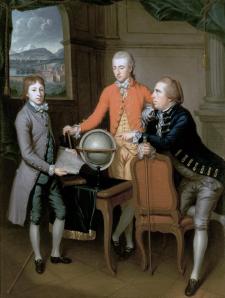
Douglas, 8th Duke of Hamilton on his Grand Tour, © National Museums Scotland A.1991.156

He’s hard to miss, the 8th Duke of Hamilton, in his red coat. I’d hazard it wool, because of the contrast with the sheen of the blue coat his physician, Dr John Moore (at right), is wearing. Dr Moore’s coat gleams like silk; the Duke’s looks dull and woolen. (Look at the way the light strikes the Dr’s shoulder; another clue is the way the button holes are worked.)

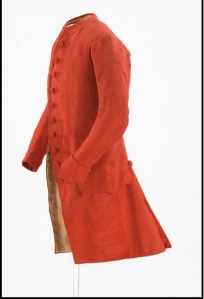
The coat below is a simpler, provincial relative of the Duke’s coat. This is the Amos King coat, owned by Colonial Williamsburg. I love the description:

“Wool plain weave fulled and napped “broadcloth”; twill worsted “shalloon” lining; tabby linen lining center back. Pocket flap lined with twill worsted; sleeves lined with tabby linen; right lower pocket is linen; left pocket is leather; inside pocket on left breast is linen, with broadcloth welt.”

Man's Coat, red broadcloth ca. 1770, CW 1953-59

Man’s Coat, red broadcloth
ca. 1770, CW 1953-59

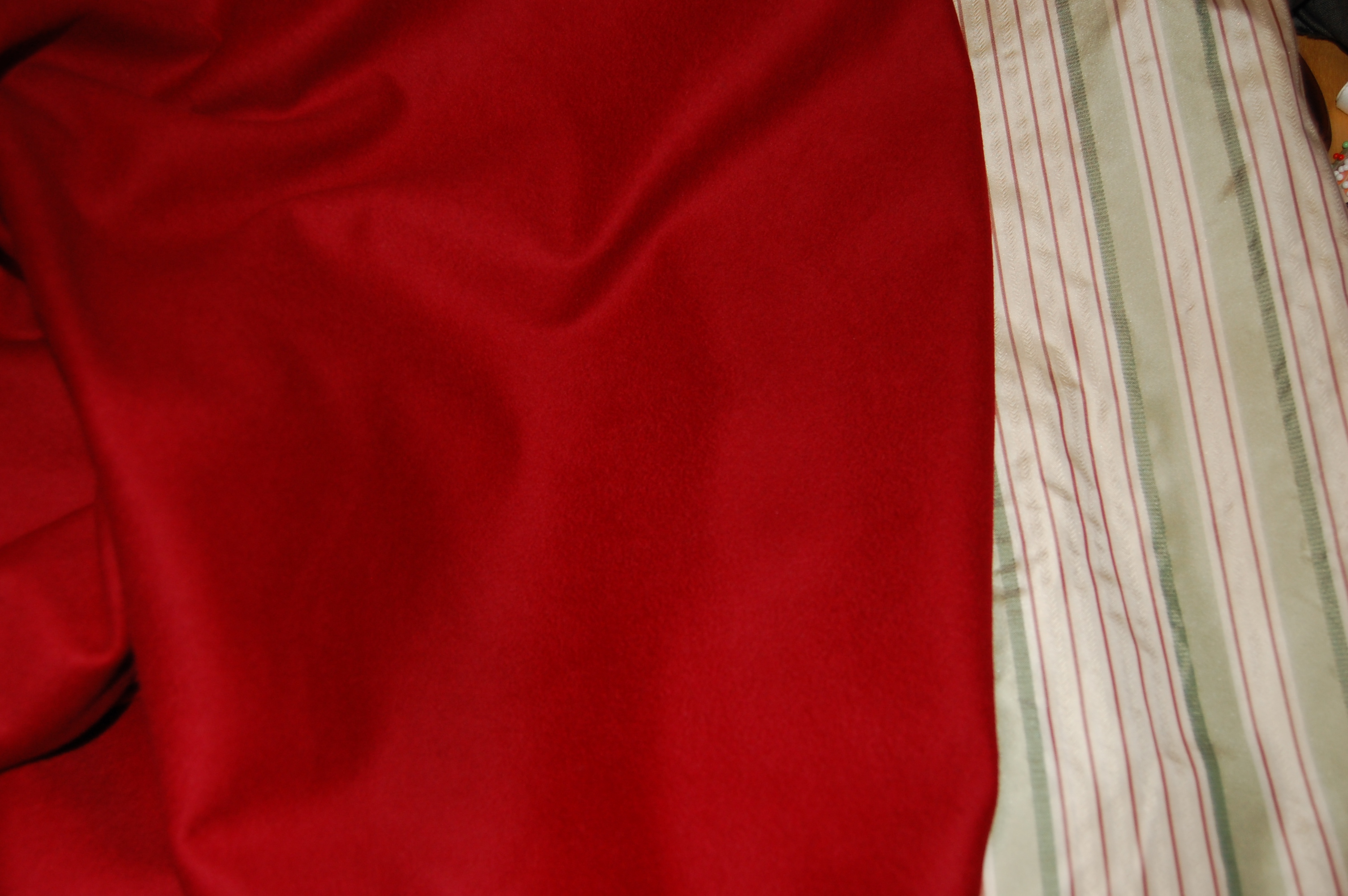
Shalloon. Tabby. Pocket leather. That paragraph is comprised of many of my favorite fabric and clothing words. And fabrics. And a leather pocket. As you may recall, I have a thing for fabric that is not at all about hoarding, and but rather about establishing reserves. When I see two yards of quality material at discount and purchase it, that yardage becomes part of the Strategic Fabric Reserve so vital to this nation’s safety. (We are all unsafe when a fabric addict is deprived of his or her fix. I’ve got a threaded needle, and I’m not afraid to use it!)

Part of this household's Strategic Fabric Reserve.

Part of this household’s Strategic Fabric Reserve.

Yardage arrived in the patriotic red, white and blue “if it fits, it ships” box on Wednesday, and when opened, we all proceeded to pet the lovely nap of the wool. Mr S wrapped himself in it, and I knew then that I would be making a red broadcloth coat of one kind or another.

It probably won’t be the “Quemans Pattern” coat John Buss mentions, not when I’ve got silk fabric for a waistcoat. The silk is from the remnant table at Artee Fabrics in Pawtucket. With careful cutting and a plain back for at least one waistcoat, there should be just enough to make both a 1770s and a 1790s waistcoat. We’ll get fancy around here eventually.

Share this:

  • Click to share on Facebook (Opens in new window) Facebook
  • Click to share on Pinterest (Opens in new window) Pinterest
  • Click to email a link to a friend (Opens in new window) Email
  • Click to share on X (Opens in new window) X
Like Loading...
Newer posts →

Archives

wordpress statistics

Creative Commons License
Kitty Calash blog by Kirsten Hammerstrom is licensed under a Creative Commons Attribution-NonCommercial-ShareAlike 4.0 International License.

Website Built with WordPress.com.

  • Subscribe Subscribed
    • Kitty Calash
    • Join 621 other subscribers
    • Already have a WordPress.com account? Log in now.
    • Kitty Calash
    • Subscribe Subscribed
    • Sign up
    • Log in
    • Report this content
    • View site in Reader
    • Manage subscriptions
    • Collapse this bar
 

Loading Comments...
 

    %d