• Home
  • Completed Costumes/Impressions
  • Emma and Her Dresses
  • Free Patterns and Instructions

Kitty Calash

~ Confessions of a Known Bonnet-Wearer

Kitty Calash

Tag Archives: Federal style

Au courant? Un canezou

02 Wednesday Aug 2017

Posted by kittycalash in Clothing, Living History, Research

≈ 5 Comments

Tags

19th century, 19th century clothing, CoBloWriMo, fashion, fashion plates, Federal style, living history, Salem Maritime Festival

Collier de Lapis. Canezou a Manche[?]

This.

Because, August (or Aôut). The Salem Maritime Festival is nearly upon us, so there’s a flurry of bonnet and accessory and other making happening chez Calash as there usually is in summer. It’s one of my favorite things to do, and this year I was asked if the millinery setup could be more of a demonstration.

That’s a kind of relief, actually, as it allows me to bring bonnets from multiple years in a variety of levels of completion, which allows me the luxury of talking about evolving styles and a variety of construction methods. Whether or not I’ll manage a drawn bonnet is still up in the air; it’s a lot of hand sewing for someone with carpal tunnel.*

Because any trip to Salem affords me the opportunity to join the mercantile class, I like to take the opportunity to make something new and non-working class when I go up there. This year, I was taken with the canezou. What’s a milliner to do, but stay as up-to-date as possible? What the heck is a canezou?
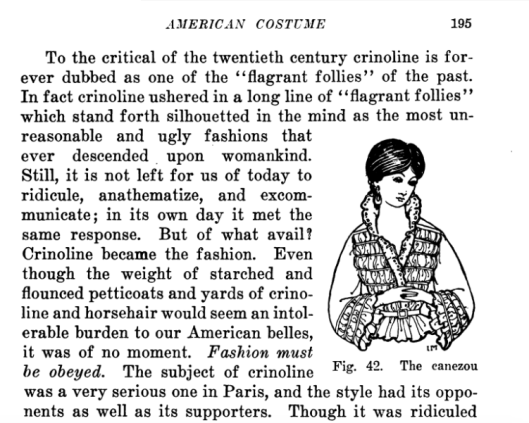
Well….roughly, from the French and English costume history books, the canezou is a short, Spencer-like garment, often in white, lightweight cotton, worn over another garment. The canezou seen here clearly has sleeves, and the plate is dated 1811, giving the lie to the wikipedia’s assertion that it’s circa 1835. (The later evolutions have become more scarf or fichu-like, but are again worn over other gowns- though apparently it enjoys a brief time as the cambric blouse worn with a riding habit. And then there’s another definition, by another fashion historian, in which the canezou is described as being like a man’s shirt.

Well, that’s all cleared up then….

With this information in hand, and the fashion plate before me, I perused the contents of the Strategic Fabric Reserve, and lit upon those popular Ikea curtains which have appeared here before as a gown and as a petticoat and now as a canezou.

I modified a Spencer pattern for the base lining of white cotton, and then draped, stroke gathered, and stitched the curtain fabric to form the floofy bodice. The lace on the cap sleeves is reclaimed from a late 19th century negligee lurking in Drunk Tailor’s collection of usable old fabrics, while the lace at the bottom was reclaimed from an antique petticoat before I picked it up in Sturbridge, MA a few years ago.

To complete this, a bodiced petticoat with an embroidered hem (machine embroidered, of fabric I may have picked up from a remnant table in Pawtucket, RI), a pair of trimmed shoes, a necklace (here of sapphire blue stones, unless I can teach myself hand-knotting by Friday), and a bonnet of blue and white check silk that arrived just in time from India. Five new items in two or three weeks: the price of fashion is slightly mad.

*Hand-sewing everything has, at last, caught up with me. I find soaking my hands in cold water helpful, as well as sleeping in those super attractive hand braces. Imma need some surgery, but for now, braces, Aspercreme, and ice water must do.

Share this:

  • Share on Facebook (Opens in new window) Facebook
  • Share on Pinterest (Opens in new window) Pinterest
  • Email a link to a friend (Opens in new window) Email
  • Share on X (Opens in new window) X
Like Loading...

Flipping a Lid

12 Wednesday Jul 2017

Posted by kittycalash in Clothing, Living History, Making Things

≈ Comments Off on Flipping a Lid

Tags

1812, bonnets, fashion plate, Federal style, hats, Metropolitan Museum of Art, millinery, millinery shop, museum collections, reproduction

In a continuing effort to simultaneously destroy my hands and make all the bonnets, I set out recently to recreate a bonnet in the Met’s collection.

Silk Bonnet, British, ca. 1815. Brooklyn Museum Costume Collection at The Metropolitan Museum of Art, Gift of the Brooklyn Museum, 2009; Designated Purchase Fund, 1983 2009.300.1613

It’s a curious thing, isn’t it, with that flipped-up brim? It looks more 1915 than 1815. But a little looking turned up this fashion plate:

Items 2 and 6, while not of silk, show the turned-up brim seen in this example. (To be fair, the original black and white photo suggests some confusion about the bonnet’s orientation.)

My version is admittedly imperfect, but a home-made interpretation that gets as close as I can (for now). I started with a lightweight buckram frame, to which I stitched slim round caning.

The brim is covered in two layers of the copper silk, and edged on the bottom side with the contrasting silk trim. the crown, or caul, is a simple tube gathered to a silk-covered buckram circle. In the absence of matching (or even sort-of-close) ribbon, my choices are to trim what’s left of the fabric and piece it together…. or start an online-ribbon hunt. At least the extant example has ribbon that’s close but not a match, giving me some leeway if I decide to save my hands for other projects and click instead of stitch.

Share this:

  • Share on Facebook (Opens in new window) Facebook
  • Share on Pinterest (Opens in new window) Pinterest
  • Email a link to a friend (Opens in new window) Email
  • Share on X (Opens in new window) X
Like Loading...

Cross my Heart

25 Tuesday Apr 2017

Posted by kittycalash in Clothing, History, Making Things

≈ Comments Off on Cross my Heart

Tags

19th century clothing, authenticity, Costume, fashion, Federal style, interpretation, patterns, sewing

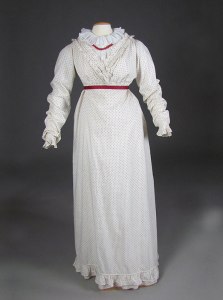
http://agreeabletyrant.dar.org/gallery/1810s/polka-dot-printed-dress/
Dress, cotton, United States, private collection; reproduction chemisette, private collection; coral necklace courtesy of Dames à la Mode.
IMG_9667

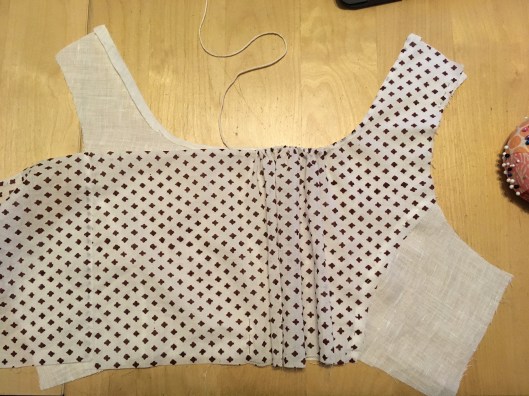
The goal is on the left. How far have I made it? Well… I have been busy. We started on the right, remember?

In executing the final plan, I did choose to cut a lining to support the lightweight fashion fabric; I didn’t think it would look, drape, or wear well without a lining.

The adaptation is truly that, and not a copy, in this instance. The lining means that the finished piece will have more of the appearance of a drawstring fitting than an actual drawstring across the back.

The sleeves, thankfully, were pretty straightforward, and I’m one of those odd people who really enjoys cutting and setting sleeves, so there you are. It took me about six days to get to this point, and then work came to a halt. I have other centuries I’m playing in, and am determined to finish that yellow dress to wear this weekend. When and where else can I look like a person of means than the Fort Frederick Market Fair?

Share this:

  • Share on Facebook (Opens in new window) Facebook
  • Share on Pinterest (Opens in new window) Pinterest
  • Email a link to a friend (Opens in new window) Email
  • Share on X (Opens in new window) X
Like Loading...

True Confessions of the Frivolously Fashion Obsessed

19 Wednesday Apr 2017

Posted by kittycalash in Clothing, History, Making Things

≈ 3 Comments

Tags

19th century, 19th century clothing, Clothing, fashion, Federal style, morning dress, museum collections, patterns, sewing

Skeptical cat is skeptical

I promised you something, didn’t I, the last time I wrote?

Well, set your skepticism aside for the cat, because here’s the scoop on the messy process of getting from page to pattern to garment.

I started with the pattern from the book, which furrowed my brow a few times until I became accustomed to the style. Everyone drafts and scales patterns a little differently; it’s like getting used to local idioms. (It’s a bubbla, here, not a water fountain and not a drinking fountain. Go figure.)

But I digress. It seemed pretty simple, especially since I have some experience scaling things up, both from Sharon Burston on taking a pattern from an original garment (plot your points like an archaeologist) and from architecture school (redraw Le Corbusier’s maison from these two tiny drawings, draft an axonometric, and make a model). With Corbu behind me, you’d think this would be a piece o’ cake.

Delightfully, you would be wrong. Creative swearing, brow furrowing, and endless distractions (yes, some 28mm 17th century soldiers will be wearing Timberlands) provided the usual soundtrack and experience. Challenging, not easy, which means I hope I might actually have learned something.

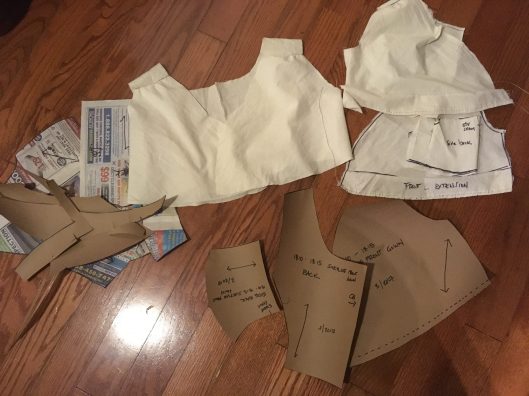
Kind of a mess, right? Here’s what I did: I scaled up the pattern in the book once I’d figured out that the measurements were, incredibly, just about what I make my Federal-era dress pieces. I used the newsprint ads that come in the mail because they are abundant and free. That’s more challenging than gridded or plain paper, but free is free. With a ruler and a pencil, you can make your own grid.

After the paper patterns were drafted, I checked them against the drawings in the book, and made free hand corrections. I’ve learned that my eye is sometimes better than my math whether I am hanging paintings or making patterns.

From the tweaked newsprint pieces, I cut muslins to stitch up and try on over my stays. You MUST fit over the proper undergarments, or the exercise is pointless. These resulted in some additional tweaks and alterations accomplished at first with pins, a Sharpie, and Drunk Tailor’s patient assistance.

What then? Another round with some adjusted pieces to yield another muslin. It’s from that final fitting muslin that I transfer changes to the newsprint and then, finally, to craft paper. I was ably assisted once again by the Most Dangerous Cat in the World.

That’s what you’re left with: scraps, a muslin that’s true, and the pieces to make it. But have I made real progress on real fabric? Of course! But that’s another post.

Share this:

  • Share on Facebook (Opens in new window) Facebook
  • Share on Pinterest (Opens in new window) Pinterest
  • Email a link to a friend (Opens in new window) Email
  • Share on X (Opens in new window) X
Like Loading...

To Breakfast In

13 Thursday Apr 2017

Posted by kittycalash in Clothing, Living History, Making Things

≈ 2 Comments

Tags

19th century, 19th century clothing, authenticity, Clothing, Costume, dress, fashion, Federal style, museum collections, sewing

http://agreeabletyrant.dar.org/gallery/1810s/polka-dot-printed-dress/

Dress, cotton, United States, private collection; reproduction chemisette, private collection; coral necklace courtesy of Dames à la Mode.

I get ideas. And like a cat I once knew, once I have an idea, it’s hard to shake. Luckily for me, my judgement is better than the cat’s– he had a tendency to pounce without regard to results, and scars do show on furry white noses. But in this case, at least, there are no scars, just some pricked fingers.

Like so many of us early-Federal era obsessives, I fell in love with An Agreeable Tyrant, and demanded the book for Christmas. It’s not just the essays or images, it’s the patterns. Scaled patterns take at least some of the guess work out of recreating historic costumes, but not all of it. And never for me– if there’s something to mess up or guess wrong, I am right on top of it– which is to say, I learn to adapt my errors and adjust my methods to fit my materials.

Surplice-front gowns have teased and delighted me for years: My first foray was with the silk “Quaker” gown of three (!) years ago, a gown I based on digging into Quaker portraits and Nancy Bradford’s Costume in Detail. It worked well enough then– not brilliantly, but close enough for my purposes. But then the polka dot dream appears, and of course, I need one to fulfill my dream of living Persuasion and having a morning dress to breakfast in. Beats the heck out of what I eat breakfast in now, and perhaps the company would improve as well. (I’m looking at you,cats.)

Dolly Eyland, by Alexander Keith, 1808. (c) The New Art Gallery Walsall; Supplied by The Public Catalogue Foundation
Courtesy Newport Historical Society

Well, so, what to do? Attempt my own, of course, since I found some fabric that seemed plausible enough and matched the color my dried blood. It’s a sheer block print cotton from India, more sheer than the original fabric, but capturing the feel well enough– and better, I suspect, than the stiff quilting cottons one is likely to find with polka dot prints. Construction and patterning fun next time on “True Confessions of the Frivolously Fashion Obsessed.”

Share this:

  • Share on Facebook (Opens in new window) Facebook
  • Share on Pinterest (Opens in new window) Pinterest
  • Email a link to a friend (Opens in new window) Email
  • Share on X (Opens in new window) X
Like Loading...
← Older posts
Newer posts →

Archives

wordpress statistics

Creative Commons License
Kitty Calash blog by Kirsten Hammerstrom is licensed under a Creative Commons Attribution-NonCommercial-ShareAlike 4.0 International License.

Website Built with WordPress.com.

  • Subscribe Subscribed
    • Kitty Calash
    • Join 621 other subscribers
    • Already have a WordPress.com account? Log in now.
    • Kitty Calash
    • Subscribe Subscribed
    • Sign up
    • Log in
    • Report this content
    • View site in Reader
    • Manage subscriptions
    • Collapse this bar
 

Loading Comments...
 

    %d