• Home
  • Completed Costumes/Impressions
  • Emma and Her Dresses
  • Free Patterns and Instructions

Kitty Calash

~ Confessions of a Known Bonnet-Wearer

Kitty Calash

Tag Archives: history

Consider the Chicken

04 Tuesday Dec 2012

Posted by kittycalash in Food, Living History

≈ 6 Comments

Tags

cooking, david foster wallace, food, history, living history, Museums, recipe, weekend, work
https://i0.wp.com/farm9.staticflickr.com/8311/7995409969_f925f8a7eb_n.jpg

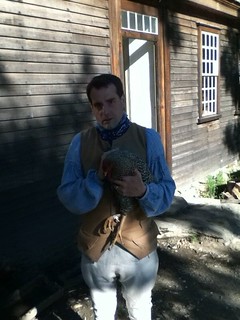
Nobody puts Dumber in a pot

With apologies to the late David Foster Wallace

The majority of us do not consider the chicken. We may consider whether the package of chicken we purchase is free range, organic, cage-free, grain fed, cruelty free. But we are unlikely to think about the implications for the physical being, the essence of chicken-ness, that the chicken’s conditions create for it.

And I am here to tell you that the cage-free, organic, free-range chickens and chicken parts that you purchase at Whole Foods or your other large vendors bear little to no relationship to the actual free-range, catch-as-catch can, ne’er-do-well chicken of the historic barn yard. For one thing, living history chicken is ripped.

https://i0.wp.com/farm9.staticflickr.com/8205/8243387583_072e352ff9_n.jpgIt’s well-developed physically, with strong, sturdy bones and robust ligaments. Its musculature is tight: this is not a bird in need of a personal trainer. Its meat, when cooked, is not white. It is dark meat, not so dark meat, and sort-of white meat. Its taste was described to me as gamey, but I disagree. It was chicken, but earthy, sweet and fresh and rich.

But all that came after the meeting of human, knife, and chicken.

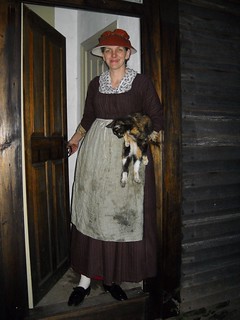
Disassembling the chicken fell to me; I declined rubbing butter into flour having prevented a fall down cellar stairs by putting my hand in fresh goose guano, so I after I washed my hands, I addressed the chicken in its bowl, and took up a knife.
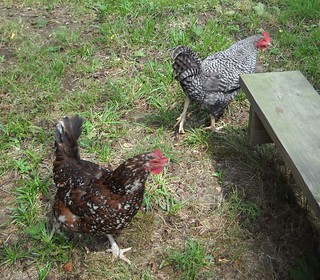
Dumber & Friend

By this time, post-carrots, -parsnips, -squash, -string, -tallow and -suet, the knife lacked the purest essence of knife, that is, sharpness. But it functioned well enough for the task, with some persuasion. The skin was much thicker and more resilient than a store-bought chicken, and greasier, though not in an unpleasant way at first. The muscles were well-developed, and pink. Rosy pink, deep pink, dark like wine. There were no large slabs of the shiny, flaccid, pale meat you find on the chickens in the store. Those aren’t chickens any more: those are products.

The process of quartering the chicken took strength and pressure on the knife, and the strength of my hands. I did have to rip joints apart, and break the carcass’s back. All of this had a sound, and a mild smell of chicken, mixed with the melting tallow. But it was the sound that, with the greasy, slick knife, and the grease that soon covered my hands and wrists, that kept bringing me back to what I was doing, and that, when the bird was broken apart and in the pot and my hands washed, again (they itched), send me outside and up the hill for air and sky.

We boiled the chicken in a kettle we’d already boiled crook neck squash in; later, we added sage, thyme, parsnips and carrots. It was delicious. The broth was incredible, and the whole meal very simple. That’s the whole of the recipe: boil a chicken, add herbs and root or fall vegetables, boil until done, serve. Use any uneaten broth and bones/meat for  stew, pie or other dishes. That’s it.

The product chickens from the market are bred to fall apart. They haven’t got what a running, pecking, eating everything chicken’s got in muscle, ligament, and tendon.

On Sunday, after we came home, I looked at the food in our cupboards. There were boxes, cardboard, plastic, layers of packaging. The cheese was square. These things came from the good market, but were they food, or were they products? I felt like a passenger on the ship in Wall*E, and I was appalled.

Share this:

  • Share on Facebook (Opens in new window) Facebook
  • Share on Pinterest (Opens in new window) Pinterest
  • Email a link to a friend (Opens in new window) Email
  • Share on X (Opens in new window) X
Like Loading...

Working Weekend

03 Monday Dec 2012

Posted by kittycalash in Living History

≈ 1 Comment

Tags

Events, history, living history, Museums, work

https://i0.wp.com/farm9.staticflickr.com/8482/8239978492_81e339d5fe_n.jpgThis is the house at the farm museum where we went to work on Sunday. That bright orange under the window is squash. The part painted red is an office addition and not interpreted space.

This is the view from the site.https://i0.wp.com/farm9.staticflickr.com/8062/8238909459_f9165ff136_n.jpg It is not exactly what the tenant farmers would have seen, even discounting the power lines and road surface.   But even with the caveats of constant change in mind, I do not have access to a better lab for understanding the past. There are times when even the smart and sophisticated among us cannot come up with a better (just between us) interpretation than, “1799 sucked. And it was greasy.”

https://i0.wp.com/farm9.staticflickr.com/8210/8238912881_454a7e8b67_n.jpgThat’s not what we want the visitor to learn (everything in the past was hard) though sometimes I fear that is all they take away. Callie, seen here swearing in my hand, was trying to take away leftover chicken and so was taken away herself.

The more time I spend stooping to reach a vat of tallow, or tearing a chicken carcass apart with my hands and a dull, greasy knife, the more I think that what we fail to grasp is not that people thought differently in the past. It’s why they thought differently.

Lives could be a great deal smaller: tasks were hard and all-consuming. Even as I realized that work would be faster with greater familiarity, I also saw that repetition would not breed enlightenment, because increased speed would only make the next task come more quickly.

Share this:

  • Share on Facebook (Opens in new window) Facebook
  • Share on Pinterest (Opens in new window) Pinterest
  • Email a link to a friend (Opens in new window) Email
  • Share on X (Opens in new window) X
Like Loading...

The Line of Beauty

29 Thursday Nov 2012

Posted by kittycalash in Clothing, History

≈ 4 Comments

Tags

Clothing, Costume, dress, history, menswear

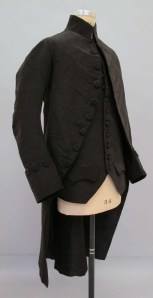
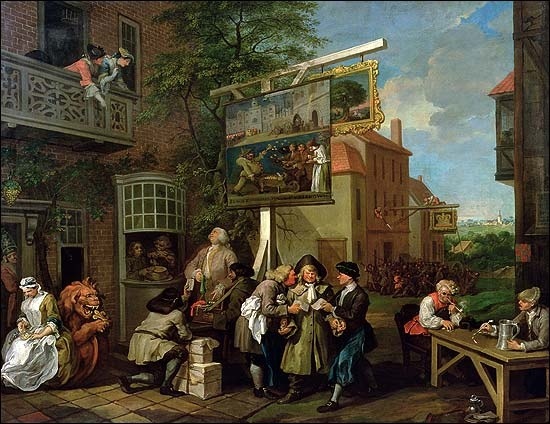
In considering menswear, I found this suit at the Met. Incredibly plain, it reminds me of classic Balenciaga: all about fabric and drape. It also reminded me of Hogarth’s Analysis of Beauty, and the serpentine line.

You could also call it the Ogee curve, and it’s found in the serpentine legs of 18th century tables, and does not come from, “Oh gee, that soldier’s got nice legs.”

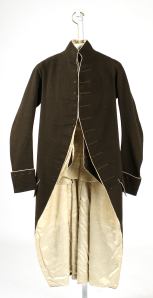
In this variation on the theme, the contrasting lining emphasizes the lapel line, but the overall effect is less elegant. It’s about materials, too, not just cut. There’s so much to learn just by looking, really looking, at clothes and paintings from the past. There are subtleties we miss as we rush past, and miss because we haven’t read enough to understand what we’re being told.

So much hides in plain sight, because we don’t see the world the way the tailors and painters and engravers saw it. I don’t pretend to have the key to that world, but it’s worth looking for, mostly just by looking.

Share this:

  • Share on Facebook (Opens in new window) Facebook
  • Share on Pinterest (Opens in new window) Pinterest
  • Email a link to a friend (Opens in new window) Email
  • Share on X (Opens in new window) X
Like Loading...

Veterans and Votes

28 Wednesday Nov 2012

Posted by kittycalash in History, Reenacting

≈ Comments Off on Veterans and Votes

Tags

history, Revolutionary War, Rhode Island

20121127-080442.jpg
On Wednesday last, I met with two fantastic colleagues, one from my own house, and the other from the local living history farm/museum. We went over topics and themes and ideas about history, and we tried to stay focused…but it was hard, because really, all three of us think the 18th century is hot stuff, and the thing we most want to share with the rest of the world.

At one point, our farm based colleague reminded us that his people (tenant farmers) would not have been able to vote. And I realized, as the conversation quickly hopped to the westward migration of Rhode Islanders–some to take occupation and ownership of Western Reserve lands given as bounty for Revolutionary War service–that there were plenty of men who served in the Continental Army who, at war’s end could not vote.

Let that one sink in for a moment: in Rhode Island, only property owners could vote. A man who served with the Rhode Island Regiments who did not own property fought, in some cases for eight years, but at war’s end, could not vote. They could not participate in the democracy they might have sacrificed not only time and profit but their own bodies to achieve.

One man, one vote was not the law in Rhode Island until after the Dorr Rebellion of 1841, when white male property owners AND men who could pay a $1 poll tax were granted suffrage.

Universal suffrage rights aside, what did voting mean to the men who fought in the Revolutionary War? How did the people of the late 18th century understand their rights, and they role in democracy? It was far different from what we take for granted in America now, which is different from how democracy was understood just 100 years ago.

Again, we could delve into how Senators were formerly not chosen by popular vote or argue about the electoral college, but what I wonder now, as I ponder the men who portray Rev War units, is to what degree those men understand how very different the men of the past were from the men they are today. It is not just breeches and “Good Days” that make us different. The way we think– how we see the world and how we see ourselves– is fundamentally different.

Share this:

  • Share on Facebook (Opens in new window) Facebook
  • Share on Pinterest (Opens in new window) Pinterest
  • Email a link to a friend (Opens in new window) Email
  • Share on X (Opens in new window) X
Like Loading...

Warm in Bed

17 Saturday Nov 2012

Posted by kittycalash in History

≈ 5 Comments

Tags

daily life, history

20121117-044602.jpg Last night, I leaned back on the pillows and felt the cold seep through my shirt. Our house, at 62 or 64 degrees, is warmer than the 58 degrees Moses Brown recorded in the early 19th century and warmer than the mid-50s temperatures some people I know still keep. But I have layers I can wear, wool or wicking space-age materials, and will wear anything to bed to keep warm. What did people wear in the 18th century? How did they stay warm in bed?

One solution was the bed warmer, the long-handled brass pan filled with hot coals and swiped over the linen sheets of a bed just before the sleeper hopped in. This method required strength, speed and a steady hand, and worked best if someone other than the sleeper could do the swiping. Heat would dissipate quickly while a warming pan was stowed safely.

Another option was heated stones or bricks wrapped in fabric and tucked into the foot of the bed. That sounds good to me now, cold as my sheets can be. Jane Nylander writes in “Our Own Snug Fireside” that some people perceived warming the bed as a sign of weakness, and it is hard to document such a mundane act.

Truly quotidian details are hard to find in written primary sources: people in the past took their daily lives as much for granted as we take ours. How often do our diarists today record whether they wore socks to bed?

In the collection at work, we do have one woolen flannel shift from the early part of the 19th century. I suspect I will want to copy that for January.

Share this:

  • Share on Facebook (Opens in new window) Facebook
  • Share on Pinterest (Opens in new window) Pinterest
  • Email a link to a friend (Opens in new window) Email
  • Share on X (Opens in new window) X
Like Loading...
← Older posts
Newer posts →

Archives

wordpress statistics

Creative Commons License
Kitty Calash blog by Kirsten Hammerstrom is licensed under a Creative Commons Attribution-NonCommercial-ShareAlike 4.0 International License.

Website Built with WordPress.com.

  • Subscribe Subscribed
    • Kitty Calash
    • Join 621 other subscribers
    • Already have a WordPress.com account? Log in now.
    • Kitty Calash
    • Subscribe Subscribed
    • Sign up
    • Log in
    • Report this content
    • View site in Reader
    • Manage subscriptions
    • Collapse this bar
 

Loading Comments...
 

    %d