• Home
  • Completed Costumes/Impressions
  • Emma and Her Dresses
  • Free Patterns and Instructions

Kitty Calash

~ Confessions of a Known Bonnet-Wearer

Kitty Calash

Tag Archives: Making Things

Finishing Touches

30 Monday Jul 2012

Posted by kittycalash in Events, Making Things, Reenacting

≈ Comments Off on Finishing Touches

Tags

Events, Making Things, Reenacting, sewing, weekend

Sewing:

  1. Finish Overalls for Mr S
  2. Waistcoat for The Young Mr
  3. The Young Mr’s haversack– can finish in camp
  4. If there’s time: linen jacket for Mr S, off-hours.
  5. Bed gown or short gown for K
  6. Linen work bag

Things to Acquire:

  1. Cane rod, local source
  2. Blanket (wool with blue stripe, in Texas) or two
  3. Tent??
  4. Camp kettle
  5. Coffee pot?
  6. Tea pot (Jackware or brown-glazed redware)
  7. Canteen for K

Things to Modify:

  1. Paint knapsack
  2. Paint Ikea box
  3. Swap Ikea box screws for brass flat-head screws
  4. Marble paper or hand-paint wallpaper to cover sewing kit
  5. Hemp webbing for pack basket (Missouri source)

As you can see, I have a sewing problem. Right now, those overalls have become breeches, and I am at the knee band stage, just before 10 more button holes. I can manage those in a week, but I suspect that will be it. And a work bag, I can probably manage a work bag. Last year, I went to OSV with bleeding and punctured fingers. This year, I’d like to have fingertips I can do things with. Also, I need to sleep in order to do my job decently, so perhaps this list is more about learning my limitations than it is about things I really need to do.

Share this:

  • Share on Facebook (Opens in new window) Facebook
  • Share on Pinterest (Opens in new window) Pinterest
  • Email a link to a friend (Opens in new window) Email
  • Share on X (Opens in new window) X
Like Loading...

A Box in a (not quite) Day

27 Friday Jul 2012

Posted by kittycalash in Making Things, Reenacting

≈ Comments Off on A Box in a (not quite) Day

Tags

Making Things, Reenacting, resources, Revolutionary War

Since I made a new knapsack based on the example in the Fort Ticonderoga collection (see also Henry Cooke’s work, or The Packet III, page 28), I had paint. When you have paint, you want to put it on something. I put mine on a box.

Ikea had ‘Kartotek’ birch ply boxes one year, and the Young Mr was using some as treasure chests in his room, but now that he’s growing up a bit, he was willing to have one remodeled. The lines were pretty basic and the construction simple enough that I thought we could do a kind of recon on this box. (Recon is Library Lingo for “retrospective conversion.”)

First, I took it apart and sanded it. Don’t forget to cover work surfaces and expect to sweep/tack cloth up dust from both the box and everything around the box. Mr. S helped me out by drilling out the riveted handles, and re-drilling holes large enough to take the rope we had. It smells like hemp, but I have no idea where it came from–perhaps a Christmas tree excursion.

All good so far, sanded, drilled, and ready to take the paint. I thought one coat would be enough, since I had the red stain underneath, and wear and tear make things look better, so, fantastic! Time to put it together.

Hold on there, pilgrim. I looked at the screws. They were Phillips head, and not really brass. That’s not right! I’ve crawled under enough old tables to know that screws are flat, slot-head, and made of brass in this time period. With the rise of the screw gun/cordless drill, this kind of screw is no longer easy to find. They’re all Phillips at the big box hardware stores, and our little speciality store recently downsized and rearranged.

Was I really screwed? No, thanks to the interwebs. Slot-head brass screws are still used in marine applications, so I was able to order a bag from Amazon–the local chandlers seem to have given way to WestMarine, and they seemed only to have stainless steel screws.

The package came on Wednesday, I got out the screw driver, and after what totals up to a day’s work, we have a box for the Young Mr S to stash his stuff in when in camp. I expect the box to soon contain one book about dragons, several sticks and rocks, a tangle of fishing line, an empty candy wrapper, and an apple core. Also, homework that counts towards his grade.

Share this:

  • Share on Facebook (Opens in new window) Facebook
  • Share on Pinterest (Opens in new window) Pinterest
  • Email a link to a friend (Opens in new window) Email
  • Share on X (Opens in new window) X
Like Loading...

Put a Lid on It!

24 Tuesday Jul 2012

Posted by kittycalash in Clothing, Reenacting

≈ 3 Comments

Tags

bonnets, Clothing, common dress, Making Things, Reenacting, sewing, taffeta

Yes, I have a bonnet problem.

I don’t know how I find all the sites and blogs I find, but I came across another interesting one today while waiting for data to load: An American Seamstress, finishing a waistcoat and struggling with a bonnet.

Have I fought with bonnets! I love bonnets, and I come by this honestly: my grandmother had a shoes thing and a hat thing, and the hat thing came with “hat face,” a particularly foxy-grandma face she make when trying on hats. So while I thought I ought to write about tent research, or the cool ad I found for a shop in Newport selling dry goods and haberdashery, now I think the heck with all that. Bonnets!

Here’s what I’ve learned, and what I’ve used. (for all images, click for a larger version)

Buckram. What they sell at Jo-Ann’s is not what you want. It is too thin to be much use unless you glue it to chip board (today’s equivalent of paste board). For more on chip board, see Kannik’s Korner on bonnets. I buy mine at Utrecht because  they’re in town. Dick Blick has it, buy the single ply.

Better buckram. I ordered a kit from Timely Tresses just to get my hands on a proven pattern and real millinery supplies. They’re hard to find in real life, and ordering online when you can’t touch stuff is hard. I did find some very sturdy buckram locally at Ryco, a mill store selling quilting fabrics, and lots of other stuff.

Millinery wire. Accept no substitutes in wire. Just trust me. I have successfully used cane originally purchased for stays. I had left overs, it curves, it worked when stitched to buckram.

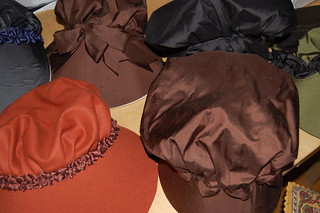
Silk. The difference between taffeta and dupioni is visible and tangible (dupioni left, taffeta right). Use taffeta. I don’t always, and I still like my dupioni bonnet but most of why it works is its size and the fact that my impression is middling-trending-lower. (And saucy. I sometimes think a raised eyebrow and a loud handkerchief can make up for a lot, especially crooked petticoat hems.) But the runaway ads include stuff (wool) and linen bonnets, so read them closely for ideas.

Make a muslin first: we all know, it applies here, too. For cauls, bigger is usually better for the 18th century. For some of the bonnets, I use the lighter weight buckram to sew an insert between the caul and the lining to keep the crown more erect and poufy. At the end of the day, you might deflate, but why should your fabulous bonnet?

Trim it up. I often use strips of self fabric folded over and looped to make “bows,” because that’s how the Williamsburg bonnet looks to me. I’ve also used ribbon, so this: use silk. Less silk is better than more poly, really really, it will handle and feel and look better, and so will you. I use Burnley & Trowbridge  and Wm Booth Draper silk ribbons, and bought some from a sutler who sold herbs and hand-dyed silk ribbon.

My next bonnet will be a black silk lined with red with the red-hand dyed silk ribbon trim, based on a runaway ad. Will it be done by OSV? Probably not, but once you have it down, a nice hand-sewn bonnet is about a day’s work.

Share this:

  • Share on Facebook (Opens in new window) Facebook
  • Share on Pinterest (Opens in new window) Pinterest
  • Email a link to a friend (Opens in new window) Email
  • Share on X (Opens in new window) X
Like Loading...

Fine Sewing

20 Friday Jul 2012

Posted by kittycalash in Clothing, Reenacting

≈ 10 Comments

Tags

18th century clothes, apron, Clothing, DressU, Making Things, sewing

20120720-211927.jpgI made the time today to finish something I’d started back in June at Dress U. I was fortunate enough to be in Sharon Burnston’s Fine Sewing class, and got started on an apron. Even before I started reenacting and sewing 18th century clothes for myself, I admired Sharon Burnston’s work and the fantastic Fitting and Proper, which I ordered for the library at work several years ago. Ms. Burnston is the living definition of a stitch counter or thread counter in the very best way, and here’s why: she counts threads, and that counts.

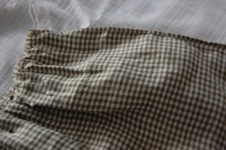
20120720-212029.jpgOne of the key points I learned was the relationship between the threads and the stitches– essentially 2 x 2 for this project. Using a traditional New England fabric makes it easy–with a linen check, you can just about “cut on dotted line” and know you’re set.

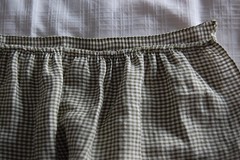
We started by hemming each side of the apron for a couple of inches, just to get started. Stitch two over, in little crosses. Then, at the top of the rectangle, we gathered. The gathers were the illuminating part: Stroke gathers. Using the check as a guide, we ran even gathering stitches twice along the top.

20120720-212120.jpg I used the every-other check pattern, so the gathers were small. Ms. Burnston suggested that the best way to think of stroke gathering was as proto-smocking, and to make an evenly spaced running stitch with cotton quilting thread. The top row of gathers will be buried in the waistband, the bottom row gets pulled. Just make sure the replicate the top row exactly!

When you pull the threads, the fabric makes lovely even gathers. Pulling them down with a needle or pin–stroking them–makes them lie down even more evenly and nicely.

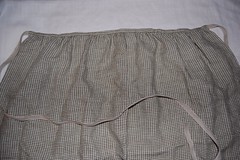
Then its on to the waistband and finishing with linen tape ties.

So, at last, finished object, green and white check. Along the Connecticut River valley, the predominate check was blue and white, but I look at this and think, maybe that’s what they mean by “bad color” in the runway ads– a kind of end-of-vat green.

ETA: Thread! I forgot the thread part. Fine stitches are achieved by using a fine needle and thread–obvious, right? Size 12 needles, if they suit your hands, and a fine linen thread. When I got home, I used 80/2 white linen thread. It worked really well, with infrequent breaks. Use plenty of beeswax, and the thread will break far less frequently–if at all–especially if you use shorter lengths. Since you need to run the gathering thread the entire width of the linen, cotton or even cotton/poly is best used for the gathers. My hands are really big, but even so I use fine quilting needles from England and manage pretty small stitches. I’ve used John James and Richard Hemming & Sons, but both had to be ordered online. Dritz applique needles can be found at Jo-Ann, if you’re in a hurry, or, like me, discover all your favorite needles are bent, blunt, or stuck in a crack in the floorboards…

Share this:

  • Share on Facebook (Opens in new window) Facebook
  • Share on Pinterest (Opens in new window) Pinterest
  • Email a link to a friend (Opens in new window) Email
  • Share on X (Opens in new window) X
Like Loading...

Hot Mess

09 Monday Jul 2012

Posted by kittycalash in Clothing, Reenacting

≈ Comments Off on Hot Mess

Tags

2nd Rhode Island, Clothing, Making Things, patterns, Revolutionary War, sewing

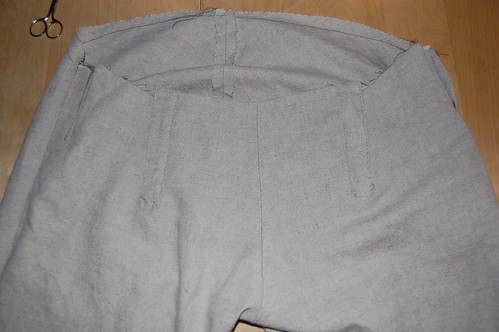
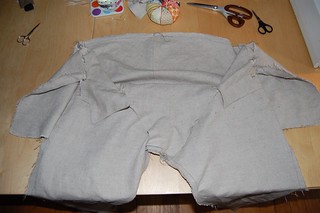
Hand sewn, except for basting for fitting

Overalls: the devil’s clothing item, even more evil than the worst multi-part replica sleeve  (that’s right sleeves, I mean you!). First there are the fiddly fall bits. Then there is the question of overall inseam length, then the shape of the leg must match the contours of the wearer, and lest we forget, the evil tongue. All of this is followed by 15-20 buttonholes.

Why did Mr. S not join a kilted regiment? Pleats and hems, easy-peasy. Overalls, not so much. The current overall score is Overalls 1, KittyCalash, 0, Draw, 1. The current pair have conquered me, but I may yet prevail but turning them into breeches with a swift amputation of the lower extremity. The first pair I made were finally overcome last fall with a new tongue piece, but they are too baggy to be correct. We’ll call that a draw.

Many moving parts

Fitting the beasts is awful, because so much sewing has to be done up at the waist, but somehow I will have to come up with a muslin and drape the legs to the subject. Once that is done, I can make a more permanent pattern that accounts for shorter than average femurs, larger than average calves, long shins, high arches, and small feet. (Most of the 2nd Helping Regiment guys have very small feet. The Young Mr is the exception, with his 12s. Obviously, his shoes will be the first to be eaten on a march to Quebec: more leather, better broth.)

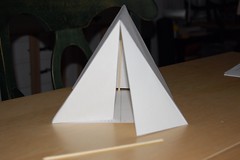
Then there is the question of a tent. Locally, a very fine hemp linen “other ranks” tent has been made, with ash tent pegs and hewn tent poles. The Young Mr and I made up a scale model last night (sans bell) to test the dimensions we worked out using math, Once school is out, all math must be real-world tested. From this, I began calculating yardage requirements, based on 57″ wide hemp linen available from a few sources. At $17/yard, it looks like $187 for a tent without a floor or mudflaps or a bell. 11 yards! That is a lot of fabric, and a lot of sewing.

Tiny little tent!

Perhaps tonight we’ll try out a slightly smaller version, with a bell. If we start this fall, we might have a tent done for next season…if the guys would only learn to sew!

Share this:

  • Share on Facebook (Opens in new window) Facebook
  • Share on Pinterest (Opens in new window) Pinterest
  • Email a link to a friend (Opens in new window) Email
  • Share on X (Opens in new window) X
Like Loading...
← Older posts
Newer posts →

Archives

wordpress statistics

Creative Commons License
Kitty Calash blog by Kirsten Hammerstrom is licensed under a Creative Commons Attribution-NonCommercial-ShareAlike 4.0 International License.

Website Built with WordPress.com.

  • Subscribe Subscribed
    • Kitty Calash
    • Join 621 other subscribers
    • Already have a WordPress.com account? Log in now.
    • Kitty Calash
    • Subscribe Subscribed
    • Sign up
    • Log in
    • Report this content
    • View site in Reader
    • Manage subscriptions
    • Collapse this bar
%d