• Home
  • Completed Costumes/Impressions
  • Emma and Her Dresses
  • Free Patterns and Instructions

Kitty Calash

~ Confessions of a Known Bonnet-Wearer

Kitty Calash

Tag Archives: Making Things

Framing a Plan

10 Monday Sep 2012

Posted by kittycalash in Clothing, Events, History, Making Things, Museums, Reenacting

≈ 2 Comments

Tags

Clothing, common dress, Costume, Events, Making Things, Reenacting, weekend, work

cross-posted from A Lively Experiment, all images copyright RIHS.

This coming weekend, I’ll be joining in at the Coggeshall Farm Harvest Fair, along with my co-worker who helped clean the museum 18th-century style. She will be helping with cleaning and laundry and ironing (must remember to pack the lavender and vinegar solution), while I will tackle a quilted petticoat.

At first glance you might think I’ll have the easier weekend, and in some ways, I will, sitting in a parlor with a quilting frame. On the other hand, I booked myself a weekend with worries that have pestered me since we were invited in mid-August. Is the fabric I’ve chosen going to work? Do I know enough about the quilted petticoats in the RIHS collections? What kind of quilting frame is correct? And where did I stash the batting?

Research is always the place to start. I compiled a Pinterest board of quilted petticoats  in other collections to build my visual literacy, and tracked down articles by Lynne Zacek Bassett in PieceWork[i] and in the  Textiles in New England  II: Dublin Seminar for New England Folklife Proceedings[ii].  From the Textiles in New England proceedings, I learned that September is the second-most common month for quilting mentions in diaries for the late 18th and early 19th century in New England (May is the most often mentioned, Octobe is third). This was a relief as I wondered if quilting in September was even appropriate. With that resolved, I was able to move on to aesthetics.

New England and Rhode Island quilted petticoats share some general characteristics: the overall skirt is quilted in a diamond or diaper grid of about 1” square. Below this is a decorative band or border, usually about 12” deep. The top of this is set off from the grid by a cyma curve or wave pattern. Some examples use an undulating feather border, and others have a stylized arc and clam shell border.  The background of the border is stitched in diagonal lines. Sometimes the direction is set from center front, and lines radiate to the left and right, and in other cases the lines radiate to left and right from the center line of each arced segment.

Within the border, floral and animal motifs are quilted. Animals seem prevalent in New England quilts—there is even a mermaid in Connecticut—but none of our quilts have a mermaid. We have sunflowers, pomegranates, and carnations similar in form to the stylized flowers that appear in samplers and embroideries of this time period. Animals include deer, lions, squirrels and a creature that looks like an oryx but may be an elk. Birds are represented as well, peacocks and stylized songbirds as well as an owl, and even what seem to be roosters.

I drew these conclusions not only from reading, but from examining two quilted petticoats in the RIHS Collection, the lighter one made ca. 1745 by Alice Tripp [Casey], accession number 1985.7.1, and the darker one made in 1770 by Anna Waterman [Clapp], accession number 1982.76.3. In the catalog record, the images for 1985.7.1 are incorrect–they are for 1982.76.2, and the confusion testament to cataloging and linking records in a building several blocks from where the petticoats are stored. Now, at least, we can work on correctly them.

The quilted petticoat that I plan to make will use the typical Rhode Island elements. The top portion will be quilted with an overall diamond pattern, while a feather border will set off the bottom band. Within that, I will quilt squirrels, chickens, and probably an owl and a cat, because they are favorite creatures in my household. I’ll also quilt in my initials, just as Anna Waterman did in her quilt.

You can join us at Coggeshall Farm Museum this weekend, September 15 & 16, starting at 10 each day, and see RIHS staff members in action! We think it will be a good warm up for What Cheer! Day, coming to the RIHS on Saturday, October 13.


[i] “Sarah Halsey’s Mermaid Petticoat.” PieceWork. January/February 2003

[ii] ‘..a dull business alone’: Cooperative Quilting in New England, 1750-1850.” Textiles in New England II: Four Centuries of Material Life, The Dublin Seminar for New England Folklife Annual Proceedings 1999. Boston University Press, 2001.
Share this:

  • Share on Facebook (Opens in new window) Facebook
  • Share on Pinterest (Opens in new window) Pinterest
  • Email a link to a friend (Opens in new window) Email
  • Share on X (Opens in new window) X
Like Loading...

Bonnet, found

25 Saturday Aug 2012

Posted by kittycalash in Clothing, Making Things, Reenacting

≈ 1 Comment

Tags

bonnets, Clothing, Costume, hats, Making Things

Readers may recall that I have a bonnet problem. It’s a problem I think can only be solved by more bonnets!

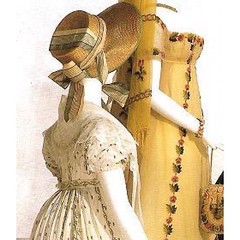
I’ve long admired and coveted the bonnet shown left in the Kyoto Costume Institute.

Well, see this bonnet? It’s called an 1812 Sun Bonnet over at HistoryHats.com. It is based on the KCI bonnet.

It is also similar to this ca. 1810 bonnet sold by Meg Andrews.

I’ll be spending time out in the sun in September, dressed for 1799. Black silk bonnet, yes, but, it could be hot and not so shady. Big plate of a straw hat? I guess so, but it’s a little too big for 1799. Straw bonnet? I wish….

But wait! Trapped on Amtrak, scrolling through Dames a la Mode,  what do I find? This! Check out that bonnet on the woman seated at right.

(Click through for larger version.) Similar cut out at the back of the neck to both the 1812 sunbonnet and the KCI bonnet. Interestingly, the woman in the straw ‘sun bonnet’ is wearing a dress with sleeves like those found on a chemise a la reine. She can’t be less fashionable than her companions, can she? How can that be in a fashion plate? I think this speaks to the persistence of fashion details longer than we might otherwise credit them. It only makes documentation trickier– or more fun, depending on who you are.

It’s 1794. By 1799, that bonnet might very well have made its way to Providence. We know girls and women were dismayed by the Jeffersonian embargoes, and driven to make their own straw hats in Providence. That means they had them, they’d seen them, and they’d seen fashion plates before the 1807 embargo.

Yes, I need a broadside or a newspaper ad to clinch the deal, but there’s an extant hat, a fashion plate in English, and I know by the early 1800s women are weaving straw for hats in Providence.

I think I might be able to have that hat after all…but I still have to finish that shirt I started for Mr. S. It simply will not sew itself!

Share this:

  • Share on Facebook (Opens in new window) Facebook
  • Share on Pinterest (Opens in new window) Pinterest
  • Email a link to a friend (Opens in new window) Email
  • Share on X (Opens in new window) X
Like Loading...

Quilting Plots

16 Thursday Aug 2012

Posted by kittycalash in Clothing, Making Things, Reenacting

≈ 2 Comments

Tags

Clothing, common dress, Costume, Making Things, petticoat

I’ve been planning and plotting a quilted petticoat for some time (since standing outdoors all day at Fort Lee in November, actually) and while the debate continues on the listserve, I know what was worn—and survived—in Rhode Island. There are quilted calamancoes and I think a black satin quilt that are run off with, either on the body or in the arms of the fleeing servant. So there were clearly wool and silk petticoats in the colony, and that fits with what I know lives in textile boxes in museum storage, where there are glazed wool domestic petticoats, blue silk satins from France, and a black silk satin with a murkier origin.

My favorites are really the woolen ones, scratchy as they are, and for some, it is replacement waists, or the linings, that are scratchy, and with multiple layers between wearer and wool, what would it have mattered? I love them best because they are in the color family that includes the “Providence Green” color that lies somewhere between gold/khaki and sinus infection, and I love them for their imagery.

The one I think I like best is this calamanco petticoat: 

The catalog decription says cream, but I don’t know, it really looks gold. The lining is definitely lighter in color, and the thread much clearer to see. What’s interesting as well is that many of the linings are pieced (it didn’t matter!) and they’re striped. 

I bought some of the last of the cinnamon “camblet” from Burney and Trowbridge last year, and did a fast quilting test on a sample.  I chose a squirrel because they’re in the wallpaper and the woodwork at work, and because they are hilarious. I keep thinking I’ve seen one in a quilted petticoat, but I can’t find it again. They are not the easiest objects to handle, either, so finding the rodent again has proved challenging. When I do quilt up squirrels and birds, it will be with a diaper background, not the vertical lines shown here. Overall, the silk-wool blend with wool batting and linen backing quilted up nicely, and should work out fairly well….I think…though it will be lighter than the ones in the boxes.

Now that I’ve got two days to spend down in Bristol, making a quilting frame and quilting up a petticoat (which would look like a quilt, and not a petticoat, on a frame, os could pass for a 1799 activity) seems like a winning proposition. All I have to do is find an appropriate pattern for a portable frame for Mr S to make. If I finish that shirt for him, he might look more favorably on that activity.

Share this:

  • Share on Facebook (Opens in new window) Facebook
  • Share on Pinterest (Opens in new window) Pinterest
  • Email a link to a friend (Opens in new window) Email
  • Share on X (Opens in new window) X
Like Loading...

A bit shirty about shirts

15 Wednesday Aug 2012

Posted by kittycalash in Clothing, Making Things

≈ Comments Off on A bit shirty about shirts

Tags

Clothing, common dress, Costume, Making Things, Revolutionary War, sewing

Fantastic seams around that gusset,seams I can really only dream of. (click for larger view)

I’m trying to be a finer seamstress, but I can tell when I’m tired and the seams wobble and the stitches get larger. Of course, I can’t always tell when I’m running on pure will power alone, so I don’t see the wobbles until the next morning.  That’s when I feel a bit shirty about how tired working can make me, since I would rather be sewing!

Mr S needs a new shirt; the one I made last year is holding up well for him but it is a small blue and white check. The check is the most common pattern in the Connecticut River valley so I’m confident in its authenticity for the period…despite murmurings about the size of the checks…but it is a “shirt from home,” compared to other shirts. Check shirts are documented to the Rhode Island Regiment in the inventory of clothes of a soldier killed at Fort Mercer in 1777. But by the later years, that shirt would have worn out, so another seems in order. I chose linen that is too heavy for a fine shirt, and probably too heavy for a not-fine shirt, but it was cut and assembly begun before the shift linen arrived on Saturday. So onward we go, and with pressing and washing, perhaps it will be OK. The placket and side slits are sewn, the neck gussets attached, and one shoulder strap. It is slow work, but a train trip next week might get it finished.

The Young Mr’s shirt, of the same check fabric and construction, has been mended twice in the  past year. He has not outgrown it, thanks to the volume of 18th century shirts, and while he has evidenced all the activity of a slug at events, he still managed to undo seams and essentially deconstruct a shirt in one day. It is a gift, I am sure.

Share this:

  • Share on Facebook (Opens in new window) Facebook
  • Share on Pinterest (Opens in new window) Pinterest
  • Email a link to a friend (Opens in new window) Email
  • Share on X (Opens in new window) X
Like Loading...

Feeling Shifty

09 Thursday Aug 2012

Posted by kittycalash in Clothing, Making Things

≈ Comments Off on Feeling Shifty

Tags

Clothing, Costume, Making Things, patterns, Research, resources

It’s clean now, but in the photo you can see some of the abuse a shift takes in a day or two of real wearing. This shift was made from the Kannik’s Korner pattern. The first shift I made is now on a mannequin at work; I used Mara Riley’s Instructions, and they worked, mostly, with some operator error. I’m tall, and that means that proportions for my clothes sometimes have to be adjusted. The third shift I made was a late-18th century version, adjusted for the change in style and my height, and it is by far the best one yet.

So now I know I need to make another mid-18th century shift, what will I do? The first place I’ll start is with Sharon Burnston’s awesome article, The Cognitive Shift. This is one of the best pieces I’ve read on costume history and the logical, methodical approach is one that not only explains her process, clarifying objects and construction, but also sets a standard for how other garments could be considered.

Among the points Sharon has made over time is the lack of decent linen available for making shifts and shirts. What we can get today is too heavy, too coarse–it lacks the hand of the linen items made in the period we’re reenacting, and not just because the objects have been washed. The fabric is simply different, and unavailable. What  I think I’ll try (having exhausted whatever shift linen I bought from a sutler) is this light weight linen, not softened. I have some that was used for a cap, and so far seems to be working out. Once it is washed, it seems to have a decent drape and appearance.

My impression is not of a fine lady, and that is at least a saving grace. I don’t want to go all the way down the social ladder to wearing an oznabrig shift, but I do want to be as accurate as I can be–and as comfortable.

Share this:

  • Share on Facebook (Opens in new window) Facebook
  • Share on Pinterest (Opens in new window) Pinterest
  • Email a link to a friend (Opens in new window) Email
  • Share on X (Opens in new window) X
Like Loading...
← Older posts
Newer posts →

Archives

wordpress statistics

Creative Commons License
Kitty Calash blog by Kirsten Hammerstrom is licensed under a Creative Commons Attribution-NonCommercial-ShareAlike 4.0 International License.

Website Built with WordPress.com.

  • Subscribe Subscribed
    • Kitty Calash
    • Join 621 other subscribers
    • Already have a WordPress.com account? Log in now.
    • Kitty Calash
    • Subscribe Subscribed
    • Sign up
    • Log in
    • Report this content
    • View site in Reader
    • Manage subscriptions
    • Collapse this bar
%d