• Home
  • Completed Costumes/Impressions
  • Emma and Her Dresses
  • Free Patterns and Instructions

Kitty Calash

~ Confessions of a Known Bonnet-Wearer

Kitty Calash

Tag Archives: Museums

Frivolous Friday

28 Friday Mar 2014

Posted by kittycalash in Museums, Research

≈ Comments Off on Frivolous Friday

Tags

Metropolitan Museum of Art, Museums, resources

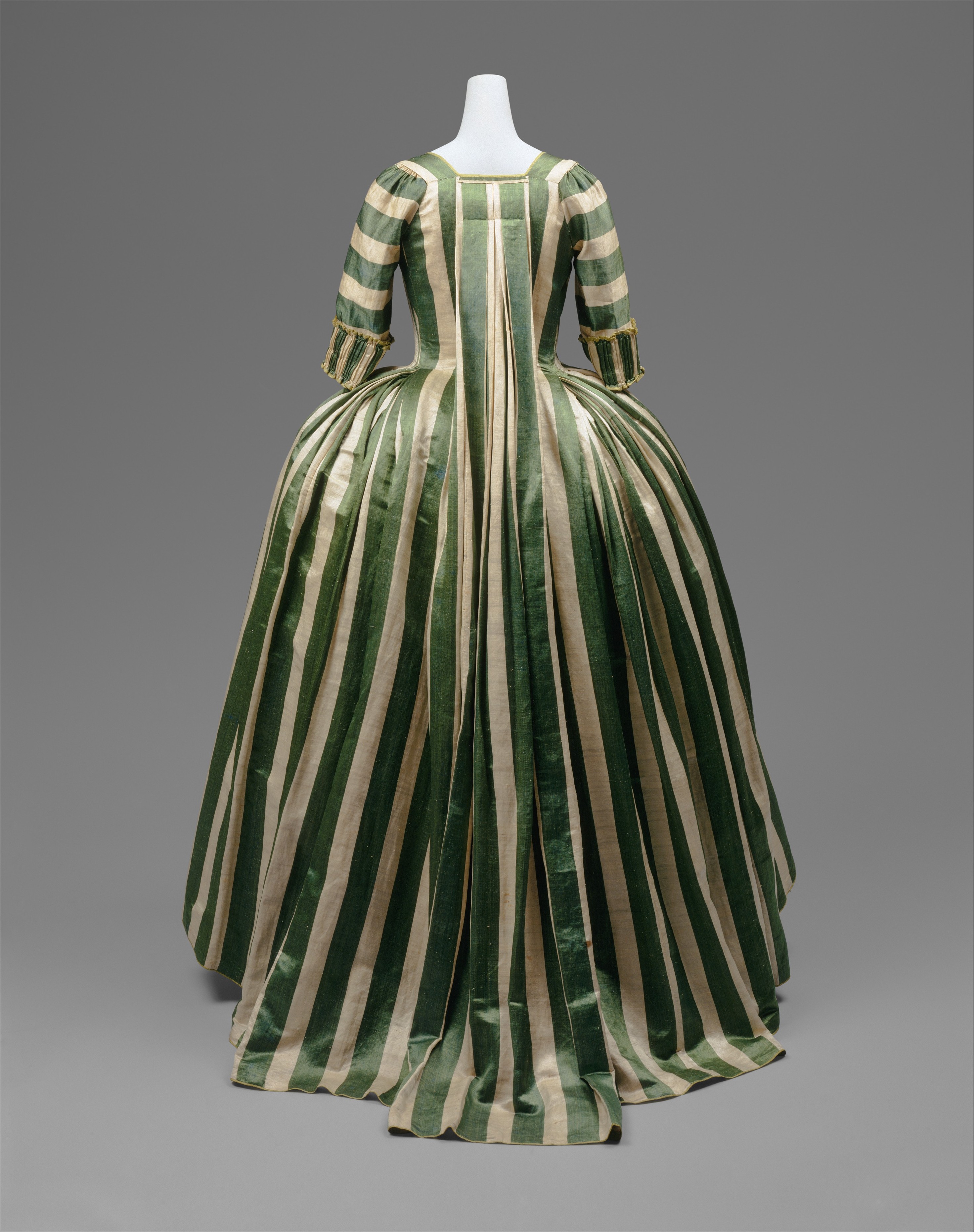
Robe à la Française 1778–85  French linen, silk  Purchase, Irene Lewisohn Bequest, 1965 MMA C.I.65.13.2a–c

Robe à la Française
1778–85
French linen, silk
Purchase, Irene Lewisohn Bequest, 1965 MMA C.I.65.13.2a–c

Yes, I give up. It has been a long week, I am tired of winter and tired of snow and packing books and carpets torn up and tired of bad communication. Fresh content? I am fresh out.

I spent Thursday beating my head against research into the Brown family textile collection, and Providence textiles in general, for a program I seem to part of next Saturday. I hope I’m prepared, but along the way to getting ready, I spent some time in many museum databases beyond our own.

The Met, as always, rocks the party and brings their largesse to us all with their online publications.

Get thee to their website, content-hungry pilgrim, and enjoy the downloadable fun. (Some of you already know this, but I keep losing the right link, so here it is again.)

Share this:

  • Share on Facebook (Opens in new window) Facebook
  • Share on Pinterest (Opens in new window) Pinterest
  • Email a link to a friend (Opens in new window) Email
  • Share on X (Opens in new window) X
Like Loading...

Criss Cross

05 Wednesday Mar 2014

Posted by kittycalash in Clothing, Living History, Museums

≈ Comments Off on Criss Cross

Tags

Clothing, Costume, fashion, Making Things, museum collections, Museums, Newport, Newport Historical Society, patterns, Quaker dress, Quakers, Reenacting, Research, Rhode Island history, sewing

Dolly Eyland, by Alexander Keith, 1808. (c) The New Art Gallery Walsall; Supplied by The Public Catalogue Foundation

Dolly Eyland, by Alexander Keith, 1808. (c) The New Art Gallery Walsall; Supplied by The Public Catalogue Foundation

I like Dolly. The colors, the textures, the style of her gown, shawl and cap all please me. She’s rocking some serious class for a woman headed towards a certain age. And she’s wearing a cross-front gown, which is what I settled on for my Quaker costume. 

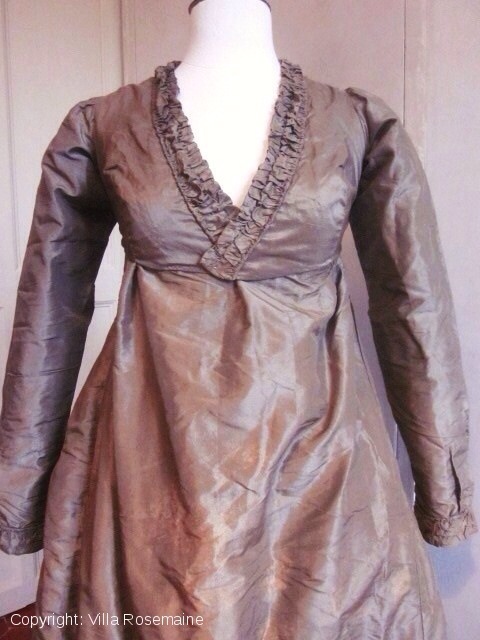
Taffeta dress, ca.1800-1810, Originally found on Villa Rosemaine site, where it does not appear now.

The trouble with making a gown based on an artistic sketch in a book is that you don’t have the most complete sense of what that garment looks like, or how it goes together.

Not to worry, I went ahead anyway, because this is as close to Everest as I will ever get.

But I wanted comparable garments to help guide me. Ages ago I found the gown at left on a French costume site. That’s helpful, in that it explains the trickiness of assembling and wearing this style of garment. Three pieces coming together in the front may be one piece too many. 

In making up my pattern, I used the pattern for the Spencer as a starting place because I knew that the set of the sleeves and arm scye were what I wanted. No reason to re-invent that process!

That left me with the luxury of concentrating on the neckline.

That took a few goes with the tracing paper and muslin:  I did lose count after a while. There may have been tears, there definitely was swearing. Mr S at one point made jokes about this process appearing on the Discovery Channel’s “How it’s Made” as “the Quaker dress.” He’s really very patient, and I do understand the selective deafness he’s had to develop as a defense against the dark arts of sewing historic clothing.

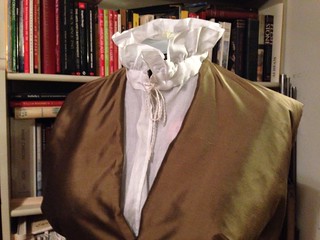
Thank you, Cassidy, for the chemisette!

Eventually, I had a decent lining and even some silk bodice fronts. I fiddled with the fronts, and settled on gathers instead of pleats, but couldn’t quite figure out where the casing went. Some days I can process drawings into objects, some days I can’t. I’d just about reached the point of cutting it all up into the gown I always make when I discovered that the excellent women of the 19th US had patterned the gown from the drawing, too. (If you don’t already use this site, I highly recommend it. Excellent work.) Those pattern pieces look like my pattern pieces, so I decided it was worth carrying on with what I have.

Share this:

  • Share on Facebook (Opens in new window) Facebook
  • Share on Pinterest (Opens in new window) Pinterest
  • Email a link to a friend (Opens in new window) Email
  • Share on X (Opens in new window) X
Like Loading...

The Difference is…

28 Friday Feb 2014

Posted by kittycalash in Art Rant, Clothing, Museums

≈ Comments Off on The Difference is…

Tags

18th century clothes, authenticity, collections management, Costume, fashion, fashion plates, museum collections, Museums, sewing, style

I make this look good.

Robe à la Polonaise ca. 1775 British silk Length at CB: 56 in. (142.2 cm) Purchase, Judith and Gerson Leiber Fund, 1981 MMA 1981.314.1

Scrolling through Pinterest lately, I was struck by how different two presentations can make one gown look.

Above, a lovely Ikat-type silk gown with en fourreau back and trim, center front closing and probably a little closer to 1778 or 1780 than 1775.

It’s presented on a mannequin that supports the gown for photography and allows us to see it clearly, from the trim at the neck to the pleats down the back and the pleasant fullness of the skirt.

The gown is shown, we get the details.

And then, in another image, another view.

Robe à la Polonaise ca. 1775 British silk Length at CB: 56 in. Purchase, Judith and Gerson Leiber Fund, 1981 MMA 1981.314.1

In this image, the gown (and its companion) have been styled and accessorized, fichus, hats, ribbons, sashes. The skirt is more fully and completely supported, showing off the silk to even better effect. We lose the trim and pleating details, but the gown is much more attractive in this view.

This is not meant to criticize the images or the handling of the costumes, but to point out that you have to look past the plain record shots in museum databases, and see the gown as it would have been worn. Working with database images, and re-creating garments from those images, requires a leap of imagination.

The more you look (at database photos, exhibition photos, extant garments, fashion plates, other re-creations) the better you will be able to imagine the garment as it might have been, and to make it yourself.

To be fair, original garments cannot always be mounted in stylish and appropriate fashion, but they can still tell us something. The more you look, the more you’ll see.

Share this:

  • Share on Facebook (Opens in new window) Facebook
  • Share on Pinterest (Opens in new window) Pinterest
  • Email a link to a friend (Opens in new window) Email
  • Share on X (Opens in new window) X
Like Loading...

Taking Tea

04 Tuesday Feb 2014

Posted by kittycalash in Events, History, Living History, Museums, Research

≈ 5 Comments

Tags

Henry Sargent, historic interiors, interpretation, John Brown House Museum, Museum of Fine Art Boston, Museums, paintings, Research, social life and customs, tea party, The Tea Party

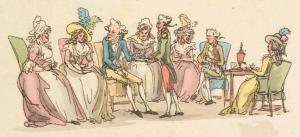
Detail, Picturesque studies and scenes of everyday life watercolor by Thomas Rowlandson, 1790. Royal Collection Trust. RCIN 810396

Detail, Picturesque studies and scenes of everyday life. Handcolored etching by Thomas Rowlandson, 1790. Royal Collection Trust. RCIN 810396

Hat tip to Jane Austen’s World for the image at left, which helped me start visualizing another program I’m involved with, this time ‘at home’ in Providence.

When we started reinterpreting the house museum, we began going back through primary sources to figure out how rooms might have been used, and furniture arranged (we don’t have inventories, so we read the house and diaries and letters– but that’s for another post).

Detail, The Tea Party. Oil on canvas by Henry Sargent, 1824. MFA Boston, 19.12

Detail, The Tea Party. Oil on canvas by Henry Sargent, 1824. MFA Boston, 19.12

One of the things I remember most vividly was the description of the uncomfortable tea parties Providence women gave, where the guests sat in chairs against the walls of the rooms, balancing a tea cup in one hand and plate in another. Several hard drives later, I’m not sure where that primary source is (the hunt begins tomorrow) but it conjured images of every hostess in Providence a Hyacinth Bucket, and every guest a quivering Elizabeth Next Door.
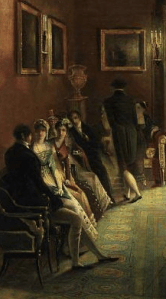
Detail, The Tea Party. Oil on Canvas by Henry Sargent, 1824. MFA Boston, 19.12

Detail, The Tea Party. Oil on Canvas by Henry Sargent, 1824. MFA Boston, 19.12

Surely that couldn’t be true? I thought I must be making it up, but then the Rowlandson turns up on the interwebs and there they are, in a row. More famously and closer to home, Henry Sargent’s painting of a Boston tea party in 1824. (The catalog description is rather nice.)

Here’s an 1824 tea party in Boston. While this is later than the tea party we’ve planned at work, it is still full of useful hints about how early, formal tea parties were conducted. We think– or I do, anyway– of ladies in frilly hats seated a tables with cakes heaped on stands and floral tea pots. I hear “tea party” and I think “doilies,” but this is not your grandmother’s tea party. It’s a different kind of social occasion, both more formal and more relaxed.
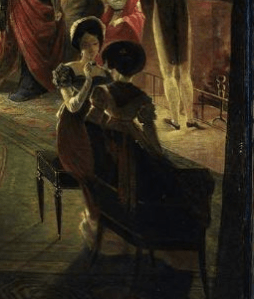
Detail, The Tea Party, oil on canvas by Henry Sargent, 1824. MFA Boston, 19.12

Detail, The Tea Party, oil on canvas by Henry Sargent, 1824. MFA Boston, 19.12

There’s not a central table to sit around, but instead chairs lined up against the wall, groups of guests, chatting. Others guests stand close to the fireplace, and a pair of ladies have taken a settee and a stool for their close conversation. We can just make out the tiny tea cup in the lady’s gloved hand.

In many ways, this depiction reminds me more of contemporary cocktail parties or open houses with the guests in small, changing groups, and no place to put your cup. Of course, most of us don’t have waiters (that’s who you see in the detail above with his back to us) or fabulous houses on the Tontine Crescent in Boston.

In so many ways, the social customs, habits and mores of the past are lost to us, and as we try to recreate them, the we excavate them from a combination of unlikely sources. Accounts, paintings, diaries, and etiquette manuals serve as sources, but it’s easier to recreate the economics of tea than the structure of a tea party. And once we do have an approximation, will it be a party anyone wants to go to?

Share this:

  • Share on Facebook (Opens in new window) Facebook
  • Share on Pinterest (Opens in new window) Pinterest
  • Email a link to a friend (Opens in new window) Email
  • Share on X (Opens in new window) X
Like Loading...

Consider the Collar

31 Friday Jan 2014

Posted by kittycalash in Clothing, Events, History, Museums, Research

≈ 5 Comments

Tags

18th century clothing, 19th century clothing, authenticity, dress, fashion, living history, museum collections, Museums, Newport, Newport Historical Society, Quakers, Research, Rhode Island, Rhode Island history, style

The Newport dresses seemed a little strange to me, in that the collar treatment was more like what I would expect to see on a pelisse than on a gown. But I am willing to be wrong, and delighted to be wrong if that’s how I will learn something.

Brown silk Quaker dress, Newport Historical Society, 20.4.1
Brown silk Quaker Dress, Newport Historical Society, D77
Morning dress, ca. 1806. American Cotton, wool. Length at CB: 54 in. (137.2 cm) Gift of George V. Masselos, in memory of Grace Ziebarth, 1976 MMA 1976.142.2
Morning dress ca. 1820. British. Cotton. Length at CB: 46 in. (116.8 cm) Purchase, Marcia Sand Bequest, in memory of her daughter, Tiger (Joan) Morse, 1979 MMA 1979.385.1

@silkdamask (that’s Kimberley Alexander’s twitter handle; she has a blog you might want to follow if you don’t already) posted a photo of the dress (above left) she imagined a young woman she’d been writing about might have worn. Housed at the Met, this embroidered American cotton and wool gown ca. 1806 has a cross-over bodice and collar.

Another day dress from the Met (above right) has a ca. 1820 date, but looks very much like the gown worn by Mrs Amelia Opie (she was a British Quaker) in this engraving after an 1803 portrait. (Other, similar gowns and portraits are pinned here.)

Amelia Opie (1769-1863). Engraving by Ridley after painting by [John] Opie, 1803. Massachusetts Historical Society, Photo. 81.490

Amelia Opie (1769-1863). Engraving by Ridley after painting by [John] Opie, 1803. Massachusetts Historical Society, Photo. 81.490

Nantucket and New Bedford  both hard large Quaker populations (remember Moby Dick?), and the Williams family in Newport had connections to New Bedford, so I looked in collections in Nantucket and New Bedford as well.

The gown below, now in the collection of the New Bedford Whaling Museum, was worn by Susan Waln Morgan Rodman (Mrs Benjamin Rodman), while pregnant; using a genealogy, we can establish pretty solid date ranges for the dresses at New Bedford Whaling Museum. It looks 1820s in style, and her first two children are born in 1821 and 1822.

Maternity gown worn by Susan Waln Morgan Rodman (Mrs Benjamin Rodman). New Bedford Whaling Museum, 1991.45.5.

Maternity gown worn by Susan Waln Morgan Rodman (Mrs Benjamin Rodman). New Bedford Whaling Museum, 1991.45.5.

A date range of 1820 to 1822 seems plausible. Susan Waln Morgan Rodman would have been about 20 with her first pregnancies. (Genealogies are on Google books.)

She seems to have kept up with style and to have liked clothes; a search for her name in the NBWM catalog returned some interesting items, though the catalog does not allow for linking to item records or searches. Mrs Rodman’s appears to have kept pace with style changes; that is, her wardrobe did not ossify in 1820-something, but evolved as fashions changed, and was appropriate for different situations.

Does that mean that all Quaker women kept pace with style changes? It’s hard to say; each of us today updates our wardrobe according to our fancy, our purse, our inclinations and our age. Are those Newport gowns going to turn out to look more like the Met gowns than I imagine? I don’t know, but it seems possible.

Share this:

  • Share on Facebook (Opens in new window) Facebook
  • Share on Pinterest (Opens in new window) Pinterest
  • Email a link to a friend (Opens in new window) Email
  • Share on X (Opens in new window) X
Like Loading...
← Older posts
Newer posts →

Archives

wordpress statistics

Creative Commons License
Kitty Calash blog by Kirsten Hammerstrom is licensed under a Creative Commons Attribution-NonCommercial-ShareAlike 4.0 International License.

Website Built with WordPress.com.

  • Subscribe Subscribed
    • Kitty Calash
    • Join 621 other subscribers
    • Already have a WordPress.com account? Log in now.
    • Kitty Calash
    • Subscribe Subscribed
    • Sign up
    • Log in
    • Report this content
    • View site in Reader
    • Manage subscriptions
    • Collapse this bar
 

Loading Comments...
 

    %d