• Home
  • Completed Costumes/Impressions
  • Emma and Her Dresses
  • Free Patterns and Instructions

Kitty Calash

~ Confessions of a Known Bonnet-Wearer

Kitty Calash

Tag Archives: patterns

True Confessions of the Frivolously Fashion Obsessed

19 Wednesday Apr 2017

Posted by kittycalash in Clothing, History, Making Things

≈ 3 Comments

Tags

19th century, 19th century clothing, Clothing, fashion, Federal style, morning dress, museum collections, patterns, sewing

Skeptical cat is skeptical

I promised you something, didn’t I, the last time I wrote?

Well, set your skepticism aside for the cat, because here’s the scoop on the messy process of getting from page to pattern to garment.

I started with the pattern from the book, which furrowed my brow a few times until I became accustomed to the style. Everyone drafts and scales patterns a little differently; it’s like getting used to local idioms. (It’s a bubbla, here, not a water fountain and not a drinking fountain. Go figure.)

But I digress. It seemed pretty simple, especially since I have some experience scaling things up, both from Sharon Burston on taking a pattern from an original garment (plot your points like an archaeologist) and from architecture school (redraw Le Corbusier’s maison from these two tiny drawings, draft an axonometric, and make a model). With Corbu behind me, you’d think this would be a piece o’ cake.

Delightfully, you would be wrong. Creative swearing, brow furrowing, and endless distractions (yes, some 28mm 17th century soldiers will be wearing Timberlands) provided the usual soundtrack and experience. Challenging, not easy, which means I hope I might actually have learned something.

Kind of a mess, right? Here’s what I did: I scaled up the pattern in the book once I’d figured out that the measurements were, incredibly, just about what I make my Federal-era dress pieces. I used the newsprint ads that come in the mail because they are abundant and free. That’s more challenging than gridded or plain paper, but free is free. With a ruler and a pencil, you can make your own grid.

After the paper patterns were drafted, I checked them against the drawings in the book, and made free hand corrections. I’ve learned that my eye is sometimes better than my math whether I am hanging paintings or making patterns.

From the tweaked newsprint pieces, I cut muslins to stitch up and try on over my stays. You MUST fit over the proper undergarments, or the exercise is pointless. These resulted in some additional tweaks and alterations accomplished at first with pins, a Sharpie, and Drunk Tailor’s patient assistance.

What then? Another round with some adjusted pieces to yield another muslin. It’s from that final fitting muslin that I transfer changes to the newsprint and then, finally, to craft paper. I was ably assisted once again by the Most Dangerous Cat in the World.
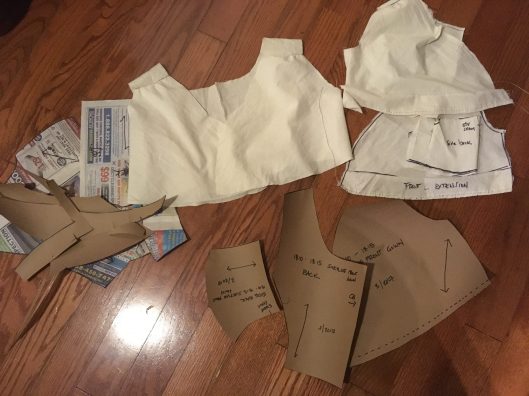
That’s what you’re left with: scraps, a muslin that’s true, and the pieces to make it. But have I made real progress on real fabric? Of course! But that’s another post.
Share this:

  • Share on Facebook (Opens in new window) Facebook
  • Share on Pinterest (Opens in new window) Pinterest
  • Email a link to a friend (Opens in new window) Email
  • Share on X (Opens in new window) X
Like Loading...

Make Mine Menswear: The finished banyan

28 Wednesday Dec 2016

Posted by kittycalash in Clothing, Living History, Making Things, Reenacting

≈ 2 Comments

Tags

18th century clothing, banyan, cotton print, menswear, patterns, sewing, stripes

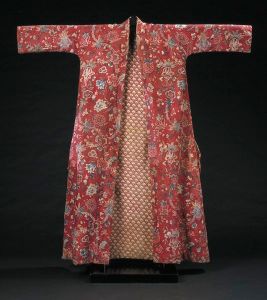
Banyan, 1750-1775. T.215-1992, V&A Museum

Banyan, 1750-1775.
T.215-1992, V&A Museum

Banyan or wrapping gown, either will do to wear as the year winds down. This project took longer than I wanted it to, mostly because I have a tendency to take on too many things at once and promptly get sick. I like to think of this ability as a gift.

In any case, this is a simple garment to make, made more fun by piecing– it’s the challenge that keeps you awake, when the majority of the work is in teeny-tiny back stitches.

I measured the subject and made up my own pattern, using the chintz banyan in Fitting and Proper and this one at the V&A as models.

img_6554

Patterning is a simple thing, really. Maybe too simple. Measure the gentleman’s chest, bicep circumference and arm length, neck, and back length. With those, you know how wide to made the body, the center back length you need to achieve, how wide to cut the neck hole, and how wide and how long the sleeves need to be. Really, not that hard.

You can use a diagram like this to start you off. I did wing the bottom width, guessing at the angle to give the garment a fullness similar to the chintz at the V&A.

Pieced more than once.
A lining in two colorways.

I didn’t have quite enough fabric to accommodate the recipient’s full height, nor could I get enough of the red print lining material; I had to piece both the stripes and the lining.  Trying to match up the stripes was remarkably satisfying, both when I succeeded and when I was  little off. Life Goal: Dizzying, please.

Again with the two color lining.

Again with the two color lining.

It contrasted well with a blue woven coverlet, making a nice bright note as the rooms were prepped for What Cheer Day. This was the effect I had hoped to achieve waaay back in April when I failed to finish anything I wanted for the After Dark program thanks to a bout of strep throat.

By October, though, I was able to finish the entire item and make a matching cap, allowing Billie Bowen to recuperate in style from an evening at the Cold Meat Club.

Next up, using this as the base pattern: a wool bedgown, lined in wool, and pieced. More mis-matched stripes, please!

Share this:

  • Share on Facebook (Opens in new window) Facebook
  • Share on Pinterest (Opens in new window) Pinterest
  • Email a link to a friend (Opens in new window) Email
  • Share on X (Opens in new window) X
Like Loading...

Criss Cross

05 Wednesday Mar 2014

Posted by kittycalash in Clothing, Living History, Museums

≈ Comments Off on Criss Cross

Tags

Clothing, Costume, fashion, Making Things, museum collections, Museums, Newport, Newport Historical Society, patterns, Quaker dress, Quakers, Reenacting, Research, Rhode Island history, sewing

Dolly Eyland, by Alexander Keith, 1808. (c) The New Art Gallery Walsall; Supplied by The Public Catalogue Foundation

Dolly Eyland, by Alexander Keith, 1808. (c) The New Art Gallery Walsall; Supplied by The Public Catalogue Foundation

I like Dolly. The colors, the textures, the style of her gown, shawl and cap all please me. She’s rocking some serious class for a woman headed towards a certain age. And she’s wearing a cross-front gown, which is what I settled on for my Quaker costume. 

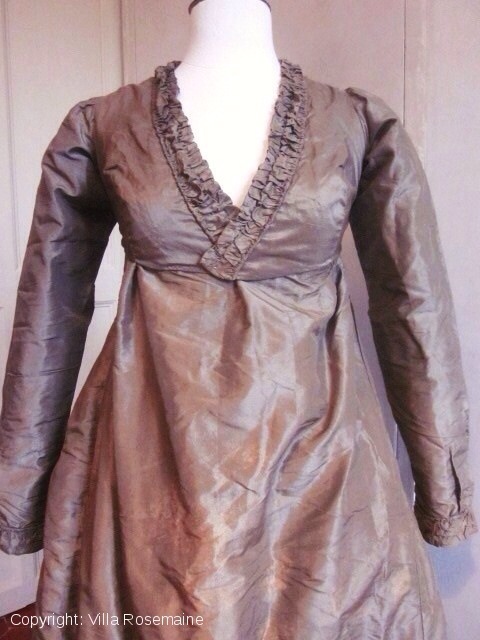
Taffeta dress, ca.1800-1810, Originally found on Villa Rosemaine site, where it does not appear now.

The trouble with making a gown based on an artistic sketch in a book is that you don’t have the most complete sense of what that garment looks like, or how it goes together.

Not to worry, I went ahead anyway, because this is as close to Everest as I will ever get.

But I wanted comparable garments to help guide me. Ages ago I found the gown at left on a French costume site. That’s helpful, in that it explains the trickiness of assembling and wearing this style of garment. Three pieces coming together in the front may be one piece too many. 

In making up my pattern, I used the pattern for the Spencer as a starting place because I knew that the set of the sleeves and arm scye were what I wanted. No reason to re-invent that process!

That left me with the luxury of concentrating on the neckline.

That took a few goes with the tracing paper and muslin:  I did lose count after a while. There may have been tears, there definitely was swearing. Mr S at one point made jokes about this process appearing on the Discovery Channel’s “How it’s Made” as “the Quaker dress.” He’s really very patient, and I do understand the selective deafness he’s had to develop as a defense against the dark arts of sewing historic clothing.

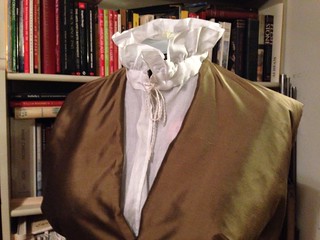
Thank you, Cassidy, for the chemisette!

Eventually, I had a decent lining and even some silk bodice fronts. I fiddled with the fronts, and settled on gathers instead of pleats, but couldn’t quite figure out where the casing went. Some days I can process drawings into objects, some days I can’t. I’d just about reached the point of cutting it all up into the gown I always make when I discovered that the excellent women of the 19th US had patterned the gown from the drawing, too. (If you don’t already use this site, I highly recommend it. Excellent work.) Those pattern pieces look like my pattern pieces, so I decided it was worth carrying on with what I have.

Share this:

  • Share on Facebook (Opens in new window) Facebook
  • Share on Pinterest (Opens in new window) Pinterest
  • Email a link to a friend (Opens in new window) Email
  • Share on X (Opens in new window) X
Like Loading...

So Hip

02 Thursday Jan 2014

Posted by kittycalash in A Silk Sacque, Clothing, Making Things, Reenacting

≈ 5 Comments

Tags

10th Massachusetts, 18th century clothes, 18th century clothing, Costume, fashion, patterns, questioning my sanity, sacque, sewing, silk taffeta, style

I don’t always feel the need to enhance my anatomy; in fact, I rarely do, but then I started on the sacque. Ah, the sacque. I nearly abandoned the whole business but then I thought I’d look pretty silly dressed as the maid, or for George Washington’s funeral instead of his birthday party.[1]

I also don’t want to have a house littered with UFOs, because that is what my knitting stash is for. In order for the sacque to look right, I need hips. HIPS.

And while I planned to make panniers AKA pocket hoops, a simpler and easier solution occurred to me. Hip pads: I’d seen them on Sharon’s site and thought I could at least try a pair. They’d help my poor fake quilted petticoat (FQP, long story[2]), which will come in handy for a party in February. So I spent my New Year’s Day making hips and playing a bit with the sacque silk.

Half hipped, or me, right after my hip replacement.
Whole hipped: symmetrical, and wide.

To make the hips, I started out by laying a piece of muslin against Cassandra, and tracing a waist arc. I worked between the muslin and paper to create a paper pattern, and then made up a muslin, which I filled with polyester stuffing and then tested under the FQP. Better, no?

Then I added the seam allowance to the paper pattern (which you can download here and print at 100% if you have a waist in the 30 inch range and want enormous hips yourself) and cut four more of linen.

After three episodes of Death Comes to Pemberly[3], I had hips. They weren’t quite the same size, but my right hip is larger or higher or something, so I put the smaller one on the right and the larger on the left to balance my own deficiencies.

The alteration to the silhouette is pretty amazing, though Mr S did laugh. Perhaps this figure is an acquired taste.


[1] All I have right now to wear with the Celebration Spencer is a black petticoat, so I’d be rocking the 1799 George-is-Dead look.

[2] The story is that I have a real one basted onto a frame but I cannot fit both the frame and a sofa in the apartment. We chose sofa. I am sad but comfy.

[3] I’m ambivalent. Though I do love Trevor Eve, I wondered why there was not more changing of dress for various times of day

Share this:

  • Share on Facebook (Opens in new window) Facebook
  • Share on Pinterest (Opens in new window) Pinterest
  • Email a link to a friend (Opens in new window) Email
  • Share on X (Opens in new window) X
Like Loading...

HSF # 26: Celebration Spencer

30 Monday Dec 2013

Posted by kittycalash in Clothing, Historical Sew Fortnightly, Making Things, Research

≈ 8 Comments

Tags

18th century clothing, dress, fashion, Historical Sew Fortnightly, patterns, Research, Spencer, style, wool

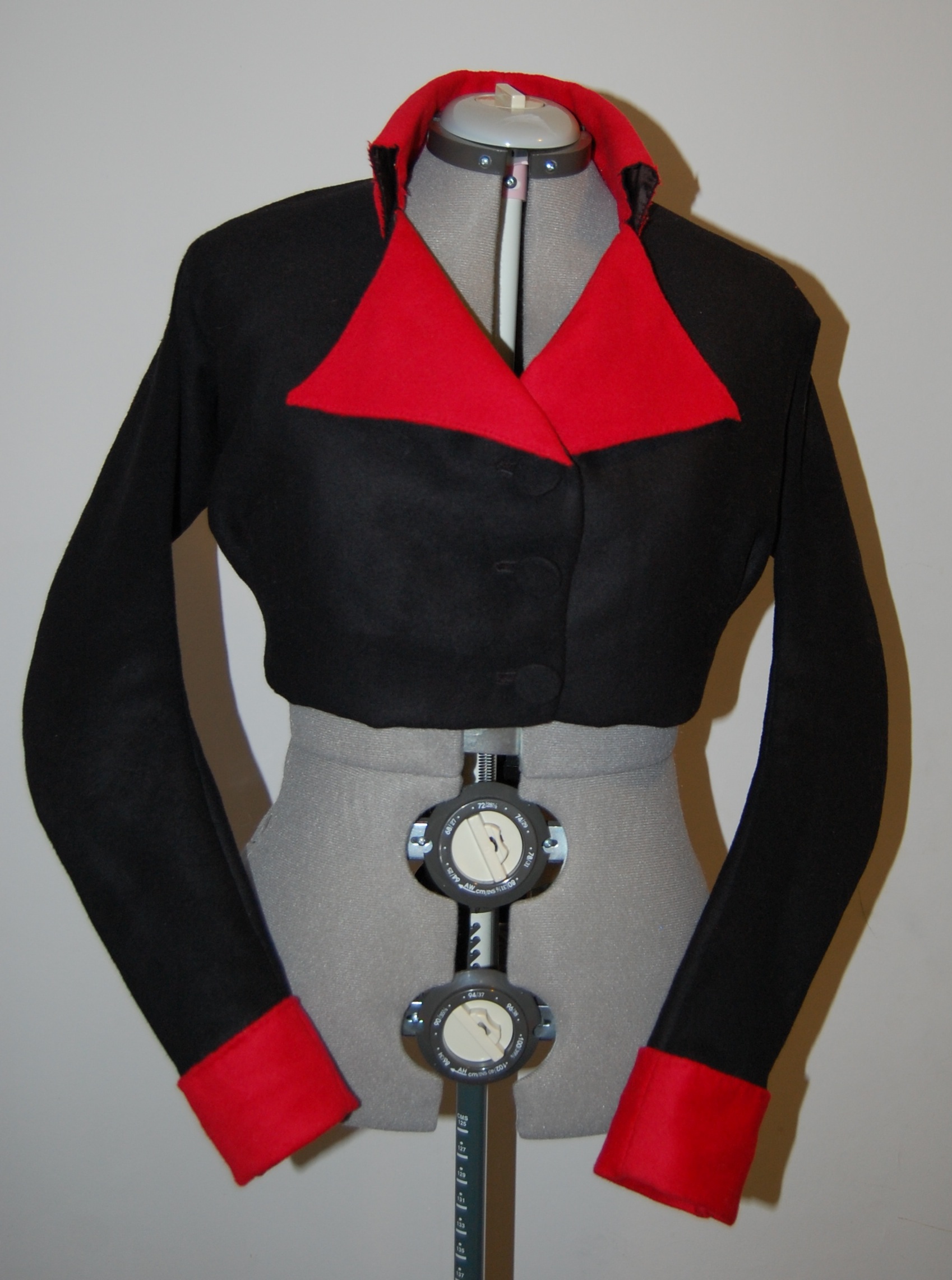
Cassandra in her new Spender.

Cassandra in her new Spencer.

This was supposed to be for #25: One Metre (yard) but things went awry. now it’s cause or #26, Celebration.

Make something that is celebration worthy, make something that celebrates the new skills you have learned this year, or just make something simple that celebrates the fact that you survived HSF ’13!

Heck, I survived the last two weeks of 2013, and that’s reason enough to celebrate. Water at work, relatives at home, high-stress holidays: if you can’t say anything nice, don’t say anything. So on to those pesky facts!

The Challenge: #26, Celebration! with a backward glance at #25, One Metre

Fabric: 34 inches of double-faced Italian wool, bought at Apple Annie Fabrics as a 50% off remnant after she found it in a pile. The collar is lined with black silk taffeta and interfaced with buckram. The sleeves are lined with black silk Persian from Wm Booth Draper, but I used taffeta on the bodice to give it more body. Technically, that’s almost two yards because it’s two kinds of fabric. Initially I didn’t plan to line this, but the edge did not hold as well as expected so I ended up breaking the rules in order to make a better garment. Celebrate rule breaking! Also, better sewing skills!

The pattern pieces on 34 inches of fabric. One cuff is pieced.

Pattern: My own, mostly. I started with the Sense & Sensibility pattern, and then modified it to make the first Spencer, working my way towards the double-breasted broadcloth of the Swedish Spencer. I first modified the lapels, and then, in order to match the arm scye to the sleeve correctly, modified the bodice at the side, and at the shoulder point. I used the Janet Arnold Spencer/riding habit as a reference, and then measured up the Leloir pattern to check my work. The two-part sleeves are borrowed from Henry Cooke’s 1770s man’s frock coat pattern taken from that extant suit; the collar and cuffs came from the same place.

Once I reshaped the sleeves from the elbow to the wrist (as I do not have a gentleman’s forearms of steel), I concentrated on adapting the bodice to make the seam sit properly on the shoulder line. Watching Mr Cooke manipulate Mr S’s garments made this a lot easier to do.

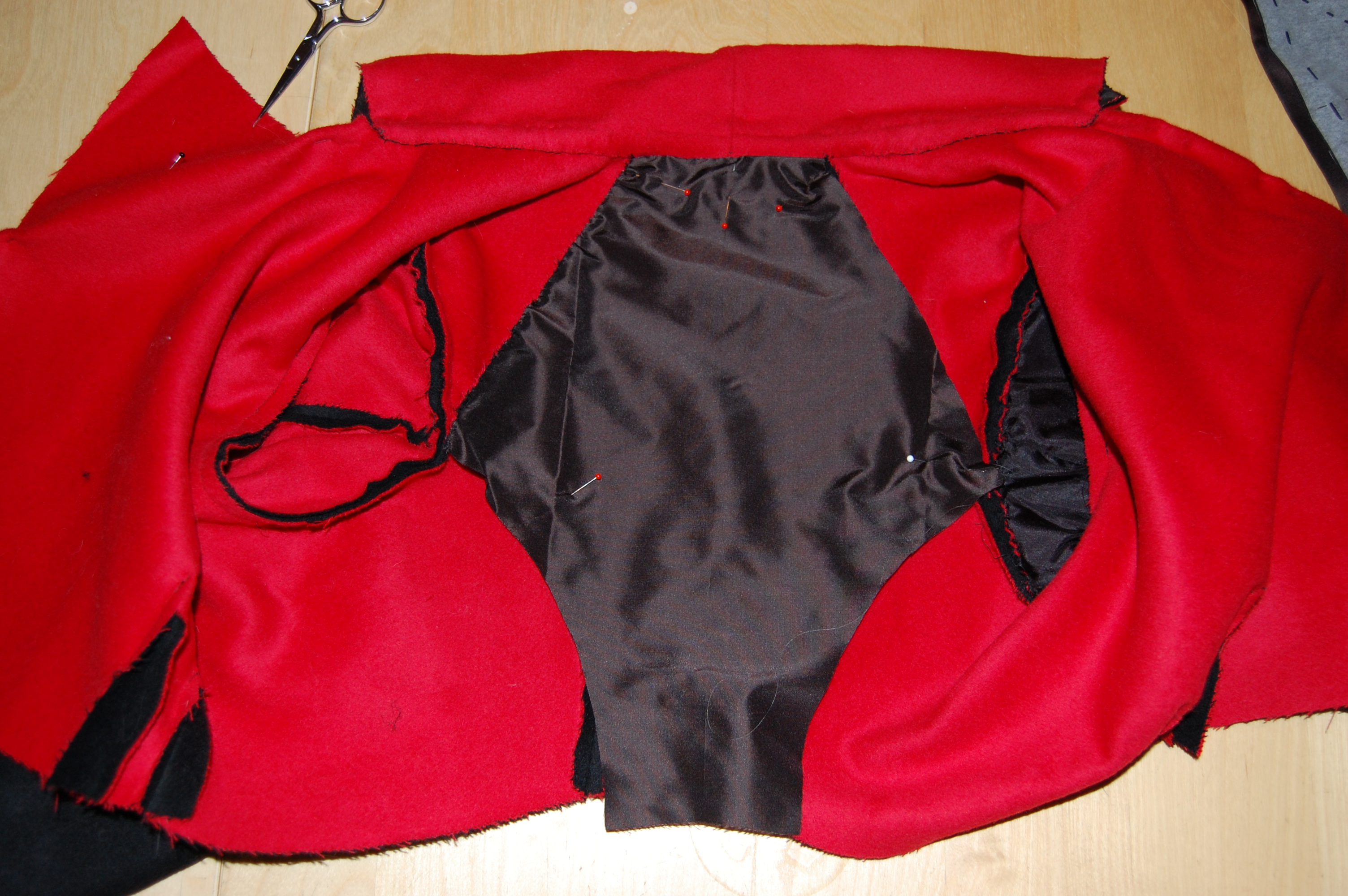
Inside view in progress.

Inside view in progress.

My theory was that if you thought of a Spencer as a miniature frock coat, starting with a man’s pattern might be the way to go. I played with that in a theoretical way, but did not pursue it fully, as I was committed to the double-breasted look.

Year: 1797, if you take the Amazon as the inspiration and marker, which I do. This style, and even the revers, persists for a while, at least in fashion plates. 1797-1800 seems about right. (See the expanded Pinterest board for examples)

Notions: Thread counts, right? Also button molds. But that was it.

How historically accurate is it? This is always the toughest part! I have verified the revers, the style, the fit, and the pattern pieces. The garment is entirely hand-sewn of the most period-appropriate materials I could find. I found reference to a very similar example in a Danish museum; if I had possessed enough fabric for a cape, I would have made one. The inaccuracies will be in details of techniques and the lining materials, which were chosen to ameliorate the very snug fit. Is it 90%, with points off for not being able to time-travel back to buy my fabrics from Providence merchants in 1797? Aside from the Andes Candies coat, I think this is the most accurate and nicest thing I’ve made yet.

The shaped back piece.

The shaped back piece.

Hours to complete: 12 to 18 for the pattern and muslins. Each sleeve took 30 minutes to pin and stitch into the armscye, but the long seams were more time consuming. 12 hours of sewing, perhaps? It seems like more than 30 hours, but once the pattern was done, parts of this moved quickly. (Personally, I love setting sleeves and sewing curvy back pieces.)

First worn: Not yet. As soon as I can talk Mr S into taking photos, I’ll wear it, but right now I have no firm plans for wearing it, which makes me sad. Wouldn’t it be a fun thing to ice skate in? Except for the very authentic way it pulls your shoulders back, which could compromise your balance.

Total cost: $15 for the wool, $6.50 for thread, and $2.80 for button molds; $8 for the amount of silk Persian for the sleeves, the taffeta was in the stash, so $24.30.

Share this:

  • Share on Facebook (Opens in new window) Facebook
  • Share on Pinterest (Opens in new window) Pinterest
  • Email a link to a friend (Opens in new window) Email
  • Share on X (Opens in new window) X
Like Loading...
← Older posts
Newer posts →

Archives

wordpress statistics

Creative Commons License
Kitty Calash blog by Kirsten Hammerstrom is licensed under a Creative Commons Attribution-NonCommercial-ShareAlike 4.0 International License.

Website Built with WordPress.com.

  • Subscribe Subscribed
    • Kitty Calash
    • Join 621 other subscribers
    • Already have a WordPress.com account? Log in now.
    • Kitty Calash
    • Subscribe Subscribed
    • Sign up
    • Log in
    • Report this content
    • View site in Reader
    • Manage subscriptions
    • Collapse this bar
 

Loading Comments...
 

    %d