• Home
  • Completed Costumes/Impressions
  • Emma and Her Dresses
  • Free Patterns and Instructions

Kitty Calash

~ Confessions of a Known Bonnet-Wearer

Kitty Calash

Tag Archives: Reenacting

Framing a Plan

10 Monday Sep 2012

Posted by kittycalash in Clothing, Events, History, Making Things, Museums, Reenacting

≈ 2 Comments

Tags

Clothing, common dress, Costume, Events, Making Things, Reenacting, weekend, work

cross-posted from A Lively Experiment, all images copyright RIHS.

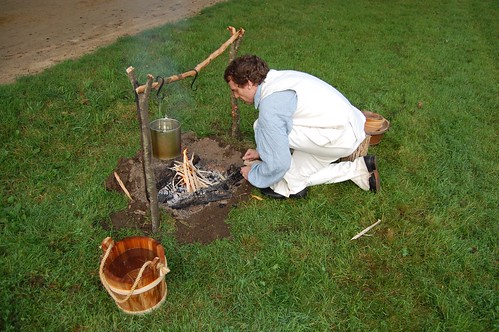
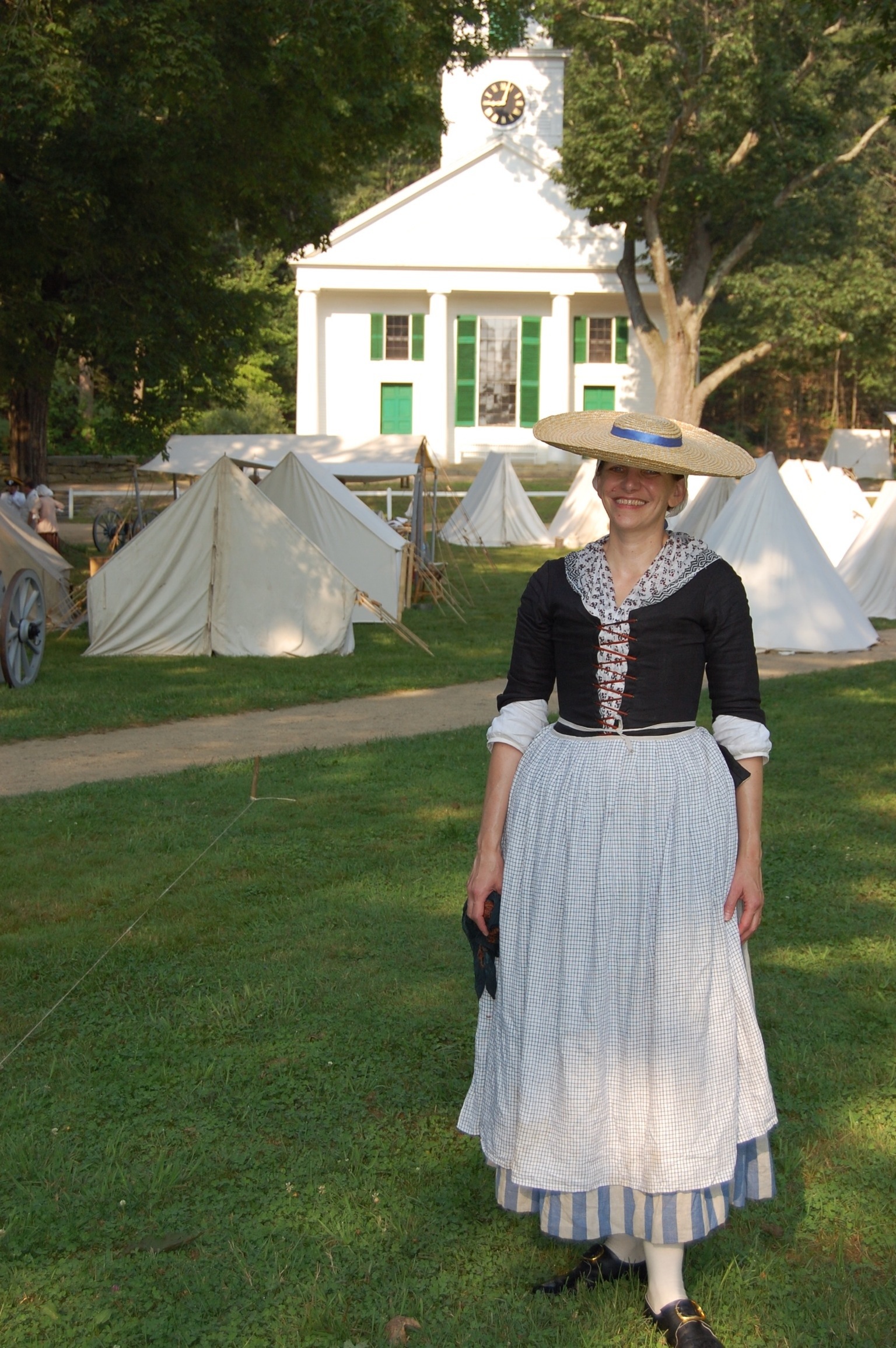
This coming weekend, I’ll be joining in at the Coggeshall Farm Harvest Fair, along with my co-worker who helped clean the museum 18th-century style. She will be helping with cleaning and laundry and ironing (must remember to pack the lavender and vinegar solution), while I will tackle a quilted petticoat.

At first glance you might think I’ll have the easier weekend, and in some ways, I will, sitting in a parlor with a quilting frame. On the other hand, I booked myself a weekend with worries that have pestered me since we were invited in mid-August. Is the fabric I’ve chosen going to work? Do I know enough about the quilted petticoats in the RIHS collections? What kind of quilting frame is correct? And where did I stash the batting?

Research is always the place to start. I compiled a Pinterest board of quilted petticoats  in other collections to build my visual literacy, and tracked down articles by Lynne Zacek Bassett in PieceWork[i] and in the  Textiles in New England  II: Dublin Seminar for New England Folklife Proceedings[ii].  From the Textiles in New England proceedings, I learned that September is the second-most common month for quilting mentions in diaries for the late 18th and early 19th century in New England (May is the most often mentioned, Octobe is third). This was a relief as I wondered if quilting in September was even appropriate. With that resolved, I was able to move on to aesthetics.

New England and Rhode Island quilted petticoats share some general characteristics: the overall skirt is quilted in a diamond or diaper grid of about 1” square. Below this is a decorative band or border, usually about 12” deep. The top of this is set off from the grid by a cyma curve or wave pattern. Some examples use an undulating feather border, and others have a stylized arc and clam shell border.  The background of the border is stitched in diagonal lines. Sometimes the direction is set from center front, and lines radiate to the left and right, and in other cases the lines radiate to left and right from the center line of each arced segment.

Within the border, floral and animal motifs are quilted. Animals seem prevalent in New England quilts—there is even a mermaid in Connecticut—but none of our quilts have a mermaid. We have sunflowers, pomegranates, and carnations similar in form to the stylized flowers that appear in samplers and embroideries of this time period. Animals include deer, lions, squirrels and a creature that looks like an oryx but may be an elk. Birds are represented as well, peacocks and stylized songbirds as well as an owl, and even what seem to be roosters.

I drew these conclusions not only from reading, but from examining two quilted petticoats in the RIHS Collection, the lighter one made ca. 1745 by Alice Tripp [Casey], accession number 1985.7.1, and the darker one made in 1770 by Anna Waterman [Clapp], accession number 1982.76.3. In the catalog record, the images for 1985.7.1 are incorrect–they are for 1982.76.2, and the confusion testament to cataloging and linking records in a building several blocks from where the petticoats are stored. Now, at least, we can work on correctly them.

The quilted petticoat that I plan to make will use the typical Rhode Island elements. The top portion will be quilted with an overall diamond pattern, while a feather border will set off the bottom band. Within that, I will quilt squirrels, chickens, and probably an owl and a cat, because they are favorite creatures in my household. I’ll also quilt in my initials, just as Anna Waterman did in her quilt.

You can join us at Coggeshall Farm Museum this weekend, September 15 & 16, starting at 10 each day, and see RIHS staff members in action! We think it will be a good warm up for What Cheer! Day, coming to the RIHS on Saturday, October 13.


[i] “Sarah Halsey’s Mermaid Petticoat.” PieceWork. January/February 2003

[ii] ‘..a dull business alone’: Cooperative Quilting in New England, 1750-1850.” Textiles in New England II: Four Centuries of Material Life, The Dublin Seminar for New England Folklife Annual Proceedings 1999. Boston University Press, 2001.
Share this:

  • Share on Facebook (Opens in new window) Facebook
  • Share on Pinterest (Opens in new window) Pinterest
  • Email a link to a friend (Opens in new window) Email
  • Share on X (Opens in new window) X
Like Loading...

Camp Cooking

08 Wednesday Aug 2012

Posted by kittycalash in Events, Food, Reenacting

≈ 1 Comment

Tags

cooking, Events, food, recipe, Reenacting, Revolutionary War

Our first overnight, camping-in reenactment went fairly well. Why the artillerists had to bring a concertina to a gunfight, I’ll never know, but a 2:36 AM rendition of “Good Night Ladies” was truly unnecessary.

The most important thing I can emphasize about reenacting in high summer is to stay hydrated. We brought the big white water pitcher we used at the House Cleaning in April, sliced a lime into it, and filled it repeatedly at the town pump. The Young Mr doesn’t like lime in his water, so he filled the coffee pot for himself, but the rest of our Regiment and members of the 10th Mass helped themselves liberally. It was well worth bringing.

The meals we ate were simple: apples, bread, ham and cheese for breakfast and lunch (I forgot to bring the eggs…) and beef stew for dinner. The stew is the most interesting part of the business. Mr S bought the meat, and without even realizing it, he picked up the appropriate amount of rations. Men were supposed to be issued a pound of beef and a pound of flour or bread a day; women, half that, and children a quarter. The amount we packed was a pound and three quarters. Seemed like too much when I packed it into the cooler, but as it turned out, we ate it all.

Enhanced Ration Stew (feeds 3 to 4)

  • 1.75 pounds beef stew meat
  • 3 carrots, sliced
  • 1 very large onion, roughly chopped
  • 4-5 small, firm, potatoes, cubed
  • Half a small kettle of water
  • 2 packets or cubes of portable soup (beef boullion)

Note: start the fire and get it hot before you bring the meat out…

Cut the meat into smaller chunks, add to the kettle, and place over the fire. Brown the meat on all sides; note that this will take as long as it takes.

When the meat is browned, add the onions and cook until they start to get soft. Add the rest of the ingredients, stir, and cover.

Bring to a rolling boil for at least twenty minutes; stir occasionally. Be sure to add wood to the fire to keep it hot. I think we cooked our stew for about 2.5 hours, but it’s hard to say exactly, as we were not wearing timepieces. We started the fire after the battle, which would have been at about 3:30 or 4:00, and ate around 6:30.

I used my pocketknife to slice the vegetables first, and arranged them in our wooden bowls. Then I sliced the beef into smaller chunks, using a piece of firewood as a cutting surface—since it gets burned, you don’t have to wash anything but the knife in hot water. Thanks to the 40th Foot at the SOI for demonstrating that technique.

Share this:

  • Share on Facebook (Opens in new window) Facebook
  • Share on Pinterest (Opens in new window) Pinterest
  • Email a link to a friend (Opens in new window) Email
  • Share on X (Opens in new window) X
Like Loading...

Sturbridge Lessons

07 Tuesday Aug 2012

Posted by kittycalash in Clothing, Events, Reenacting

≈ 2 Comments

Tags

Clothing, Reenacting, Revolutionary War

20120807-054104.jpgThe game warden is coming for my shift.

It has the most distinctive odor, and my friends at work should thank me in advance for not bringing it in. Wood smoke, sweat, rain, black powder and something else I cannot place all infuse the fabric, and it will be a shame to wash it, except that it is, truly, gamey enough to suggest I need a license to keep it. So, the lesson learned from this, and other observations:

Make another shift. Make another two shifts, even. You will want a dry one to sleep in, or to put on in the morning. I didn’t get rained on until 4:00 PM on Sunday. No, I soaked every layer of my clothing with sweat. Make another shift, stat!

Make a bedgown. In trying to maintain maximum 18th century effect, the stay-less parade to the flush toilet necessitated short gown over shift. My short gown is pleated to be worn over stays. Ahem. Make a bed gown, now I truly get their purpose, and as soon as I clean up the house, that’s what is going on my sewing table.

Line your stays. I was too lazy or busy or finger-chewed to finish installing the lining in my stays. Now they’ve gotten soaked through, I have a sweat line on my stomacher. Gross, isn’t it? Authentic, but….Line your stays. Just do it.

Make more than one cap. I have three, and was so glad to have a dry one for Sunday. Saturday’s cap now has sweat stains.

Share this:

  • Share on Facebook (Opens in new window) Facebook
  • Share on Pinterest (Opens in new window) Pinterest
  • Email a link to a friend (Opens in new window) Email
  • Share on X (Opens in new window) X
Like Loading...

Finishing Touches

30 Monday Jul 2012

Posted by kittycalash in Events, Making Things, Reenacting

≈ Comments Off on Finishing Touches

Tags

Events, Making Things, Reenacting, sewing, weekend

Sewing:

  1. Finish Overalls for Mr S
  2. Waistcoat for The Young Mr
  3. The Young Mr’s haversack– can finish in camp
  4. If there’s time: linen jacket for Mr S, off-hours.
  5. Bed gown or short gown for K
  6. Linen work bag

Things to Acquire:

  1. Cane rod, local source
  2. Blanket (wool with blue stripe, in Texas) or two
  3. Tent??
  4. Camp kettle
  5. Coffee pot?
  6. Tea pot (Jackware or brown-glazed redware)
  7. Canteen for K

Things to Modify:

  1. Paint knapsack
  2. Paint Ikea box
  3. Swap Ikea box screws for brass flat-head screws
  4. Marble paper or hand-paint wallpaper to cover sewing kit
  5. Hemp webbing for pack basket (Missouri source)

As you can see, I have a sewing problem. Right now, those overalls have become breeches, and I am at the knee band stage, just before 10 more button holes. I can manage those in a week, but I suspect that will be it. And a work bag, I can probably manage a work bag. Last year, I went to OSV with bleeding and punctured fingers. This year, I’d like to have fingertips I can do things with. Also, I need to sleep in order to do my job decently, so perhaps this list is more about learning my limitations than it is about things I really need to do.

Share this:

  • Share on Facebook (Opens in new window) Facebook
  • Share on Pinterest (Opens in new window) Pinterest
  • Email a link to a friend (Opens in new window) Email
  • Share on X (Opens in new window) X
Like Loading...

A Box in a (not quite) Day

27 Friday Jul 2012

Posted by kittycalash in Making Things, Reenacting

≈ Comments Off on A Box in a (not quite) Day

Tags

Making Things, Reenacting, resources, Revolutionary War

Since I made a new knapsack based on the example in the Fort Ticonderoga collection (see also Henry Cooke’s work, or The Packet III, page 28), I had paint. When you have paint, you want to put it on something. I put mine on a box.

Ikea had ‘Kartotek’ birch ply boxes one year, and the Young Mr was using some as treasure chests in his room, but now that he’s growing up a bit, he was willing to have one remodeled. The lines were pretty basic and the construction simple enough that I thought we could do a kind of recon on this box. (Recon is Library Lingo for “retrospective conversion.”)

First, I took it apart and sanded it. Don’t forget to cover work surfaces and expect to sweep/tack cloth up dust from both the box and everything around the box. Mr. S helped me out by drilling out the riveted handles, and re-drilling holes large enough to take the rope we had. It smells like hemp, but I have no idea where it came from–perhaps a Christmas tree excursion.

All good so far, sanded, drilled, and ready to take the paint. I thought one coat would be enough, since I had the red stain underneath, and wear and tear make things look better, so, fantastic! Time to put it together.

Hold on there, pilgrim. I looked at the screws. They were Phillips head, and not really brass. That’s not right! I’ve crawled under enough old tables to know that screws are flat, slot-head, and made of brass in this time period. With the rise of the screw gun/cordless drill, this kind of screw is no longer easy to find. They’re all Phillips at the big box hardware stores, and our little speciality store recently downsized and rearranged.

Was I really screwed? No, thanks to the interwebs. Slot-head brass screws are still used in marine applications, so I was able to order a bag from Amazon–the local chandlers seem to have given way to WestMarine, and they seemed only to have stainless steel screws.

The package came on Wednesday, I got out the screw driver, and after what totals up to a day’s work, we have a box for the Young Mr S to stash his stuff in when in camp. I expect the box to soon contain one book about dragons, several sticks and rocks, a tangle of fishing line, an empty candy wrapper, and an apple core. Also, homework that counts towards his grade.

Share this:

  • Share on Facebook (Opens in new window) Facebook
  • Share on Pinterest (Opens in new window) Pinterest
  • Email a link to a friend (Opens in new window) Email
  • Share on X (Opens in new window) X
Like Loading...
← Older posts
Newer posts →

Archives

wordpress statistics

Creative Commons License
Kitty Calash blog by Kirsten Hammerstrom is licensed under a Creative Commons Attribution-NonCommercial-ShareAlike 4.0 International License.

Website Built with WordPress.com.

  • Subscribe Subscribed
    • Kitty Calash
    • Join 621 other subscribers
    • Already have a WordPress.com account? Log in now.
    • Kitty Calash
    • Subscribe Subscribed
    • Sign up
    • Log in
    • Report this content
    • View site in Reader
    • Manage subscriptions
    • Collapse this bar
%d