• Home
  • Completed Costumes/Impressions
  • Emma and Her Dresses
  • Free Patterns and Instructions

Kitty Calash

~ Confessions of a Known Bonnet-Wearer

Kitty Calash

Tag Archives: Research

Choosing a Gown

19 Tuesday Mar 2013

Posted by kittycalash in Clothing, Events, History, Living History, Making Things

≈ 1 Comment

Tags

18th century, 18th century clothes, authenticity, Battle Road 2013, Clothing, common dress, Costume, fashion, history, living history, Research, Revolutionary War

Here’s a good question (I love questions): how do you choose which [historic example] to make?

The answer, as almost always: Research.

I start with a date. For Battle Road, the dress must be typical of New England in April, 1775 and appropriate for my impression or persona.  As I imagine my character from the past, she’s in her 40s, from the upstart town of Providence, married to a tradesman or craftsman. She has one child, and I haven’t thought about whether or not it’s one only or one surviving—too busy chasing the One Child Who Eats Like Ten.
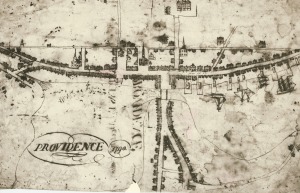
Providence, 1790. John Fitch, RIHS Map #30
Providence, 1790. John Fitch, RIHS Map #30

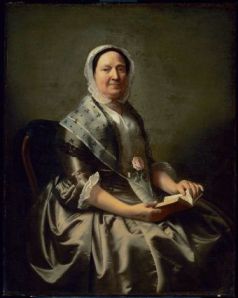
Mrs Nathaniel Ellery, J S Copley, 1765, MFA Boston

Mrs Nathaniel Ellery, 1765, MFA Boston

Living in a port city means my character—we’ll call her Kitty—has access to new goods and ideas, a town where you can buy almost anything, but where staymakers are less common than in Newport.  It’s less refined than Newport, brassier, but competitive and striving and with plenty of money in some hands. Providence is where the Gaspee affair was plotted; in 1790, residents from around the world are recorded here—men from Java, living in Providence—it’s polyglot, mercantile, striving.

Given that Kitty is of the middling sort in a town, she can wear linen and wool and camblet and even some silk. Her clothes will be fashionable but not high style, “a thought behind the current moment,” as Lord Peter says of someone’s hat. What’s the purpose of this brown gown? Everyday wear, that, with accessories, can be dressed up, or dressed down. Eventually, who knows, I might manage a crewel work stomacher and nice linen cuff-ruffles for my shift, though a filthy apron, burned skirt, and a striped rough linen petticoat are more likely…
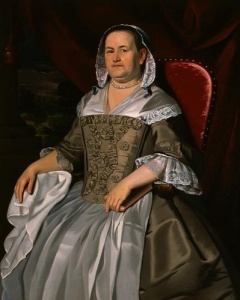
Mrs. James Otis (Mary Allyne Otis). JS Copley, ca. 1760. Wichita Art Museum

Mrs. James Otis ca. 1760. Wichita Art Museum

Making an everyday dress means not copying the silk dress from Williamsburg, and honestly, I couldn’t wear that wedding cake frosting on my chest, nor what Mrs. Otis has on her stomacher. How about that lovely Norwich wool gown? Well…almost. But I can’t sew that well, and haven’t got fabric that lovely, couldn’t afford it now, wouldn’t have had it then. I have brown wool. Have I seen Mrs. John Brown dressed like one of Copley’s women? Perhaps (if you take Copley as evidence, which you must do carefully.) Have I looked at the lovely brown silk satin and thought, I could do that. Possibly.
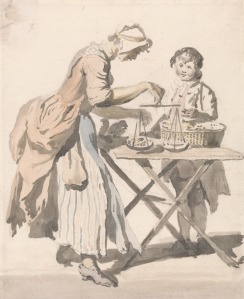
Black Heart Cherries, Paul Sandby, ca. 1759. YCBA B1975.3.206

Black Heart Cherries, Paul Sandby, ca. 1759. YCBA B1975.3.206

What we do know is that in New England, gowns are found more often than any other kind of garment (i.e. short gowns or jackets or riding habits). We know that wool is common, but that linen is found in towns and cities, wool more often in the country, and that the pretty, but expensive, cotton prints are popular. Open robes are more common earlier, and “hatchet” cuffs (pleated tubes) predominate. The style is worn by Copley’s women and Sandby’s girls, and it’s seen in images from 1760 on. That means it’s a good choice for a base style for any class level.

Here’s my process, more or less:

Determine the date, that sets the style.
1775 means stomacher front gown.

Determine the character, that sets the fabric and trims.
Kitty’s New England middling, so she’ll have a wool gown with robings but not trims, a plain stomacher, cuffs and not ruffles, and a matching petticoat.

Determine the event, that sets the accessories.
Battle Road is a hard one for me: as a woman, I shouldn’t be there, and as a Rhode Islander, I really shouldn’t be there. (RI militia were stopped at the border by the governor to prevent them joining Massachusetts men after news of the events at Lexington and Concord reached Rhode Island. They did get there eventually and participated in the siege of Boston, but you see what I mean…) So I have to construct a story for how to dress, and the best I can manage is going out, either to a shop or to pay a casual call on family. So what I plan is a matching petticoat, white neck handkerchief, clean check apron, and bonnet over a clean white cap. (This emphasis on clean should remind me to wash and iron a thing or two.)

That’s my story, and I’m stickin’ to it. For now, anyway, till I get a better idea.
Share this:

  • Share on Facebook (Opens in new window) Facebook
  • Share on Pinterest (Opens in new window) Pinterest
  • Email a link to a friend (Opens in new window) Email
  • Share on X (Opens in new window) X
Like Loading...

More on Pockets

18 Monday Mar 2013

Posted by kittycalash in Clothing, Museums

≈ Comments Off on More on Pockets

Tags

18th century, 18th century clothes, Clothing, Costume, dress, museum collections, Research, resources, Revolutionary War

If you think you don’t like military history, think again. A friend of mine is working on a French and Indian War 250th Anniversary project in Boston, and in the course of his research he got interested in a red velvet grenadier’s cap that I happen to be adjacent to from time to time.

UBM 2006-08-53

UBM 2006-08-53

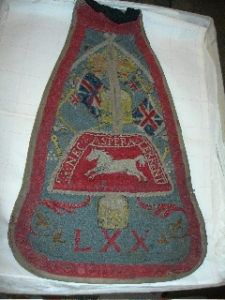
One thing led to another, fortunately for him and not me, and he ended up calling on the National Army Museum in London. There a curator after my own heart distracted him with one of the coolest things I have ever seen: A Lady’s Pocket made from the decorative panel of a mitre cap, or as they call it, Mitre Pocket.

Here’s their description:

“Front section of a mitre cap made into a ladies pocket, 1760 (c); wool and cotton; on front the emblems for the 70th Regiment of Foot, all sewn as for the period, 1760 (c); back is made of brown cloth; front is bound with red cloth binding.

Note: Hanoverian white horse and ‘Nec Aspera Terrent’ used by 8th (The King’s) Regiment of Foot, later King’s (Liverpool Regiment), which might make the L an initial not a numeral and the XX a company number rather than part of the regimental numeral.”

Grenadier’s cap, 1833.1.1, RIHS

One of the most charming things about the email is that the woman at the NAM sent my friend an image of a gown and pocket, just so he’d be clear about how it would have been worn. He knew anyway, but I thought that was a very nice thing to do.

The cap we’re looking into is this one, said to have been picked up at Bunker Hill. Not for nothin’ (as the locals say), but this cap would make a lovely pocket.

Share this:

  • Share on Facebook (Opens in new window) Facebook
  • Share on Pinterest (Opens in new window) Pinterest
  • Email a link to a friend (Opens in new window) Email
  • Share on X (Opens in new window) X
Like Loading...

Sweet Danish!

28 Thursday Feb 2013

Posted by kittycalash in Clothing, Museums

≈ 1 Comment

Tags

dress, Museums, National Museum of Denmark, patterns, Research, resources, Tidens Toj

That dress!

You know the fabulous 1797 wedding gown from the Danish Museum? It turns up on blogs as the Tidens Toj gown. Many of the links to the pattern and the gown are broken now, but fear not, it only moved. Wouldn’t know anything about museum website links changing…

You may know this already, but it’s here now. The National Museum of Denmark has a nice set of Pinterest boards,  which is how I found the dress. The PDF is still available from the catalog record, and has a link here.

English Dress, 1780

The Fashion History- Future Clothing exhibit is still up, and many of the garments have PDF patterns. There is a pretty post-RevWar era “English Dress,” which also has a pattern. The translation that Google provides is a trifle (no, actually, quite) hilarious. Don’t trust it…you’ll end up with sweaters and wrinkles instead of Brunswicks and pleats.

Share this:

  • Share on Facebook (Opens in new window) Facebook
  • Share on Pinterest (Opens in new window) Pinterest
  • Email a link to a friend (Opens in new window) Email
  • Share on X (Opens in new window) X
Like Loading...

Dressing and Undressing in Newport

24 Sunday Feb 2013

Posted by kittycalash in Clothing, History

≈ 3 Comments

Tags

18th century clothes, Clothing, common dress, Costume, history, living history, Research

A lady and her maid

The Ladies, Dressed, in Newport

Last Thursday evening, my friend and I went to the Colony House in Newport  for the “Undressing History: What Women Wore in the 18th Century” program presented by the Newport Historical Society.

There were excellent questions from children (I loved, “What would you wear for pajamas?”) and adults, including:

If you were not a wealthy woman, or you were an enslaved woman, what did you wear on laundry day?

At Sandpit Gate, Paul Sandby, 1765. RCIN 914329

At Sandpit Gate, Paul Sandby, 1765. RCIN 914329

The image that sprang into my mind was Paul Sandby’s women at Sandpit Gate, doing laundry work. They’re wearing their shifts, stays, petticoats, neck handkerchiefs, caps and shoes. (I particularly like the woman working at the tub; you can see the angle of her stays diverging from her spine as she bends forward; it’s a fine little detail and very accurate.)

So women wore one of their shifts, their stays, petticoat(s), stockings and shoes.

And that brings us to the question, How many shifts did they have?

Several months ago I had the luxury of doing some research in the manuscript collections at work, and found MSS 957, the Stafford Family Papers. In those papers there is an undated estate inventory, thought to be from ca. 1780-1799. It’s extensive, and while I have a hand-writen transcription of the whole, I’ll quote the most relevant entry:

5 shifts [illegible]

Yes, five shifts. A woman who owned five slaves had five shifts. They were not for her slaves (though that leads to yet another set of questions about people who were property owning property…and where might that be enumerated?). And if she was laid out in a shift, or wearing one when she died, was it counted, too?

With five shifts, this unidentified woman could have worn each for two days and managed a washing every week–or rather, managed for another day or two or three while her slave women washed, dryed, and ironed her clothing.

In The Dress of the People, Styles points out in Chapter 2 that the largest differences between what the rich and poor wore lay in “numbers, quality and value,” (p. 31) and tables in the back lay out the different number of shifts lost by different women in a fire on an afternoon in May, 1789, in Brandon, Suffolk, England. A blacksmith’s wife lost six shifts, the mantua maker lost one. We can’t know if that emphatically means the mantua maker had but two shifts, or if she saved more than the blacksmith’s wife; one servant lost seven shifts! What we can tell is that women had more than one shift.

We can’t take one undated inventory as typical of 18th century clothing inventories in Rhode Island, (more research lies ahead of me) but counting shifts would be an interesting exercise. Based on my own experience, I can verify that one wants more than one shift. I think it likely that inventories will turn up multiple shifts for women, and shirts for men, no matter where we look, and that this will probably hold true even for slaves. Styles reminds us that the differences are not just numbers, but quality and value.

Share this:

  • Share on Facebook (Opens in new window) Facebook
  • Share on Pinterest (Opens in new window) Pinterest
  • Email a link to a friend (Opens in new window) Email
  • Share on X (Opens in new window) X
Like Loading...

Shoe Envy

21 Thursday Feb 2013

Posted by kittycalash in Clothing, Making Things

≈ 3 Comments

Tags

1914-1918, Clothing, Edwardian, Essex Steam Train, fashion, Making Things, Museums, Research, sewing, shoes

Suit, 1914-1918. MMA

Suit, 1914-1918. MMA

Yes, I am as shallow as stereotypes might suggest: I see shoes, I often want shoes. Even my current co-workers know about the red leather Cuban-heeledAdrienne Vittadini pumps I passed up when they were on post-Christmas sale at Marshall Field’s way back in the Dark Ages. They would have gone nicely with this red wool suit from the Met.

There’s a Steam Railway in Essex, CT and when we went on Staff Day, we were told the train car was from 1914, an excellent year for fashion–at least before that August. It seemed like a great plan: make 1914 clothes and ride the train again next fall, possibly carrying vintage luggage or a basket with a delicious picnic. Really, who’s in? Let’s book it!

The World War I era has fascinated me for a long time, from Vera Brittain to Siegfried Sassoon,  from Wobblies (perhaps because I grew up in Chicago) to war memorials, so the Steam Train Outing in Period Dress was particularly tempting, and I started a board for early 20th century costume. Downton Abbey fans will enjoy it, too, and while I tired of Swedish murders and finally caved to Downton’s charms, my film choice for the period is Testament of Youth.

Libby Hall Dog Photo from flickr

When I saw the American Duchess pre-order for Gibson shoes, I was sorely tempted. (They’re quite similar to what the lady on the right is wearing.) Fortunately, I am saved by my pedal extremities, for which my size is not yet available.

But what really holds me back is the thought of sewing the corset. It’s like the hip surgery I don’t want to have: I know how painful it is, and how inescapable. There is no way to properly dress in the past unless you do it from the skin out. But shoes–and those fantastic Edwardian hats–might just get me to make that corset. Shallow, isn’t it?

Share this:

  • Share on Facebook (Opens in new window) Facebook
  • Share on Pinterest (Opens in new window) Pinterest
  • Email a link to a friend (Opens in new window) Email
  • Share on X (Opens in new window) X
Like Loading...
← Older posts
Newer posts →

Archives

wordpress statistics

Creative Commons License
Kitty Calash blog by Kirsten Hammerstrom is licensed under a Creative Commons Attribution-NonCommercial-ShareAlike 4.0 International License.

Website Built with WordPress.com.

  • Subscribe Subscribed
    • Kitty Calash
    • Join 621 other subscribers
    • Already have a WordPress.com account? Log in now.
    • Kitty Calash
    • Subscribe Subscribed
    • Sign up
    • Log in
    • Report this content
    • View site in Reader
    • Manage subscriptions
    • Collapse this bar
 

Loading Comments...
 

    %d