• Home
  • Completed Costumes/Impressions
  • Emma and Her Dresses
  • Free Patterns and Instructions

Kitty Calash

~ Confessions of a Known Bonnet-Wearer

Kitty Calash

Tag Archives: Research

Virtual Museum

01 Thursday Nov 2012

Posted by kittycalash in Museums

≈ 2 Comments

Tags

museum collections, Museums, Research, resources, Rijksmuseum

Rijksmuseum, jak, BK-BR-609

Holy Curator’s Dream, Batman!

If you like history and costume and paintings (oh my) stop reading this and go play at the Rijksmuseum.

Hot tip: search for “jak” or “japon” if you’re looking for jackets and dresses.

The zoom feature is amazing, and the collections are clearly drop-dead awesome. Only a tiny fraction are digitized, but what has been is astonishing. Look at that jacket! It’s dated 1810-1820, but earlier fabric.

Rijksmuseum, jak, BK-NM-4959

There’s another one, earlier, and less visually striking but still lovely.

What are you still doing here? Go visit!

Share this:

  • Share on Facebook (Opens in new window) Facebook
  • Share on Pinterest (Opens in new window) Pinterest
  • Email a link to a friend (Opens in new window) Email
  • Share on X (Opens in new window) X
Like Loading...

Projects a-waiting

28 Sunday Oct 2012

Posted by kittycalash in Clothing, Making Things, Reenacting

≈ Comments Off on Projects a-waiting

Tags

Costume, Research, sewing, weekend

From Essex House, 1790

We’re ready at work (electronics unplugged, shutters closed, anything outside brought in) and at home (water and non-perishables in stock, matches–or flint and steel–plus candles at the ready) so now all there is to do is to wait for Sandy’s effects to be felt.

What to do while waiting? Laundry, for one thing, vacuuming for another (day). And what else but obsessing?

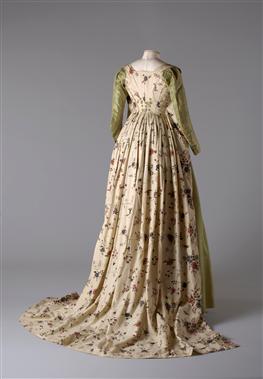
First, the Curtain-along-kerfluffle continues. Found last night, a gown from Fairfax House in Essex (UK). Looks like a robe that goes over a lighter gown, shown here with a green silk underdress. And then there are the Kyoto Costume Institute’s English gowns from Revolution in Fashion and Fashion.

I also love the detail in the back of the V&A’s printed cotton open robe, so in the end, what I may do is design a gown based on the principles of extant examples and fashion plates, rather than recreate an extant example.

Before any of that can really happen (sigh), I must have the right undergarments. I have been hunting up examples, and I may be able to adapt and refine the hand-sewn pair based on a set at the Met that I made to wear to Coggeshall Farm. I have to address those anyway because…the guys want to volunteer for winter chores in December, and needs must dress appropriately.

That puts me at a project list:

1. Refine, correct, beat into shape 1790s Met stays………………….December 2

2. Two pairs men’s trousers (5-7 buttonholes each)………………….December 2

3. Two men’s waistcoats ca. 1790 (8-10 buttonholes each)……….December 2

4. Finish grey workman’s coat 1780-90 (12+ buttonholes)…………December 2

5. Undefined outerwear in wool for child (too many buttonholes)..December 2

6. Wool gown and petticoat, 1790s…………………………………………December 2

7. 1790s gown in Indienne print………………………………………………March 9

8. 1790s white cotton petticoat………………………………………………..March 9

9. 10th MA regimental coat, private’s……………………………………….April 20 –or–

10. 2nd RI regimental coat, private’s………………………………………….April 20—and–

11. 10th MA musician’s coat……………………………………………………..April 20–or–

12. 2nd RI musician’s coat………………………………………………………..April 20

13. Umm, excuse me, I lost track of the fun here……………..

Right. I note the lack of wool 1770 gown for April 13 here, or my quilted petticoat, or the floaty blue silk 1799 gown and blue wool spencer I want to make. It’s hard to be dressmaker and tailor. Also not on the list above are the finer shift and white linen shirt that are in process in my basket, and the Williamsburg jacket of remnant reproduction print. At least that’s an easy one, like making gingerbread. I have a pattern that works, I have the fabric, all I have to do is cut it out and sew.

Share this:

  • Share on Facebook (Opens in new window) Facebook
  • Share on Pinterest (Opens in new window) Pinterest
  • Email a link to a friend (Opens in new window) Email
  • Share on X (Opens in new window) X
Like Loading...

The Great Curtain-a-Long Kerfluffle

25 Thursday Oct 2012

Posted by kittycalash in Clothing, History

≈ 4 Comments

Tags

Costume, preparations, Research, resources, sewing

Not to be confused with the Great Benefit Street Curtain Kerfluffle of 2007, in which I averred in a lectured that the wealthy of Providence did, in fact, have not just shutters but also curtains, and was publicly challenged by irate docents. Sometimes I feel the need to remind them that John Brown did not in fact squat naked in a corner of a fireless room gnawing on a joint until Benjamin Franklin appeared with the gift of fire called down from the sky by a kite….why, yes, I do have some docent issues.

Way back in a warm sunny month I bought the Waverly curtains at Lowe’s in the cream color way, though both the black and the red were also tempting. Now the question is, what to make? Not that there aren’t plenty of other projects requiring my attention…but sometimes, you want to do something just because it’s fun.

“Fun” is a concept I have some trouble with. I am much better with work and responsibility and guilt. “Spontaneous” isn’t too bad (how do you think I end up in some of the situations I find myself in?) but simple “fun” can be tricky. So here I am with the spontaneously purchased curtains, and the need for a plan.

The plan has vacillated between “just for fun” dress and a fully documented dress. A “just for fun” dress would not have to be documented to 1770-1780 New England or 1790-1805 Rhode Island. How liberating! French dressing, here I come! Except…where and when would I get to wear my new creation? So I need not just a plan but a cunning plan.

Where to turn? I chose the Met, and here’s what I found.

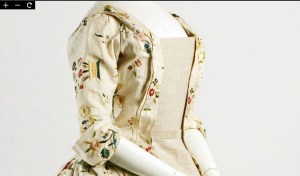
Dress number 1, 1725-1750, British, embroidered linen. Has the right features (open, robings, cuffs) and the fabric could be plausibly mimicked with the print. Could be worn with a matching petticoat (need another curtain if I do that) or a red flannel petticoat. Would be super amazing with a crewel stomacher if I made myself do that. Could probably be worn to Rev War events if I felt a bit brazen. (She wore curtains at Battle Road?! My dear, the idea!)

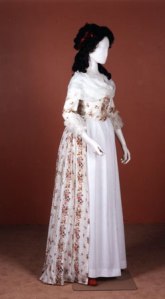
Dress number 2, 18th century, French. Printed cotton. Actually a two-piece item, jacket or bodice and petticoat, this is probably 1790-1800. Dates are good for work and other places in Rhode Island. Problem? It’s French, and there’s no evidence that anything like this was worn in the U.S., much less in New England.

Dress number 3, mid-18th century, American, linen and cotton. The bodice closes edge-to-edge, the back is pleated, and the skirts open. Probably 1775-1785, trending later than 1775 judging by the closed front and the longer sleeves and the style of the cuff. Not OK for Rev War events. Just OK for events at work, but not ideal.

Dress number 4, ca. 1780, from the Scottish National Museums. I have been looking in the National Trust Collections online for an image of the gown that appears in Nancy Bradfield’s book (see below), but to no avail. (I do keep falling asleep at night, and while that doesn’t help, it may be that the dress has not been photographed.) The fun part of this dress is that I have some light-weight Ikea curtains to make a petticoat and  kerchief out of. Also, my hair can get into the crazy hedgehog style practically on its own. But I can document this to Rhode Island 1780-1790?

See the dilemma? Maybe the thing to do is to make the fabric into a banyan for Mr S (that would be a little weird to see on a private soldier in von Steuben camp) and think again about the later styles.

Or maybe the thing to do is to lighten up a tiny bit and make a dress that’s just for fun.

Share this:

  • Share on Facebook (Opens in new window) Facebook
  • Share on Pinterest (Opens in new window) Pinterest
  • Email a link to a friend (Opens in new window) Email
  • Share on X (Opens in new window) X
Like Loading...

On Baskets, and Authenticity

17 Wednesday Oct 2012

Posted by kittycalash in Clothing, Events

≈ 4 Comments

Tags

authenticity, Clothing, common dress, Events, Reenacting, Research, resources, Revolutionary War, Rhode Island


I have been thinking a great deal about Surprise Number 4, issues of authenticity in reenacting, and what is really important. As tempting as it would be to post an image of Surprise Number 4, I remember how ticked I was at the comments about an image of someone’s unkempt tent at Fort Frederick, so I can’t. It would be wrong. I may have missed the Dalai Lama today (HVAC will be my undoing, I think) but I didn’t miss the point about “doing unto others.”

So instead of philosophizing, have some photos.

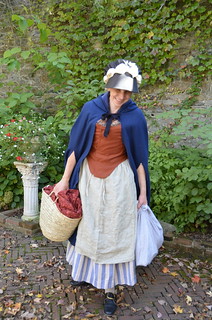
The large one actually captures the entire Kitty Calash family, from Mr S at the right of the rank of soldiers to the Young Mr, in close proximity: a rare sighting indeed. Mr S’s calves stand out nicely in his new overalls, if I say so myself. Two more buttonholes, two more buttons, two more straps and those suckers are done. He did a good job, too, getting them dirty before Nathan Hale.

Yes, that’s my attempt at the “Ale House Door” jacket.  The fit is OK, the style a little late for RevWar, but it’s what I have in wool for now, made from a Wm Booth Draper remnant, and that’s the first wearing of the Sharon Burnston apron.

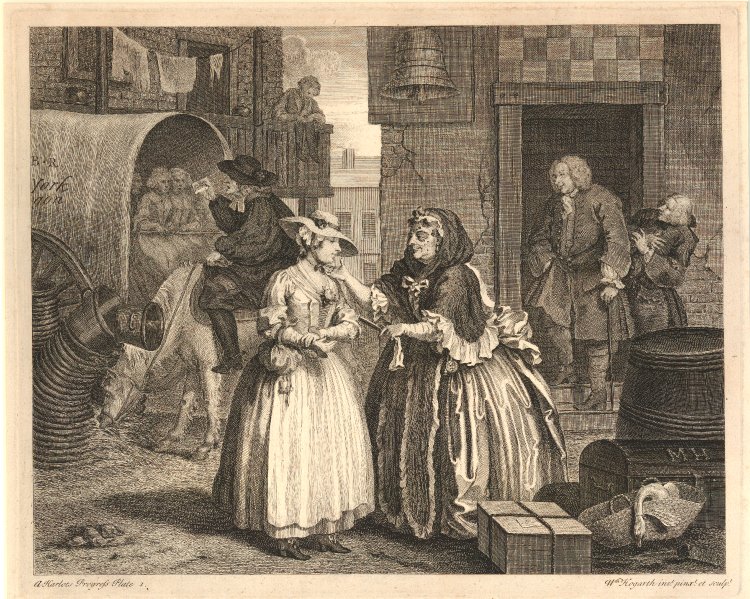
Sew 18th Century has a nice post on baskets, and where to get them, but wondered about the documentation of the market basket. What I can find is 1732, Plate 1 of Hogarth’s series, The Harlots’ Progress, based on Moll Flanders.


Would these have been out of use by 1770? Hard to say—I think I may have seen this form in catchpenny prints, but I have only a print source for those and it’s buried in one of the many stacks of books at home.

Still, I love my newly-arrived basket, ordered from Jeanne Beatrice for $24.

And there I am running away. Coventry, Connecticut, here I come!

Share this:

  • Share on Facebook (Opens in new window) Facebook
  • Share on Pinterest (Opens in new window) Pinterest
  • Email a link to a friend (Opens in new window) Email
  • Share on X (Opens in new window) X
Like Loading...

Images and Ideas

27 Thursday Sep 2012

Posted by kittycalash in Clothing, History

≈ Comments Off on Images and Ideas

Tags

Clothing, preparations, Research, resources, sewing

If the museum date is mutable, what to do? How to take non-illustrated Vogue for the Lower Sorts and turn it into an actual plan for a garment? By using period images.

Anne Carrowle runs away in 1774 in “an India red and black and white calicoe long gown,” but what does that mean?

Start with the negatives: It means she is not wearing a short gown or a bed gown or a jacket. She’s probably wearing what we most commonly think of women wearing, an ankle- or near-ankle length dress, open in the front (remember that the petticoat is described!) that pins to a stomacher or is fastened with bands or a band over a handkerchief.  (Excellent info on the topic At the Sign of the Golden Scissors blog.)

 When I start thinking about a gown for 1774, I start looking for earlier images. Not too much earlier, but a range. In this case, Anne left England in 1769, so 1769-1774 seems like a reasonable time frame. I made a Pinterest board for 1765-1774 ideas, which is easier than posting them all here.

To the left is a robe that’s clearly open: it’s hanging open. Laundry-work, women washing at Sandpit Gate, Paul Sandby, 1765; watercolor. Royal Collection.

1765 gets us closer to the time period, and it is before Anne left England, and it’s likely from the class she was born into. But it is early.

The two prints above are both from 1774; on the left, note the maid’s gown, which hangs open and has robings. On the left, the old woman asleep wears a gown laced over a stomacher.

But best of all perhaps is this image, of Thomas Mifflin and his wife, Sarah Morris Mifflin, painted by Copley in 1773. Thomas Mifflin (1744-1800) and his wife, Sarah Morris Mifflin (1747?-1790), were the only Philadelphians painted by John Singleton Copley. Mifflin was an ardent patriot and by the time this portrait was made, had established himself as a successful merchant; later he rose to the rank of major general in the Continental Army, and was elected the first governor of Pennsylvania after the United States achieved independence.

Why does this work for me? Because these are Philadelphians, and my woman ran away from the Philadelphia area. The detail really shows that Mrs. Mifflin is wearing an open robe with robings and stomacher over a quilted petticoat with a filmy white apron. This is multiple tiers above Anne Carrowle, but the style is what I’m aping, not the materials (obviously silk).

Another Copley portrait, of Mr. and Mrs. Isaac Winslow, depicts a woman in a gown with robings and a stomacher. Jemima Winslow is 41 in the painting, putting the style into my ballpark, and better still, the gown is of a patterned fabric.

Below is a detail of the fabric and stomacher. Though it will be a vastly simplified version, I think I have a model for my dress.

Share this:

  • Share on Facebook (Opens in new window) Facebook
  • Share on Pinterest (Opens in new window) Pinterest
  • Email a link to a friend (Opens in new window) Email
  • Share on X (Opens in new window) X
Like Loading...
← Older posts
Newer posts →

Archives

wordpress statistics

Creative Commons License
Kitty Calash blog by Kirsten Hammerstrom is licensed under a Creative Commons Attribution-NonCommercial-ShareAlike 4.0 International License.

Website Built with WordPress.com.

  • Subscribe Subscribed
    • Kitty Calash
    • Join 621 other subscribers
    • Already have a WordPress.com account? Log in now.
    • Kitty Calash
    • Subscribe Subscribed
    • Sign up
    • Log in
    • Report this content
    • View site in Reader
    • Manage subscriptions
    • Collapse this bar
 

Loading Comments...
 

    %d