
Tags
10th Massachusetts, 18th century, 18th century clothes, common dress, menswear, Revolutionary War, sewing, uniforms

Falling In, OSV 2012
We were invited to join a Massachusetts regiment after the event at Old Sturbridge Village last summer, and we did. This has been a good thing, though it’s sometimes a little tricky to figure out which unit to “be” with. It is also a challenge because even though the Rhode Island unit has careful (if unwritten and slightly out-of-date) standards, the Massachusetts unit is another thing altogether.
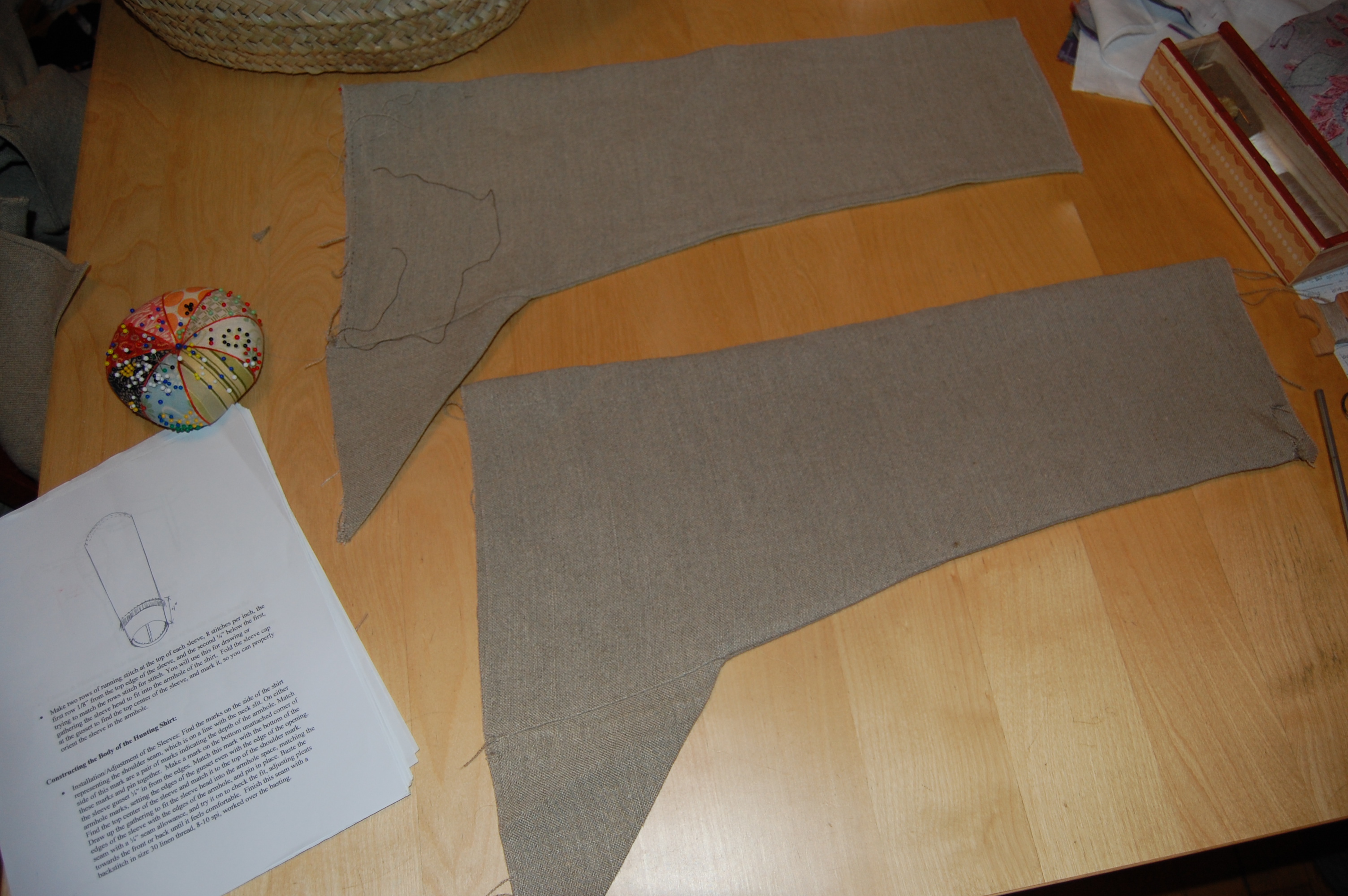
Gathering the sleeve heads. Saturday is soon!
The women last weekend kept asking what I was working on so assiduously. It was the hunting shirt (to become a frock) for the Young Mr for the new unit. Cut by the master, entirely hand-sewn by me. This is not something they would do.
“Sewing for The Adjutant, ” I said, “is another thing altogether.”
“Don’t even try. Who can sew like that? He’s a professional,” I was told.

What we’re aiming for.
Well, yes.
So wouldn’t that be the very thing to reach for? It’s not like he’s not helpful. I have his shirt to copy, he answers my questions patiently, and I haven’t yet felt like an idiot.
The skill I have I owe in part to my mother and grandmother, and to the Dress U workshop with Sharon Burnston. Stroke gathers, two-by-two stitching, using the tiniest needle possible are all things I learned or honed in Sharon’s workshop. And thanks to that workshop, this hunting shirt-(perhaps)-soon-to-be-frock is a great deal easier to tackle.
The other part of skill is practice. It’s as true for piano or soccer as it is for sewing. Just keep stitching, and it will come.
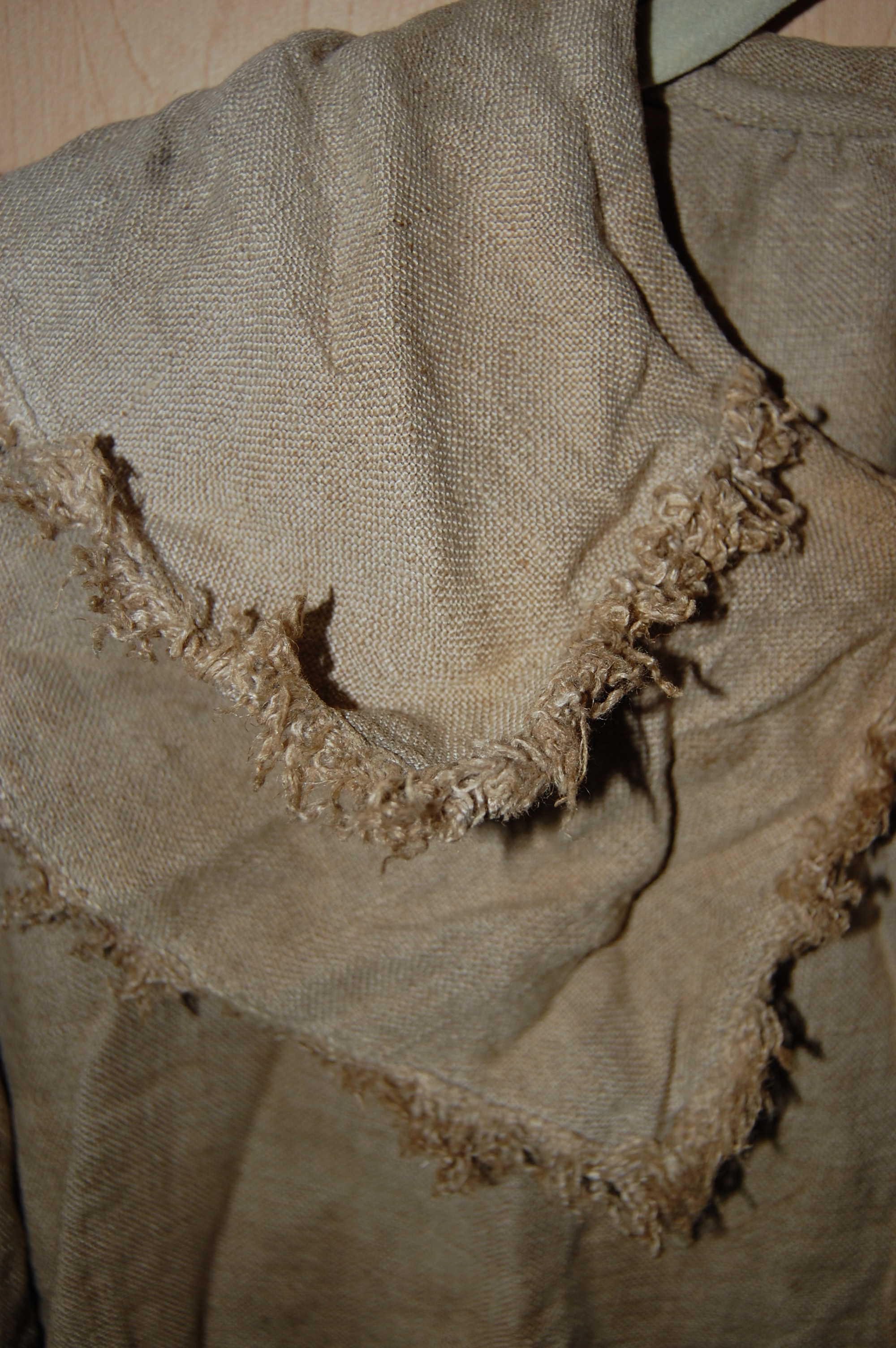
After fitting comes fringing. That’s for someone else to do.
What I find hardest is fit: not only is it hard for me to judge how much to take in a garment to achieve 18th century fit while maintaining enough ease for the wearer to swing an ax (or to accommodate teenage wriggling), alterations annoy me. I suspect that the key may well be not to fit at the end of a day, but at a beginning, or at least a middle. Fitting after a long day of sewing could make you think you were tossing away a whole day of work. It also feels, still, like taking a car to the mechanic or the cat to the vet. There’s something wrong, and I don’t quite understand it. Yet. But with Shoulders Roll Forward and Monkey Arms, I bet I’ll understand more soon.
 Kitty Calash
The apron was a “sampler” project, upon which to practice the stitches, see how that works? Nice to see people putting those sewing techniques to use!
When I made the white linen apron for Battle Road, it wen super fast and was so much better thanks to your workshop. All the projects girls learned stitches on in the 18th century really make sense.
Pingback: The 1763 Project | Kitty Calash