• Home
  • Completed Costumes/Impressions
  • Emma and Her Dresses
  • Free Patterns and Instructions

Kitty Calash

~ Confessions of a Known Bonnet-Wearer

Kitty Calash

Category Archives: Clothing

Bed Gown, my Bed Gown

08 Friday Feb 2019

Posted by kittycalash in Clothing, Events, Living History, Research

≈ Comments Off on Bed Gown, my Bed Gown

Tags

bed gowns, bedgowns, chintz, Research, workshops

The female orators/ M. Rennoldson sculp. etching & engraving on laid paper, hand-colored. 1768. Lewis Walpole Library

I’m teaching a workshop in a few weeks, and that is giving me all kinds of reason to re-examine how I do things, what I know, and how I know it. After a few years, I worry that I take the knowledge I’ve gained for granted– which is a dangerous thing to do! Even when you have the good fortune to be building on the work of notable experts (like Sharon Burnston), you have to fact-check yourself. In part, I did this to verify that the pattern I use will work for the time period in question (last half/quarter of the 18th century). The other question I had was about material and prevalence. I’ve maintained that the bedgown is the most common, cozy, and cute garment of the 18th century, but is that true?

View near the Ring in Hyde Park, looking towards Grosvenor Gate, during the Encampment, Paul Sandby, 1780. Pen and watercolour |RCIN 451581

Many of the images of women in bed-gowns seem to depict older women made deliberately unattractive, poor women with their clothes in rags, or bawdy women. All of those are great in their own way, but most of us want to look our best (even when being our worst). For me, this affects the fabric choices I make. Fabric cheers me up– the varieties of color, texture, pattern make winter bearable, job rejections tolerable, and future plans graspable. I have a predilection for pattern, particularly Indian patterns, so I’m always looking for references to prints and chintz being worn.

Maryland Journal, July 17, 1776

Well, bless Jean Shepherd’s heart for running away (with a “down look”) from York, PA in 1776. She took off in a dark calico bed-gown, a brown worsted petticoat, and a half-worn white pelong bonnet. The images of printed bed gowns I’ve found thus far have light grounds (the yellow of the orators being more light than dark, though certainly saturated).
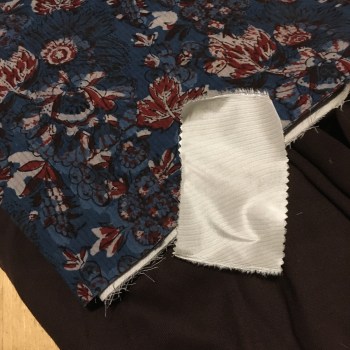
But I can find dark ground cottons, and while what I have is not documented reproduction, I am comfortable with it. The lining will be off-white plain weave wool because it’s winter. I don’t have documentation for this combination but among the fabrics on hand in my reduced-but-accessible Strategic Fabric Reserve, the wool has the best hand and the correct yardage, so wool it is. (It feels like brushed cotton, and was meant for a shift but needs must.)

Blue chintz lining in a man's banyan, 1731 - 1760. Museum of London, 53.101/10
Blue chintz lining in a man’s banyan, 1731 – 1760. Museum of London, 53.101/10
detail, banyan at left.

Newspaper ads for runaways show a fair range of fabrics: red baize; red calico; brown linsey; stamped linen; black and white calico. That last sounds so graphic– and, worn with a black calimanco petticoat, must have been striking. This same woman, Katey Norton, also took with her “an homespun Cotton tight bodied Wrapper” which is appealing indeed– and which I can picture. But that’s another patterning exercise.

Share this:

  • Share on Facebook (Opens in new window) Facebook
  • Share on Pinterest (Opens in new window) Pinterest
  • Email a link to a friend (Opens in new window) Email
  • Share on X (Opens in new window) X
Like Loading...

The Colour of Things to Come

28 Monday Jan 2019

Posted by kittycalash in Clothing, History, Living History, material culture, Reenacting, Research

≈ 5 Comments

Tags

18th century clothing, bonnets, Costume, fashion, French and Indian War, millinery, Research, Revolutionary War

I have a thing for hats– well, for bonnets, really. I know I made stays and a shift before I made anything else for the 18th century, but I might have made a bonnet before I made a proper gown. It’s a condition I inherited from my grandmother, and a great aunt who was a milliner, so there’s little to be done about it– except to dive in deeper.

Miss Theophila Palmer (1757-1848), oil on canvas, attributed to Sir Joshua Reynolds ca 1770. Pretty sure that’s a white “whalebone” or “skeleton” bonnet.

As people do more research and generously share it with me, I’ve come to realize that I need to synthesize what we are seeing. It’s a tricky thing, what with that single (known) extant bonnet at Colonial Williamsburg and only prints and images to go on. What I’ve done to compile a stack of references from newspaper ads (primarily Mid-Atlantic and New England colonies at the moment) and interfiled them with images. This has given me a much better sense of  the change in shapes and construction over time, as well as the range of colours– yes, colours, available and popular.

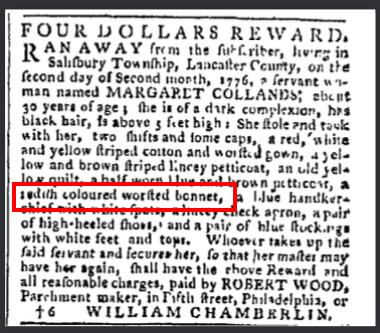
It’s not just that wool bonnets are a thing– there’s the ““a reddish coloured worsted bonnet” in the April 8, 1776 Pennsylvania Packet an ad for runaway Margaret Collands, and the “black durant” recommended in Instructions for Cutting Out Apparel for the Poor– but close reading shows that the colors are more varied than we’ve accept lately, but they vary by region and time period.

The Misses Waldegrave. Are blue bonnets *only* for children? Maybe.

There’s been a rule that “all bonnets are black silk,” which is too broad a statement. Most bonnets are black, that’s true. But in 1768, in Boston, a place where folks would have you think that black is the only colour bonnet you can ever have, you can have “Black, pink, blue and crimson sattin hatts and bonnets” (Joshua Gardner and Com. ad, Boston News-Letter, November 24, 1768).

Heck, if you shopped at Caleb Blanchard, you could have a green bonnet, too! Blanchard advertised “black, blue, green, white and crimson Sattin bonnets” in the Boston Gazette on December 18, 1769.

screen shot 2019-01-26 at 6.56.33 am
screen shot 2019-01-26 at 6.56.22 am
What does this mean? My SWAG is that roughly 60-70% of bonnets should be black. After that, blue, white, red and green would make up the balance. In Philadelphia, green bonnets– and green flowered bonnets– last longer in the ads. Philadelphia is also where I see more white bonnets, a brown silk bonnet, a diaper bonnet, a “queen’s grey” bonnet, and, in Trenton, a “lye coloured” bonnet. In Rhode Island, there’s a blue stuff bonnet. So yes, bonnets should mostly be black. But they can also be other colours.

Share this:

  • Share on Facebook (Opens in new window) Facebook
  • Share on Pinterest (Opens in new window) Pinterest
  • Email a link to a friend (Opens in new window) Email
  • Share on X (Opens in new window) X
Like Loading...

Dresstory: The Turnabout Skirt

12 Wednesday Dec 2018

Posted by kittycalash in Clothing, Dresstory, personal

≈ 3 Comments

Tags

Clothing, Dresstory, memoir, personal, vintage clothing

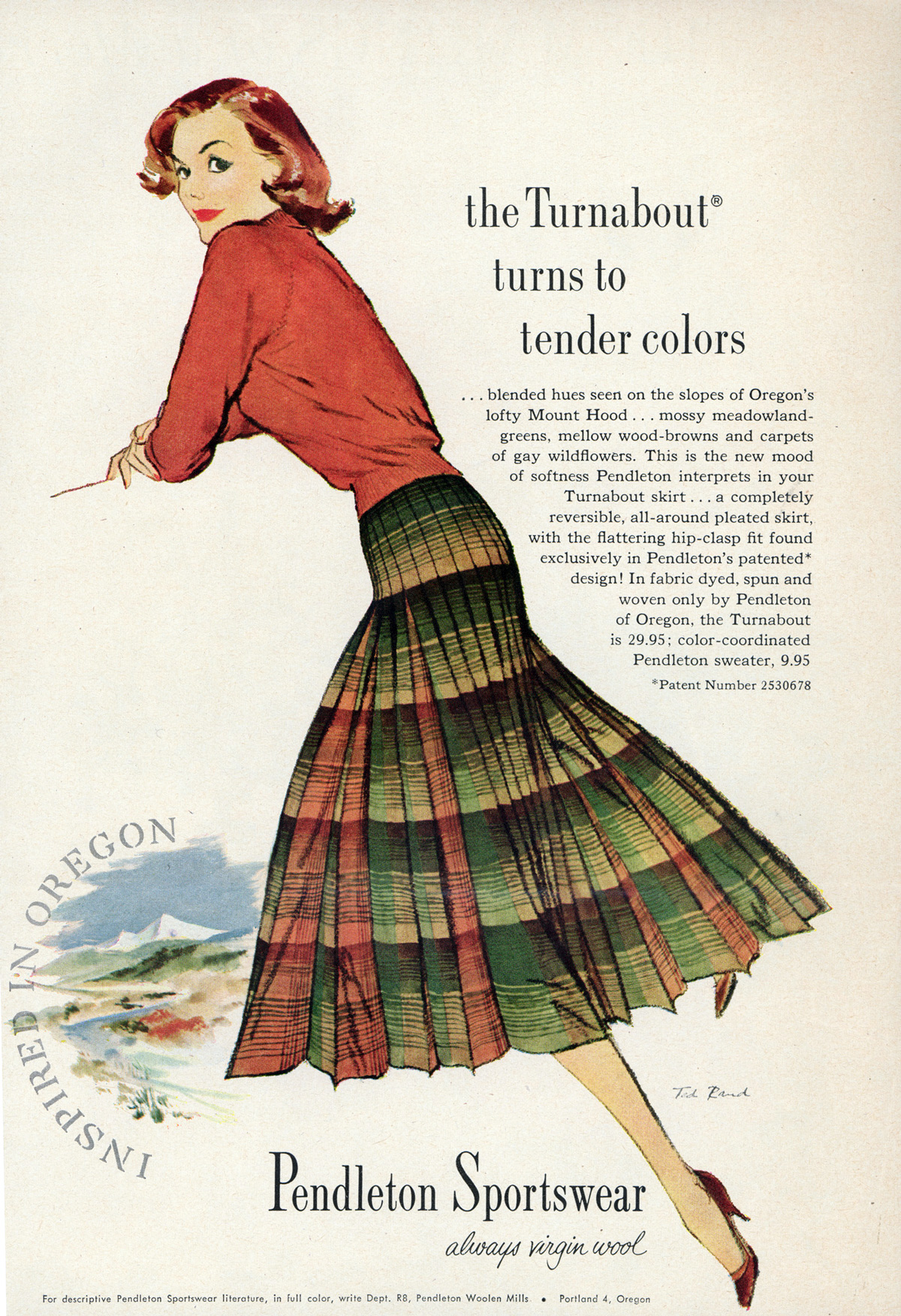
Two first dates, at least, and almost always with boots: the Pendleton plaid reversible pleated “Turnabout” skirt. I bought it in a long-gone shop on Thayer Street in Providence in 1989 or 1990 with money I earned working in the inter-library loan department at the Brown Science Library, the ugliest building on College Hill, until the apartments went in on Brook Street across from the Wheeler School. It would not have been cheap; that is, it probably cost enough to make me think twice, but it was a Pendleton, it was warm, heavy wool, and it fit. The knife pleats opened slightly when I walked, revealing a contrasting color. How could I resist? Practical and pretty, in a fabric more durable than the soles of my shoes, this skirt was made for walking.

The heavy wool was useful in the chilly frame triple-decker flats where I lived and kept the heat low for money’s sake. This would prove useful again, when I moved back west to Saint Louis, and had even less money as a graduate student than an entry-level library employee. Saint Louis had been home before, and the source of much of my vintage wardrobe, though I lost many pieces in a very bad breakup before I had the Green Eyed Lady dress. By the time I started my second round of graduate school, my wardrobe was a melange of slightly professional pieces, vintage clothing, well-worn jeans, and sweaters stolen from my father’s closet. Sometimes I think I must have looked like a walking laundry pile from a disgruntled teenager’s floor, but there I was, 24, and ready to take on anything in my eclectic armor.

IMG_6271
IMG_6273

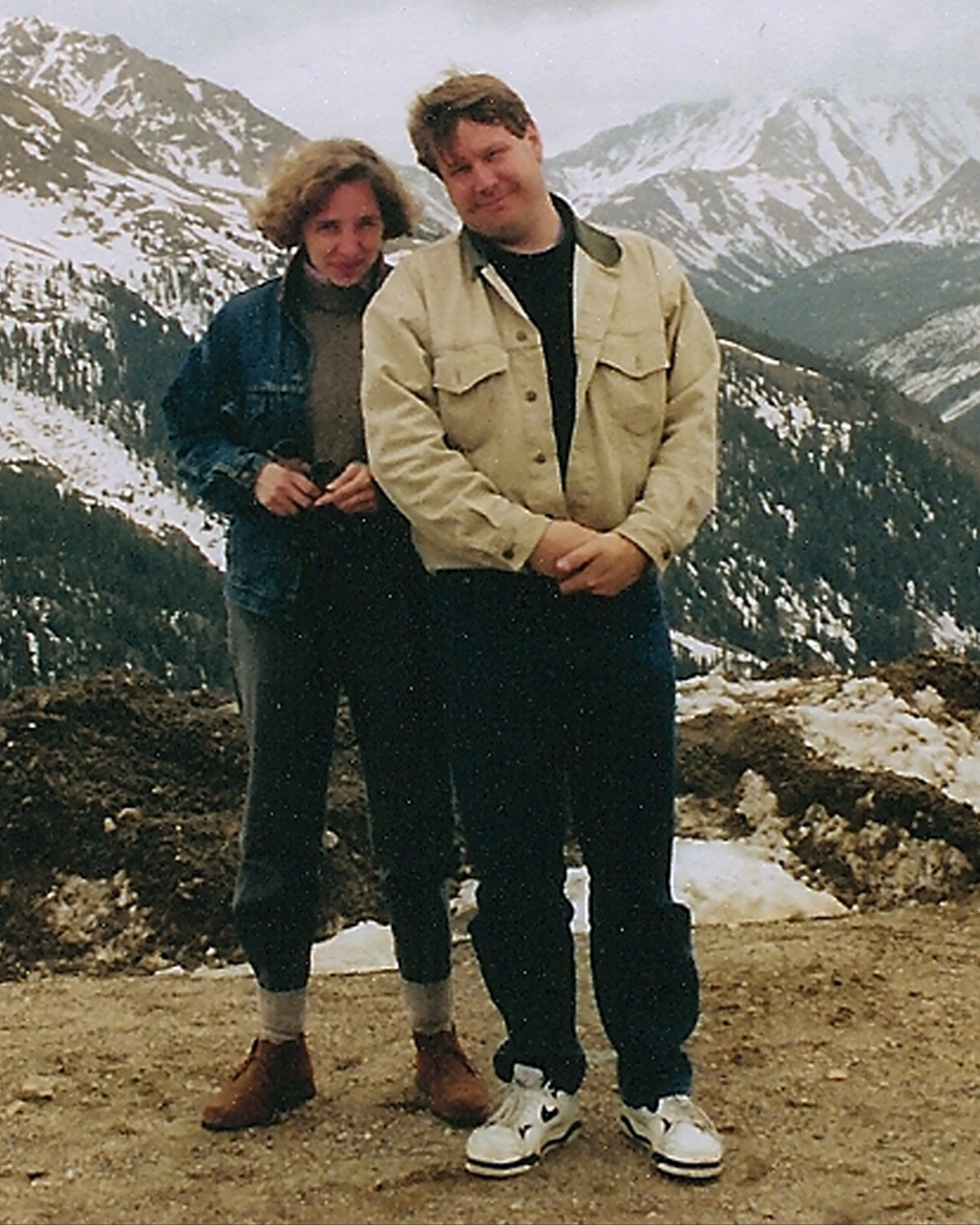
I wasn’t wearing the Turnabout the night I met the man who really broke my heart, but I wore it on our first date the following Saturday when we went for a walk in Tower Grove Park. He was a photographer, living in a second-floor flat on a street named for a river on the near South Side of Saint Louis. I’d known him in college, or known who he was, as he had known who I was. Photography and sculpture were in the same studio building, and even among a group known for being obnoxious, I stood out.

A trip to Colorado

When I met him again late on a November Wednesday, in a partially-converted brewery, I was bored with an art opening, trying to decide whether to get a drink or go home. He stopped in the doorway to survey the gallery, a hazy golden light behind him like a Renaissance painting, so unlike the bruise-blue sky above the bony trees that waved outside my windows. A neon blue line, like the colored lines in a Thiebaud painting, wavered around him.

He talked me into a date that Saturday afternoon, picking me up at the studio so we could take his sandy-haired dog, Cooper, to the park. Cooper, distinguished as the only dog to survive eating both a Hasselblad and a Harris tweed jacket sleeve, kicked up brown leaves as he ran ahead of us. The late autumn light in Saint Louis made anything red more red, highlighting what leaves remained on trees, the painted pavilions, and the folds of my skirt.

His camera malfunctioned on what became a trip through irony

Over the months we dated and eventually lived together, Cooper went on many walks with us, and with me and my dog. I took in strays; my cat had kittens, adding half a dozen more to the three cats we already had. It was lively, and sad, and I proved too much for the photographer, who asked me leave just a few days after giving me a red Trek mountain bike for my birthday. I sold the bike, kept the cats and kittens and the skirt, and moved into my own pre-war flat on a street named for the river I now live near.

We kept being together and not together, so hard to quit seeing each other, like a bad cover of a Gun Club song. But we moved on, encountering each other in the grocery stores of the South Side for years, until I moved back to Providence. Two years later, I read his obituary in the alumni newsletter. I kept the skirt–it still fits, though more snugly than before I had a child. Twenty five years after my date with the photographer, I wore the skirt again on a rainy afternoon date with Drunk Tailor, walking the shore of Narragansett Bay in Colt State Park.

Note: The images of us are poor because they are taken from 35mm color negatives made in 1991, some of which were double exposed when the camera malfunctioned, and not printed until 2008. In the intervening decades, they acquired the dust which appears in the prints and subsequent scans.

Share this:

  • Share on Facebook (Opens in new window) Facebook
  • Share on Pinterest (Opens in new window) Pinterest
  • Email a link to a friend (Opens in new window) Email
  • Share on X (Opens in new window) X
Like Loading...

You Are My Sunshine

10 Monday Dec 2018

Posted by kittycalash in Clothing, Making Things, material culture, Research

≈ 2 Comments

Tags

Federal style, miniatures, portraits, Regency, yellow print fabric

Miniature painting, probably 1815-1820. Private collection.

The best things turn up when I’m looking for something else entirely. First came the miniature, now in a private collection, with the lovely carnelian or coral jewelry and the bright yellow dress. I’ve got some yellow cotton with a red and black print pattern in the cupboard, so this dress seemed within reach.

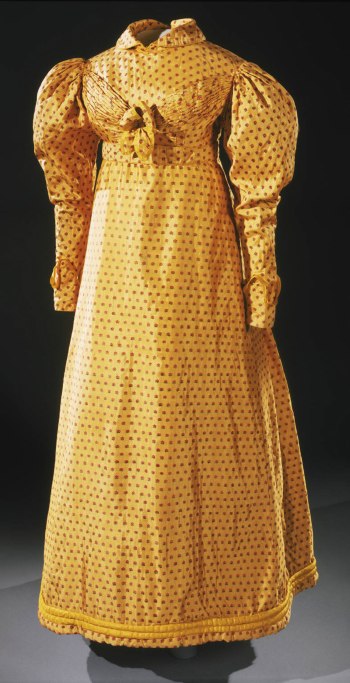
And then, while looking for something else, I found the right fabric! Not that I can buy it, mind you. It’s already owned and in use, in a gown at the Philadelphia Museum of Art. And not that I haven’t spent some quality time searching the interwebs for similar fabric, which can be found if you look hard enough. Fortunately, better sense prevailed and no cupboard will burst with an additional five yards of block printed silk.

Woman’s Day Dress, English, ca. 1820. Yellow silk brocade exported from India. Philadelphia Museum of Art. 1996-164-1a,b

Still, the fun bit is finding two such similar thoughts, one in paint and one in cloth, without even looking. that means there are more bright yellow Federal or Regency gowns out there. All it will take is the looking.

Share this:

  • Share on Facebook (Opens in new window) Facebook
  • Share on Pinterest (Opens in new window) Pinterest
  • Email a link to a friend (Opens in new window) Email
  • Share on X (Opens in new window) X
Like Loading...

Dresstory: The Green Eyed Lady

05 Wednesday Dec 2018

Posted by kittycalash in Clothing, Dresstory, personal

≈ 3 Comments

Tags

1980s, college, Dresstory, fashion, memoir, personal, Saint Louis, style

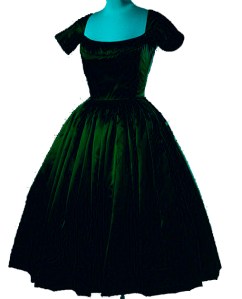
Almost my dress, thanks to PhotoShop

I didn’t know then that it was called changeable silk; what I knew was that the skirt rustled when I walked, and spread out like a plate when I twirled. Irresistible. Probably homemade, I would have found it in a junk shop on South Broadway in St. Louis, or at the Veterans Village thrift store on Natural Bridge Road, a place white girls like me had to be careful (respectful) about going to.

Square neck, tight waist, full skirt, side zip: at one point, I was skinny enough to pull it over my head without opening the zipper, as long as I wiggled just right. The only time I clearly remember wearing the Green Taffeta Party Dress was to the KWUR Student Radio end-of-year party at the Women’s Building on the Washington University Campus. April or May of 1987, probably, though possibly 1986, before I went to Skowhegan on a summer scholarship.

My date was my on-and-off boyfriend, another sculpture major, working on his master’s if it was 1986, and newly graduated if it was 1987. He had a shambling walk, shuffling, a little hunched over, as if 6 feet were too tall for the spaces he occupied, though the city was large enough. Sneakers, jeans, an Army fatigue jacket, a smile waiting for reactions, waiting to deploy. Patrick was the son of a firefighter and a nurse, and I stole him from his college sweetheart.

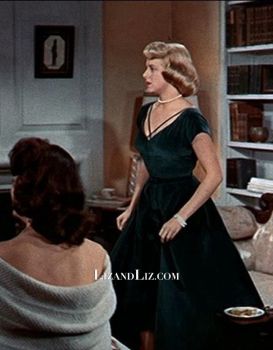
Rosemary Clooney in White Christmas. Velvet, but very similar.

The green of my dress was like the green of his car, dark and forest like. We made installations together, layering found objects and drawings in the small gallery in the studio building where we worked. We drifted into a relationship: his girlfriend visited every weekend, driving up from the smaller college town where they’d met. Red haired, pale-skinned, in burgundy beret, Roslyn sat on a stool and watched Patrick work. Across the wide wood shop, I watched her watching him, and smirked. Reader, I was unkind. My friend Jane and I played Raspberry Beret on repeat every time Rosyln visited, hard to do in the pre-CD era, but we managed.

My style icons at the time were Joe Strummer, the Beastie Boys, and Lydia Lunch and when we weren’t taunting Roslyn with Purple Beret, I was inflicting 8 Eyed Spy on my studio mates. Reader, I was a snob. Paddock boots and ankle-zip jeans; white high tops and baggy Marithe et Francois Girbaud trousers; and the occasional 1950s evening gowns comprised my idea of campus-appropriate dress. My wardrobe came from thrift stores, gifts from my mother and grandmother (the Girbaud trousers), and practical work wear I bought with money I earned in the summers (high tops and paddock boots). In winter, I had a ca. 1950 Army trench coat with a button-in lining, which I insisted upon wearing to a Fortnightly dance in Chicago my senior year of high school. It is amazing my mother lived through all this sartorial humiliation, and amazing, too, that I was harassed as little as I was on the streets of Chicago and Saint Louis.

Wash U Women’s Building. KWUR was in the basement.

The KWUR Prom was in May, though I think of that evening as summer, so I would have needed nothing over the dress. I wore it with a gartered corset, black fishnet stockings, and Johnson motorcycle boots styled like paratroopers boots, leather soles slick from walking, and good for dancing. By May of the year I met Patrick, he’d broken up with Roslyn. We started making art together on a dare, and in our rambles collecting window screens, broken chairs, old medicine cabinets and other detritus, we grew closer, stopped being adversarial and became friends, and then lovers, until we were not. I wonder about Roslyn sometimes, and what became of her; I know where Patrick is, though we have not spoken since 1991. I broke his heart, for a time, after he broke mine, and now he lives where I began.

Share this:

  • Share on Facebook (Opens in new window) Facebook
  • Share on Pinterest (Opens in new window) Pinterest
  • Email a link to a friend (Opens in new window) Email
  • Share on X (Opens in new window) X
Like Loading...
← Older posts
Newer posts →

Archives

wordpress statistics

Creative Commons License
Kitty Calash blog by Kirsten Hammerstrom is licensed under a Creative Commons Attribution-NonCommercial-ShareAlike 4.0 International License.

Website Built with WordPress.com.

  • Subscribe Subscribed
    • Kitty Calash
    • Join 621 other subscribers
    • Already have a WordPress.com account? Log in now.
    • Kitty Calash
    • Subscribe Subscribed
    • Sign up
    • Log in
    • Report this content
    • View site in Reader
    • Manage subscriptions
    • Collapse this bar
 

Loading Comments...
 

    %d