• Home
  • Completed Costumes/Impressions
  • Emma and Her Dresses
  • Free Patterns and Instructions

Kitty Calash

~ Confessions of a Known Bonnet-Wearer

Kitty Calash

Category Archives: Museums

Tentage

26 Friday Jul 2013

Posted by kittycalash in Events, Living History, Making Things, Museums, Research

≈ Comments Off on Tentage

Tags

18th century, authenticity, common soldier, Reenacting, resources, Revolutionary War, tents

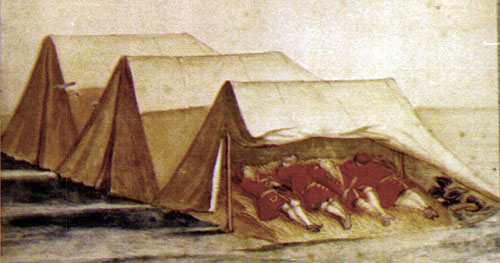
Scene of the Camp on Hampton Green, 1781

Scene of the Camp on Hampton Green, 1781

Like many other reenactors/living historians/suckers for wool in summer, I’ve been following the First Oval Office project with interest and envy. Imagine my delight upon finding this blog by Tyler Rudd Putman, who is working on that and many other projects of interest.
The common tent project l is one that I really do hope to take on someday, though I doubt I can ever achieve a tent of this level of quality. (Reader, I cannot weave.) But I can aspire, at the least, and I see that a hand-sewn tent is something even I can achieve. It won’t get done by me in just one day, but over the course of several weeks I could get one done as long as I cleared the downstairs of all our furniture, and put up with a cat sewn into a seam. (My assistant has been lying down on the job, melting in the heat.)

The Howling Assistant Lies Down on the Job

I’ve been thinking about tents since the after-dark hilarity at Monmouth setting up an unknown tent in the dark with a brittle pole that had to be repaired with string from a pasty wrapper, and the later perhaps over-zealous cleaning by Mr S of the tent abused by a cat and identified on the NJ turnpike’s extended play of “What the Hell’s that Smell?”

I’m not sure why we’re allowed to remain in our regiments, really, I am not. But I suspect that an ability to produce Chesire Pork pie is a factor in our favor.

We’ll be setting up tents at OSV in just about a week, broken pole and all, and looking ahead to that, I give you the following links for further reading on tents.

John U. Rees on tents in both armies of the Revolution.

How to fold a tent.

Period (British) images.

Even more documentaton: scrolling down, Rhode Islan had a return of 147 tents in May, 1781– that’s about 882 soldiers, at 6 men per tent, a max of 1029 at 7 men per tent. (At least one is always on duty, so there would not be more than 5 or 6 sleeping at any one time).

Amazing and image-rich essay, The Tent Article

Lochee, Essay on Castremetation, which I read and forget by the time it is dark and some man is trying to reason with me about how a camp should be arranged, when all I want to do is sleep. With that in mind, a brush arbor is starting to look good…
Share this:

  • Share on Facebook (Opens in new window) Facebook
  • Share on Pinterest (Opens in new window) Pinterest
  • Email a link to a friend (Opens in new window) Email
  • Share on X (Opens in new window) X
Like Loading...

Sewing for Zombies

13 Saturday Jul 2013

Posted by kittycalash in Clothing, Events, Making Things, Museums

≈ 4 Comments

Tags

18th century clothes, common dress, fashion, menswear, museum collections, Reenacting, Revolutionary War

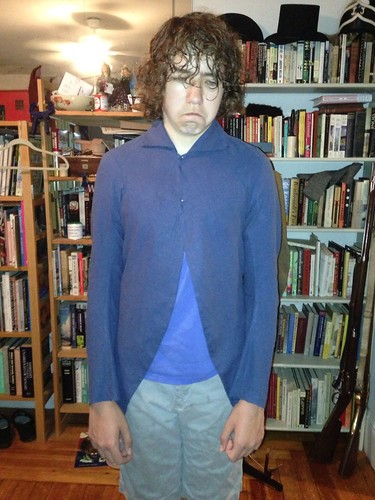
Death by Fitting

He doesn’t always look this horrible, but when the Young Mr sets out to look like death, he does it very well. Dressing 18th Century style comes at the price of fittings, and while we like to cut a fine enough figure at an event, we want no part whatsoever of the process. Even the promise of playing with a dog won’t get us to a fitting. And he dearly wants a dog…so you know fittings are a trial.

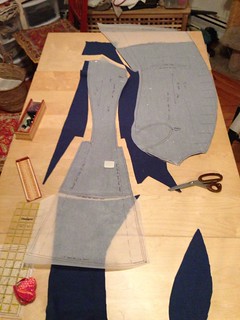
Cutting Out on Sunday

The pattern is by Henry Cooke, based on both a Rhode Island original in a private collection and a jacket in the collection of the Connecticut Historical Society. It is solidly 1770s-1780s, unlined, and both originals made up in brown linen. (From the pattern notes and what I know of the CHS jacket, accession number 1981.110.0; their catalog links are unstable, search for 1981.110.0.)

It goes together well; I started without directions, but as I am more idiot than savant, I got myself confused. I did have to alter the sleeve for the Young Mr, as he has long, thin arms. The rest of the pattern seemed to fit him pretty well, all in all, but a few untoward things happened between measuring, mock-up, basting and fitting. Still, it can be worn, with improvements made next week after he wears it in Cambridge this Sunday. 

Share this:

  • Share on Facebook (Opens in new window) Facebook
  • Share on Pinterest (Opens in new window) Pinterest
  • Email a link to a friend (Opens in new window) Email
  • Share on X (Opens in new window) X
Like Loading...

More Banyan Business

12 Friday Jul 2013

Posted by kittycalash in Clothing, History, Museums

≈ Comments Off on More Banyan Business

Tags

18th century clothes, banyan, Clothing, fashion, menswear, Museums, RISD Museum of Art

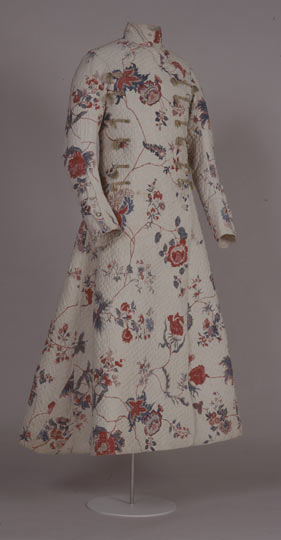
Prince of Wales' banyan, ca. 1780. Royal Pavilion & Museums, Brighton. ID CT002728

Prince of Wales’ banyan, ca. 1780. Royal Pavilion & Museums, Brighton. ID CT002728

Soooo, what about that banyan?

Cotton chintz printed in red, brown and purple with blue pencil. Batting seems to be cotton by the way it has bunched in the diamonds, but I expected wool. If it is wool, it is super fine lambs’ wool. Since it was for the Prince of Wales, I think that’s possible.

The mariner’s cuffs are pieced onto the end of the sleeves, reducing bulk (no double layer). The buttons at the cuffs are round, domed, self-covered buttons.

The double breasted closure is made with multi-colored silk braid frogs and silk dome-shaped buttons.

The collar is quilted, too.

The center back seam does not bother to match the pattern; it’s just sewn up the center.

Triangular piecing at the side seams helps give this flair in the skirts. You can see this in the photo at left.

The sleeves are set in, two-piece sleeves typical of menswear.

That’s everything I can remember from my visit on Saturday with Sew 18th Century. I really do have to go back with a notebook and a stool!

Share this:

  • Share on Facebook (Opens in new window) Facebook
  • Share on Pinterest (Opens in new window) Pinterest
  • Email a link to a friend (Opens in new window) Email
  • Share on X (Opens in new window) X
Like Loading...

One Hot Banyan

11 Thursday Jul 2013

Posted by kittycalash in Clothing, History, Museums

≈ 1 Comment

Tags

18th century clothes, Costume, exhibits, fashion, Museums, Research, resources

Prince of Wales' banyan, ca. 1780. Royal Pavilion & Museums, Brighton. ID CT002728

Prince of Wales’ banyan, ca. 1780. Royal Pavilion & Museums, Brighton. ID CT002728

Alert! This item is currently on display at the RISD Museum of Art in Providence, through August 18, 2013. I have been to see it twice now.

As much as I am itching to get this on a table and investigate it, I am limited to craning my neck and squatting in front of the case. Awesomeness in cotton, this banyan has a five-button mariner’s cuff with a double arc like a broken pediment on a chest-on-chest. It would be a crazy thing for a Continental private to come strolling out of a tent in, not to mention impossible to make before the next camping excursion, but holy cats! that’s one fine banyan.

The RISD Museum is free on Sundays. You, too, can entertain the guards by craning your neck–photography is not allowed. Next visit: sketchbook.

There are a lot of other wonderful things to see, too–silk jersey breeches I expect to see on a colleague at some point, an indigo silk frock coat, the greatest great coat ever, and Fred Astaire’s tails, as well as a small section that I think does everything PUNK wanted but failed to do.

Share this:

  • Share on Facebook (Opens in new window) Facebook
  • Share on Pinterest (Opens in new window) Pinterest
  • Email a link to a friend (Opens in new window) Email
  • Share on X (Opens in new window) X
Like Loading...

[Another] Wild & Crazy Idea

07 Friday Jun 2013

Posted by kittycalash in 1841 Flash Mob, Clothing, Events, Museums, Research

≈ 2 Comments

Tags

1841 Flash Mob

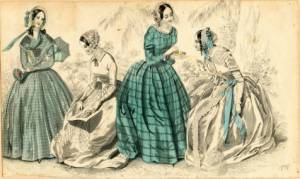
Fashions, 1841. Fashion Plate Collection, Ella Strong Denison Library, Claremont College

Fashions, 1841. Fashion Plate Collection, Ella Strong Denison Library, Claremont College

Perhaps the Young Mr is correct: I may be crazy.

I have agreed to, at the very least, explore a project and grant funding to recreate an April 17 1841 Suffrage Parade for my workplace. We still have to decide to what lengths we’ll go, but the idea is so appealing that I want to give it a shot. (Orator positions opening soon?)

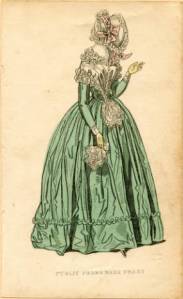
Public promenade dress, 1842. Claremont College

Public promenade dress, 1842. Fashion Plate Collection, Ella Strong Denison Library, Claremont College

Why is this crazy? Another year-specific event, with the event part to organize, plus wardrobe for at least some people? Pure madness, utter delight. Blame it on the Godey’s Lady’s Magazine paper dolls I bought at the Chicago Historical Society all those years ago. It could even mean another corset, and we all know how much I love making corsets. But I was thinking about how at my age in 1841 I’d be accustomed to an earlier style…but the key, as always, is looking. And looking tells me I need more of a waist than I can perhaps achieve with the stays I have in hand.

To my Pinterest board (thanks for so many wonderful leads, Cassidy) mix of extant garments and accessories, I’ve been pinning from fashion plate collections, including the well-cataloged collection at Claremont College Library.

Fashion plates are one of the sources you have to be careful with. Like Vogue, in fact exactly like Vogue, these are high-style images that are as mannered in their rendering as fashion images are today. Waists will be slimmer and skirts rounder, but the silhouette and shapes will be recognizable in extant garments, painted portraits, and thankfully, photography.

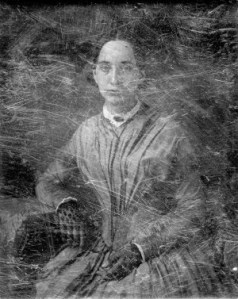
Mrs. Thomas Easterly. Daguerreotype by Thomas M. Easterly. Missouri Historical Society, PHO:17434

Mrs. Thomas Easterly. Daguerreotype by Thomas M. Easterly. Missouri Historical Society, PHO:17434

The year of the Suffrage March, 1841, is early for photography but not impossible (thank you, M. Daguerre). It’s not the right state, but there is a fantastic collection of images in Missouri. These portraits give a good sense of what people were actually wearing, and what shape their bodies took inside their stays and corsets. (Hot tip: don’t clear daguerreotypes with Scotch-brite pads.)

This is, really, a mad scheme that goes far beyond dress. But a banner painted with an ox and the slogan “I die for Liberty” carried by butchers? A wagonload of disenfranchised Revolutionary War veterans? Enlisting students (not in costume) to follow along behind costumed interpreters marching the known route of the 1841 parade? It’s too tempting not to try.

Bonus: Patterns and plaid!

Share this:

  • Share on Facebook (Opens in new window) Facebook
  • Share on Pinterest (Opens in new window) Pinterest
  • Email a link to a friend (Opens in new window) Email
  • Share on X (Opens in new window) X
Like Loading...
← Older posts
Newer posts →

Archives

wordpress statistics

Creative Commons License
Kitty Calash blog by Kirsten Hammerstrom is licensed under a Creative Commons Attribution-NonCommercial-ShareAlike 4.0 International License.

Website Built with WordPress.com.

  • Subscribe Subscribed
    • Kitty Calash
    • Join 621 other subscribers
    • Already have a WordPress.com account? Log in now.
    • Kitty Calash
    • Subscribe Subscribed
    • Sign up
    • Log in
    • Report this content
    • View site in Reader
    • Manage subscriptions
    • Collapse this bar
 

Loading Comments...
 

    %d