• Home
  • Completed Costumes/Impressions
  • Emma and Her Dresses
  • Free Patterns and Instructions

Kitty Calash

~ Confessions of a Known Bonnet-Wearer

Kitty Calash

Category Archives: Museums

Mrs Pabodie, I presume?

16 Wednesday Nov 2016

Posted by kittycalash in Clothing, History, Living History, Museums, Pabodie Project

≈ 1 Comment

Tags

18th century clothes, 18th century clothing, 19th century clothing, dress, fashion, Federal style, interpretation, Research, Rhode Island Historical Society
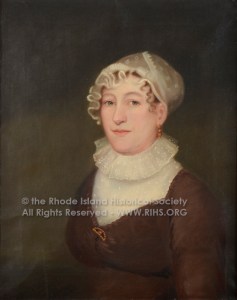
Mrs William (Jane) Pabodie. oil on canvas, 1813. RIHS 1970.60.2

Mrs William (Jane) Pabodie. oil on canvas, 1813. RIHS 1970.60.2

Remember Mrs Pabodie? She appeared a week ago today in Providence after an intense sewing effort left your author with numb fingers. The process was as straightforward as these things ever are, manipulating fabrics to do your bidding once you think you have the right materials.

It took more rounds of white muslins from Burnley and Trowbridge than I care to count, and a variety of book muslins from Wm Booth Draper, just for the chemisette and cap. The laces came from Farmhouse Fabrics in the most expensive small package I’ve yet ordered that did not contain antique jewelry.

Mrs Pabodie attempts to remember when she was born (1771). Photo by J. D. Kay

Mrs Pabodie attempts to remember when she was born (1771). Photo by J. D. Kay

The gown is a wool and silk blend remnant from Wm Booth Draper, just enough to make a gown (even at my height) though I admit the front hem will need some piecing or a ruffle to give it the proper length. Still, the thing more or less works, though as I compare the details to the original painting, I admit we’re still in beta.

Impressed from Newport-- or nearly so-- Low Spark makes his Providence debut. Photo by J.D. Kay
Impressed from Newport– or nearly so– Low Spark makes his Providence debut. Photo by J.D. Kay
Reverend Hitchcock, hoping against hope that the tailor will one day finish his fine silk waistcoat. Photo by J. D. Kay
Sissieretta Jones extols the beauties of Paris-- and pearls. Photo by J. D. Kay
Sissieretta Jones extols the beauties of Paris– and pearls. Photo by J. D. Kay

I was joined by three friends from different eras (because you know me: if it’s not didactic, we’re not doing it): a sailor who on the run from a Newport press gang in 1765; Reverend Enos Hitchcock of the Beneficient Congregational Church in 1785; and Sissieretta Jones, soprano of Providence, around 1880. Each of the characters described their lives and their clothing, and I will admit that the Annual Meeting audience may not have been fully prepared for some of what they heard– I’m not certain they had ever considered how apt “balancing a sheep on my head” might be in describing Reverend Hitchcock’s wig.

Mrs Pabodie points out East Side landmarks to a visitor examining the theatre curtain backdrop painted around 1810. Photo by J. D. Kay

Mrs Pabodie points out East Side landmarks to a visitor examining the theatre curtain backdrop painted around 1810. Photo by J. D. Kay

In the end, they were entertained, and may even have learned something, as we celebrated 2016’s interpretive theme, Fashioning Rhode Island.
Share this:

  • Share on Facebook (Opens in new window) Facebook
  • Share on Pinterest (Opens in new window) Pinterest
  • Email a link to a friend (Opens in new window) Email
  • Share on X (Opens in new window) X
Like Loading...

Now Left

13 Sunday Nov 2016

Posted by kittycalash in Events, History, Living History, Museums, Reenacting

≈ Comments Off on Now Left

Tags

authenticity, Fort Ticonderoga, living history, military events, progressive reenacting, Revolutionary War, women's history, women's work

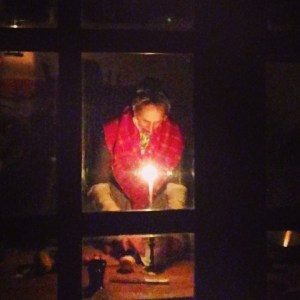
Through the barracks window on Friday night. Photo by Eliza West.

Through the barracks window on Friday night. Photo by Eliza West.

While for some events there are no second chances, Fitzgerald himself knew it wasn’t true that there are no acts in American lives.  And so it is with Fort Ticonderoga, changing hands several times throughout its existence, until British troops, retreating in 1777, did their best to raze the structure.

A day after participating in the “Now Left to their Own Defense” event at the Fort, I feel a bit destroyed myself, in the best possible way. (It isn’t history till it hurts, but sometimes cold nights on straw-filled ticks get into what’s left of my hip bones.)

Women at work.

Women at work. Photo by M.S.

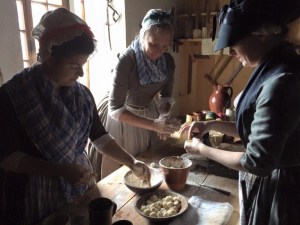
Every trip to Ti teaches me something new. This time, against all odds, it was cooking. Against all odds because I usually object to reinforcing gender norms at living history events, particularly in a military setting, when women did not typically cook for mens’ messes. Fort Ti is different: both times I have cooked there, it has been as part of the women’s mess.

img_8435

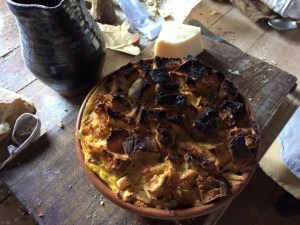
Done! And no, it didn’t taste burnt. Photo by M.S.

This past Saturday, we may have gone a bit overboard, but we justified our efforts with the thought that Loyalist women would not only have used up all the supplies they could (waste not, want not) before retreating, but that they might also have striven for normal activity and to prove their worth to men whose protection they needed.

To that end, we made bread pudding. I’m a fan of Indian pudding and rice pudding, but I’ve never made a bread pudding, despite the similarity of these starch-and-custard concoctions. I like to think that rather than having reached a “throw reason and caution to the winds” point, I have, like any good 18th century cook, become comfortable enough not to rely on measuring cups but rather trust my eye and experience. Enablers help, of course, and I had the pleasure of spending my day with some of my favorites and meeting new ones, too.

Share this:

  • Share on Facebook (Opens in new window) Facebook
  • Share on Pinterest (Opens in new window) Pinterest
  • Email a link to a friend (Opens in new window) Email
  • Share on X (Opens in new window) X
Like Loading...

A Giant One-Night Stand

26 Wednesday Oct 2016

Posted by kittycalash in Events, History, Living History, Museums, Philosophy, Reenacting

≈ 4 Comments

Tags

anarchist guide to historic house museums, authenticity, experimental archaeology, first person interpretation, historic house museums, interpretation, John Brown House Museum, Rhode Island history, What Cheer Day

Drunk Tailor’s told you some of the story, and Our Girl History a little bit more, but here we specialize in confessions, so let’s begin.

One night stands: no, not that kind, this kind: the Anarchist kind. I’ve been following Mr Vagnone’s work for some time now, and while museum professionals are not all in agreement about his techniques and approaches, I find them intriguing and thought provoking. I’ve also found that the best way to accomplish anything is by baby steps, as annoying as that can be. That’s how we got to this What Cheer Day: incremental progress over a five-year period. What was so different? Well….

Jimmie and Billie, unwell and unable to dress themselves without Gideon's aid. Photograph by J. D. Kay

Jimmie and Billie, unwell and unable to dress themselves without Gideon’s aid. Photograph by J. D. Kay

To begin with, we slept in the house. Eight of us. In the period beds and on the period sofas. No harm came to anything, except the gentlemen, who seem to have contracted mild, possibly mold-based, ailments from ancient feather beds.*

img_8303

We scampered around the enormous house (I swear the front hallway would contain my entire flat, both floors!) in bare feet and period night clothes. I has a regret about that, because the floors could be cleaner, and I forgot to ask for my slippers back.  

Anyway:

Big house. Dark night. Flickering candles. Rain storm. Cantonware cider jug.

Mind blowing.

Why? Why do it? Why risk it? Why, when I’ve been there after dark? Why, when I’ve slept in other historic houses and historic beds? Because to really understand someone, you have to walk in their shoes– or sleep in their bed, as the case may be.

Goody Morris makes up a bed. Photograph by J. D. Kay

Goody Morris makes up a bed. Photograph by J. D. Kay

I lay in bed in an enormous mansion house, the first one built on the hill in Providence, completed in 1788. Almost every week, I tell the story of the house, the family moving, James complaining about the June heat as he walked up the hill from Water Street to move into the new brick edifice. I tell the story of Abby’s wedding, the longways dances on the second floor of the unfinished house, candles and dancers glittering in the enormous mirrors at either end of adjoining rooms. But I’d never seen it. I’d never heard it. I’d never really thought about service circulation and stealthy maneuverings in the house.

Now I have.

Now I have lain in the enveloping warmth of a feather bed and heard the rain pouring outside, and nothing else. I’ve heard the deep quiet of thick brick walls. I’ve seen the utter darkness of the house at night, and, padding up the stairs to bathroom, been comforted by the presence of my companions even as they failed to sleep across the hall.**

A dreadful night: almost too much to bear. Photograph by J. D. Kay.

A dreadful night: almost too much to bear. Photograph by J. D. Kay.

To enter the room as a maid, I’ve used the doorway from the former service stairs, and silently carried in a jug to serve the occupants. I’ve gotten closer to the near-invisible role of servants, in a period when full invisibility hasn’t yet been established. I’ve watched someone I love sleep off a migraine in a room where we interpret illness and 18th century medicine.

Best Maid/Bad Maid.  Photograph by J. D. Kay

Best Maid/Bad Maid. Photograph by J. D. Kay

All of that is mundane. And because I did all of that in a historic house with period furnishings, all of that is magical. My job now is take what I have learned and felt, and find new ways to use those personal experiences to connect our visitors’ personal experiences to a larger (and a smaller) story about Providence, early Federal Rhode Island, and a family.


* Most amazingly comfortable feather beds ever. Drunk Tailor’s review is unprintable on a family blog, but hilarious.

** Sorry about that… I slept pretty well, considering.

Share this:

  • Share on Facebook (Opens in new window) Facebook
  • Share on Pinterest (Opens in new window) Pinterest
  • Email a link to a friend (Opens in new window) Email
  • Share on X (Opens in new window) X
Like Loading...

What Cheer Day: Emotional Goals and Historical Content

25 Tuesday Oct 2016

Posted by kittycalash in Events, History, Living History, Museums, Philosophy, Reenacting

≈ 6 Comments

Tags

authenticity, emotions, first person interpretation, historic house museums, interpretation, John Brown House Museum, museum practice, Rhode Island Historical Society, What Cheer Day

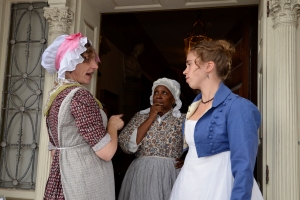
Petulant Alice faces her first hurdle, Kitty and Goody Morris. Photograph by J. D. Kay

Petulant Alice faces her first hurdle, Kitty and Goody Morris. Photograph by J. D. Kay

I think about three or four things most of the time: food, sex, museums, and clothes. That seems pretty adequate, but from time to time I am forced to consider intersections between these rather broad topics. The intersectionality of clothing and museums seems pretty obvious: from accurate costumed interpretation to proper packing and storage, easy. Food and museums will be much on my mind in the coming year, as we work on “Relishing Rhode Island,” and I’m continually harping on how eating locally and seasonally is the core of eating historically. Sex and museums is a little harder (yes, I know about the Museum of Sex), though one gets a chance even in a historic house museum, and really, it’s not just about the act: it’s about the feels.

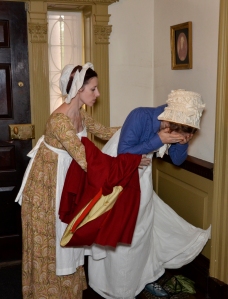
Mary assists Alice in the hallway as she prepares to face her mother. Photograph by J. D. Kay

Mary assists Alice in the hallway as she prepares to face her mother. Photograph by J. D. Kay

In the main, I am not particularly good at the feels aside from some very hands-on experience with anxiety, but a number of things have coalesced recently to make me reconsider the intersection of emotions, museums, and history.

Hamilton is one, and if you read this, you probably watched the Hamilton’s America documentary  on PBS last Friday. If you didn’t, go do it now. Really: I can wait. And here’s why:

In the thinking I’ve been doing for some time about Hamilton,* I’ve reached the conclusion that what makes it so damn good (aside from the brilliant writing) is how Lin-Manuel Miranda has captured the emotions. The quotes I wrote down from the documentary are about emotion and drama, because I’m looking for them (confirmation bias for the win) but here they are:

“Each piece of music is specific to an emotion and a character”

“I got into the history through the characters”

“Research is over and you write the character defined by history”

“Write the parts you think are a musical”

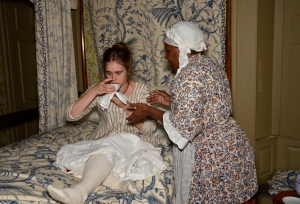
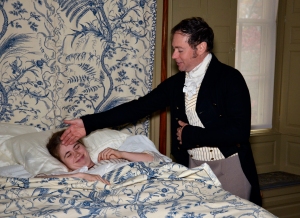
Goody Morris helps Alice drink lemon water to soothe her stomach. Photograph by J. D. Kay

Goody Morris helps Alice drink lemon water to soothe her stomach. Photograph by J. D. Kay

What is a museum exhibit but “the parts you think are a musical?” While Our Girl History struggled with being Alice (I know a bit about the part where your ego gets connected to a character), she had to portray a character defined by history, but also by emotion. And in thinking about Hamilton, about What Cheer Day, and about the exhibits that give me pleasure, and art that brings me joy, I have reached a couple of conclusions.

I believe that museums, where we currently set educational and interpretive goals, and increasingly experiential goals, need to begin setting emotional goals for their programs and exhibitions. You could argue that experiential and emotional goals are the same, but I disagree: I believe that interpretation helps define the experiences that create emotional responses, and within the intersection of experience and emotion we will find the educational goal revealed, because we are always working within a content-driven context.

James checks on sister Alice. Photograph by J. D. Kay

James checks on sister Alice. Photograph by J. D. Kay

I also believe the reason gun-based reenactments retain their popularity is their easy emotions. “Boom!” is exciting anywhere: there’s an immediate reaction of shock, surprise, a mild fear, and excitement. Traditional reenactments have those “boom!” emotions embedded within them, which is how they retain their potency. Until we locate the emotion within the everyday– and trust me, it’s there– we will not see the primacy of non-military reenactments and living history.

*Yes, I was aware of it when it was in previews at the Public Theatre. I am *that* kind of hipster, but really, it was because Oscar Eustis went from Trinity Rep here to the Public and there’s a PVD-NYC theatre connection.

Share this:

  • Share on Facebook (Opens in new window) Facebook
  • Share on Pinterest (Opens in new window) Pinterest
  • Email a link to a friend (Opens in new window) Email
  • Share on X (Opens in new window) X
Like Loading...

What Cheer! Week

19 Wednesday Oct 2016

Posted by kittycalash in Events, Living History, Museums

≈ Comments Off on What Cheer! Week

Tags

first person interpretation, interpretation, living history, Museums, Rhode Island Historical Society, Rhode Island history, What Cheer Day

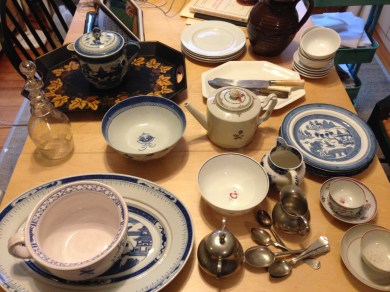
It takes a lot of china to serve a family.

It takes a lot of china to serve a family.

What Cheer! Wednesday: that’s today, with a preview of What Cheer Day itself as props are distributed through the house, the display cases open for viewing and a talk and demonstration of early Federal-era fashion in Rhode Island at 2:30 today. Or not— since we have another program at 4:00. At least I found out before lunchtime.

It’s not the first time I’ve packed a day as full as possible– in fact, I know more is possible, because I’ve done it.

A maid and her mistress

A maid and her mistress

Yesterday, in addition to packing up a small household for use on Saturday, m’colleague and I dressed two mannequins– well, one and a half, since the mistress still needs some work. I don’t know how I forgot the second petticoat when it was right there on my list, but so it goes. Mannequin dressing will finish this morning for this afternoon’s free talk and demonstration.

Saturday, though: that’s the really exciting day, when Alice tries to sneak past her mother after staying out all night at a party. Julia Bowen may not be the good influence we thought she was, if her uncle is anything to judge by.

img_8278

The fun starts at 1:00 PM and runs until 6:00, so we can take advantage of what we learned for After Dark. Extending the life of program research: is there anything better? Maybe a new Spencer, finally completed after more than a year. The weather promises to be chilly enough to make a Spencer necessary, not that I could resist flashing buttons anyway.

Share this:

  • Share on Facebook (Opens in new window) Facebook
  • Share on Pinterest (Opens in new window) Pinterest
  • Email a link to a friend (Opens in new window) Email
  • Share on X (Opens in new window) X
Like Loading...
← Older posts
Newer posts →

Archives

wordpress statistics

Creative Commons License
Kitty Calash blog by Kirsten Hammerstrom is licensed under a Creative Commons Attribution-NonCommercial-ShareAlike 4.0 International License.

Website Built with WordPress.com.

  • Subscribe Subscribed
    • Kitty Calash
    • Join 621 other subscribers
    • Already have a WordPress.com account? Log in now.
    • Kitty Calash
    • Subscribe Subscribed
    • Sign up
    • Log in
    • Report this content
    • View site in Reader
    • Manage subscriptions
    • Collapse this bar
 

Loading Comments...
 

    %d