• Home
  • Completed Costumes/Impressions
  • Emma and Her Dresses
  • Free Patterns and Instructions

Kitty Calash

~ Confessions of a Known Bonnet-Wearer

Kitty Calash

Category Archives: Philosophy

Malaise or Ennui?

09 Tuesday Sep 2014

Posted by kittycalash in Clothing, Events, Fail, Living History, Making Things, Philosophy, Reenacting

≈ 17 Comments

Tags

19th century, 19th century clothing, authenticity, Clothing, common dress, Costume, Events, fashion, history, interpretation, Newport, Newport Historical Society, Quaker, Quakers, Rhode Island, Rhode Island history, style

image Hard to say which, but I am ill at ease and dissatisfied with my costuming. You might even call it bratty. But I don’t wanna be like Bridget Connor!

It started the week of the Stamp Act protest, when I felt quite tired of being the shabby, unrefined woman of the regiment and street vendor, and wanted a nice cozy shop like the milliner had. I was also looking forward to being a housekeeper again, and several weeks of moving boxes and volumes with red rot at work had me feeling generally filthy and unappreciated. Bratty.

When in doubt, sew. A new dress can’t help but cheer you up, right?

Well… sort of…

Last Thursday, we did a reprise of the Williams family letters program at the Newport Historical Society. The Williams family were Quakers, and the letters were from the early part of the 19th century, so for the program in March, I made a green silk cross-front gown based on the Quaker gown in the back of Costume in Detail. (Check out the schematic on the 19thus.come page; I didn’t see this until I was mostly done with the dress, but thank goodness I got it right!)

But it’s September, and Thursday was expected to be quite warm, so I salved my bureaucratic wounds in the $1.99 loft at the local mill store, and made a new Quaker gown, also suitable for a maid.

I ask you! Even though it’s my very own pattern based on sketches of original drawings, even though it fits, even though it cost $10, even though every seam is overcast and the whole thing is made with period correct stitches, it still fails to make me happy and cheerful and delighted.

image

This brattiness has resulted in a reappraisal of my approach– and a trip to Sewfisticated in Framingham. What did I buy there? Yards and yards of pink taffeta? Gold taffeta? Blue taffeta?

No.

Because they didn’t have the right colors in the right weave– too slubby– or in enough yardage. Brace yourselves: I bought brown.

Many thanks to Sew 18th Century for taking the photos!

Many thanks to Sew 18th Century for taking the photos!

It appears I do not learn from my mistakes. When I think, “Gee, I’d like a pretty dress,” I end up buying fabric based on the texture as much as the color, and I have to tell you, that brown taffeta has the most wonderful l hand and sheen, and I will look much more like a Copley portrait than I ever have before, so that’s something.

It seems I have created a set of mental rules for myself, a mission, if you will, for the historic clothing I sew and the roles I take on, and I only play within those rules.


Share this:

  • Share on Facebook (Opens in new window) Facebook
  • Share on Pinterest (Opens in new window) Pinterest
  • Email a link to a friend (Opens in new window) Email
  • Share on X (Opens in new window) X
Like Loading...

On Wanting to Quit the Hobby

29 Friday Aug 2014

Posted by kittycalash in Fail, Living History, personal, Philosophy, Reenacting

≈ 8 Comments

Sometimes I want to quit this hobby.

It’s usually for selfish, petty reasons: for all I swear that I didn’t see the trash compactors and cars in Newport, spinning wheels, cast iron, and candelabra in dining flies made me nuts at Bennington. Why the difference? In Newport, the modern things were all backdrop and unchangeable. At Bennington, reenactors had choices.

Why would someone else’s cast-iron kitchen make me want to pack up my sticks and go home? Maybe because I’ve been very tired this summer. But more honestly, I have a streak of self-righteous grade-grubber: “I work hard at this, why can’t you?” was surely my internal whine as I surveyed the mess area at Bennington.

My emotional immaturity aside, I think that same “I get this, why can’t you?” is felt by a lot of reenactors/interpreters when they stand in their well-researched, hand-sewn, and agonized-over clothes in a Spartan camp watching the public interact with sofa-print-gown- or baggy-breeches-wearing cooks bent over cast iron in camps littered with slat-back chairs, folding tables, and candlesticks.

We feel unappreciated. We feel like no one recognizes our hard work. We are not getting the grade we deserve.

We need to get over it.

Don’t abandon the authenticity: abandon the attitude. Abandon the eye-rolling, the snubbing, the sneers, and the turning away.

Comparison is the enemy of contentment. Even when you think you’re better.

Stop playing the “I’m more authentic than you” game. It sucks. It makes people want to quit this hobby. It makes people want to skip events.

You want to have events where only people who meet your personal authenticity standards can play? Knock yourself out. Keep it private. In privacy, be as catty as you like with people who enjoy it, but keep it in the real world and not online. Online, it comes off as passive-aggressive cowardice.

Right?

Right?

Not everyone wants to play the same game. But no matter what the game is, it’s never fun to be the butt of meanness, and it’s not really fun to be mean—plus, it’s bad for your health, bad for the hobby, bad for the people around you.

We’re visual creatures: we can over-focus on what we see. We focus on the clothing being worn instead of the person inside those clothes. But really, it is the person who is important.

So maybe we should lighten up a little.

So maybe we should lighten up a little.

Individual choices don’t always affect a group. When choices do affect a group—cars in camp past stated removal times, weapons and fire safety violations—then I think anyone can and should speak up. But violations of published and easily accessible standards should be pointed out to event organizers, and not handled at the individual level. When there are no published and readily accessible shared standards, there’s nothing to enforce. So consider stepping down from the fashion police and enjoying yourself instead. I’ve been to very few events without redeeming factors.

Lighten up!

All that iron at Bennington? Forgotten when I focused on what I was doing: cooking something new in camp, and forgotten even more when I shared the pudding and compote with my friends.

That’s why I don’t quit this hobby: it allows me to share amazing experiences with my friends, I learn new things all the time, and I get far outside my petty worries.

Share this:

  • Share on Facebook (Opens in new window) Facebook
  • Share on Pinterest (Opens in new window) Pinterest
  • Email a link to a friend (Opens in new window) Email
  • Share on X (Opens in new window) X
Like Loading...

Who do you play with?

08 Friday Aug 2014

Posted by kittycalash in Living History, Philosophy, Reenacting

≈ 4 Comments

Tags

authenticity, engagement, history, interpretation, living history, philosophy, Reenacting

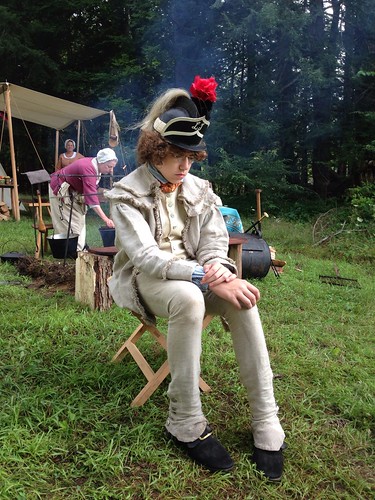
sad light infantry private

Don’t just sit there pouting…

Solving romantic troubles is not my forte, but just as your first crush may not be the person you spend your life with, the first living history/reenactment group may not be your last.

Some folks are serial joiners, just as there are people who engage in a series of medium-term relationships: as long as everybody knows what’s going on, things should be fine and no one will be set anyone else’s goldfish free and leave each other twisting in the wind. But some of us want a long-term home in history: what should we consider?

In no particular order, I offer the follow areas to examine:

Communication Style & Frequency
Surprised to discover members of your group at an event you thought they weren’t attending, so you went with someone else? Find yourself alone at an event that people said they were attending, but dropped at the last moment? Just because all life is like middle school, there’s no need to recreate scenes from Gidget in historic clothing: communicate.

Everyone requires different amounts of information, but after considerable time working, I think it’s hard to over-communicate. Folks, if it’s too many emails, hit the delete key. But if you do not get the basics– a list of events and potential attendees, reminders as the event approaches, coordination of food, canvas and powder supplies– and end up powderless and alone at an event, you may want to reconsider your allegiance.

Level of Activity & Engagement
“It’s just event after event after event,” whined the Young Mr last summer, and I hadn’t even made him march to Fort Ti and sleep under a brush arbor. Some people need to mix primitive camping in funny clothes with a few days at the beach, others spend their entire summers living life as old-school as they can. Some perform the classic turn-your-back maneuver described on Peabody’s Lament (pro tip: don’t do that!) while others actively seek opportunities to engage the public. Some like to be in first person, and others are always and only in third person.

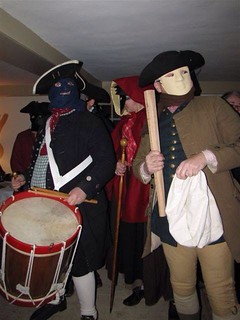
Mummers at Major John Buttrick House

How many activities can you fit into your year?

What’s your preference? If you want to try immersive, first-person interpretations, you need a unit that will support that, and opportunities to try it out. And if you want to go out often, you may need some flexibility in time period and activity.

But even beyond the times when you’re dressed in historic clothing and working with the public, you want to be with a group that includes people who are set a variety of RPMs. If you’re all super-intense original garment/gear/methods copying maniacs, you might not be balanced. As a newcomer, you need an environment that mixes challenges and support– like a good kindergarten.

Authenticity Standards
On that super-intense original garment/gear/methods copying theme, if the group doesn’t manage to meet a certain level of authenticity, or is not striving to improve, and to learn and try new things, is that the right group for you? I find that a curious mind is a necessity, one willing to accept that research advances and what we thought was right in the past may be proven wrong.

The other key here is, how does the group help you meet standards? Are there workshops to help you make up kit or improve what you already have? How deep do the standards go: clothing only, or to camp set up? What about how you cook, what you eat, and what you eat it with?

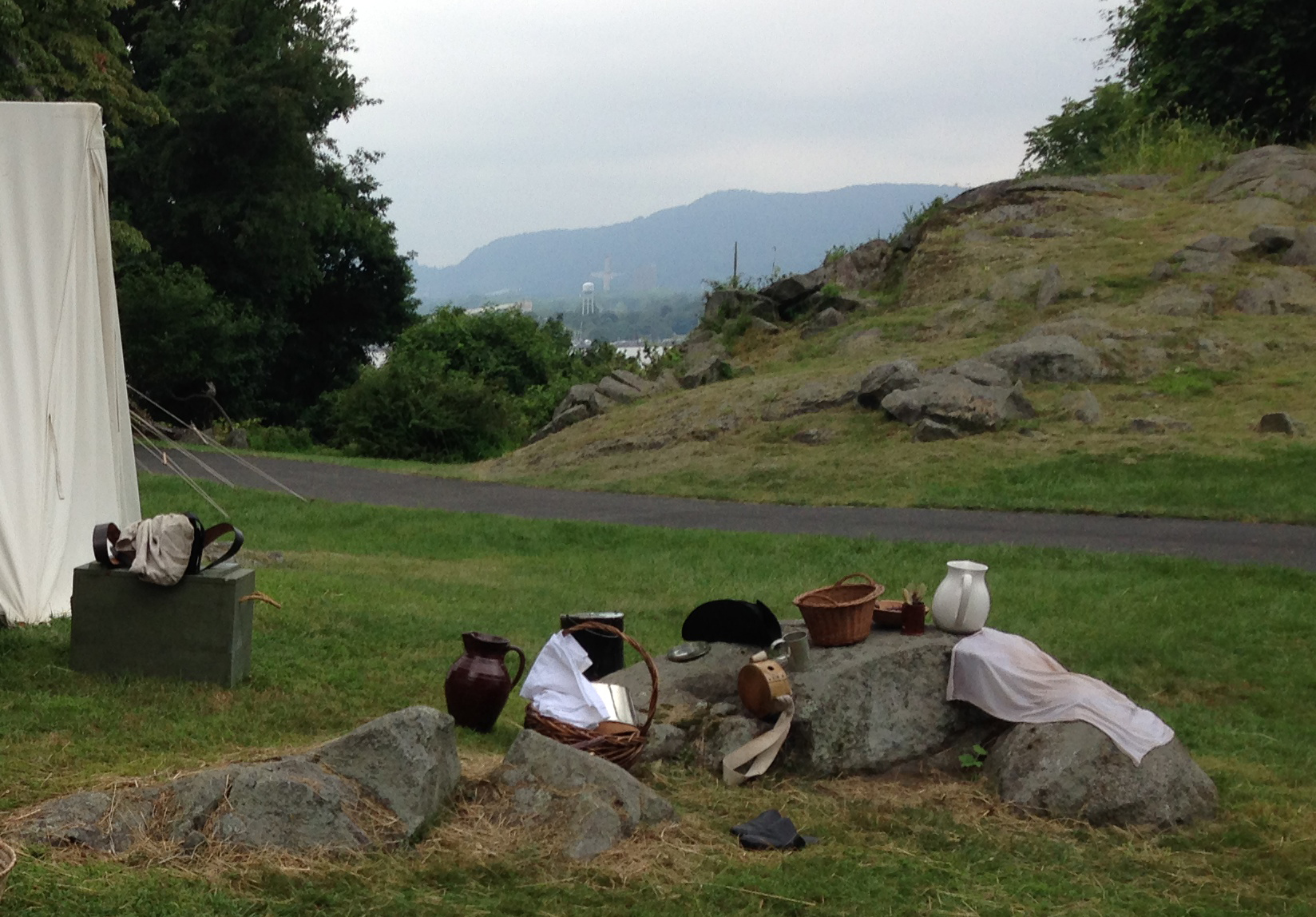
Colonial breakfast on a rock

“Furniture”

Are the compromises people make balanced and understood? My family and I ar among the people who go to events in “wearable but not done” clothes, and that’s OK in our world. While we have period shoes, they are not always perfectly correct: the gents wore buckles in 1812 and the Young Mr definitely doesn’t get a second pair of shoes until we know his feet won’t grow larger than they are now….

Interpretation and Imagination
Did you have one, maybe two, really-really best friends in grade school? Did you play dress-up, imaginative games, engage in narrative play? Did you enjoy the school play (and insist on leading the writing of a research-based script)?If you did, you are probably looking for folks who played the way you did as a child.

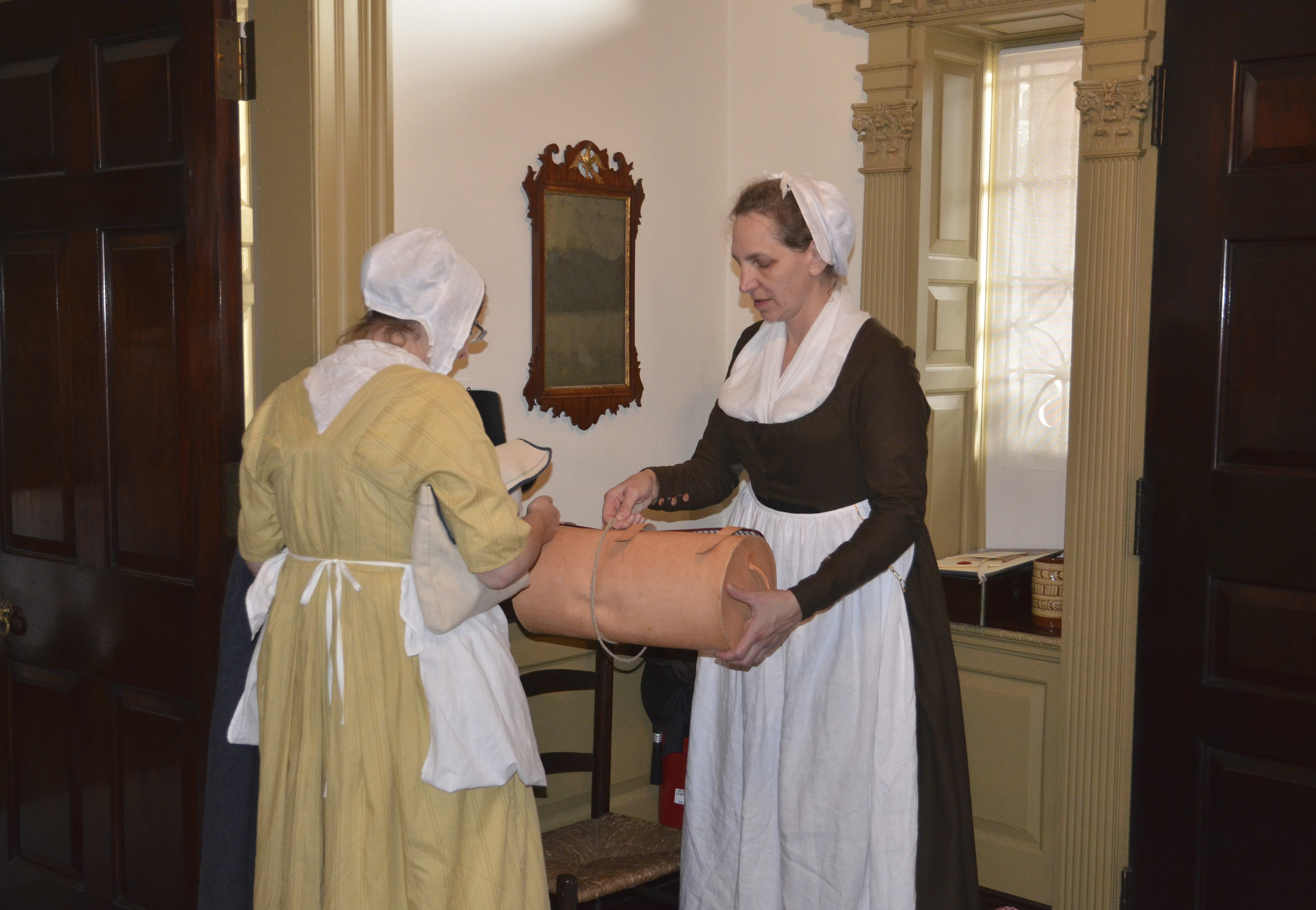
Esther takes Mr Herreshoff's case to his room

What kind of interpretation do you prefer?

Good interpretation requires that someone in the group have an active and vivid imagination, and that people are willing to take risks. Interpretation is a risk: will this portrayal of a captain’s death, a washerwoman’s trial, a wayward apprentice’s punishment, actual work? Do we trust each other enough to slip into new roles?

Trust is key: will the other people in the group bail you out if you freeze, encourage you if you run with an idea, and meet you in the same moment? You will have to spend time with people to find out how well you can all play together but, happily, you will quickly learn if you cannot. If your questions about who you are, why you are in a place, and if you should be wearing a 1781 coat at a 1777 event are rebuffed, you may need to consider other options.

Another time: What are your options?

Share this:

  • Share on Facebook (Opens in new window) Facebook
  • Share on Pinterest (Opens in new window) Pinterest
  • Email a link to a friend (Opens in new window) Email
  • Share on X (Opens in new window) X
Like Loading...

Once Upon A Time…

14 Friday Mar 2014

Posted by kittycalash in Clothing, History, Living History, personal, Philosophy, Reenacting

≈ 2 Comments

Tags

18th century clothes, 18th century clothing, Betsy Ross, Child Guidance Educational Activity, Costume, Costumes, dress, Educational Activity, fashion, interpretation, living history, paper dolls, Reenacting, resources

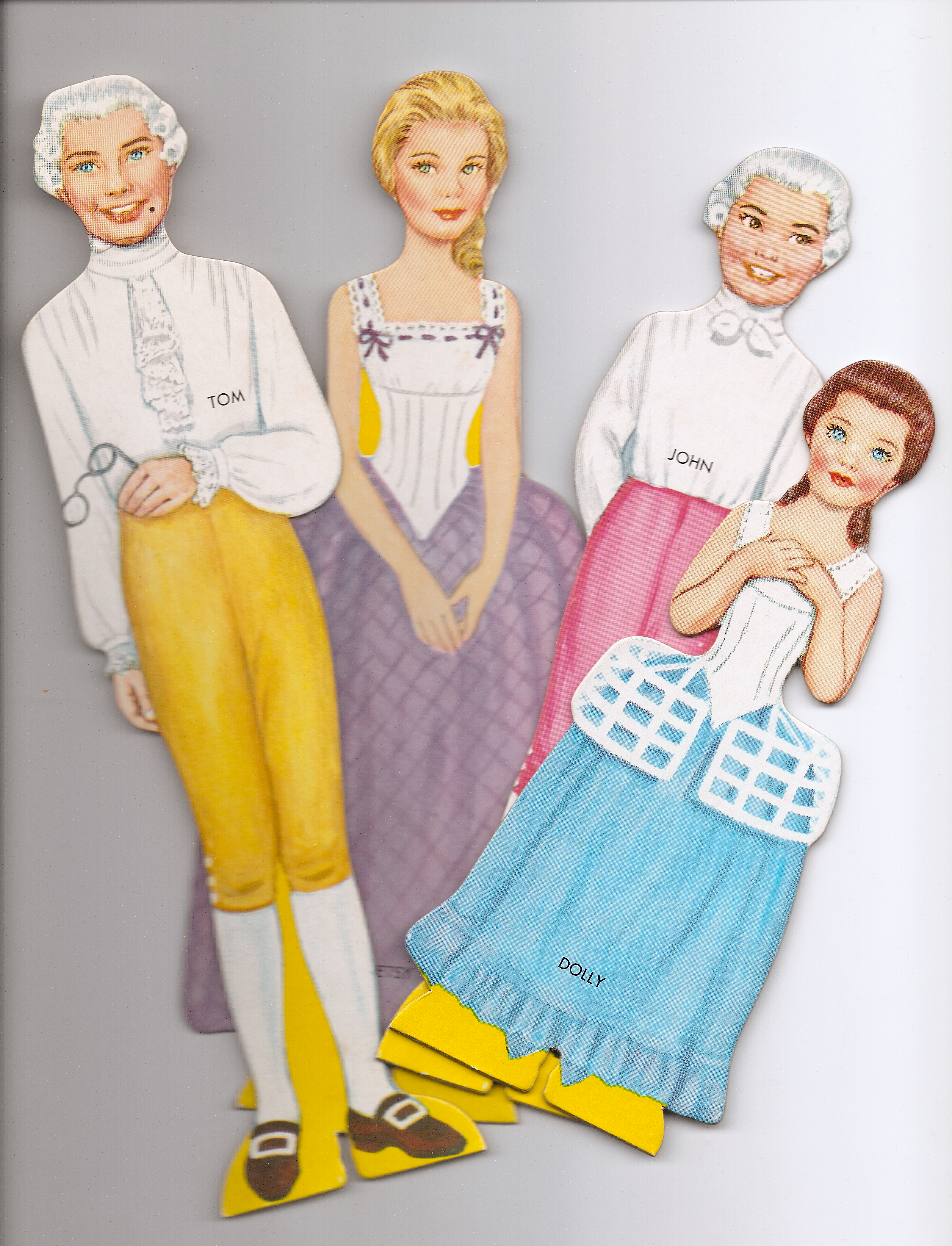
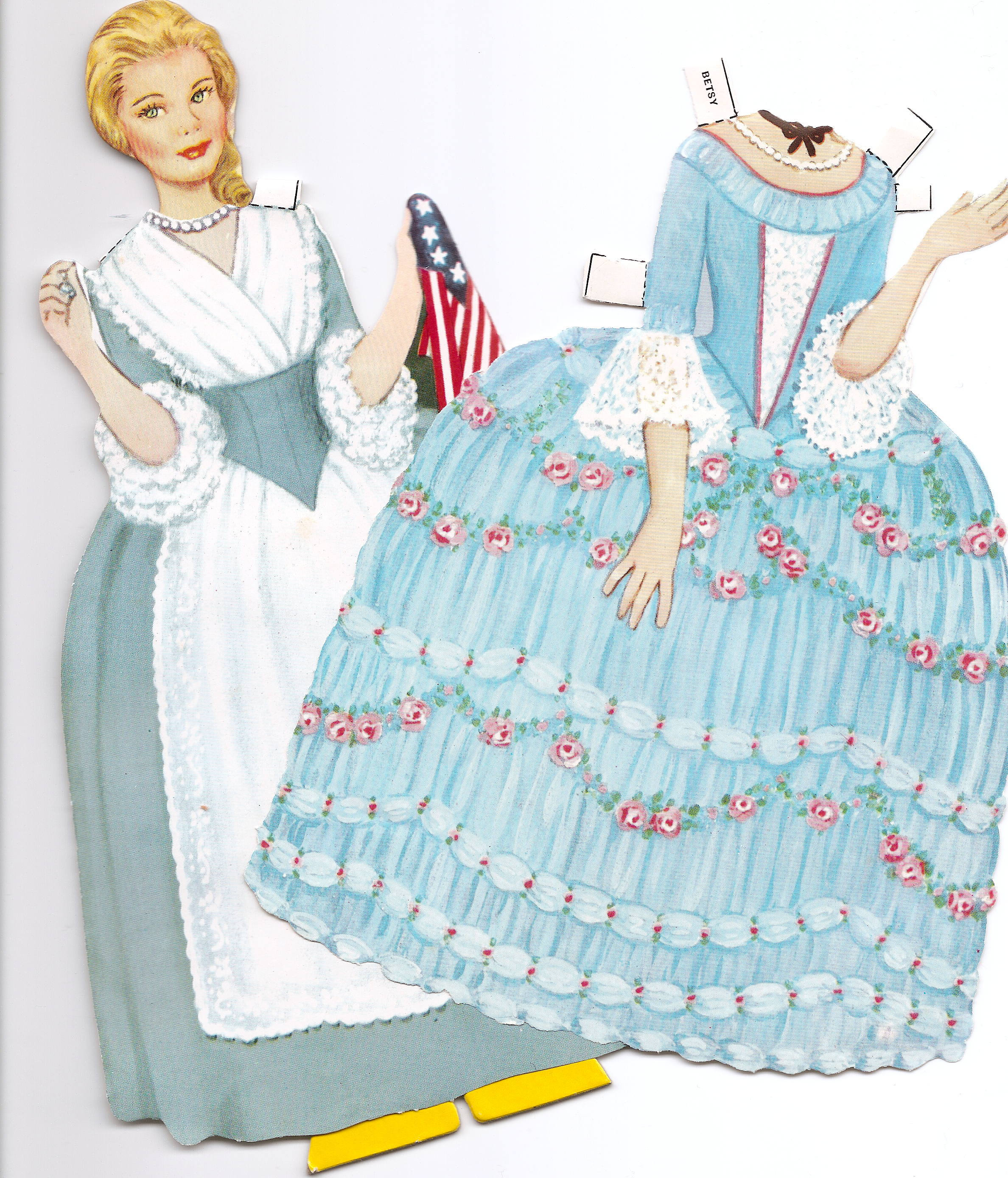
Betsy Ross and friends: A Child Guidance Educational Activity

Betsy Ross and friends: A Child Guidance Educational Activity

This is the third set of these paper dolls (Educational Activity) I have owned. The very first set was given to me by my mother, Lo, at the Dawn of Time, in the Dark Ages known as the 1970s.

I wore them out.

A new set was purchased, probably once again at Marshall Field’s, possibly in the book department. They now reside in an attic outside Philadelphia (how appropriate).

From this Educational Activity flowed many more home-designed outfits and home-made paper dolls of historical and literary origins, which have led to this moment, when I make myself and my family into historical characters, make us outfits, and set us in motion with friends and colleagues in scenes of historical play-acting, by which I mean Educational Activity.

Cooking at Saratoga: very Educational. Photo courtesy D Molly Ross.

I like to think that the clothing we wear is more correct than the “Authentic Costumes” advertised on Betsy Ross’s box, but there is always more to learn. I am in no way denigrating Betsy Ross, or paper dolls, or suggesting that I see my family, friends and colleagues as paper dolls. But I do know that as long as I have been playing, I’ve been playing history and reading history, and drawing history, and using books and paintings and yes, even paper dolls, to figure out the world present and past.

If January Jones played Betsy Ross...

If January Jones played Betsy Ross…

Even though I always thought I wanted Betsy’s birthday cake gown, the one I really liked was the work gown. The “construction” of her garments confused me even as child: how the heck does that kerchief work? And the bodice front? Never mind, have a slice of dress, I mean cake. (Field’s had a cafeteria that served slices of pink-iced layer cake that I somehow conflated with the paper dolls, thanks to the shopping trips my mother and I made.)

Memory and fact, impression and citation: when we reenact the past as an Educational Activity, we should remember that some will walk away enlightened, and others will walk away thinking about birthday cake. Our job, beyond getting the facts right, is to engage our visitors, to interest them, and to excite their imaginations. What they do from there is up to them, but we will know that we have done our best to present them with a scene that can take them one step closer to being there.

Share this:

  • Share on Facebook (Opens in new window) Facebook
  • Share on Pinterest (Opens in new window) Pinterest
  • Email a link to a friend (Opens in new window) Email
  • Share on X (Opens in new window) X
Like Loading...

Light Housekeeping

17 Friday Jan 2014

Posted by kittycalash in Philosophy

≈ 1 Comment

Tags

philosophy, process, Research, standards

Heavy Housekeeping: Piano Relocation

As new readers stumble along here, I thought it might be helpful to explain a few things, to explicate the process, if you will.

The Images

The images I post are, wherever possible, linked back to the holding institution or owner. When a full caption appears, chances are good there is a catalog record for the image. If the holding institution doesn’t have a database, or doesn’t have a good way to link to the image, there will be clues to the source in the text or caption. That way, if you want to share an image, you can click it and get the source to share elsewhere. Check Pinterest as well, usually there are even more images than I can fit here.

The Writing

While I conduct research for what I write and for the events I am part of, this is obviously not an academic blog. It’s a personal blog, and a conversation. I think by writing, so my posts tend to be process-oriented and more about questions than answers. The longer I live the less I know, and the more I am comfortable with uncertainty and the search for knowledge and understanding. You may not see the snow leopard. It’s OK. (I do recommend Matthiessen’s book if you haven’t read it.)

Jumping Snow Leopard by Emmanuel Keller

I try to give my sources (sometimes as footnotes, sometimes in the text; this is a blog, I don’t always follow the Chi Man of Style) so that you can verify what I find and reach your own conclusions. Most sources I use can be found on Google Books, or the Internet Archive so that everyone can enjoy the digital surrogates; I also try to link to holding library catalog records where digital sources do not exist. Please forgive me: I am not the greatest proofreader at 5:00 AM when many of these posts are written.

I pad stitch like crap, but it’s getting better.

The Sewing

Talk about your work in progress! I’m still figuring all of this out, and I expect I always will be. Grab your popcorn, I will be doing something stupid any minute now on a garment I need in very short order. Again, what I think is true is that 18th and early 19th century tailors and sempstresses had a vocabulary of stitches, materials, and techniques that they commonly used in a variety of ways. There will be typical constructions and idiosyncratic assemblages. Some garments will be a mix of both. Welcome to idiosyncratic central. This is about the process of figuring things out, gaining knowledge and increasing ability and understanding. I try to understand how I would have sewn in the 18th century, which  means not even as well as an 8-year-old would have constructed clothing in 1770.

The Topics

I have my obsessions, you have yours. Historic laundry processes, living history, poor women, cats, museums, art, books, construction, the spectacle of the art and antiques market…you’ll find I jump around. Think of it as a restaurant with a varied tasting menu built around a few key ingredients.

The Attitude

Snotty and snarky? Yes. But because I know some folks read this at work, you are spared my customary in-person profanity despite the mighty effort it takes some days to resist writing like Rebecca Schuman. Especially when I write about the art and antiques market.

The Philosophy or Mission

Be excellent to each other. Practice kindness. Share your knowledge.

Thank you for reading and commenting. I really do appreciate it. Now, where’s that snow leopard?

Share this:

  • Share on Facebook (Opens in new window) Facebook
  • Share on Pinterest (Opens in new window) Pinterest
  • Email a link to a friend (Opens in new window) Email
  • Share on X (Opens in new window) X
Like Loading...
Newer posts →

Archives

wordpress statistics

Creative Commons License
Kitty Calash blog by Kirsten Hammerstrom is licensed under a Creative Commons Attribution-NonCommercial-ShareAlike 4.0 International License.

Website Built with WordPress.com.

  • Subscribe Subscribed
    • Kitty Calash
    • Join 621 other subscribers
    • Already have a WordPress.com account? Log in now.
    • Kitty Calash
    • Subscribe Subscribed
    • Sign up
    • Log in
    • Report this content
    • View site in Reader
    • Manage subscriptions
    • Collapse this bar
 

Loading Comments...
 

    %d