• Home
  • Completed Costumes/Impressions
  • Emma and Her Dresses
  • Free Patterns and Instructions

Kitty Calash

~ Confessions of a Known Bonnet-Wearer

Kitty Calash

Category Archives: Reenacting

The Very Specific Spencer, Finished!

11 Tuesday Nov 2014

Posted by kittycalash in Clothing, Fail, Living History, Making Things, Reenacting

≈ 2 Comments

Tags

1790s, 1797, 18th century clothes, 18th century clothing, fashion, Federal style, sewing, sewing project, Spencer, Spencers, style, What Cheer Day, wool

Ta da!
JDK_8197_1

Yes, finished! And just in time, too! The braid arrived in the mail three days before the Spencer was wanted, and fortunately I had finished the garment by then, and the baking could take care of itself after a while, and I managed not to get eggs beaten with sugar on any lovely wool or mohair.

JDK_8210_1

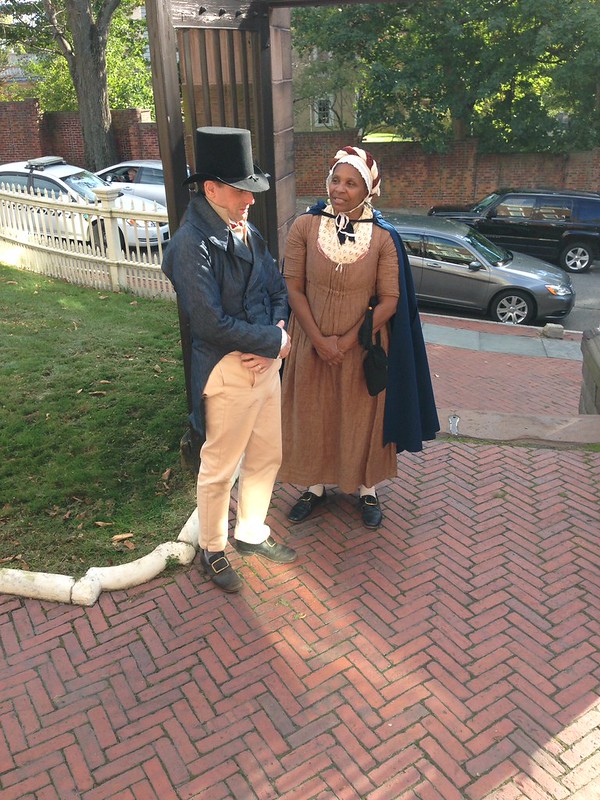
I think it looks well enough with the gown and bonnet, though I am fairly certain the darts are too far to the sides in this iteration. How that happens when you use the same pattern twice I do not know.

You may recall that this is the Spencer where I demonstrated an uncanny ability to sew a collar on upside down. The braid went on pretty quickly, again proving that good materials make good sewing.

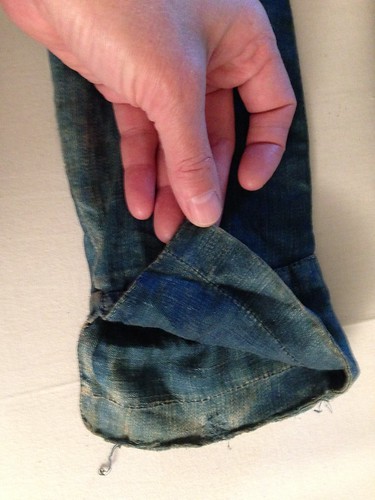
As mentioned previously, the cuffs are pieced, but this is a perfectly accurate way to deal with a shortage of material and/or cuffs.

I’m fairly pleased with how it turned out, and very pleased with how warm it is.  Over the cotton gown, the Spencer was plenty warm– and I certainly wished I had it after we left the house and went down to the river!

On the whole, I suppose I’m pleased…as pleased as I ever am …which means you can expect pattern revisions in the future!


Share this:

  • Share on Facebook (Opens in new window) Facebook
  • Share on Pinterest (Opens in new window) Pinterest
  • Email a link to a friend (Opens in new window) Email
  • Share on X (Opens in new window) X
Like Loading...

Authenticity Measur’d in Moments

30 Thursday Oct 2014

Posted by kittycalash in Events, Fail, History, Living History, Philosophy, Reenacting

≈ 10 Comments

Tags

authenticity, historic houses, history, living history, military events

Chopping wood: it takes  a lot to cook and to keep warm in 1799

Chopping wood: it takes a lot to cook and to keep warm in 1799

In the post-What Cheer Day aftermath, when I was very tired and two houses were very messed up, I started thinking about why I bothered with living history. What exactly is this thing, and why I do it? Those questions made me think about the very best moments I have had in this business of re-creating the past in cloth and smoke and time.

In no particular order:

1. Going up to the field at Coggeshall Farm to call the boys down to dinner after spending all day in the kitchen. I was desperate to get out, and finally knew first hand how limited women’s lives could be in the 18th century, especially non-elite women.

2. Running upstairs at the John Brown House with Eliza, giggling over a joke to be played on Mr Mason. I don’t know what Mr C thought of it but I felt twelve years old, silly, carefree and light. John Brown’s housekeeper surely never felt that way, but a naughty maid might have, and for an instant I knew what it was to have no responsibilities.
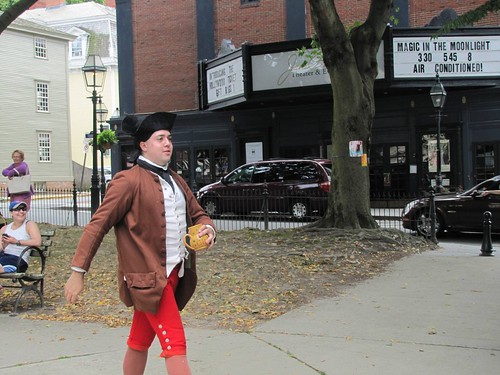
We didn’t even notice the background at the time

3. Chasing the Young Mr, a wayward apprentice, across the street; mobbing Mr Howard’s house; and arguing with the Stamp Inspector, all during the Stamp Act Protest in Newport It was not until I looked at the photos that I realized we really had been in front of a theatre, and that there were actual cars! A friend confirms that he, too, forgot about the cars, to the point of nearly being hit whilst running to Mr Howard’s house.

4. Assembling with a group of friends to take tea with Mrs Silsbee in Salem, sorting ourselves into a group on the sidewalk and venturing out, only to meet Mrs Silsbee on the street. That is the most Jane Austen/Mrs Gaskell I have ever felt. The wretched cobblestones do not count, as they were from the 20th century, but walking out on the wharf, and meeting a friend who brought an umbrella as the rain began was also very Austen-esque.

Perhaps more Gaskell than Austen, here

Perhaps more Gaskell than Austen, here

None of these are military events, and the majority of them happened this year, in past three months. I think this may be because we have been to fewer military events, and I expect the concentration is due, in part, to finally getting better at this practice. They are also site-specific, and trending toward first-person interpretation.

Coats

Those coats.

For reasons explained better by the NPS and in the excellent study of NPS-Reenactor relationships, no battle reenactment can ever capture the truth of the war it attempts to recreate, and that is true even when the battle takes place on the same site, at the same time of year, and even when soldiers are dressed in as-close-as-possible replicas of the uniforms worn at that battle, on that field, on that date, 236 years earlier, and no one has brought a spinning wheel or tent chandelier to camp.

I respect the notions of moveable monuments and performances as commemoration. I like military history, I like war memorials: there is not a competition between civilian and military reenactments. But military events have not yet had the power to transcend experience for me.

My best guess as to why military events are not transformative for me is that, to this point, the business remains too much like camping in funny clothes. As I experiment more with 18th century methods of cooking appropriate rations, and as I strip away the gear we carry into the field, the military events are better (as at Bennington). But I already know how limited women’s perspectives could be (see item 1), and while Bennington was instructive in how ridiculously different the experiences of men and women could be, the military events remain more instructive experiences for the men.

18th century camp

Domesticity in the Field

Why? Because the specificity of site plays out at those events in the battle, and not in the camp. The point at Bennington and at Saratoga and at Stony Point was to use the site as it had been used. The men experienced the landscape in ways as close as possible to what soldiers and militia had actually seen. And women stayed in camp and got smoke in their eyes, cut up vegetables, or washed clothes, which is pretty much what happens at any outdoor event where we can have a fire and, with differences in technology, is pretty much what I do when I get home from work every day.

All that leaves me wondering what to make of military events, and what I want to do in the coming year. No matter how much of this is “for the public,” it still has to be rewarding for the practitioner.

Share this:

  • Share on Facebook (Opens in new window) Facebook
  • Share on Pinterest (Opens in new window) Pinterest
  • Email a link to a friend (Opens in new window) Email
  • Share on X (Opens in new window) X
Like Loading...

What Cheer Day Review

27 Monday Oct 2014

Posted by kittycalash in Events, History, Living History, Museums, Reenacting

≈ 14 Comments

Tags

Clothing, Costume, historic houses, historic interiors, John Brown House Museum, living history, Providence, Rhode Island Historical Society, What Cheer Day

There will be more, and better, images

Let’s begin with the easy part: pretty pictures of a pretty house. (It’s too easy, right?  More on that later this week.)

There are only a few for now– while our photographer took over 800 images, before he can process and sort them, we have to put the house back together first!

October 25 was a Saturday in 1800, the last Saturday before the first public schools opened in Providence on October 27. Mr Sweet, the tailor’s apprentice, had too much current-day public school homework to join us.

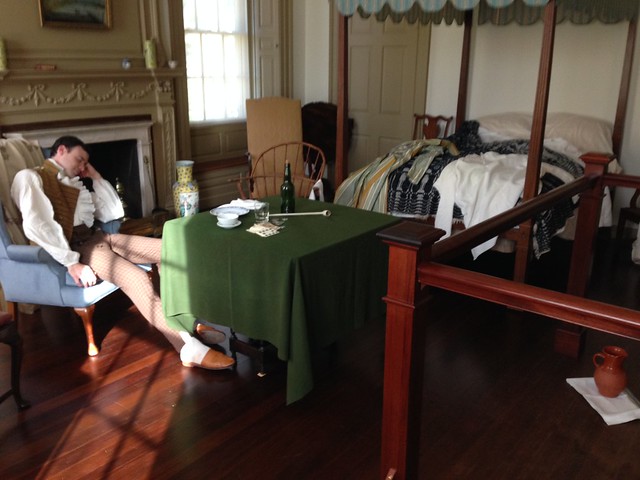
Mr Mason begins his day

It was as well, perhaps, that Mr Sweet did not see the client in his natural environment. His tailor, Mr Taber, arrived with many samples and plates for Mr Mason’s perusal, and the room was in quite a state by the day’s end. I do not know why Mr Mason could not take the short walk to Cheapside, but his custom is so good that the tailor made an exception and came to call.

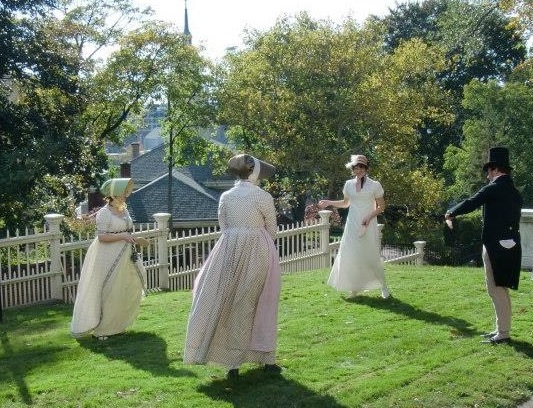
Lawn games

Late in the afternoon, we played battledore and shuttlecock; I was surprised and pleased to see the images and how much like Diana Sperling’s drawings they looked. It was a pleasure to see that we were doing something right, though a cold scoop bonnet was no help in seeing the shuttlecock.

Nancy Smith hears her fortune from Goody Morris

The fortune teller came, much to the consternation of Mrs Brown and her sister. I believe it was the housekeeper who thought she could get away with inviting her friend to the house; in any case, it was foretold that Kitty should have comfort in her life, which was a great relief to someone who had been wearing straight-lasted and very flat shoes for some twelve hours.

Mr Young and Goody Morris

Of late there has been a man hanging about the house; he enjoyed Goody Morris’s conversation as well, though late in the afternoon he caused quite a disturbance with a delivery of wine. We think he had been imbibing from our order, and his behaviour caused our new maid, Eliza, much distress. Mrs Brown was not well pleased at the commotion in her house.

What Cheer Day 2014

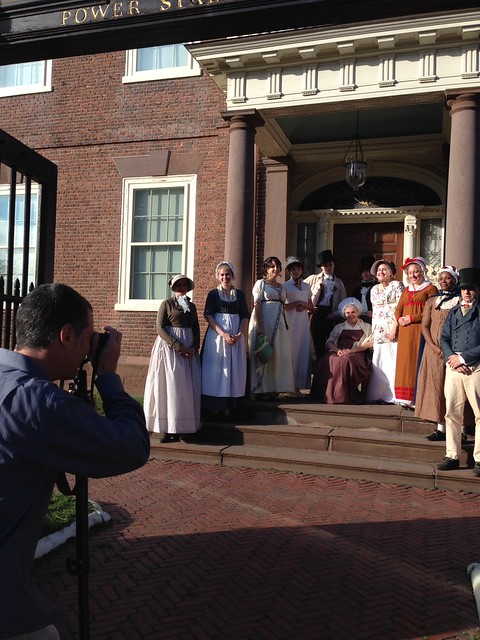
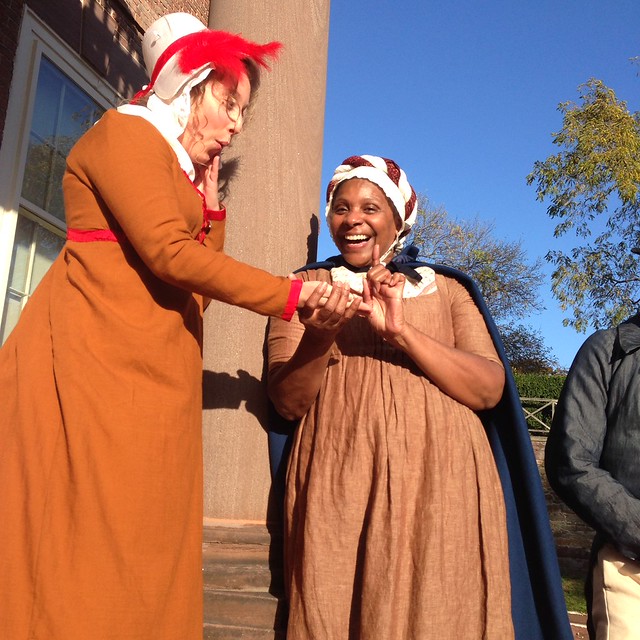
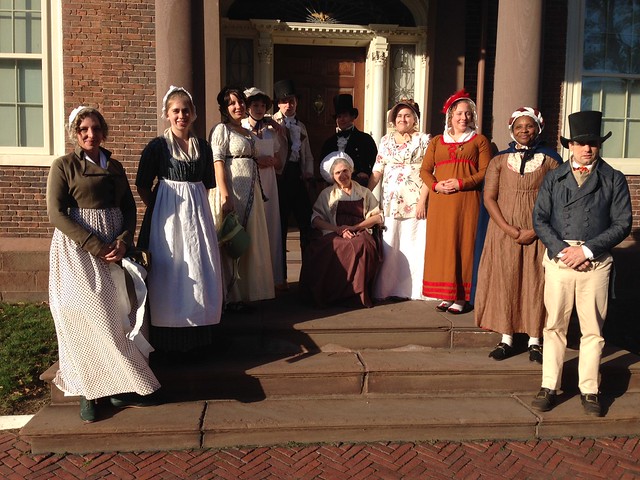
Still, by the end of the day, we were well satisfied with our work, and posed for the passing limner.

Share this:

  • Share on Facebook (Opens in new window) Facebook
  • Share on Pinterest (Opens in new window) Pinterest
  • Email a link to a friend (Opens in new window) Email
  • Share on X (Opens in new window) X
Like Loading...

Cold Scoops

30 Tuesday Sep 2014

Posted by kittycalash in Clothing, History, Living History, Reenacting, Research

≈ 8 Comments

Tags

18th century clothing, 19th century clothing, authenticity, Clothing, common dress, common people, John Brown House Museum, Julia Bowen, Julia Bowen Martin, living history, Providence, Research, Rhode Island, What Cheer Day

What Cheer Day preparations must begin in earnest now, no matter how distracting I might find orderly books or silk shoes (not in my size, alas: no last can be found). I already have clothes enough for a housekeeper, though I still crave a broadcloth Spencer and am working on a petticoat. I’ll hardly go outside that day, so why am I thinking bonnets– especially when I have a known bonnet problem?

One of my favorite resources for Federal era Providence is Julia Bowen’s diary. Born December 1, 1779, Julia’s diary records her life in Providence in 1799, when she was 19. She records the daily activities of the second set of Providence women– daughters not of the most elite merchants, like John Brown and John Innes Clark, but the Bowens, Powers, Howells, and Whipples. Distinguished, but not super-elite. Many of the entries are as prosaic and superficial as you’d expect from a young woman in late adolescence, and thank goodness they are, or we’d never be able to imagine life in such fine detail.

Julia got me thinking about bonnets with her entry of April 12:

found the Major & Citizen Sarah & C. Angell altering their cold scoops into Rosina hats, so busily were they employed that the Major could not go a visiting, which deprived me at once of the greatest pleasure I anticipated in my visit.

(She used code names for her friends; some we can decode, and some we cannot.)

I haven’t been able to decipher what “Rosina hats” were, but cold scoops I could handle: coal scoops.
That colloquialism fits not just fashion plates but extant coal scoops and buckets.

Denham's Auctioneers: Lot 418 A copper coal shovel and a brass coal shovel
Denham’s Auctioneers: Lot 418 A copper coal shovel and a brass coal shovel
Denham's Auctioneers: Lot 153 A copper helmet shaped coal scuttle with brass shovel and turned wooden handle £20-40
Denham’s Auctioneers: Lot 153 A copper helmet shaped coal scuttle with brass shovel and turned wooden handle £20-40

You just have to imagine them turned over.

The Gallery of Fashion, 1797, Bathing Place, Morning Dresses.

The Gallery of Fashion, 1797, Bathing Place, Morning Dresses.

15400635112_e9997f750f_z
15397772861_3ff46f286d_z

I went for cold scoop, with a pasteboard brim and olive green taffeta brim and caul. The mannequin is a 3-D sketch, if you will, of what the housekeeper plans to wear this autumn. At least until she can figure out what a Rosina hat is.

Share this:

  • Share on Facebook (Opens in new window) Facebook
  • Share on Pinterest (Opens in new window) Pinterest
  • Email a link to a friend (Opens in new window) Email
  • Share on X (Opens in new window) X
Like Loading...

Replication and Responsibility

18 Thursday Sep 2014

Posted by kittycalash in Clothing, History, Living History, Making Things, Museums, Reenacting, Research

≈ 8 Comments

Tags

1812, fashion, John Miner coat, menswear, Stonington, Stonington Historical Society, style, tailcoat

Detail, the John Miner Coat, Stonington Historical Society, 2009.120.001

Detail, the John Miner Coat, Stonington Historical Society, 2009.120.001

If I examine and exactly replicate a coat for personal use, what do I owe the museum that owns that coat– anything? I think I owe the museum any information I can share that will improve their records and help build a research file for the future.* I also think I owe them copies of the images I may take, and with digital images, that’s now incredibly easy.

But if I replicate this coat (shoulder intact) for Mr S or the Young Mr, should I give the coat to the Stonington Historical Society when we are done with it? SHS thinks I probably should, but as someone who manages collections, how many replicas do I want, and what standards do I use to judge them?

I think the best course of action is for museums to make patterns of popular or often-requested garments available for purchase, so that anyone who wants to make a replica has all the data they need. Short of that– and funds are often short for that– catalog records with as many measurements and as complete a description as possible will allow dedicated tailors and stitchers to get as close as possible to original garments.

True replicas involve recreating fabrics and using period techniques, and matching a garment measurement to measurement– and in the case of the Miner coat, there is no way to replicate its history. And the amount of work and expertise that would go into a true replica of any historic garment seems enormous– it would constitute a large donation to the museum, even if the garment had been worn.

*For those of you reading the caption on the Miner coat, yes, it needs work, and yes, SHS knows there are problems with that description. I promised to help them with their catalog record.

Share this:

  • Share on Facebook (Opens in new window) Facebook
  • Share on Pinterest (Opens in new window) Pinterest
  • Email a link to a friend (Opens in new window) Email
  • Share on X (Opens in new window) X
Like Loading...
← Older posts
Newer posts →

Archives

wordpress statistics

Creative Commons License
Kitty Calash blog by Kirsten Hammerstrom is licensed under a Creative Commons Attribution-NonCommercial-ShareAlike 4.0 International License.

Website Built with WordPress.com.

  • Subscribe Subscribed
    • Kitty Calash
    • Join 621 other subscribers
    • Already have a WordPress.com account? Log in now.
    • Kitty Calash
    • Subscribe Subscribed
    • Sign up
    • Log in
    • Report this content
    • View site in Reader
    • Manage subscriptions
    • Collapse this bar
 

Loading Comments...
 

    %d