• Home
  • Completed Costumes/Impressions
  • Emma and Her Dresses
  • Free Patterns and Instructions

Kitty Calash

~ Confessions of a Known Bonnet-Wearer

Kitty Calash

Category Archives: Reenacting

An Insomniac Dreams of Pudding

11 Friday Jul 2014

Posted by kittycalash in Events, Food, Living History, Reenacting

≈ 5 Comments

Tags

10th Massachusetts, Brigade of the American Revolution, Events, food, living history, Stony Point

Thomas Rowlandson, 1756–1827, British, Gypsies Cooking on an Open Fire, undated, Watercolor and with pen and brown ink and pen and gray ink on medium, slightly textured, cream wove paper, Yale Center for British Art, Paul Mellon Collection

Thomas Rowlandson, 1756–1827, British, Gypsies Cooking on an Open Fire, undated, Watercolor and with pen and brown ink and pen and gray ink on medium, slightly textured, cream wove paper, Yale Center for British Art, Paul Mellon Collection

Once again, I’m sleeping 18th-century-style, but without of the luxury of sleeping late. What wakes you in the middle of the night? Whatever woke me, I finally fell back asleep after 4:00 thinking of what to make for Stony Point.

This will be a cold camp, with very limited cooking, which presents a stiff challenge for the caffeine-dependent, as I must confess I am. (There are gentlemen in the expected party who are also not quite themselves until they’ve had their coffee, too, and they know who they are.)

I’m up against it, this time, given how I will be spending the week leading up to Stony Point (very busy) and that Friday (giving a talk in Newport, instead of baking). As a devoted fan of breakfast, I usually spend the Fridays before a weekend event baking and assembling the provisions for the weekend; this time, however, I will be crossing and re-crossing a bridge.

As I considered prepping a pork-apple-and onion pie Thursday night for Mr S to bake on Friday morning, and the logistics and food safety concerns associated with transporting and eating meat, it finally came to me: Indian pudding. Simpler, easier, filling: all the remains to be done is to talk the Young Mr into eating it, though when presented with no other option, he may acquiesce, at last, to reality.

Share this:

  • Share on Facebook (Opens in new window) Facebook
  • Share on Pinterest (Opens in new window) Pinterest
  • Email a link to a friend (Opens in new window) Email
  • Share on X (Opens in new window) X
Like Loading...

Breaking Up By Letter

09 Wednesday Jul 2014

Posted by kittycalash in Events, Living History, Reenacting

≈ 2 Comments

Tags

10th Massachusetts, 18th century clothing, history, living history, Massachusetts, Revolutionary War

Mr S, always slightly suspicious

Mr S and I joined other members of the 10th Mass and National Park Service staff and volunteers at the North Bridge in Concord, Mass last Saturday for the postponed reading of the Declaration of Independence. It was one of those perfect New England summer days, breezy blue skies and dry wind smelling of grass and flowers: days like that I finally get the Transcendentalists.*

Some of those present in modern and historic clothes alike had never heard or read the Declaration all the way through; it is one of my favorite documents, and not just because I was in a 5th grade play about the document. Questions of slavery and principles aside, the Declaration is a great poem of a break-up letter. It makes poetry of the list of King George III’s crimes and reminds us of the core principles that undergird our government and that began with the Magna Carta, limiting the power of the king.

Governments are instituted among Men, deriving their just powers from the consent of the governed

Leaning against a tree near the North Bridge, you could close your eyes to the shorts and kayaks and baseball caps and listen to a document being read as it would have been 238 years ago, and imagine what it was like to hear this for the first time (at least until the airplane passed overheard).

I have a complicated relationship with patriotism, which makes me a curious candidate for this living history business. But that moment in Concord reminded me of the enthusiasm I had for history as a child, and the passion I had for what educators now call narrative play, and what some of us now grown up call reenacting, and others call historical re/creation.

There is something we can learn, as participants, and that the public can learn, as we go about this business of re-investigating the past, through making clothing and reading and cooking and re-learning historic processes and crafts. We may not always learn what we expect to about the past or about our selves, but if some in the audience enjoyed the smell of grass in the wind, and heard the true poetry of Jefferson’s text, maybe that’s enough to be getting on with. Because for all the questions about how a musket works, the real point of all of these events isn’t the musketry, it’s the history.**

*They clearly did not wake up to the “what the hell’s that smell?” game tidal canals like to start on summer mornings.

** Sorry, lads, but I think it’s true: wars are about words backed by muskets or other weapons.

Share this:

  • Share on Facebook (Opens in new window) Facebook
  • Share on Pinterest (Opens in new window) Pinterest
  • Email a link to a friend (Opens in new window) Email
  • Share on X (Opens in new window) X
Like Loading...

Six Toiles, a Coat and a Bonnet

07 Monday Jul 2014

Posted by kittycalash in Clothing, Events, Living History, Making Things, Reenacting

≈ 2 Comments

Tags

1812, 19th century clothing, bonnets, frock coat, living history, menswear, Salem event, sewing, tailcoat

14557116394_73c2d5ea9f_zYes, six toiles.
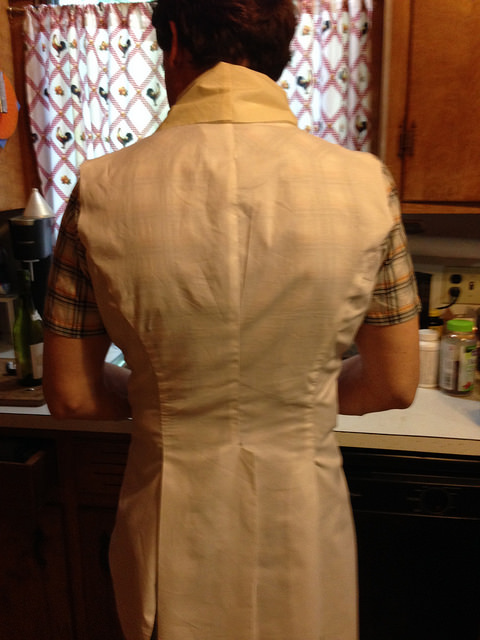
That’s how many it took to get a coat pattern to fit Mr S the way I thought it should. I finally built the pattern around a sleeve and arm scye that I knew worked and suited the period. From there, I built out the back, altering the center back seam curve to suit Mr S’s figure. Arm scyes are still hard for me to figure out, although sleeves are often my favorite part of a garment. I like how flat pieces become three dimensional in a sleeve, and I enjoy setting sleeves– go figure.

Thanks to the three-day holiday weekend and sitting out a parade to pad stitch, I have a coat body.

IMG_1725
IMG_1727

I’m not thrilled about the size of the lapels, though I have found extant examples and fashion plates showing lapels this size, and sleeves, too. While I’ve pinned up the sleeves in the back, thinking there’s too much fabric there, I can also see from the images that the subject’s posture was not the best– and that was the moment when I realized that I really did want a mannequin for menswear as the subjects are hard to catch at any age, and variable in posture and wiggliness. They also object to being pinned accidentally.

But there is at least a coat body on the way to being done, so I took a break and made a bonnet, which is really the point here <ahem> milliner’s, not tailor’s, shop, after all.

IMG_1738

Pasteboard brim, blue silk taffeta lined with white silk taffeta (they had new things at the fabric store, very exciting!), trimmed with silk ribbon from Wm Booth and paper flowers from the V&A.

Now, more bonnets, two waistcoats, a gown, an exhibition, a lecture, and Stony Point are all that stand between me and the milliners’ shop in Salem…

Share this:

  • Share on Facebook (Opens in new window) Facebook
  • Share on Pinterest (Opens in new window) Pinterest
  • Email a link to a friend (Opens in new window) Email
  • Share on X (Opens in new window) X
Like Loading...

The Taylors’ Instructor

25 Wednesday Jun 2014

Posted by kittycalash in Clothing, History, Living History, Making Things, Reenacting, Research

≈ 4 Comments

Tags

books, Federal style, menswear, Regency, Research, resources, tailcoat

Title page, The Taylors' Instructor

Title page, The Taylors’ Instructor

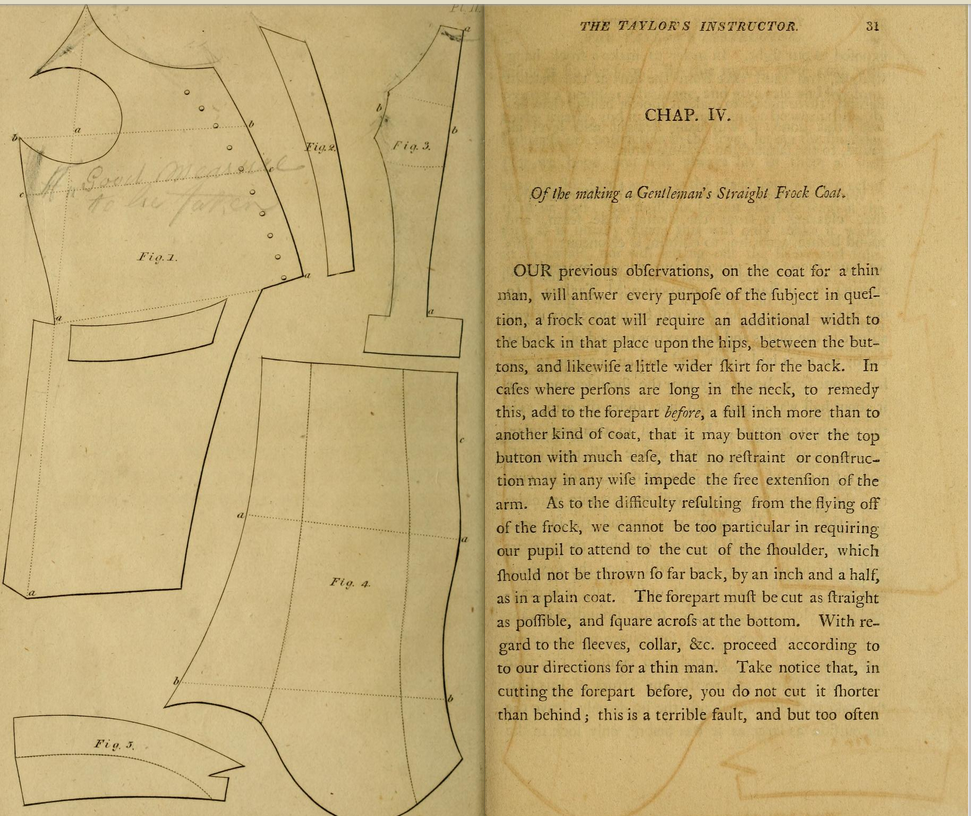
So who else was wondering what Mr Cooke meant by Lapsley and Queen? Wonder no longer, frustrated toile-makers and cuff-detail mavens, it is available on the vast interwebs of knowledge.

Go! Download the PDF and immerse yourself in an 1809 American tailors’ manual published in Philadelphia, with Eight Appropriate Engravings. We may note that there was excited squeaking when I located this, altering my nearest companions to A FIND, and letting them know that yes, I am back, and probably will continue to squeak on and off for some time to come.

From the introduction:

“…there is no situation more awkward than that of a TAYLOR who has cut and mutilated his own or his employer’s Cloth which will frequently be the case when a man has nothing to depend upon but the poor resource of chance or hope, that his clothes will fit.”

The Taylors' Instructor

The Taylors’ Instructor

I can tell from the text on Coats that my subjects will have to be further apprehended and measured, even against their will, but the results will undoubtedly be better than before.

Happy Reading, Historical Sewing Enthusiasts, and a big thank you and hat tip to Henry Cooke for the reference.

Share this:

  • Share on Facebook (Opens in new window) Facebook
  • Share on Pinterest (Opens in new window) Pinterest
  • Email a link to a friend (Opens in new window) Email
  • Share on X (Opens in new window) X
Like Loading...

Coat Tales

23 Monday Jun 2014

Posted by kittycalash in Clothing, Events, Fail, Living History, Making Things, Reenacting, Research

≈ 6 Comments

Tags

1812, 19th century clothing, fashion, Federal style, fitting, Fitting and Proper, frock coat, menswear, Norah Waugh, Regency, Salem event, style, tailcoat

Coat pattern version 3

Coat pattern version 3

As the Salem Maritime Festival approaches, my anxiety increases.

Whatever will those ‘gentlemen’ wear? Coats and waistcoats, and thank goodness I finished the Young Mr’s shirt and his farm trousers still fit. He has promised to be a very annoying runaway apprentice, and I have promised to chase him from the miilliners’ shop with a broom, but before any of that can happen, ‘gentlemen’ will need new waistcoats and coats.

I got out Fitting and Proper, and took a look at that coatee pattern. It’s a little earlier than I want, so I also looked at The Cut of Men’s Clothes. In truth, I did not draft up a pattern from scratch. I had a commercially available pattern that I’d purchased when it first came out, one that purported to be historically correct, researched, and came from a reputable company.

Toile number 3. One more fitting to go...

Toile number 3. One more fitting to go…

Well…so I guess the issue with the pattern is that the gentlemen in my household are not of the typically boxy build one may see streaming past tourist sites in Boston, or even lumbering across a field in historical uniforms. My gentlemen are built for the Light Infantry, so when I finished the first muslin (or toile) of the coat and fitted it to Mr S, I removed inches–yes, inches–of material along the side and center back.

I suspected this would be necessary when I first traced the pattern pieces, but went ahead because you really have to mark up a toile on the body in question to get the fit correct. Maybe it’s just this many toiles because I’m inexperienced.

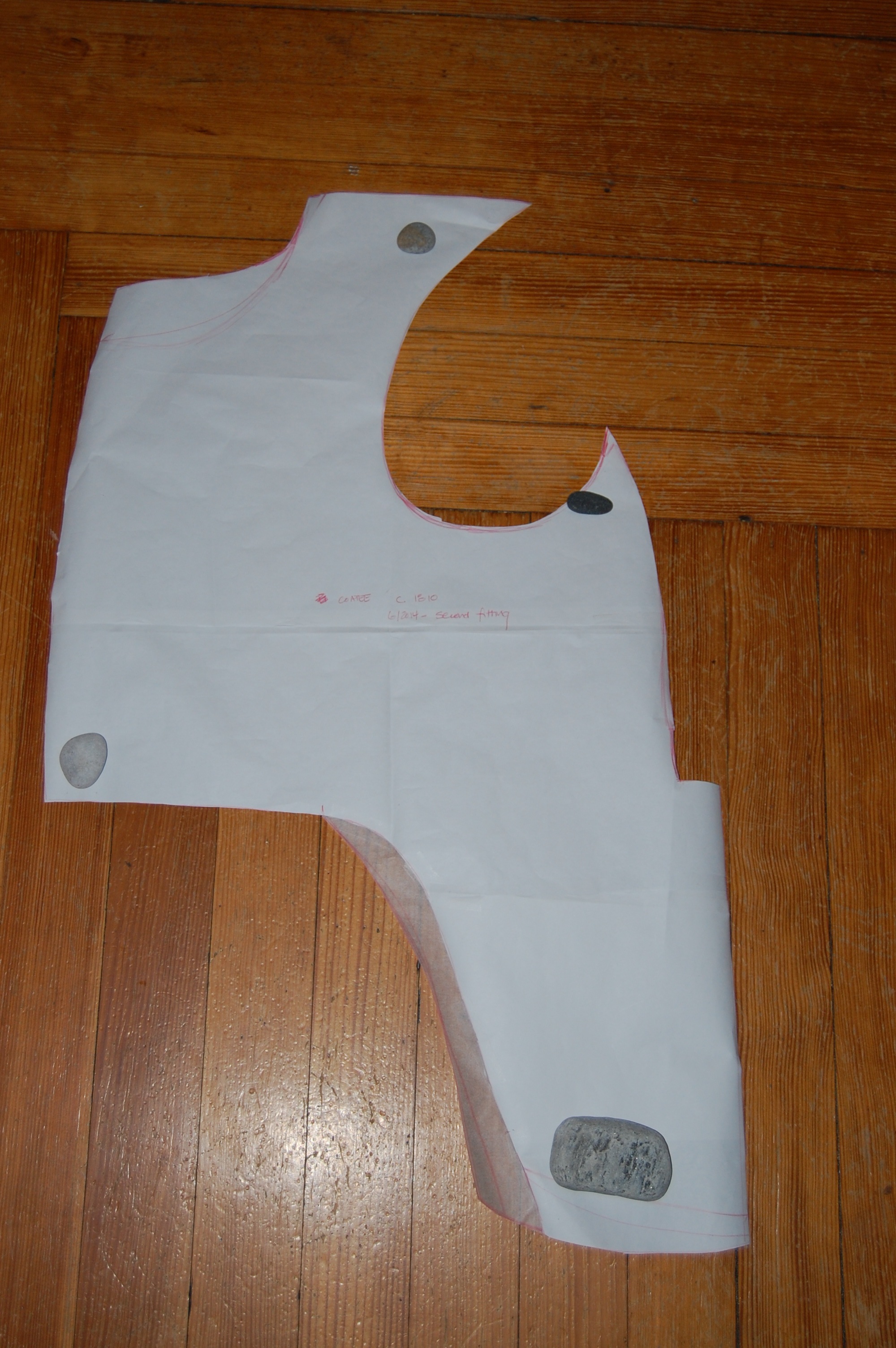
Center back pattern, version 3

Center back pattern, version 3

In any case, the armscye and upper shoulder seam were re-drafted, the drape and sweep of the tails, the width of both side and center tails, the side seam of the body, and both seams on the center back piece, which originally had a flat center back seam (I ask you!), a shorter shoulder seam, and a different side seam.

I’ve left the tail length short and after toile number 4, will mark the final tail length for both gentlemen (luckily we are at a sweet spot where this fits Mr S well and the Young Mr passably, so that with minor adjustments for the lad, a second coat could be made at some time).

I still don’t believe the tail pleats entirely, but lack the time this week to draw them from an original. They still seem too wide, though I have taken an inch or more off every tail edge.

The last thing to really wrangle, after bringing the under arm seam back up, is the sleeve; the upper arm is too long, reflecting the fact that the basis for this sleeve is my Spencer sleeve, which traces its origin to Mr Cooke’s linen suit coat pattern. Both Mr S and the Young Mr have shorter humeri and femora, which put the elbow crook on their forearms which looked rather silly and uncomfortable.

In the end, the pattern I had proved useful only in saving me from the math of enlarging a pattern from a book– it got me full-scale immediately, so that I could proceed to fitting–but this project will, when it finished, reflect multiple fittings and four pattern drafts.

If there is a moral to this story, it is this: Almost nothing will fit straight out of the book or the envelope, so leave plenty of time for catching your subject and fitting muslins.

Another moral may be, “Buy muslin in bulk,” which I did thanks to a clearance sale. I’ve already used 2 yards off the bolt I bought Saturday afternoon.

Share this:

  • Share on Facebook (Opens in new window) Facebook
  • Share on Pinterest (Opens in new window) Pinterest
  • Email a link to a friend (Opens in new window) Email
  • Share on X (Opens in new window) X
Like Loading...
← Older posts
Newer posts →

Archives

wordpress statistics

Creative Commons License
Kitty Calash blog by Kirsten Hammerstrom is licensed under a Creative Commons Attribution-NonCommercial-ShareAlike 4.0 International License.

Website Built with WordPress.com.

  • Subscribe Subscribed
    • Kitty Calash
    • Join 621 other subscribers
    • Already have a WordPress.com account? Log in now.
    • Kitty Calash
    • Subscribe Subscribed
    • Sign up
    • Log in
    • Report this content
    • View site in Reader
    • Manage subscriptions
    • Collapse this bar
 

Loading Comments...
 

    %d