• Home
  • Completed Costumes/Impressions
  • Emma and Her Dresses
  • Free Patterns and Instructions

Kitty Calash

~ Confessions of a Known Bonnet-Wearer

Kitty Calash

Category Archives: Reenacting

Authenticity, Reenacting, and the Mobile Museum

15 Thursday Aug 2013

Posted by kittycalash in Living History, Museums, Reenacting

≈ 10 Comments

Tags

American Alliance of Museums, authenticity, Brigade of the American Revolution, British Brigade, Continental Line, living history, Museums, Public Trust, Reenacting, Research, The Public
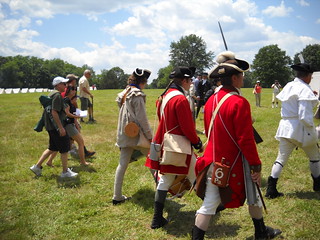
No stanchion here: the public marches with the exhibits

The more I think about issues of authenticity in re-enacting, the more I think about museums. Reenactments can be seen, as scholars have suggested, as “mobile monuments,” part of a culture of memorialization and commemoration of the past. “Recreated” battles, or battles staged on historic sites are not just the tactical weapons demonstrations they’re billed as, but rather ritual performances that commemorate notable events and connect practitioners with the past. They’re almost priests of the past, those men in uniform: they wear special robes, carry special equipment, and engage in practices arcane and exclusive–and denied to most women. (Indeed, the practice of women fielding reminds me of the history of women as deacons and eventually priests and bishops in the Episcopal church, but more about women in this hobby another time.)
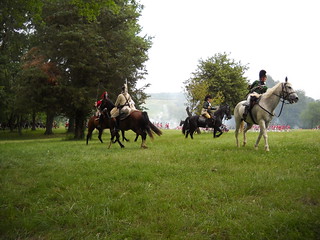
Dragoon battles are highly staged, for safety

That’s just the battles, though they are also museum theatre, vivid, smoky demonstrations of the ways of the past: what about the rest of the event?

Reenactments, with their ranks of tents, kitchens, and varied participants, are in many ways mobile museums that set up at sites and provide “this weekend only!” semi-immersive experiences for visitors. There’s often a gift shop: the sutlers are there, and the site itself may have a shop, and push re-enactment themed items.

Each vignette or camp is like a gallery or object within a museum. Not all appeal to every visitor, some like Rangers, some like Redcoats, some like Rebels.
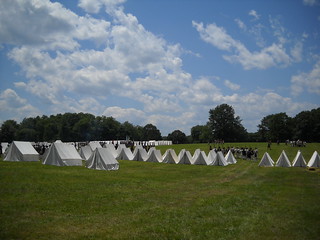
Continental camp at Monmouth

But in a world where museums and libraries are among the most trusted sources of information (online and otherwise), there are repercussions for the “mobile museums” of reenactments. If we accept a museum-like role, and see ourselves as custodians and practitioners of the past, we will need to also accept high(er) standards for material culture and presentation. That does not mean first-person interpretation by everyone at all events and it does not mean carrying actual 18th century goods into the field. That’s not good cultural stewardship.

It does mean doing the same hard work that museums do, researching and presenting oneself and one’s chattel with as much thought and care as possible. Who are you? Why do you have what you have? Where did you get it? Why does it look like that?

It means making one’s clothes and kit and accouterments as near to original as possible. The things we carry into the field, onto the stage of the mobile museum, should not look old. They should look used, but they will lack the patina of 235-year-old objects. They’ll represent the prelapsarian past of the objects, a time before they were painted with latex paint.

Can we, all of us, reach the highest levels of presentation? No. There are as many kinds of reenacting units as there are museums. Some are the Met, and have their owned branded truck. Some are your local historic site. Resources vary.

But just as most museums look to national accrediting organizations like the American Alliance of Museums for information on ethics, standards, and professional development, so too can the reenacting groups look to the umbrella organizations like the Brigade of the American Revolution, the British Brigade, and the Continental Line (the Big Three of 18th century reenacting). The BAR has an inspector, and unit inspection and re-inspection has a function similar to AAM accreditation.
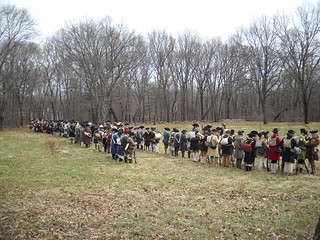
At Battle Road 2013

It’s not easy to become an accredited museum, but each museum that goes through the process learns, improves, and becomes stronger for having gone through the process of self-examination and, often, improvement. They meet standards. And like AAM, umbrella organizations can and do have standards, and the individual units have standards. Those are often online, and as individuals and other units strive to improve their impressions, following others’ well-researched and documented standards helps improve the entire field.

Peer-to-peer learning, public distribution of information, detailed and published standards of appearance, presentation and behavior: these exist, but not systematically, in the reenacting community. The more the Big Three can do to function the way the AAM does, the more I suspect we will see authenticity increase in the field.

Because it does matter: if museums and reenactors are trusted sources of information, we owe it to the public and our pride to create the best representation of the past that we can.
Share this:

  • Share on Facebook (Opens in new window) Facebook
  • Share on Pinterest (Opens in new window) Pinterest
  • Email a link to a friend (Opens in new window) Email
  • Share on X (Opens in new window) X
Like Loading...

Hunting Frocks, Again

11 Sunday Aug 2013

Posted by kittycalash in Clothing, Living History, Reenacting, Research

≈ Comments Off on Hunting Frocks, Again

Tags

10th Massachusetts, 18th century clothes, 2nd Rhode Island, common soldier, history, hunting frock, Making Things, menswear, Research, resources, Revolutionary War, uniforms

They’re not Mr S’s favorite thing, and I can understand why. Hunting frocks lack pizzazz, buttons, tape, lace, lapels, skirts and all the things that make him so fond of the Ugly Dog Coat worn by the 10th Massachusetts in 1782. (I think these are the coats captured from British supply ships and dyed at Newburgh and West Point in tanner’s vats.) But what he has right now is a hunting frock.

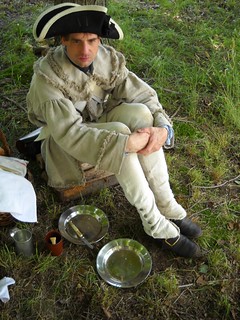
Here’s the kid in his new hunting frock, and a hand colored copper engraving by Johann Martin Will from 1776.

You gotta hold your tongue just right when you drill.

Americaner Soldat, Johann Martin Will. Ann S. K. Brown Collection, Brown University.

Americaner Soldat, Johann Martin Will. Ann S. K. Brown Collection, Brown University.

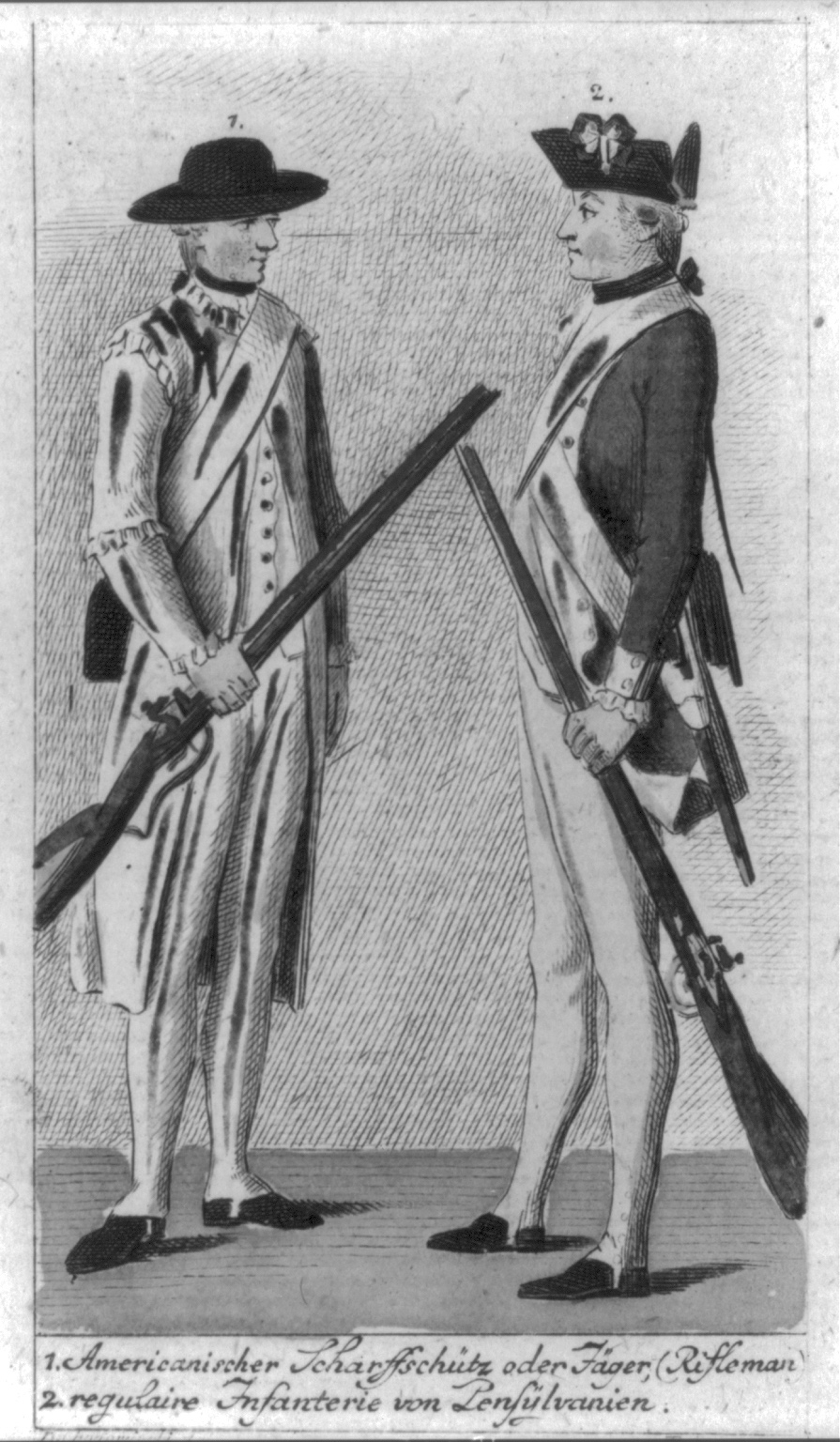
And then there are the colored and plain engravings, “1. Americanischer scharffschütz oder Jäger (rifleman) 2. regulaire infanterie von Pensylvanien,” engraved by Berger after Chodowiecki.

 Library of Congress

Library of Congress

Berger after Chodowiecki, Ann S. K. Brown Military Collection, Brown University

Ann S. K. Brown Collection

I started thinking about these again because not only am I reading Hurst’s thesis, but I’m fresh from helping the guys get dressed and arrange their capes and straps. I have been doing that as long as Mr S has been wearing historic clothing.

Early days of draping

Early days of draping


Drapey capes

The hunting frock drifts if it does not have some kind of fastening at the neck. The two halves migrate in opposite directions, and while belts help, the light infantry bayonet shoulder belt does not contain the hunting frock as well as one might like. So the thing to do, I think, is to attach a loop and button at the neck to hold the garment in place. From the period engravings, I think that’s acceptable. The garments all look as if they are closed at the neck. From the evidence in the field, and from the images, I plan to make loops and attach buttons, and hope that will limit some tendency to wander.

The image of the two soldiers together suggests another wrinkle in the hunting frock quandary, since the left hand soldier’s out garment looks like a long pocket-less coat with applied fringe and only a very small cape at the neck. Thank goodness that soldier is a rifleman, and thus outside the realm of immediate relevance. (And on a side note, I know a gentleman who very much resembles the Pennsylvania infantry man: identical calves, and even a similar face.)

Share this:

  • Share on Facebook (Opens in new window) Facebook
  • Share on Pinterest (Opens in new window) Pinterest
  • Email a link to a friend (Opens in new window) Email
  • Share on X (Opens in new window) X
Like Loading...

Authenticity: Sources II, or, Stripes!

10 Saturday Aug 2013

Posted by kittycalash in Clothing, History, Living History, Reenacting, Research

≈ 7 Comments

Tags

18th century clothes, 2nd Rhode Island, authenticity, Clothing, common dress, common soldier, Costume, fashion, menswear, Museums, Revolutionary War, Rhode Island, uniforms

In any decade, I love stripes.

Stripes. I love them, really, I do. Gowns, petticoats, cats. Why do I want to use them so much?

For the guys, because I can document what they’re wearing, at least based on their current state of residence and their current nominal “home” unit with the BAR.

Here’s why:

1777 Oct 22
An inventory of Searjeant George Babcock’s
Wearing Apparil who was Killed at fort Mercer
Octor 22d 1777 Belonging to Capt Thos Arnold’s Comp’y in Colo Green’s Regemt

Two Check Linen Shirts
one Pair of Striped Linen overalls
one Striped Cotton & linen Jacket without Sleeves
one flannel Jacket without Sleeves
one home spun Woolen Jacket without sleeves
one Linen & Worsted cotee
one Kersey outside Jacket Lined with flannel
one beaver Hat & one Pair of shoes
one Pair of blue worsted stockings
one pair of thread ditto
one pair of blue yarn Stockings
one Linnen Handkerchief
one knapsack

(Clothing inventory, Capt Thos. Arnold, Col. Christopher Greene, Rhode Island Regiment
RIHS MSS 673 SG 2, S1, SSA Box 1 Folder 13)

From RIHS MSS 72, Preserved Pearce papers,  Tailor's and Tavern account books, 1778-1781.

From RIHS MSS 72, Preserved Pearce papers, Tailor’s and Tavern account books, 1778-1781.

This inventory has formed the basis for many of the clothing choices I’ve made for Mr S and the Young Mr from their check linen shirts to their blue stockings. I was criticized for the size of the checks of their linen shirts (too small! I heard), but feel vindicated time and again by the extant garments I’ve found (aprons, mostly) in this period. The checks are small.

The best piece of evidence I found was serendipitous: whilst going through tailor’s books Thursday, looking for stays, I found a scrap of blue and white checked linen used as a binding. The biggest lesson from that scrap is that I need a deeper, more indigo-rich blue and white to begin with.

The “Striped Linen overalls” in the inventory are definitely on the list of things I’d love to make, along with the “Striped Cotton & linen Jacket without Sleeves.”

One of my favorite garments of all time. Boy's frock, ca. 1760-1770. RIHS 1959.6.1

One of my favorite garments of all time. Boy’s frock, ca. 1760-1770. RIHS 1959.6.1

There are extant Rhode Island garments from made of blue striped linen, documented to the period we interpret, and another one, recently acquired (coming soon to a database near you!) from which a pattern has been taken.

After a while, though, blue stockings and checked linen shirts seem…ordinary. Common. You might start to wonder if they’re just another re-enactorism, they’re so ubiquitous.

It’s worth checking again to see that these are, in fact, common garments, probably as prevalent then as they are now.

Share this:

  • Share on Facebook (Opens in new window) Facebook
  • Share on Pinterest (Opens in new window) Pinterest
  • Email a link to a friend (Opens in new window) Email
  • Share on X (Opens in new window) X
Like Loading...

About those bed sacks…

07 Wednesday Aug 2013

Posted by kittycalash in Events, Living History, Reenacting

≈ 2 Comments

Tags

bed sacks, camping, comfort, Old Sturbridge Village, Reenacting

Sunset over the fields at OSV.

They’re so worth doing.

What, you want photos? Well, wait till September, when I hope we’ll be deploying them at Saratoga. Have a sunset instead.

They were simple to make, and I ran two up on the machine last Thursday afternoon. Ticking fabric, stitched up like a market wallet, using the selvedge as the “finished” edge of the center slit: what could be simpler? I made one two 36″ widths across and 74″ long, and the other one 60″ width folded in half lengthwise, and longer–perhaps 78″. (The second sack was from a 2 1/2 yard remnant that needed trimming.) Both were stuffed with hay and crickets and dragged into the tents.

It’s not like sleeping on your squishy, puffy mattress at home and yes, some campers laughed at us, but in the end, our camp goes up and comes down faster, takes up less room in the car, and we have less to hide. The bed sacks vastly increased how warm we felt, and with several wool blankets we were pretty comfortable. The most uncomfortable thing was the slope: gravity’s a bitch and she wins every time.

The other thing we use are canvas drop cloths from Home Depot for ground cloths. They’re cotton canvas on one side, and treated on the back to be wet-resistant. From 10 feet, they look fine if a corner escapes from a tent, though once you drop a bale of hay on them they really don’t move.

Share this:

  • Share on Facebook (Opens in new window) Facebook
  • Share on Pinterest (Opens in new window) Pinterest
  • Email a link to a friend (Opens in new window) Email
  • Share on X (Opens in new window) X
Like Loading...

Sturbridge: Always Something to Learn

06 Tuesday Aug 2013

Posted by kittycalash in Events, Living History, Reenacting

≈ 3 Comments

Tags

10th Massachusetts, anxiety, Events, family, living history, parenting in public, weekend

Adorable, right? But so very miserable.

This year, it was about anxiety.

After some too-public parenting and a minor diversion home and back to Sturbridge this past weekend, I can say that yet another event has taught me yet another set of lessons.

To wit:

  • Adolescents do not think clearly and will not tell you what is going on except under duress. Expect tears.
  • Keep the kid busy.
  • First aid help exists, use it.
  • Pack Gatorade.
  • Bed sacks increase warmth and comfort immensely.

The Young Mr, seen above in Full Pout Mode, had a roiling head full of anxiety made worse by heat and dehydration, for which he refused water and the suggestion of luxuriating in the air conditioned splendor of the upholstered sofette in the lobby of the Bullard Tavern. He made it through one activity and then I took him home because he felt so unwell, complaining of a headache and a stomach ache and feeling hot and then cold that I thought he was really ill. (We’ve had some tense “will-he-or-won’t-he puke-in-my-purse” train rides home, so I tend to overreact.)

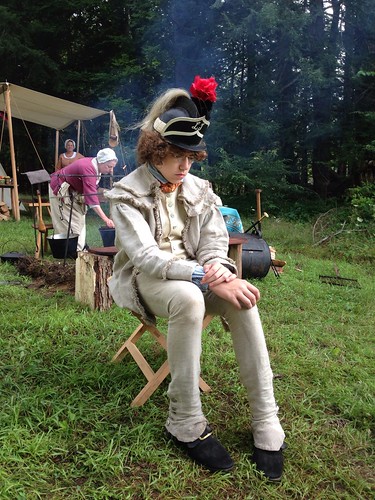
Here he is as the ensign, displaying the colors.

Not until Auburn and a large bottle of Gatorade later, when suddenly his stomachache and headache were gone, did I figure out that it was mild heat exhaustion and anxiety, not flu or something worse. And then realized I could have taken him to the first aid station instead of home. But, once home, after a nap and a fight and a dish of curry, he’d promised to go back up on Sunday, which was much better.

Their lyrics were hilarious.

Again, he got to serve as ensign and carry the colors, marching behind the guys as they sang their way through the village. But somehow, Sunday, everything seemed better than it had the day before, when he hadn’t told me how much he fears the start of high school, and how worried he is about his future.  No more reading the New York Times for him…

This isn’t the costume or action report you might want, but living history with an adolescent is challenging. The Young Mr is just too young to field (he’s only 14 but almost 15) and he doesn’t want to be a drummer. It’s a challenge to find things that he can legally and safely do that integrate him into the unit of guys, which is what he really craves. Perhaps it’s because he gets to try out what it’s like to be a man, while still being a boy.

Share this:

  • Share on Facebook (Opens in new window) Facebook
  • Share on Pinterest (Opens in new window) Pinterest
  • Email a link to a friend (Opens in new window) Email
  • Share on X (Opens in new window) X
Like Loading...
← Older posts
Newer posts →

Archives

wordpress statistics

Creative Commons License
Kitty Calash blog by Kirsten Hammerstrom is licensed under a Creative Commons Attribution-NonCommercial-ShareAlike 4.0 International License.

Website Built with WordPress.com.

  • Subscribe Subscribed
    • Kitty Calash
    • Join 621 other subscribers
    • Already have a WordPress.com account? Log in now.
    • Kitty Calash
    • Subscribe Subscribed
    • Sign up
    • Log in
    • Report this content
    • View site in Reader
    • Manage subscriptions
    • Collapse this bar
 

Loading Comments...
 

    %d