• Home
  • Completed Costumes/Impressions
  • Emma and Her Dresses
  • Free Patterns and Instructions

Kitty Calash

~ Confessions of a Known Bonnet-Wearer

Kitty Calash

Category Archives: Reenacting

Can’t talk, sewing.

21 Thursday Mar 2013

Posted by kittycalash in Clothing, Events, Living History, Reenacting

≈ Comments Off on Can’t talk, sewing.

Tags

18th century clothes, Battle Road 2013, Clothing, common dress, Reenacting, Revolutionary War, sewing, weekend

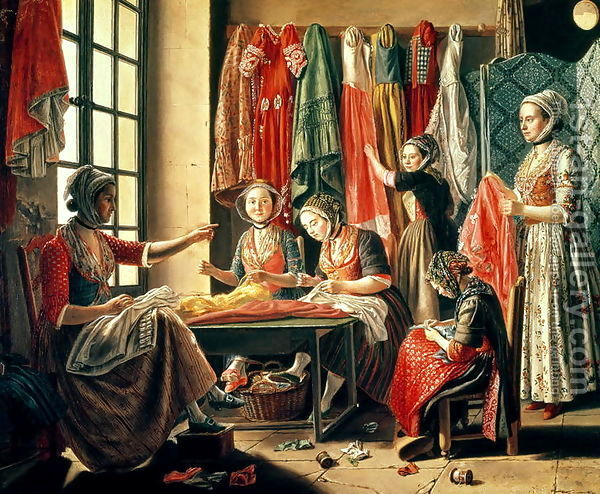
Raspal,_Antoine_-_The_Couturiers_workshop_-_1760

I wish I had this workshop to help me! Instead, I have the “assistant” who tends to howl and a room full of garments to finish and alter. The skirts of the brown gown are done and want only tape at the hems, so I can, in theory, move onward to sleeves. I’ll have to scrap plans for an HSF petticoat this weekend, as I have really fallen behind.

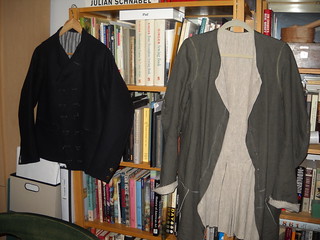
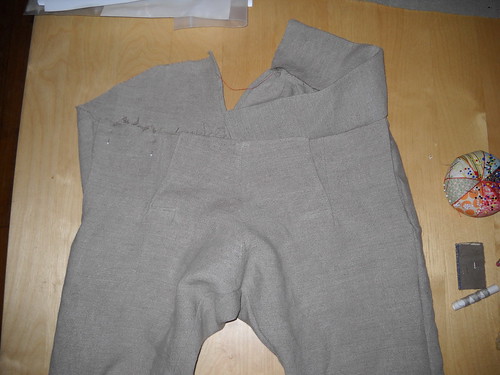
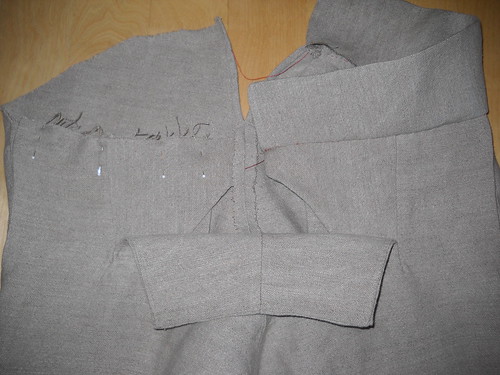
Menswear, to finish and to alter

Battle Road inspection/walk through is Saturday, and second hand reports of the reactions to letters received have me thinking about authenticity, standards, and communication. Last Saturday, I went to see Sew18thCentury and had a lovely time. Not only did we have a delicious late lunch and tea, an interesting chat about ideas and sewing and all sorts of things, I also got to get outta town on my own. (For growing up in a city, I am very happy to spend time in open spaces with grass, trees, and cows.)

I mentioned to Sew18thCentury that we’d wrestled with Fort Ti and chosen not to go because we did not, in our estimation, meet standards, and she was surprised that we didn’t. In truth, we did not. The guys clothes weren’t right, and I know our blankets aren’t right…heck, our tent’s not right.

What makes it all worse is that I know these things aren’t right. So I’ve tracked down blankets and just need to order them, and the tent–well, not this year, but maybe next, I can get around to sewing a linen bell-back tent. Mr S has learned back-stitching and whip stitching this week, so in a year we could tackle a tent together. It’s a process, and this year, unless there was a miracle of increased speed in sewing, I still wouldn’t go to Fort Ti in September.

But what about Battle Road? This inspection is not just for safety, it’s also for dress and appearance. This has thrown me into a tizzy: the jacket’s not done and the coat’s not altered. If the guys don’t pass inspection, they can’t be part of Battle Road, and I’ll feel bad that I didn’t put alterations first. But realistically, I can’t imagine getting their things done by Saturday morning. At least the coat will have the alteration marks made by the master… the road to hell may be paved with good intentions, but the road to Battle Road is paved with pins and linen thread.

Share this:

  • Share on Facebook (Opens in new window) Facebook
  • Share on Pinterest (Opens in new window) Pinterest
  • Email a link to a friend (Opens in new window) Email
  • Share on X (Opens in new window) X
Like Loading...

Ladies of a Certain Age….

20 Wednesday Mar 2013

Posted by kittycalash in Clothing, History, Living History, Reenacting

≈ 9 Comments

Tags

18th century clothes, age, authenticity, Battle Road 2013, Clothing, common dress, fashion, fashion plates, Research

Alsa Slade, 1816.

Alsa Slade, 1816.

I don’t know exactly what “that certain age” is, but I think I’m headed there downhill on an icy street in a speeding carriage.

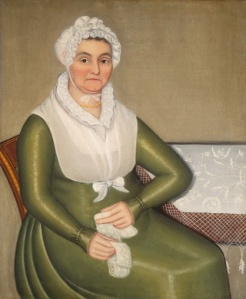
Here’s another good question: What about age? I didn’t address it directly in working out Kitty’s Brown Gown, but I did consider it. She’s in her 40s, and if you look at portraits by Copley and other artists, older women are often dressed in brown. These are respectable ladies, and when Kitty’s feeling more like a bad servant, she’s happy to wear her ca. 1774 red and black calico dress, and make tracks for Germantown.

I’ve been thinking a lot about personae and impressions, and first person interpretations. One of the best things I learned at a recent workshop was “first person thinking,” and in the historic costuming/re-enacting/living history/ historic re-creationist context, when you wonder what to wear, do, say, pack, eat, I think this is where it starts:

Know Your Self. It all flows from who (and when) you imagine yourself to be.
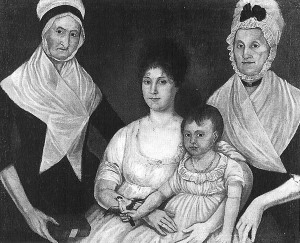
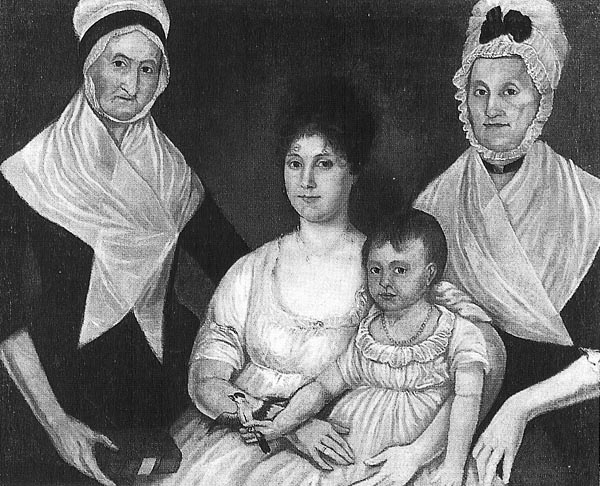
The Ege-Galt Family, 76.100.1, Abby Aldrich Rockefeller Folk Art Center

The Ege-Galt Family, 76.100.1, Abby Aldrich Rockefeller Folk Art Center

So let’s take age in account. For Battle Road, 1775, Kitty’s in her 40s. That means she was born around 1735, and came of age in the 1740s and 1750s. Knowing the styles of that time I’m even more comfortable choosing cuffs, because that’s what she grew up with.  She’s not going to be very fashion forward–not just because of her class, but also because of her age. (For added fun and dimensions, start thinking about what she saw and read.)

What about choosing fashions for the older set in 1812? That’s where it gets really interesting, to me. Check out the Ege-Galt family portrait, ca. 1802. The older women are NOT in the high-waisted filmy gowns. Left to right, the sitters were born in 1724, 1779, 1801, and 1748. They are wearing more traditional-looking, darker, firmer-stays-underneath, gowns.
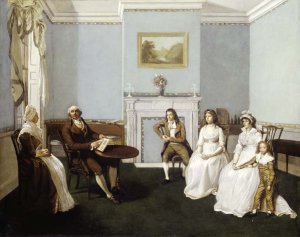
Museum of London

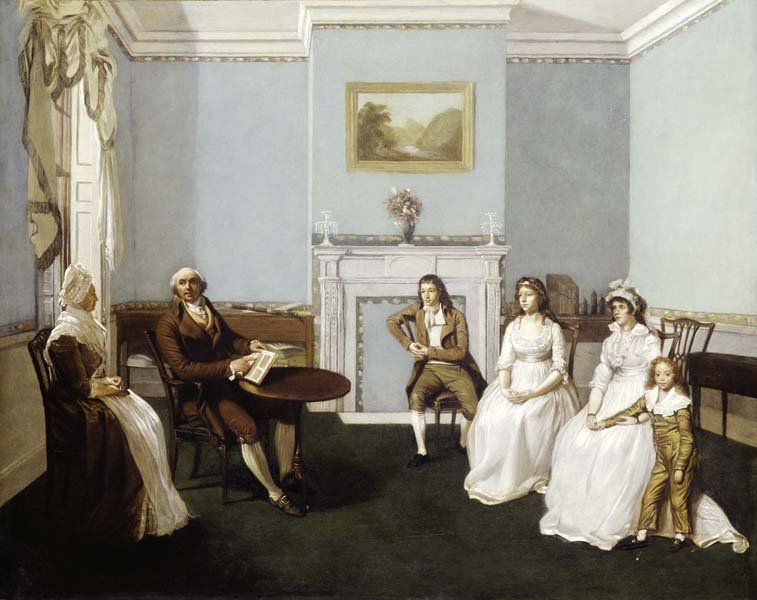
John Middleton with his family, ca. 1797 Museum of London 93.28

The same pattern plays out in this image of the artist’s colorman, John Middleton. The older servant is wearing a dark, older-style gown, while Middleton’s daughters are wearing the most fashion-forward clothes.

For anecdotal, quasi-experimental archaeological evidence, here’s my experience. I started out with solid, carapace-like ca. 1770 stays. (Mr S says touching me in them is like hugging a lobster, and then raps my ribs.) They’re not unpleasant, but they are confining, and even comforting. For an event at work, I made a pair of soft, semi-ribbed, transition stays with cups. They felt very strange after fully boned stays.

Long-line stays with cording and a busk? They felt better: more containment. It’s not just about my avoir du pois. It’s about the enveloping sense that the stays provide. The physical difference of the stays made me look at the Ege-Galt portrait again: what would I have felt comfortable and appropriate in, when styles changed radically?

Fashion plates, then as now, have bias in them. Know your self.

Here’s how I’d work it out:

Let’s say Kitty is 45 in 1812:   she was born in 1767, turned 20 in 1787: she grew up in full stays. She turned 30 in 1797, just in time to adopt shorter stays, but probably tending to longer line stays with corded bust gussets. Let’s say Kitty’s cousin is 55 in 1812. Born in 1757, she turned 40 in 1797. Chances are good she favored a longer stay with more boning, and maybe corded gussets, too.
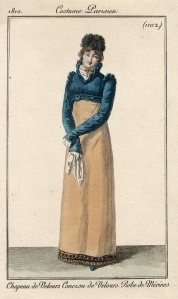
1813, chapeau de velours,  robe de Merino.

1813, chapeau de velours, robe de Merino.

What does that mean for her silhouette? It means that she lowers the waist of her gowns (You win again, gravity!) She also wears darker colors. Filmy gowns of the Regency era fashion plates aside, what did women wear for everyday? If you check Pinterest boards of fashion plates, or the various collections at NYPL, Claremont College, LAPL, and the Met, you can find Griselle, and that’s a help. Better yet, searching extant collections can turn up lovely-in-their-own-right gowns…with color!

The “real people” wore colors, and ajusted styles to their circumstances. I find the 19th U.S. 1812 site useful, not just for their studies of extant garments, but also for their presentations. The 1809 apron front gown from MHS is an excellent example of a non-filmy gown worn by a real woman. Caveat: it’s supposed to be Quaker. MHS has also has a nice set of watercolors online bny Anna Maria vonPhul, painting the town of Saint Louis in the first part of the 19th century. Her characters range in class and age, and reflect what she really saw.
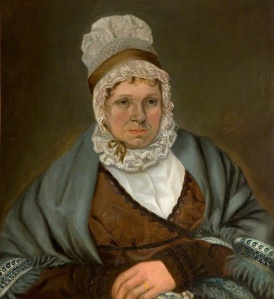
Dolly Eyland, Alexander Keith, 1808; New Art Gallery Walsall P11/02

Dolly Eyland, Alexander Keith, 1808; New Art Gallery Walsall P11/02

We have a gown at work worn by Mrs John Brown (also, perhaps, a Quaker) in the late 18th or first quarter of the 19th century. While it has a higher waist and does mimic fashionable trends, it reminds me of the Quaker gowns at the MFA (I think it is earlier). But it’s brown! Practical, attractive in the right shades, brown. Which does at least come in a variety of shades, and can be thought of as an excuse for darker red…

Share this:

  • Share on Facebook (Opens in new window) Facebook
  • Share on Pinterest (Opens in new window) Pinterest
  • Email a link to a friend (Opens in new window) Email
  • Share on X (Opens in new window) X
Like Loading...

Work, work, workman’s jacket

04 Monday Mar 2013

Posted by kittycalash in Clothing, Historical Sew Fortnightly, Making Things, Reenacting

≈ 4 Comments

Tags

18th century clothes, Battle Road 2013, common dress, Historical Sew Fortnightly, living history, Making Things, Revolutionary War

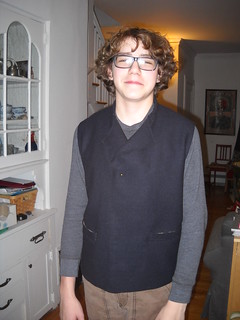
It fits! It might be painful, though.

Ah, yes. Work. It continues on the workman’s jacket for the Young Mr to wear at Battle Road, and for next week’s HSF deadline. There are some additional views of him in the same pose here. I tacked the lapels down because I have seen that detail on an original garment, and because if I don’t, they’re likely to bother the kid.

The nice thing about a workman’s jacket is that a waistcoat is optional underneath it. This short, only post-RevWar waistcoats look alright. So for Battle Road, long underwear may be in order. It wasn’t last year, but who knows?

Paul Sandby, A Sandpit. YCBA B1975.3.930

Paul Sandby, A Sandpit. YCBA B1975.3.930

Sandby, Roslin Castle detail, YCBA, B1975.4.1877

Paul Sandby, Roslin Castle detail, YCBA, B1975.4.1877

The form is authentic, thank goodness, for working men’s clothes; on the left, in a detail from Sandby’s A Sandpit, is a jacket in blue. On the right, in a detail from Roslin Castle, Midlothian, is another jacket that looks short, worn without a waistcoat. It may not be as short, but I am encouraged by the lack of waistcoat, though I will insist on shoes…

The form persists for a long time, and is seen in military wear as well, in light infantry and dragoon troops, as well as in sailor’s clothing.


Share this:

  • Share on Facebook (Opens in new window) Facebook
  • Share on Pinterest (Opens in new window) Pinterest
  • Email a link to a friend (Opens in new window) Email
  • Share on X (Opens in new window) X
Like Loading...

Better Backstitching

25 Monday Feb 2013

Posted by kittycalash in Clothing, Making Things, Reenacting

≈ 2 Comments

Tags

18th century clothes, Clothing, Costume, overalls, Revolutionary War, sewing, uniforms

Almost ready for fitting!

Practice: that’s the key. That’s the only key. Just keep stitching…and eventually, the stitches will get smaller and you will get faster.

I spent the week transforming last Monday’s stack of pieces into overalls. This sewing business is amazing! Flat pieces turn into something wearable, and it’s all made out of string in various arrangements. (I may need to get out more…)

The pattern from Henry Cooke goes together very nicely. The pockets are a nice element, and their installation is simpler (I’d call it elegant) than other breeches or trouser pockets I’ve made thus far (this is pair six of breeches/overalls/trousers, pattern four).

That sounds like a lot, doesn’t it? Here’s the spool of thread I bought 18 months ago on the left, and the new one on the right. Along the way, I’ve also used up several spools of colored linen thread, a couple of silk and a few of cotton. The new spool is 1150 feet of linen thread, which seems like a lot to start with. It goes fast, though. The used-up spools were smaller, but when you aim for 10-12 spi, that’s a lot of stitches. Best not to count.

With the fall dropped, you can see the bearer/waistband connection

Very cleverly done, this pocket-bearer-waistband arrangement. My sewing has improved, and luckily for me, these are heavy plain weave linen (acting as osnaburg, here) rather than heavy drill. Heavy drill kills my hands, but this has been pretty pleasant to stitch thus far. Who’s to say what fresh hell the buttonholes will bring–but that’s another week away, at least.

And then it will start all over again on pair number two…but not before I’ve altered the frock coat and possibly breeches, made a jacket and a hunting shirt, and, I hope, a gown. Six weeks to go!

Share this:

  • Share on Facebook (Opens in new window) Facebook
  • Share on Pinterest (Opens in new window) Pinterest
  • Email a link to a friend (Opens in new window) Email
  • Share on X (Opens in new window) X
Like Loading...

Three sticks, two kettles, no matches

20 Wednesday Feb 2013

Posted by kittycalash in History, Living History, Reenacting

≈ 2 Comments

Tags

18th century, authenticity, living history, Reenacting, Research, resources, Revolutionary War

Soldiers Cooking, 1798 National Army Museum (UK), 1983-11-63-1

Here’s some visual evidence for why we travel with three sticks, two kettles, and no matches. (We bring the sticks as we suspect the sites where we camp & cook don’t want amateur logging on their grounds.)  I stumbled upon this at the National Army Museum in the UK. Here’s what they say about the image:

Soldiers from an unknown unit attend to their cooking pot on a break from their duties during the Wars of the French Revolution (1793-1802). They are accompanied by their womenfolk. Although only a few men from each unit were officially allowed to marry and have their wives and families accompany them, women would have been found in almost every British military camp. Some worked as cooks, laundry women and sutlers (camp followers who sold provisions), while others were prostitutes.

One of the things one learns when reading about women who followed the armies of the Revolutionary War is that prostitution–at least for those following the American army– was not high on the list of occupations for women.

Why not? Lack of ready cash, folks.

Working for the Army would get you rations, and that literal meal ticket was desirable in a time of shortages and want. If you’d been burned out of your home or farm (I’m looking at you, 54th Reg’t of Foot, Aquidneck Island torchers) what would you eat? What would you do? It depended, of course, but one thing to do would be to follow your husband if he had enlisted.

I know less about the women who followed the British Army, but for a Continental Army start, I recommend the following books:

Belonging to the Army. Mayer, Holly A. USC Press, 1996.

Liberty’s Daughters. Norton, Mary Beth. Cornell, 1980. (My edition, 1996)

Revolutionary Mothers. Berkin, Carol. Vintage Books, 2005.

In Pursuit of Liberty. Werner, Emmy. Potomac Books, 2009.

The last title is about children in the time of the Revolution, not women, but considering who was left home with the children, and in trying to understand what the time might have been like for the Young Mr, I’ve given it a read as well.

As for the camp gear? We keep it at a minimum based on period images. We don’t all sleep in one tent, but we pack as light as we can. It’s nice when authenticity and ease are the same.

Share this:

  • Share on Facebook (Opens in new window) Facebook
  • Share on Pinterest (Opens in new window) Pinterest
  • Email a link to a friend (Opens in new window) Email
  • Share on X (Opens in new window) X
Like Loading...
← Older posts
Newer posts →

Archives

wordpress statistics

Creative Commons License
Kitty Calash blog by Kirsten Hammerstrom is licensed under a Creative Commons Attribution-NonCommercial-ShareAlike 4.0 International License.

Website Built with WordPress.com.

  • Subscribe Subscribed
    • Kitty Calash
    • Join 621 other subscribers
    • Already have a WordPress.com account? Log in now.
    • Kitty Calash
    • Subscribe Subscribed
    • Sign up
    • Log in
    • Report this content
    • View site in Reader
    • Manage subscriptions
    • Collapse this bar
 

Loading Comments...
 

    %d