• Home
  • Completed Costumes/Impressions
  • Emma and Her Dresses
  • Free Patterns and Instructions

Kitty Calash

~ Confessions of a Known Bonnet-Wearer

Kitty Calash

Category Archives: Research

Smell Ya Later

16 Tuesday Jun 2015

Posted by kittycalash in Clothing, Fail, History, Laundry, Living History, Reenacting, Research

≈ 9 Comments

Tags

19th century, 19th century clothing, authenticity, clothes, Clothing, common people, historical clothing, historical myths, historical reenactors, history, interpretation, laundry, smell

Wool on hooks, cat on prowl

Wool on hooks, cat on prowl

One of the most common questions you get when you’re wearing historical clothing is the undying, “Aren’t you hot in those clothes?”

A heavily perspiring visitor wearing practically nothing usually asks this question, and the standard reply is a variation of “Aren’t you hot? In really warm weather, everyone is hot. But natural fibre clothing wicks the moisture from the skin and helps to keep you cool.” My internal response (vocalized only once) is, “Why yes, I am—and thank you for noticing. I work hard for this look.”

The “aren’t you hot” question is often followed by, “Wow, and they didn’t bathe, so everyone really smelled.” You try not to think of that Monty Python sketch about Britain’s deadliest joke program in WWII and move the conversation on to weekly laundering of body linen, multiple shifts, shirts, and under-drawers, and the general hygienic practices of the past.

What struck me after a sticky weekend is how much I noticed the smell of modern people.

two tailors and a tailoress

two tailors and a tailoress

My traveling companions and I bathed on Friday morning, drove for 7+ hours in muggy weather, slept in our clothes, wore wool, cotton and linen in rain and thick humidity, sweated in the tailor’s shop, slept in our clothes again, and spent another warm, close, day in muggy weather, including grave digging and pall bearing. But as feral as my shift may have been on Sunday night, I never smelled us.

Mr H reported that his wool trousers were really stinky in the rain, and I think his white Spencer was well-seasoned even before this weekend, but I didn’t notice anything. Mr S’s soaking greatcoat was whiffy only at extremely close range.

What I did smell were modern perfumes, deodorants, and hair products. Those linger around their wearers and trail behind them, sometimes eye-watering in their intensity. I encountered lingering perfume in a bathroom at the museum, and we were overwhelmed by cologne at diner Monday morning: wow, people must really smell now, of petrochemicals.

more wool

more wool

This is not to say that homeless people and sulky teenagers don’t smell of unwashed bodies and clothes, but people in the past may not have smelled quite as badly as we think. They washed, if not bathed (bathing being full immersion washing) and by changing body linen and airing their clothes, they kept reasonably clean.

There was plenty to whiff in the past: wastes of all kinds, stagnant bodies of water used as dumps, rotting foods and corpses. But I’m not convinced that we haven’t simply exchanged one set of smells for another of different origin and intensity.
Share this:

  • Share on Facebook (Opens in new window) Facebook
  • Share on Pinterest (Opens in new window) Pinterest
  • Email a link to a friend (Opens in new window) Email
  • Share on X (Opens in new window) X
Like Loading...

Under the Green Umbrella

06 Saturday Jun 2015

Posted by kittycalash in Clothing, Research

≈ 5 Comments

Tags

19th century, 19th century clothing, British Museum, Costume, fashion, fashion plates, menswear, Metropolitan Museum of Art, museum collections, Museums, style, umbrellas

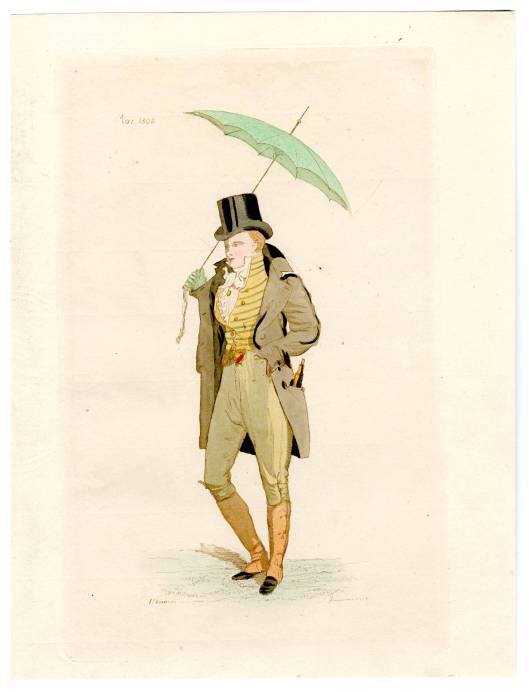
May, 1802. Gift of Woodman Thompson, Costume Institute Fashion Plates, Metropolitan Museum of Art

May, 1802. Gift of Woodman Thompson, Costume Institute Fashion Plates, Metropolitan Museum of Art

How do you like this gentleman? He’s from the Met’s online collection of fashion plates, in Men’s Wear 1790-1829, Plate 032.

I know a gentleman with a similar waistcoat and a similar smirk who needs only the umbrella and spy glass to complete this picture.

In case you’re wondering, the Hull Museum (UK) has a page devoted to a brief history of the umbrella. While classically and stereotypically British, it certainly rains enough here to justify carrying one. The British Museum has 46 trade cards that include umbrellas, with a few pre-1800 examples.

Share this:

  • Share on Facebook (Opens in new window) Facebook
  • Share on Pinterest (Opens in new window) Pinterest
  • Email a link to a friend (Opens in new window) Email
  • Share on X (Opens in new window) X
Like Loading...

Frivolous Friday: “Sport Your Little Spencers”

05 Friday Jun 2015

Posted by kittycalash in Frivolous Friday, Museums, Research

≈ Comments Off on Frivolous Friday: “Sport Your Little Spencers”

Tags

18th century clothes, Clothing, Costume, dress, fashion, prints, satirical prints, Spencers, style

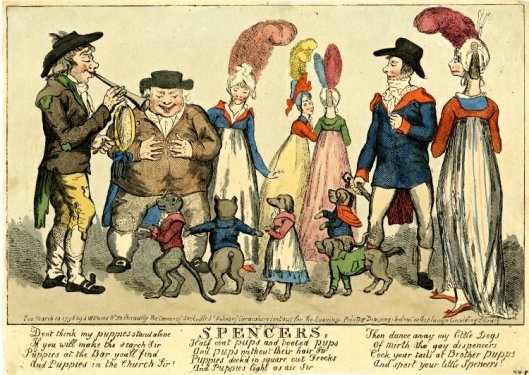
Spencers. hand-colored etching published by S W Fores, 1796. British Museum, 1851,0901.782

Spencers. hand-colored etching published by S W Fores, 1796. British Museum, 1851,0901.782

Spencers were clearly the rage for well over a decade, turning up in satirical prints from at least 1796 (We’ll get to that satire soon). I was wrong when I questioned the Maine catalog record that called a man’s short coat a Spencer: there were Spencers for men.

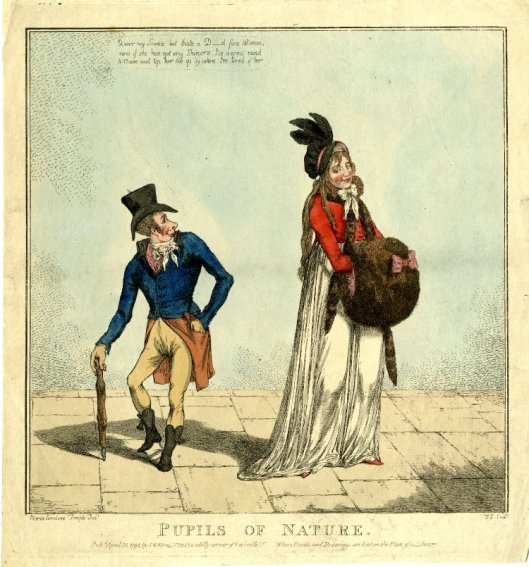
Here, everyone is wearing a Spencer down to the monkey and the dogs. What I find particularly interesting is that the short Spencer jacket is worn over the men’s coats– this is an entirely new concept to me. Yet, here it is again, in the “Pupils of Nature” print.

Pupils of Nature.hand-colored etching published by S W Fores after Maria Caroline Temple, 1798. British Museum, 1867,0713.409

Pupils of Nature.hand-colored etching published by S W Fores after Maria Caroline Temple, 1798. British Museum, 1867,0713.409

Were Spencers were the 18th and early 19th century equivalent of Members Only or Barracuta jackets? (You will know a red Barracuta–even if you think you don’t.) Perhaps. They do seem to be a splashy unisex fad in the late 1790s that gives way to women’s wear, but that’s a thesis in need of more research than Frivolous Friday demands or permits.

Share this:

  • Share on Facebook (Opens in new window) Facebook
  • Share on Pinterest (Opens in new window) Pinterest
  • Email a link to a friend (Opens in new window) Email
  • Share on X (Opens in new window) X
Like Loading...

Frivolous Friday: Silken Cone of Shame

29 Friday May 2015

Posted by kittycalash in Clothing, Frivolous Friday, Research, Snark

≈ 3 Comments

Tags

bonnets, British Museum, engravings, millinery, prints, satires, shame, snark

La famille Anglaise à Paris.Plate 11 to 'London und Paris', x, 1802 [1803]. Explanatory text, pp. 90-5. Copy of No. 11 in 'Le Suprême Bon Ton' series, see BMSat 9957. An English John Bull stands stolidly full face with clasped hands, a grown daughter on his right arm, his wife on his left arm. With them are two tiny little girls and a grown-up son, also stolid. A Frenchman and a lady attitudinize elegantly on the left. 1802 Hand-coloured etching. British Museum  1856,0712.605

La famille Anglaise à Paris.Plate 11 to ‘London und Paris’, x, 1802 [1803]. Explanatory text, pp. 90-5. Copy of No. 11 in ‘Le Suprême Bon Ton’ series, see BMSat 9957. An English John Bull stands stolidly full face with clasped hands, a grown daughter on his right arm, his wife on his left arm. With them are two tiny little girls and a grown-up son, also stolid. A Frenchman and a lady attitudinize elegantly on the left. 1802 Hand-coloured etching. British Museum 1856,0712.605

Mr JS and I have amused ourselves of late not just with thimble chatter, but with this satirical print of the English family in Paris.

I’m not nearly as funny as Mr JS, who pointed out that the bonneted girl on the far right is “I literally can’t even right now.” I think of her as Lisa Simpson, 1803. That’s the voice I hear reading the line texted to me: “I just want to pull this chemise dress over my head and die. Could someone with yellow fever cough on me?”

The father is Homeresque in his proportions, and nearly as befuddled. The artist is clearly mocking this poor family, contrasted with the graceful Parisians at left, but only the two youngest are aware, hiding in their cones of shame.

That deep coal-scuttle-like bonnet is mocked in other engravings; it is probably closer to the actual form of Julia Bowen’s cold scoop of 1799 than my approximation this fall. Julia would surely have known the shaming purposes of those grandiose and over-sized calashes: “Go sit in your calash and think about what you’ve done!” Mr JS quipped.

Appropriately enough, the silk I ordered to make my own calash of shame has arrived at the post office. Dark green taffeta envy lined with the bright magenta of embarrassment: clothes are so emotional.

Share this:

  • Share on Facebook (Opens in new window) Facebook
  • Share on Pinterest (Opens in new window) Pinterest
  • Email a link to a friend (Opens in new window) Email
  • Share on X (Opens in new window) X
Like Loading...

Frivolous Friday: A Feather Kerfluffle

22 Friday May 2015

Posted by kittycalash in Clothing, Events, Fail, Frivolous Friday, History, Living History, Reenacting, Research, Snark

≈ 3 Comments

Tags

18th century clothing, Costume, interpretation, millinery, Research, some snark

Miss Caroline Vernon by François-Xavier Vispré (c.1730 – London 1790). pastel on paper. ©National Trust Images/John Hammond.

I troll the interwebs in the fishing and not the under-the-bridge sense: there’s a lot to read out there. Still, I’ve kept one eye on the feather-and-flower kerfluffle that erupted in certain circles this week, but have been much more interested in documentation of one kind and another.

Miss Vernon is really my favorite image of feathers on hats, and I wish I could say that a) I have replicated this fabulous creation or b) that I have seen such a thing, but alas! I have not.

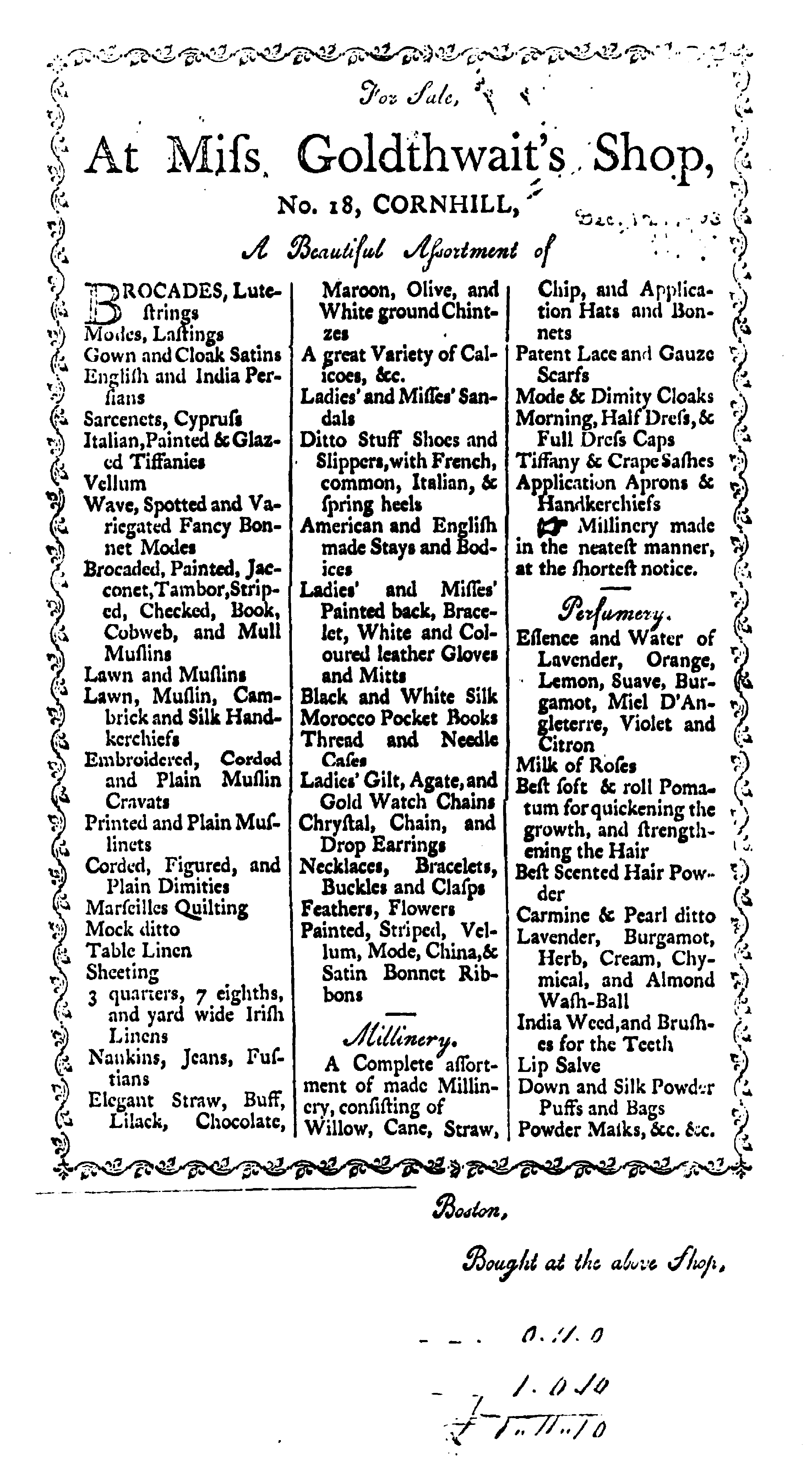
Still, scouring sundry repositories for tayloring manuals (more on that another time), I found this delightful broadside. We can’t use 1782 to document 1780, and no means of using any of these items is mentioned or implied. Still, there they are, those inflammatory terms: Feathers, Flowers.

1782 Broadside. Early American Imprints, Series 1, no. 45771  (filmed)

1782 Broadside. Early American Imprints, Series 1, no. 45771 (filmed)

To paraphrase Max, Let the wild rumpus continue.

Share this:

  • Share on Facebook (Opens in new window) Facebook
  • Share on Pinterest (Opens in new window) Pinterest
  • Email a link to a friend (Opens in new window) Email
  • Share on X (Opens in new window) X
Like Loading...
← Older posts
Newer posts →

Archives

wordpress statistics

Creative Commons License
Kitty Calash blog by Kirsten Hammerstrom is licensed under a Creative Commons Attribution-NonCommercial-ShareAlike 4.0 International License.

Website Built with WordPress.com.

  • Subscribe Subscribed
    • Kitty Calash
    • Join 621 other subscribers
    • Already have a WordPress.com account? Log in now.
    • Kitty Calash
    • Subscribe Subscribed
    • Sign up
    • Log in
    • Report this content
    • View site in Reader
    • Manage subscriptions
    • Collapse this bar
 

Loading Comments...
 

    %d