• Home
  • Completed Costumes/Impressions
  • Emma and Her Dresses
  • Free Patterns and Instructions

Kitty Calash

~ Confessions of a Known Bonnet-Wearer

Kitty Calash

Category Archives: Research

tite Dressed

15 Saturday Mar 2014

Posted by kittycalash in History, Research

≈ Comments Off on tite Dressed

Tags

10th Massachusetts, 18th century, common soldier, Revolutionary War, uniforms

William Dickinson, 1746-1823, The Relief, 1781, Stipple engraving and etching on moderately thick, slightly textured, beige laid paper, Yale Center for British Art, Paul Mellon Collection

William Dickinson, 1746-1823, The Relief, 1781, Stipple engraving and etching on moderately thick, slightly textured, beige laid paper, Yale Center for British Art, Paul Mellon Collection

Reading the Abbott orderly books takes some patience, even though they have been transcribed. As with so many 18th century texts, punctuation is unreliable and open to interpretation. Here’s an entry from July, 1782, on the subject of uniforms, guard duty and fatigue duty.

July 22 1782
The Greatest Care and aten
tion is to Be pade to the preservation of the Mens
Clothing and to keep the Cloth Clean.. As
the Guards are always to Be fill Dressed in
uniform they are not while on that Duty to be
put on Ferteeg or any kind of Meaniel service
but to appear Clean, tite Dressed and In a
Soldierly manner when any parties for
Ferteeg are Necesery they are not to be applied for
and Sent in there undress or Ferteeg Clothes
this order to be Strictly observed

Which seems in more sentence-like form to be:

The greatest care and attention is to be paid to the preservation of the men’s clothing and to keep the clothes clean. As the guards are always to be full dressed in uniform, they are not, while on this duty, to be put on fatigue or an kind of menial service, but to appear clean, tight dressed, and in a soldierly manner. When any parties for fatigue are necessary, they are not to be applied for, and sent in their undress or fatigue clothes. This order to be strictly observed.

Here’s what I think it means:

Pay attention to the men’s clothing and keep it clean.
Men assigned to guard duty are always to appear in full uniform. When on guard duty, these men are not to be assigned to fatigues or menial duties. They should instead always appear clean, neatly dressed, and solider-like. When fatigue parties are called, the guards are not to be assigned to that duty, so that they do not appear on guard in their fatigue or undress uniforms. This order is to be strictly obeyed.


Share this:

  • Share on Facebook (Opens in new window) Facebook
  • Share on Pinterest (Opens in new window) Pinterest
  • Email a link to a friend (Opens in new window) Email
  • Share on X (Opens in new window) X
Like Loading...

Order!

10 Monday Mar 2014

Posted by kittycalash in History, Living History, Research

≈ 2 Comments

Tags

10th Massachusetts, authenticity, Captain Stephen Abbott, common soldier, living history, orderly books, primary sources, Research, resources, Revolutionary War

Francis Wheatley, 1747-1801, British, Soldier with Country Women Selling Ribbons, near a Military Camp, 1788, Oil on canvas, Yale Center for British Art, Paul Mellon Collection

Francis Wheatley, 1747-1801, British, Soldier with Country Women Selling Ribbons, near a Military Camp, 1788, Oil on canvas, Yale Center for British Art, Paul Mellon Collection

You know you’re taking something seriously when you’re willing to pay for the privilege of reading a primary source. The microfilm I ordered from the Phillips Library arrived a week or so ago and I managed to snatch an hour or so between meetings to read and print some of the most interesting pages. I get a week or so more before the reader at work goes to storage, and then I’ll have to go haunt another library.

This is the kind of stuff I will happily read at bedtime, though it should also be noted that I will read regimental record books at bedtime, or runaway ads, so we may not share tastes in literature.

I was willing to pay for the film because I wanted to read the books in full to get a better sense of the context in which Bridget Connor was operating. (Delightedly, I realized last night as I fell asleep, of course there’s no death record for her in Massachusetts. She was expelled from camp at Newburgh, so why would she walk all the way back to Massachusetts? Why not set up a new life in New York? A whole new place to look for her!)

Beyond Bridget, there’s a wealth of detail in the Stephen Abbott Orderly Books.

Thomas Sandby, 1721-1798, British, Encampment at Maestricht, 1747, Pen in black ink, over graphite with gray wash on medium, moderately textured, beige, laid paper, Yale Center for British Art, Paul Mellon Collection

Thomas Sandby, 1721-1798, British, Encampment at Maestricht, 1747, Pen in black ink, over graphite with gray wash on medium, moderately textured, beige, laid paper, Yale Center for British Art, Paul Mellon Collection

“Regl Orders 5th June 1782
the Regiment will make Every preparation
to March on Fryday the Soldiers are to
Clean there arms to Morrow and pack up
there Clothing.. The Commedants of Com
apanies are Directed to Send the tent poles
which are Finished to Morrow by 12 oClock
to the Landing where the tent Lay the Guard
with the tents will pitch a No of tents Suff
iciant to Cover the Straw and what ever Bag
gae is Brought previous to the march”

This helps us get a picture of the camp, and from the order about the tent poles, I think we may gather that there were plenty of tent poles NOT expected to be finished. (My colleagues enjoyed that part when I read it aloud at work.)

Regimnl Orders June 6th 1782
the Regiment will turn out to Morrow Morning
at the Beating of the Revelee and to March
By Six oClock they are to pack there cloth
ing and kook there provisions this Evening
when they have arivd on the Ground for Encam
ping the officer commanding on the Spot
will order a partry if Forty men from the Reg
iment a Capt and two Sub’s to Command them
to Return to the Encampment in order to asist
in Bringin on the Baggage the Soldiers
are to Carry there kittles in there hands and
are to Leave there arms and pakes &c at the
New Encampment any Soldier who is found
Plundering another pack is to be tyd up and
punished with out Trial..

Carry their kettles in their hands, their provisions cooked the night before. Now, wouldn’t that change an encampment’s appearance? Let alone tied up plunderers…

Share this:

  • Share on Facebook (Opens in new window) Facebook
  • Share on Pinterest (Opens in new window) Pinterest
  • Email a link to a friend (Opens in new window) Email
  • Share on X (Opens in new window) X
Like Loading...

Who was Bridget Connor?

26 Wednesday Feb 2014

Posted by kittycalash in History, Living History, Research

≈ 5 Comments

Tags

10th Massachusetts, 18th century, Brigade of the American Revolution, common people, common soldier, Continental Army, genealogy, impressions, laundry, living history, orderly books, Research

Detail, James Malton, 1761-1803, A Military Encampment in Hyde Park, 1785, Watercolor with pen in black ink, with traces of graphite on moderately thick, moderately textured, beige, laid paper, Yale Center for British Art, Paul Mellon Collection. B2001.2.999

Detail, James Malton, A Military Encampment in Hyde Park, 1785. YCBA Paul Mellon Collection. B2001.2.999

Who knows? She’s hard to find, though I am told and have real hope that the microfilm of the Abbott orderly books that chronicle her misdeeds in wending its way to me down the dirty, salt-and-sand covered highways of southeastern New England.

Where have I looked for her and Francis Connor, whom I presume is her husband?

  • In every online vital record for the Commonwealth of Massachusetts.
  • In the National Archives microfilm of compiled records of Massachusetts soldiers in the 10th Regiment and the miscellaneous records.
  • In the Revolutionary War pension records index.
  • In the DAR index.
  • In the Soldiers and Sailors of Massachusetts.

Francis appears in Soldiers and Sailors of Massachusetts, for seven months’ service. That’s all I can find.

Well, crap, right? This genealogy stuff in Massachusetts is hard work—there are so many more people and towns than we have here in Li’l Rhody—but diligence and method pay off, and when you figure you’ve about exhausted the primary sources you can access for now,[1] you turn to secondary sources.

Lest you think I dislike Deborah Samson, note that I found her life a useful source in thinking about Bridget, as well as Book of Ages and Jane Franklin Mecom’s life. I’ve also been re-reading Holly Mayer’s Belonging to the Army.

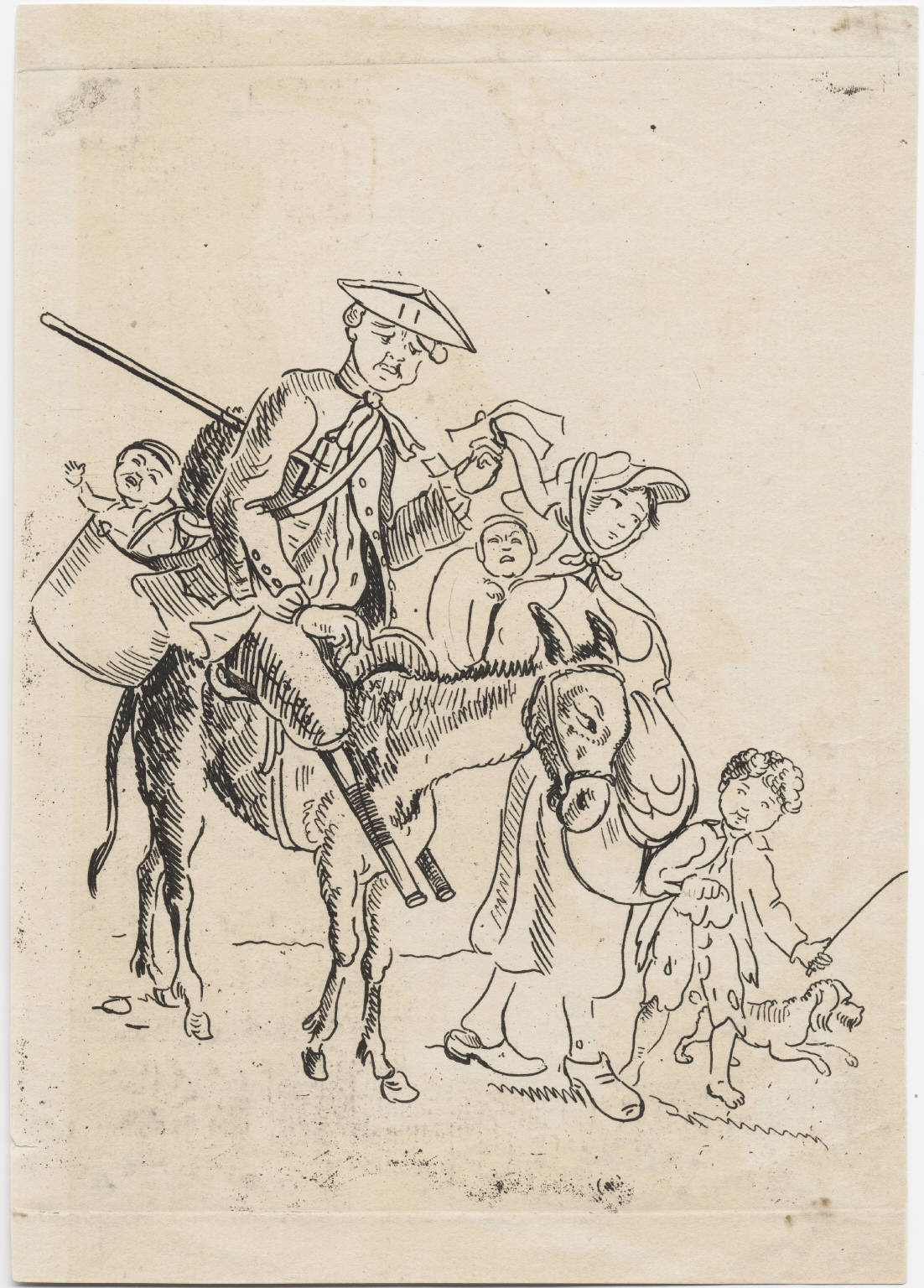
Crippled soldier with family. Etching, London (?) ca. 1760. Lewis Walpole Library, 760.00.00.16

Crippled soldier with family. Etching, London (?) ca. 1760. Lewis Walpole Library, 760.00.00.16

The common denominator: poverty, and the resulting lack of choices. This is useful for Bridget, because her story is probably one of necessity. Most women who followed the Continental Army, and worked for it, were from the lowest ranks. [2] These are women who would do what was necessary to survive, and as Mayer notes, “would rather steal than starve.” [3]

I’m not suggesting that Bridget, who would likely have received rations, needed to steal shirts to survive: I rather think she was attempting to leverage her position and profit by ill-gotten gains. But how did she end up in the Army to begin with? Massachusetts in 1782 is not New York in 1780, or Rhode Island in 1778.  What drove her to (presumably) follow Francis Connor?

Late in the war, maintaining troop strength is more difficult. The fervor of patriotism has cooled, and recruiting sergeants find it harder to fill the ranks.[4] There are bounties to be had, and the economy has suffered. Could Francis have been a property-less laborer who enlisted for the bounty? Nothing talks like cash. And, if the couple were tenants somewhere, without Francis’ income, Bridget might not have been able to maintain a home. Laundry doesn’t pay that much.

Why didn’t she stay with family? Could they have been indentured servants? Could they have been immigrants? My guess is that Bridget had no family, and if Francis had family, Bridget got on with them as well as she did with the officers of the 10th. I think she had nowhere to go, no way to survive without Francis.

Did they love each other? Did they like each other? Were they grifting together? I don’t know—but Francis Connor deserts the same day Bridget Connor is expelled from camp, so they’re bound together in some way. No matter what, Bridget was assuredly dependent on Francis.

Knowing so little about them opens up a world of possibilities, and the “opportunity” to do a great deal more research on the context of 18th century Massachusetts populations and enlistments. My best guess is that they’re an unpropertied laboring class couple from Boston, source of many of the relatively unstable and non-homogenous companies that made up the 10th Massachusetts. I also think they don’t have family, and might be former indentured servants. I have guesses about their religion and country of origin, which could be why the records are so hard to find. [5]

Looking for Bridget, and not finding her, leaves me with more and more questions, and I’m happy about that.


[1] She’s in the Abbott Orderly books, at least. Other Orderly Books to follow, as time and funds permit.

[2] Mayer, Belonging to the Army, page 122.

[3] Mayer, page 127

[4] How do you think Deborah Samson got in, passing as a boy? That’s 1782 for you.

[5] The Catholic Diocese of Rhode Island maintains separate historical vital records, and when we cannot find someone in the usual town records, we ask the genealogist if their family is perhaps Catholic or Quaker. Lack of evidence can be a suggestion of faith in my home state. But could these two be Irish Catholic in Massachusetts in 1782? I have no idea, but it seems a great stretch and a great question all at once.

Share this:

  • Share on Facebook (Opens in new window) Facebook
  • Share on Pinterest (Opens in new window) Pinterest
  • Email a link to a friend (Opens in new window) Email
  • Share on X (Opens in new window) X
Like Loading...

Taking Tea

04 Tuesday Feb 2014

Posted by kittycalash in Events, History, Living History, Museums, Research

≈ 5 Comments

Tags

Henry Sargent, historic interiors, interpretation, John Brown House Museum, Museum of Fine Art Boston, Museums, paintings, Research, social life and customs, tea party, The Tea Party

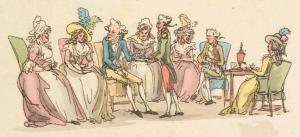
Detail, Picturesque studies and scenes of everyday life watercolor by Thomas Rowlandson, 1790. Royal Collection Trust. RCIN 810396

Detail, Picturesque studies and scenes of everyday life. Handcolored etching by Thomas Rowlandson, 1790. Royal Collection Trust. RCIN 810396

Hat tip to Jane Austen’s World for the image at left, which helped me start visualizing another program I’m involved with, this time ‘at home’ in Providence.

When we started reinterpreting the house museum, we began going back through primary sources to figure out how rooms might have been used, and furniture arranged (we don’t have inventories, so we read the house and diaries and letters– but that’s for another post).

Detail, The Tea Party. Oil on canvas by Henry Sargent, 1824. MFA Boston, 19.12

Detail, The Tea Party. Oil on canvas by Henry Sargent, 1824. MFA Boston, 19.12

One of the things I remember most vividly was the description of the uncomfortable tea parties Providence women gave, where the guests sat in chairs against the walls of the rooms, balancing a tea cup in one hand and plate in another. Several hard drives later, I’m not sure where that primary source is (the hunt begins tomorrow) but it conjured images of every hostess in Providence a Hyacinth Bucket, and every guest a quivering Elizabeth Next Door.

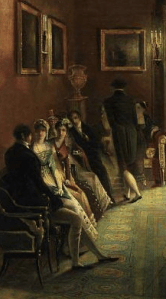
Detail, The Tea Party. Oil on Canvas by Henry Sargent, 1824. MFA Boston, 19.12

Detail, The Tea Party. Oil on Canvas by Henry Sargent, 1824. MFA Boston, 19.12

Surely that couldn’t be true? I thought I must be making it up, but then the Rowlandson turns up on the interwebs and there they are, in a row. More famously and closer to home, Henry Sargent’s painting of a Boston tea party in 1824. (The catalog description is rather nice.)

Here’s an 1824 tea party in Boston. While this is later than the tea party we’ve planned at work, it is still full of useful hints about how early, formal tea parties were conducted. We think– or I do, anyway– of ladies in frilly hats seated a tables with cakes heaped on stands and floral tea pots. I hear “tea party” and I think “doilies,” but this is not your grandmother’s tea party. It’s a different kind of social occasion, both more formal and more relaxed.

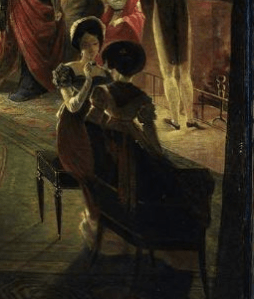
Detail, The Tea Party, oil on canvas by Henry Sargent, 1824. MFA Boston, 19.12

Detail, The Tea Party, oil on canvas by Henry Sargent, 1824. MFA Boston, 19.12

There’s not a central table to sit around, but instead chairs lined up against the wall, groups of guests, chatting. Others guests stand close to the fireplace, and a pair of ladies have taken a settee and a stool for their close conversation. We can just make out the tiny tea cup in the lady’s gloved hand.

In many ways, this depiction reminds me more of contemporary cocktail parties or open houses with the guests in small, changing groups, and no place to put your cup. Of course, most of us don’t have waiters (that’s who you see in the detail above with his back to us) or fabulous houses on the Tontine Crescent in Boston.

In so many ways, the social customs, habits and mores of the past are lost to us, and as we try to recreate them, the we excavate them from a combination of unlikely sources. Accounts, paintings, diaries, and etiquette manuals serve as sources, but it’s easier to recreate the economics of tea than the structure of a tea party. And once we do have an approximation, will it be a party anyone wants to go to?

Share this:

  • Share on Facebook (Opens in new window) Facebook
  • Share on Pinterest (Opens in new window) Pinterest
  • Email a link to a friend (Opens in new window) Email
  • Share on X (Opens in new window) X
Like Loading...

HSF #2: Innovation

03 Monday Feb 2014

Posted by kittycalash in Clothing, Historical Sew Fortnightly, History, Living History, Research

≈ 6 Comments

Tags

19th century clothing, authenticity, bonnets, Costume, fashion, fashion plates, Historical Sew Fortnightly, Quakers, Rhode Island history, sewing, silk taffeta, style

For this challenge, I initially thought I’d be working on the compere fronts for a silk sacque, but then I took another look at the calendar and realized March was awfully close! Instead, I opted to spend the past week working to better understand the Quakers, especially Quakers in Rhode Island, in advance of a program in early March. (I did do #1, Make Do and Mend, but do you need to know about re-stitching a petticoat binding?)

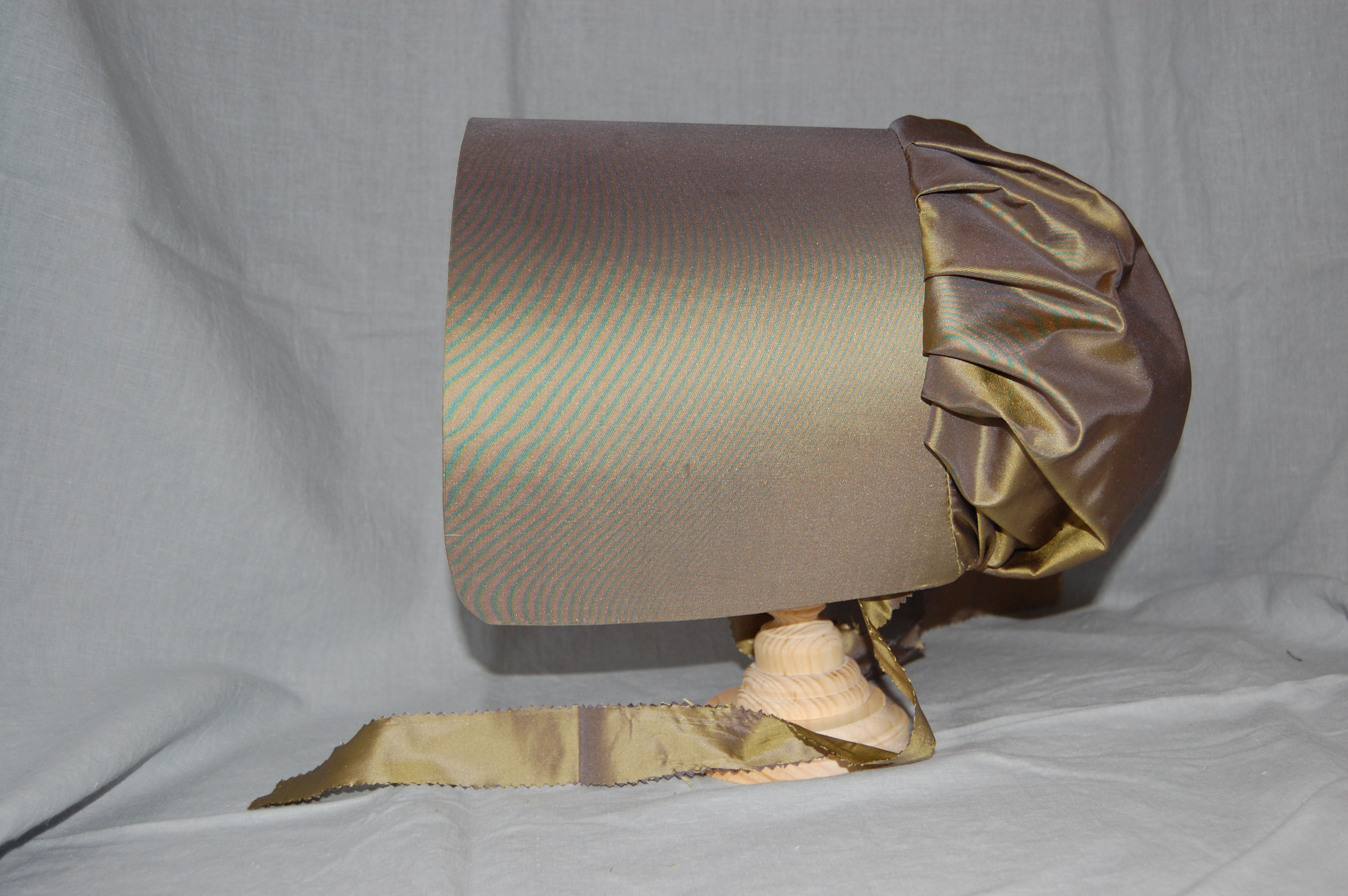
'Quaker' bonnet

‘Quaker’ bonnet

To help get myself out of a sewing rut and panic, and a general malaise, I made a bonnet. A ‘Quaker’ bonnet. Bonnets are like cupcakes: delicious, sugary, but lower in calories and committment than a full garment.

Quaker bonnet ca. 1800, Nantucket Historical Association, 1928.54.7

Quaker bonnet ca. 1800, Nantucket Historical Association, 1928.54.7

Quaker women in the late 18th and early 19th century did not, as far as I can tell, wear the black ‘sugar scoop’ bonnet we now associate with Quakers.

There are numerous entries in Amelia Gummere about bonnets, and types of bonnets, and the reflection of particular sects of Quakers in the pleating of the bonnet caul. But early in the 19th century, at the dawn of the Age of Bonnets, Quaker and non-Quaker styles seem to have been closer.

Fashion Plate: Promenade Dresses, 1801. Museum of London. 2002.139/1397#sthash.YsOpwKG2.dpuf

Fashion Plate: Promenade Dresses, 1801. Museum of London. 2002.139/1397#sthash.YsOpwKG2.dpuf

The fashion plate from the Museum of London presented a style that I thought I could approximate, and that made sense to me for 1800-1810ish, but I chose an olive green silk (actually yellow and black sort-of-changeable taffeta) because I have seen Quaker bonnets in olives and tans, especially earlier bonnets. Going with a color that was less distinctive, and a form that was undecorated, seemed to me to strike the best balance between plainness and style in this time period.

I chose this for innovation because the new bonnet forms of the early 19th century are departures from the full, round, pudding-on-the-head styles of the late 18th century, and the Quakers took it a bit further. In standardizing the appearance of their bonnets (simple, unadorned, eventually ossified in form and signaling sect in pleat patterns), the Quakers were innovators in clothing as  outward symbol and sign of inner faith and affiliation.

There’s your rationalization, how about some facts?

The Challenge: HSF # 2, Innovation

Fabric: Sort-of-changeable black and yellow silk taffeta in olive green for the body and ribbons, white linen for the caul lining and brim interlining, white poly taffeta for the brim lining, and pasteboard for the brim.

'Quaker' bonnet, view two.

‘Quaker’ bonnet, view two.

Pattern: Modified Kannik’s Korner Bonnets, View E

Year: ca. 1803

Notions: Thread, PVA (acid-free white glue for book binding)

How historically accurate is it? Well, white poly taffeta aside, pretty accurate. All hand-stitched and assembled in a period method. Gentlewomen can disagree about accuracy of style, but we could call this a plain bonnet ca. 1803 and be safe. After March, I can decorate the bonnet. The poly will remain, so, well, 60%? (How many points from Gryffindor for using the right weave in the wrong fiber?)

Hours to complete: Five, perhaps? These are quick, so five would be from start to finish, not including agonizing in advance.

Mr S's day took a bit of turn.

Mr S’s day took a bit of turn.

First worn: First by Mr S, who wasn’t feeling well, but to be carried along by me on March 7.

Total cost: All supplies came from the Strategic Fabric Reserve and chip board depot. It takes so little of anything to make a bonnet…maybe $2.50 in silk, $3.00 in linen, .50 in chipboard, so $6.00? (The silk came from the remnant table at $10/yard, chipboard is $2.00 a sheet, and linen about $12/yard.)

Share this:

  • Share on Facebook (Opens in new window) Facebook
  • Share on Pinterest (Opens in new window) Pinterest
  • Email a link to a friend (Opens in new window) Email
  • Share on X (Opens in new window) X
Like Loading...
← Older posts
Newer posts →

Archives

wordpress statistics

Creative Commons License
Kitty Calash blog by Kirsten Hammerstrom is licensed under a Creative Commons Attribution-NonCommercial-ShareAlike 4.0 International License.

Website Built with WordPress.com.

  • Subscribe Subscribed
    • Kitty Calash
    • Join 621 other subscribers
    • Already have a WordPress.com account? Log in now.
    • Kitty Calash
    • Subscribe Subscribed
    • Sign up
    • Log in
    • Report this content
    • View site in Reader
    • Manage subscriptions
    • Collapse this bar
 

Loading Comments...
 

    %d