Codes of Conduct & Rules of Civility

Tags

, , , , , ,

These have been a tough couple of years. We are, once again it seems, in a period of polarization and increasing political violence. In times like these, when disagreements flare brighter and behavioural norms are changing, even the things we do for fun can be affected. From online fights that turn nastier than ever to onsite behaviour that runs the gamut from passive-aggressive to hostile, the real world creeps into our fantasy worlds. I have experienced and seen behaviour that I find unacceptable. It was subtle, but not acceptable. When I posted about it online, a lively discussion ensued.

From that, an idea was born: Sharon Burnston suggested a Code of Conduct, which I heartily endorsed. Drawing on her experience organizing and managing events and groups, Sharon wrote a draft code of conduct. Now, with edits and suggestions from others, it is available on her website.

“We are all here at this site/event for the same purpose, to portray events that happened here in the past for the benefit of the public, and for our own enjoyment. We agree to follow the site’s rules for fire safety, gunpowder and weapon safety, curfew, alcohol consumption, and whatever other restrictions they require of reenactors. Just as we have agreed to adhere to standards for our clothing and our kit, it is appropriate that we agree to adhere to standards for our behavior. The standards for our behavior are modern, not period. We are interpreting history, not re-creating historical attitudes to class, gender, or race. We are 21st century people, and 21st century expectations apply.

In its simplest terms, treat everyone else as you would want them to treat you. Don’t be a jerk. But to break it down into specifics, and in order for this community to feel welcoming to the largest possible population, we expect everyone to endorse the following standards of behavior. Anyone who cannot adhere to these simple rules will not be invited to future events.”

Don’t be a jerk.

Seems so simple, right? Apparently not for everyone, because not everyone embraced a fundamental grade-school lesson:

“I will take responsibility for both my actions and my feelings. I have the right to have my feelings respected, I have the right to be heard and understood, I have the right not to feel pressured or browbeaten. I extend the same rights to all other reenactors and to the public.”

For me, this presents an interesting conundrum. You see, I kinda started this when I announced online:

Now, this is in fact a wimpy way to deal with a person who I think treated me pretty shabbily at an event, and who made clearly misogynistic comments at that event, and has posted white nationalist stuff on social media. A quicker-witted person than I would follow Sharon’s precept six:

“I will call out these inappropriate behaviors in others. If I see something, I will say something – either to the offender directly or to an authority figure – a captain, event planner/organizer, or someone I trust. I will stand in solidarity with my fellow reenactors and pledge to stand up to bullies, abusers, and other unpleasant behavior to ensure the safety and comfort of those around me.”

This last is easier for some than for others. It gets easier when one can believe that one will be listened to, heard, and taken seriously. And that is not on the person reporting: that’s on the person hearing. When someone’s feelings are dismissed, or another’s actions excused (he’s a good guy; he’s just insecure), the status quo is maintained, the ranks secured, and the world unchanged. It will take all of us to make places safe and pleasant to be it. A code of conduct we can all agree to is a good place to start.

This is That

Tags

, , , , , ,

Mark Rothko: another suicidal abstract bad-boy painter from the middle of the last century, so what?
This is what: a day at the museum when then the last painting in the Napoleon exhibit is presented in such a way that it was, in effect, the same as the last painting I happened to see.

Rothko wasn’t one of my top-ten favorite artists, but he was the top of the list of color-field painters I liked when I was studying art. He’s the kind of artist who grows on you as you mature, the way eating habits change with experience. The article I’m reading now compares his work to Roman villa murals, and that makes sense when you encounter his work. It’s color and not color, depth and surface, immersive. Simply immersive. Rothko creates a world that exists within your own head; his paintings invite you into his mind, which then occupies yours. It’s not always comfortable, given Rothko’s own dark visions. It remarkably effective in its apparent simplicity, the colors hovering over one another, creating depth with saturated color.

The first Rothko I saw must have been in Chicago, though the first one I remember is Red, Orange, Orange on Red in St. Louis; I must have seen the Albright Knox’s not long after they acquired it– the red and black are more familiar and more comfortable, in a way, than the orange and red.

But this is a history blog, you say, a costume blog. Why are we talking about Rothko? We’re talking about Rothko because seeing a Rothko– standing in front of an actual Rothko, taking a breath and looking— is an experience. An emotional experience. Reader, I wept.*

Just as the projected waves washed the walls of the final gallery in the Napoleon exhibit, so too did the blues of this untitled painting move. They vibrated with emotion, and I was immersed in blue, a kind a symphony of color, as close as I will ever come to synesthesia.

And that’s what good exhibits do, what good history does, what accuracy does. It renders the past visible, tactile, sensible, immersive. It catches us, and we fall down. Art, history, culture: if we are sucked into that otherness, hooked by feeling, we are more likely to learn something.

As stood before the Rothko, I noticed a Cornell– and a teenager noticing the Cornell. Joseph Cornell’s boxes were my first obsession, when I skipped school to go to the Art Institute of Chicago to spend my day surrounded by Cornell’s tiny universes, transported to another place.

Untitled (Primary Title), painted and papered wood and glass box, with wood, plaster pipe, metal rings, nails, and string by Joseph Cornell, probably 1950s. Virginia Museum of Fine Arts, 96.41

Isn’t that what we’re trying to do, every time we dress in these funny clothes, visit historic sites, reenact the past? Aren’t we all seeking some sublime moment, when this solid present becomes the ether of the past? Sometimes the way to understand that most readily is to study something else entirely– like a Rothko. Or a Cornell. Sometimes the way into a thing is sideways, when understanding and inspiration come from an unfamiliar place, when me make connections we don’t expect.

L’Empereur Napoléon Ier sur son lit de mort, oil on panel by Denzil O. Ibbetson, 1821.

Death and Napoleon and Rothko and Cornell all seem obviously connected to me– and not just through the symbolism of the rich cobalt blues.

*I do this in museums: when I walked into the Kaufman Gallery at the NGA, tears welled in my eyes at the sight of so much beauty.

Black and Blue

Tags

, , , , , ,

Unlike some of my earlier posts, this Black and Blue refers to a different kind of historical effect: the purely aesthetic. (Yes, it is a departure for me. Moving below the Mason-Dixon line has been curious, as my encounters at the bank regularly make me wonder if I have stumbled into the Invasion of the Body Snatchers or Pleasantville. Surely real humans aren’t this nice! I thought the people of Rhode Island were just fine, but maybe my standards were warped by growing up in a Major Midwestern City.) In any case, times change and so do people. Onward, to the aesthetic!

First, there was the new waistcoat. That should be enough to refresh an outfit, right?
Wrong.

The armscye sits way back over the shoulder blades

The set of the armscye didn’t coordinate with the white gown I made two summers ago, so a new item would be in order. I thought this would be the case in the muslin, but when I basted up the blue silk (selected because I had enough material to make a waistcoat and a cap), it was clear something new would have to go underneath.

The original waistcoat’s date of ca. 1797 helped narrow down my choices, and a 1799 fashion plate helped as well. Blue over white: pretty snazzy. I sketched up the plan for the white wrap-front gown, re-imagined that when I got batiste after asking for voile, and figured I’d be fine. A blue silk cap trimmed in black wool lace or gold silk cord still seemed like a good solution.


But the fashion plate showed a black hat or bonnet, and whilst trolling Etsy with a Manhattan in hand, searching for an 1830s-appropriate buckle, I took a look at one of my favorite shops, just to see.

Reader, I saw.

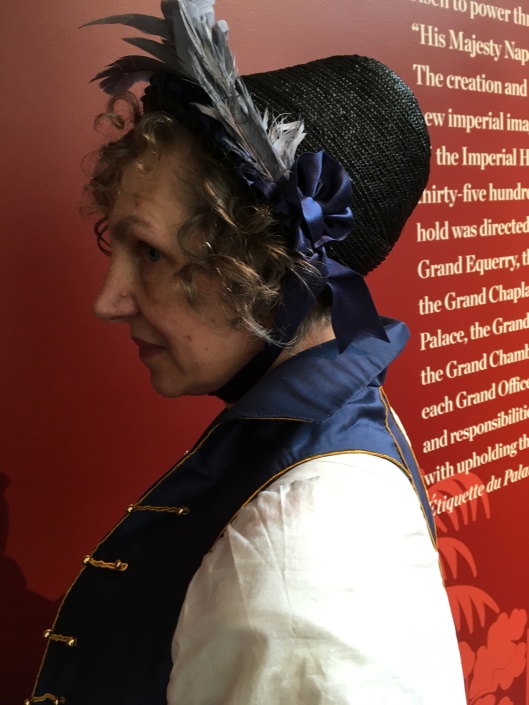
The “overly honest milliner” confessed that this style would not flatter everyone. Challenge accepted! In truth, though, I have a small head, and having cut my hair short for the summer, can (must) wear a slightly different kind of headware. I’ve also tried on enough of Anna’s millinery to know what will and won’t work for me, so I was pretty certain this bonnet would suit me well.

I trimmed it with some blue silk double-faced satin ribbon recovered from a failed bonnet attempt of several years ago, and then cast about for something else. Something different. Wednesday found me steaming feathers– as you do– while Drunk Tailor pulled KP duty. I hid the feather quills (more or less) with a ribbon rosette, and the considered fastening. Many early-nineteenth century bonnets don’t tie under the chin, and in any case, I didn’t have enough ribbon left to pull that off.

Parking lot selfie, with sweat, curls, and feathers. I like the way the feathers contrast with the curls.

The solution? Another rosette. On the feather side, I stitched the straight tail of the ribbon to the bonnet. The second rosette attached to the ribbon, which I then ran under my chin and pinned. Bonnet secured, more or less, though the feathers necessitate caution when exiting a vehicle.

Tripping in Richmond

Tags

, , , , , ,

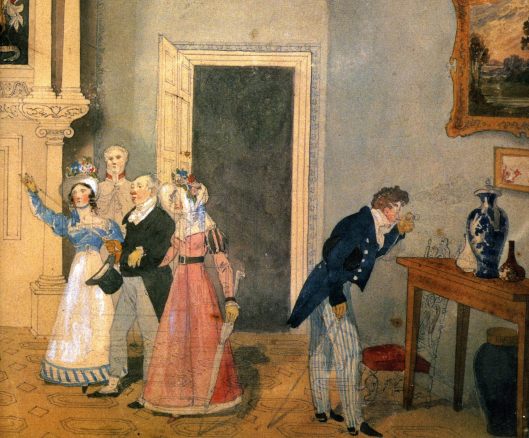
Visiting the Stately Home: an early touristic diversion

Friday night, Drunk Tailor and I waited until the worst of rush hour in NOVA was over and headed south to Richmond, surprised not to be engulfed in a terrific thunderstorm of the kind we are becoming accustomed to driving in. We had planned a weekend trip to see the Napoleon: Power and Splendor exhibition at the Virginia Museum of Fine Arts. It’s a traveling exhibit, but this is the first time I’ve been close enough to see it, and we had the added benefit of being able to attend in costume with the Regency Society of Virginia. (Reader: I required a new outfit.)

The idea of visiting a museum in costume is incredibly appealing, and all the more so when you can visit galleries of objects from the time period your costume replicates. Add to that the layer of traveling on the weekend in the clothes from the time when tourism first became a “thing” (at least among the monied classes), and you have a recipe for an excellent adventure.

(Somehow, while often at events together, Drunk Tailor and I are rarely seen “together,” so images like this are nice to have.)

If you are going to play the tourist, especially if you are visiting the “spoils” of the former emperor, you have to dress appropriately. American tourists today may travel in camo crocs and backwards baseball caps, but people in the past dressed for touring and it seemed appropriate to dress for this trip.

Admiring the panorama. (Cropped only to enhance periodicity)

This trip, with the fun of visiting in period clothes, reminds me of the books still in storage, and the books I have yet to read — one on early country house tourism— that document the changes in how people spent their time and consumed goods, and the reasonably concurrent rise of both the museum and the department store.

Raptures about the mounting, I think, but we might as well we shopping.

Peale and Zola have more in common than you might think, or at least Mr. Peale and Mr. Selfridge. These compendia of material goods are similarly structured — both organized around themes or types, whether ladies’ lingerie or Oceanic art– and have similar aims of edification and [cultural] consumption.

When your hat sees its cousin in a case….

All in all, an excellent trip, with much to see and talk about. After finishing our tour of the Napoleon exhibit, we lunched (another experience similar to the department store) and toured more of the museum, and had a day well spent.

Hair a la Titus and the Resting Bingley Face

Tags

, , , ,

Reader, it is hot where I live. June, July, and August are tiresome months here, humid and warmer than what I became accustomed to in New England. After a year, I realized I’d had enough of trimming my hair myself. I texted a friend with good hair, and found someone to liberate my neck. Excellent, right? Well…it’s all good until you want to dress up.

19th century history hair being somewhat mullet-like, my short in the back bob was not going to get the job done for last weekend’s Jane Austen Ball at Gadsby’s Tavern. What to do? Cap it, of course– there’s no way I could figure out how to tie a turban elegantly and reliably without giving up the hope of finishing some other projects I really want to finish this month. So, a cap/hat/sewn headdress. Aside from the examples seen in film adaptations of Jane Austen’s novels, what evidence is there for these concoctions?

ladies heads with various wraps and feathers

London Head Dresses, June 1804

woman in a gray tam o-shanter cap

Detail, Plate 11, April 1799 Journal des Luxus und der Moden.

Enough, it would seem, to be getting on with. In addition to the 1804 Ladies’ Head Dresses plate, there are plates in the Journal des Luxus und der Moden showing headdresses and wraps, as well as an image of a pelisse and matching tam-o-shanter-like hat. These are simple enough to make, and I managed one in less than 24 hours.

two couples in historical dress

I had no idea Drunk Tailor and I would color coordinate so well. Also, Dat Hat.

The fabric is left over from a gown I made to wear to a dance in Salem one spring, , but which happily coordinated well enough with the sari gown made for a photoshoot, and also worn to Salem for a dance. Briefly, the cap is made from scraps, ornamented with a two-layered rosette centered with a paste button, with the bulk of the caul gathered up and stitched down to hold the shape and embellished with three coordinating tassels looped onto a gold silk-wrapped cord. In the end, not too resting Bingley face, and a satisfactory cover for what I’ll call my hair a la Titus when I’m not in the current century. Drunk Tailor’s hat covered, somewhat, here.