Tags
19th century clothing, authenticity, Events, fashion, John Brown House Museum, living history, Rhode Island, Rhode Island Historical Society, What Cheer Day
An overview of the day, to begin with.
12 Wednesday Nov 2014
Posted in Events, Living History, Museums, Reenacting, Thanks
Tags
19th century clothing, authenticity, Events, fashion, John Brown House Museum, living history, Rhode Island, Rhode Island Historical Society, What Cheer Day
An overview of the day, to begin with.
11 Tuesday Nov 2014
Posted in Clothing, Fail, Living History, Making Things, Reenacting
Tags
1790s, 1797, 18th century clothes, 18th century clothing, fashion, Federal style, sewing, sewing project, Spencer, Spencers, style, What Cheer Day, wool
Yes, finished! And just in time, too! The braid arrived in the mail three days before the Spencer was wanted, and fortunately I had finished the garment by then, and the baking could take care of itself after a while, and I managed not to get eggs beaten with sugar on any lovely wool or mohair.
I think it looks well enough with the gown and bonnet, though I am fairly certain the darts are too far to the sides in this iteration. How that happens when you use the same pattern twice I do not know.
You may recall that this is the Spencer where I demonstrated an uncanny ability to sew a collar on upside down. The braid went on pretty quickly, again proving that good materials make good sewing.

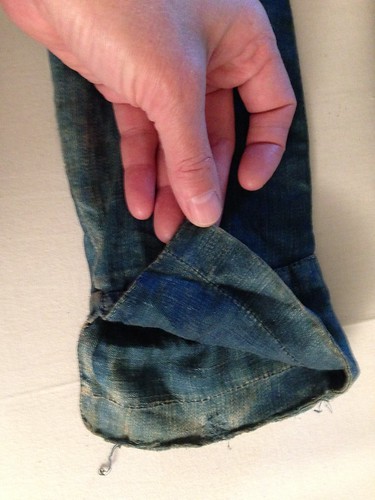
As mentioned previously, the cuffs are pieced, but this is a perfectly accurate way to deal with a shortage of material and/or cuffs.
I’m fairly pleased with how it turned out, and very pleased with how warm it is. Over the cotton gown, the Spencer was plenty warm– and I certainly wished I had it after we left the house and went down to the river!
On the whole, I suppose I’m pleased…as pleased as I ever am …which means you can expect pattern revisions in the future!
10 Monday Nov 2014
Posted in Collecting, History, personal
The Sunday, November 9th Guardian had a series of short articles on collecting, including one on why people collect things. This was similar to the New York Times’“Room for Debate” series on Why We Collect Stuff.
I liked the Guardian’s “Love, anxiety or desire?” question, and asked it of myself: why do I collect?
Collecting is something that I had given up for a while, given that so much of what Mr S and I had collected was stashed in boxes in our basement after an apartment move nine years ago. Nine years! If you haven’t unpacked in that time, do you really even care about those things?
No, not really. Many the things I unpacked recently as we went through the basement again are destined for Etsy: McCoy pottery vases, colorful Pyrex, FireKing glassware. I bought it at a time when I liked green pottery—it was an outgrowth of the blue and yellow creamware I’d begun collecting when I first lived in Rhode Island.
But now, I’m done with it: done with the mid-century modern, and going back to the early American things. There’s an aesthetic quality I like in both styles: simple lines, bright colors.
The most recent acquisition is a drop-leaf table in a very country Sheraton style, with a tiger maple skirt. I watched this table for months before finally committing to it, and dragging Mr S up there late Saturday afternoon. He was game, and in the past day the table has grown on him.
Why did I want it? For one thing, it reminds me of a maple drop-leaf Sheraton-style table my mother has, so perhaps there’s an element of nostalgia, or a desire for approval. I also imagined it exactly where it is, though it will require some adjustment in lighting. Did I buy a piece not only of the American past, but of my own? Is this what adulthood looks like? Or am I just responding to shape and color?
The table and chairs are low, and not comfortable in the way that modern furniture is: I wouldn’t want to sit in the chairs or work at the table every day, but these things give me pleasure, whether bought for love, anxiety, or desire.
08 Saturday Nov 2014
Posted in History, Living History, personal
Tags
18th century, 19th century, China trade, Chinese export porcelain, collecting, Federal style, porcelain, tea party, tea pot
I try hard not to be acquisitive, though our home is perhaps more crowded than it might be if I were better at the task or cleaned at work less and at home more. Around the time of What Cheer Day, I became rather obsessed with teapots.
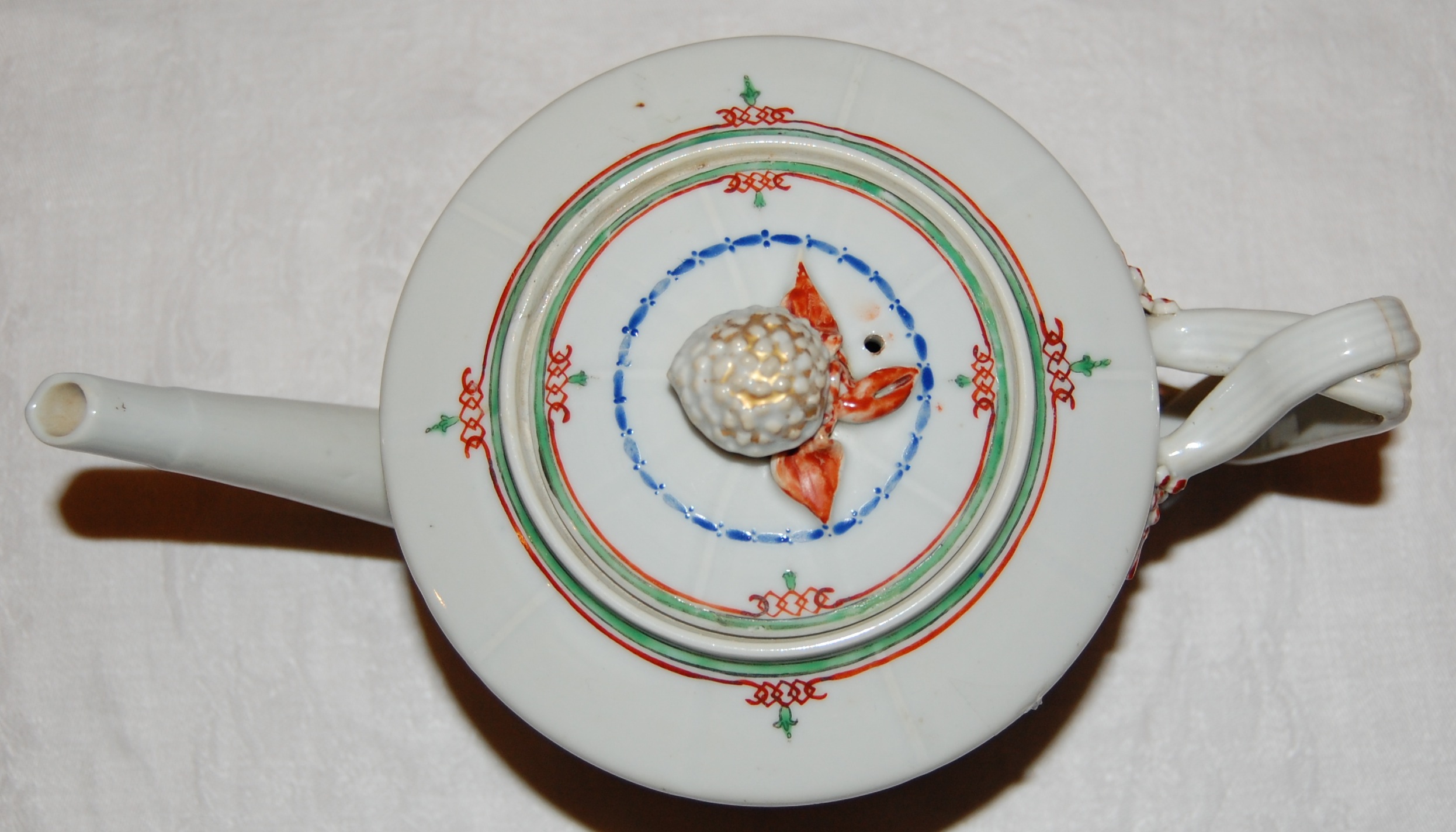
At the local antique mall, I found an attractive Chinese export porcelain cylinder or barrel-form teapot with crossed strap handles, suitable in design and shape for use in 1800 Providence. I made a special mid-week trip fully intending to buy the teapot and free poor Mr S from ever hearing “teapot” again in endless conversation. When the item was out of the case, though, it turned out to have a mended crack right across the bottom, and as I told the woman, “It matters because I intend to use this.”
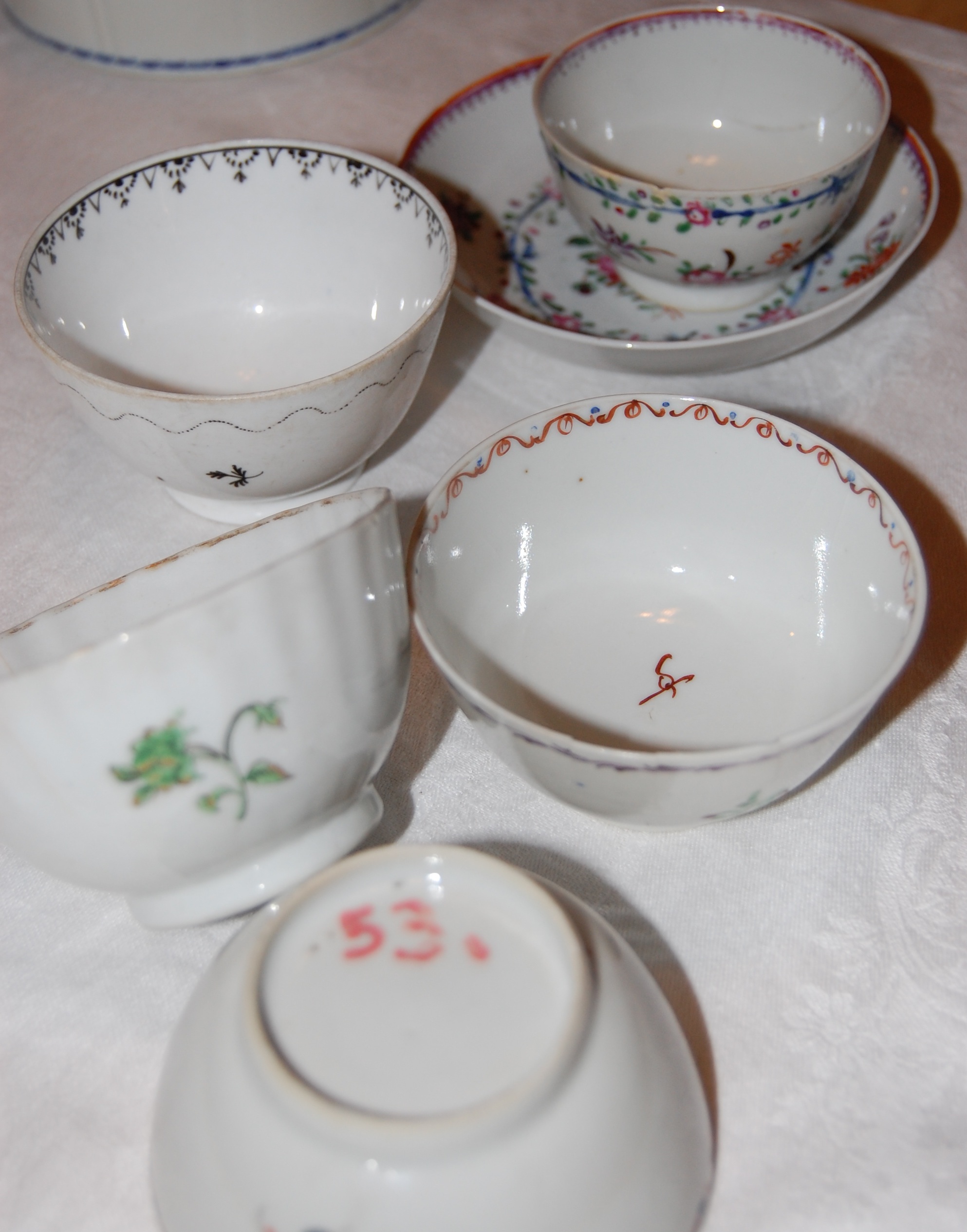
In the end, I did not have my fabulous teapot for What Cheer Day. In fact, my fabulous teapot arrived just this past Thursday, after patient stalking on eBay. It arrived with a bonus of five cups and a saucer, most with mends, but the pot itself has just a handle flaw or mend (typical, and seen, along with wear, in some museum pieces, too). The quantity of cups suggests that the previous owner had a relationship with them not unlike the one you might develop with a large litter of kittens you were fostering…adopt one, get another! Just to get them out from underfoot.
The cups and pot reminded me of the difficult meals and teas Elizabeth Bennett takes with Maria Lucas and Lady Catherine whilst visiting Mr Collins and his new bride Charlotte Lucas. There’s a tension in these cups, some combination of the dainty and the strong, some slightly misshapen (not all makers were equally skilled) that calls to mind the polite verbal combat of tea parties.
I washed the cups, and was reminded of the duties of maids to clean and care for these delicate items, the kind of thing they were unlikely ever to acquire, though there were grades of china then as now: what sat on John Brown’s table was not what sat on the Dexter’s table, or at least not in the same quantity.
The quantities of china coming into Providence and the rest of the Eastern seaboard after 1788 were enormous: in 1797, dinner sets of 172 pieces could be ordered at Canton for $22, and included 6 dozen large flat plates, 2 dozen large soup plates, 2 dozen small dessert plates, 8 pudding dishes, 2 large tureens, dishes and tops, 2 smaller ditto, 16 dishes of various sizes, 6 sauce boats and stands, and 4 salt cellars. Tea and coffee sets of 81 pieces were bought in Canton for $6 to $9! Just for dinner and tea, you could have 253 pieces of china, and we haven’t even begun to get into custard cups, cache pots, and garnitures!
The indifferent pieces I have acquired may have started out as kaolin, feldspar and quartz in Ching-te-Chen, 200 miles west-southwest of Shanghai. There were important porcelain manufactories there, and porcelain wares traveled by road and boat to Canton, where sets were customized to meet specific orders and then loaded onto ships bound back to America, six months or so after the order was placed in Providence, Salem, or Boston. It’s a lot of work for a fashionable sip of Hyson or oolong, and no wonder cups and pots were mended, saved, and reused.
30 Thursday Oct 2014
Posted in Events, Fail, History, Living History, Philosophy, Reenacting
In the post-What Cheer Day aftermath, when I was very tired and two houses were very messed up, I started thinking about why I bothered with living history. What exactly is this thing, and why I do it? Those questions made me think about the very best moments I have had in this business of re-creating the past in cloth and smoke and time.
In no particular order:
1. Going up to the field at Coggeshall Farm to call the boys down to dinner after spending all day in the kitchen. I was desperate to get out, and finally knew first hand how limited women’s lives could be in the 18th century, especially non-elite women.
2. Running upstairs at the John Brown House with Eliza, giggling over a joke to be played on Mr Mason. I don’t know what Mr C thought of it but I felt twelve years old, silly, carefree and light. John Brown’s housekeeper surely never felt that way, but a naughty maid might have, and for an instant I knew what it was to have no responsibilities.
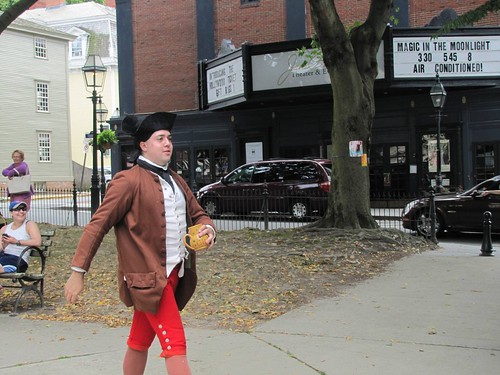
We didn’t even notice the background at the time
3. Chasing the Young Mr, a wayward apprentice, across the street; mobbing Mr Howard’s house; and arguing with the Stamp Inspector, all during the Stamp Act Protest in Newport It was not until I looked at the photos that I realized we really had been in front of a theatre, and that there were actual cars! A friend confirms that he, too, forgot about the cars, to the point of nearly being hit whilst running to Mr Howard’s house.
4. Assembling with a group of friends to take tea with Mrs Silsbee in Salem, sorting ourselves into a group on the sidewalk and venturing out, only to meet Mrs Silsbee on the street. That is the most Jane Austen/Mrs Gaskell I have ever felt. The wretched cobblestones do not count, as they were from the 20th century, but walking out on the wharf, and meeting a friend who brought an umbrella as the rain began was also very Austen-esque.
None of these are military events, and the majority of them happened this year, in past three months. I think this may be because we have been to fewer military events, and I expect the concentration is due, in part, to finally getting better at this practice. They are also site-specific, and trending toward first-person interpretation.
For reasons explained better by the NPS and in the excellent study of NPS-Reenactor relationships, no battle reenactment can ever capture the truth of the war it attempts to recreate, and that is true even when the battle takes place on the same site, at the same time of year, and even when soldiers are dressed in as-close-as-possible replicas of the uniforms worn at that battle, on that field, on that date, 236 years earlier, and no one has brought a spinning wheel or tent chandelier to camp.
I respect the notions of moveable monuments and performances as commemoration. I like military history, I like war memorials: there is not a competition between civilian and military reenactments. But military events have not yet had the power to transcend experience for me.
My best guess as to why military events are not transformative for me is that, to this point, the business remains too much like camping in funny clothes. As I experiment more with 18th century methods of cooking appropriate rations, and as I strip away the gear we carry into the field, the military events are better (as at Bennington). But I already know how limited women’s perspectives could be (see item 1), and while Bennington was instructive in how ridiculously different the experiences of men and women could be, the military events remain more instructive experiences for the men.
Why? Because the specificity of site plays out at those events in the battle, and not in the camp. The point at Bennington and at Saratoga and at Stony Point was to use the site as it had been used. The men experienced the landscape in ways as close as possible to what soldiers and militia had actually seen. And women stayed in camp and got smoke in their eyes, cut up vegetables, or washed clothes, which is pretty much what happens at any outdoor event where we can have a fire and, with differences in technology, is pretty much what I do when I get home from work every day.
All that leaves me wondering what to make of military events, and what I want to do in the coming year. No matter how much of this is “for the public,” it still has to be rewarding for the practitioner.