• Home
  • Completed Costumes/Impressions
  • Emma and Her Dresses
  • Free Patterns and Instructions

Kitty Calash

~ Confessions of a Known Bonnet-Wearer

Kitty Calash

Tag Archives: 18th century clothes

HSF #0: Waistcoat, Bloody Waistcoat

02 Wednesday Jan 2013

Posted by kittycalash in Clothing, Historical Sew Fortnightly, Making Things, Reenacting

≈ 6 Comments

Tags

18th century, 18th century clothes, Clothing, common dress, Costume, Historical Sew Fortnightly, living history, Making Things, sewing project, waistcoats
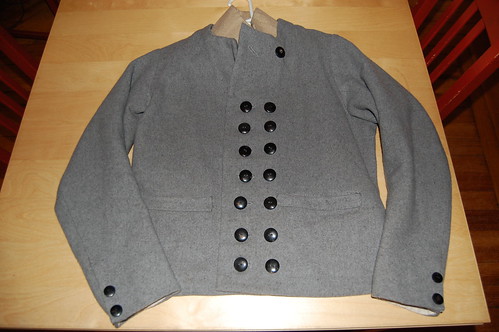
Challenge garment peers from jacket. Calm thyselves, fellow authenticity hounds. New buttons for jacket are on order.

(Actually, the jacket was bloody where I jabbed myself with the needle inserting the sleeve, but that’s fun for another day. And how you know your historical sewing project is complete. I bled for this, man.)

The Challenge: #0, Starting Simple

Fabric: Body: ¾ yard remnant from Wm Booth Draper WWB816 Broadcloth, light brown. Lining: Left over heavy-weight linen. Might also have come from Booth, I forget.

Pattern: Kannik’s Korner Man’s Waistcoats, 1790-1815

Year: Call it 1799. That’s the year where it will be worn.

Notions: 9 brass buttons from Wm Booth Draper
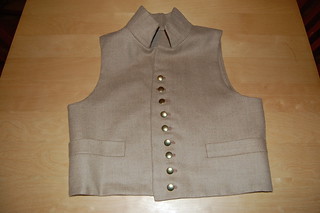
What monkey did those buttonholes?

How historically accurate is it? Well…the pattern has good documentation and the fabric is within reason for the period. The waistcoat is entirely hand-sewn, but the button holes were apparently accomplished by drunken crack-headed monkeys, which is what you get for trying to finish a garment on New Year’s Eve. I was neither drunk, nor on crack, and have no helper monkeys, but all the same…thank god for jackets to hide the sins of my buttonholes.
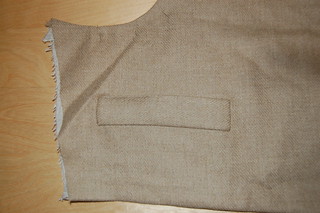
Best welt I ever made–aside from butting heads with a colleague once.

Hours to complete: Don’t ask. It’s a soul-robbing number. The buttons and buttonholes alone took 1 full and two half Abbot & Costello movies, and two “Monarchy” episodes. Probably 25 hours total (I started in November, but stopped sewing after December 2). Total time may include naps taken when I fell asleep while sewing.

First worn: To be worn by the new owner (Mr S) January 19, at the Winter Frolic.

Total cost: Blood, sweat, tears… sorry, wrong war. Buttonholes bring that out in me.

  • Fabric:  $13.50
  • Lining: Leftover, hence not factored in.
  • Buttons: Used 9, but bought 10 because I’m not as simple as I look, so $12.50
  • Pattern: Also from Wm Booth, $16.

That puts the cash outlay at $26 for materials, and $16 for pattern, which I will use again starting yesterday. Yes, sports fans, another bloody waistcoat to sew. Lucky for me, it’s red, so the blood won’t show. Checking the HSF schedule, I can see that the only 1813 garment I can make is another waistcoat (1790-1815, remember?) for the Young Mr, who needs a full set of clothes made by January 19. Waistcoat underway, pattern pieces assembled and two more pieces of broadcloth remnant order for a jacket, leaving trousers to wrestle with. At least I have fabric. 

Share this:

  • Share on Facebook (Opens in new window) Facebook
  • Share on Pinterest (Opens in new window) Pinterest
  • Email a link to a friend (Opens in new window) Email
  • Share on X (Opens in new window) X
Like Loading...

Portrait of a Waistcoat

21 Friday Dec 2012

Posted by kittycalash in Clothing, History, Museums

≈ Comments Off on Portrait of a Waistcoat

Tags

18th century clothes, Clothing, Costume, fashion, mercantile trade, museum collections, resources, robert jenkins, silk velvet

RIHS-Robert Jenkins

Meet Mr. Jenkins. There are references to a Robert Jenkins, Vestryman of Christ Church, Boston and merchant of Salem, MA and Newport, RI. A Robert Jenkins married Elizabeth Champlin of Newport, and we have a pendant portrait of Betsey Jenkins, suggesting stronger ties to Newport. The records are confusing, but one thing is clear: that’s his waistcoat and he’s happy to have you see it.

This 1748 portrait by John Greenwood shows a man associated with a port city, perhaps connected with shipping and mercantile trade (see the ships in the background), and who has made enough money to a) commission a portrait and b) either own that sweet silk velvet waistcoat or to have one painted. It is entirely possible that he owned it.

Met-Waistcoat

And it probably looked a lot like this 1750-1755 one from the Met, but without the sleeves. There is fragment (two fronts) of one very like this in the collection at work. It’s not Robert Jenkins’, but it is Rhode Island, so we know these kind of garments were available and worn. The last piece to track down would be an account book, to get some idea of what this might have cost.

What I like in particular about the Met’s waistcoat is the cuff detail. The sleeve, which would be heavy if fully made of velvet, is not. Only the cuff is the velvet, while the sleeve itself is lighter weight silk.

Share this:

  • Share on Facebook (Opens in new window) Facebook
  • Share on Pinterest (Opens in new window) Pinterest
  • Email a link to a friend (Opens in new window) Email
  • Share on X (Opens in new window) X
Like Loading...

Smibert Smitten

19 Wednesday Dec 2012

Posted by kittycalash in History, Museums

≈ 5 Comments

Tags

18th century clothes, Clothing, Costume, dress, fashion, john smibert, Museums, Research, resources

John Smibert made me laugh. He’s been dead since 1751, so it wasn’t easy.

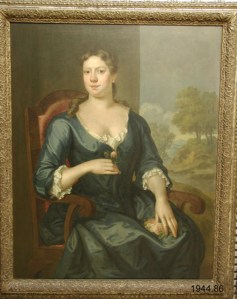
The day I went to the MFA and walked into the gallery with Mrs Tyng on wall, I laughed, and said, “I know her!” while my son died a small interior death. Then I pulled up the record and image for Mrs Browne, and showed him how I knew Mrs Tyng.

Follow Smibert’s pictorial advice if you’re reenacting an American woman of means between 1729 and 1732, and you’re wearing blue silk. You may have a red silk wrapper/shawl. Your shift will show at the center front and sleeves to show off your fine linen. You look like you might be a little cold, but perhaps that explains the “I store oranges in my bodice” look.

See for yourself:

MMA, Mrs Brinley & her son

MFA, Mrs MacSparran

RIHS, Mrs Browne

MFA, Mrs Tyng

MFA, Mrs Dudley

Smith College- Mrs Erving

Smith College- Mrs Erving


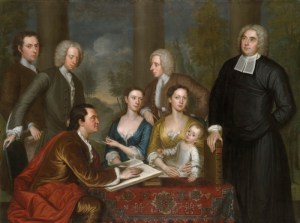
Yale- The Bermuda Group

Yale- The Bermuda Group

After a while, you start to wonder if there was only one woman in the colonies in 1730… And then you wonder how she got into every painting…

I know, style and conventions helped create these portraits as much as Smibert’s skill. And the portraits only get weird when you do the thing that was never supposed to happen. We were never meant to see all of these portraits all together, all at once, anywhere.

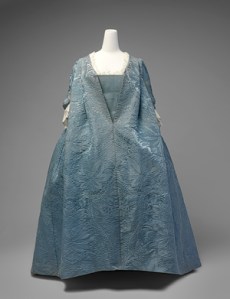
h2_2010.148-1 So, what’s she wearing? Probably this dress. No, not this exact dress, though if it was same woman in all those paintings, maybe the Met does have her actual dress. (Sometimes I have these weird museum-y ideas, and that’s generally when I need a vacation or come up with a new program idea.)

The robe volante shows up in paintings of women dressing, and in informal scenes, as below. She’s clearly wearing stays, which is helpful to know, because while I knew the women in the Smibert paintings ought to be wearing stays, and they had conical torsos, the orange-smuggling look was confusing.

Galerie Dreyfus- Scène galante dans un parc, ca 1725

Galerie Dreyfus- Scène galante dans un parc, ca 1725

In fact, it confuses me still.

Seriously, the 18th century was a pretty sexy place, if you like oranges and silk.

Yale- Mrs Tyng

Yale- Mrs Tyng

Look, there’s Mrs Tyng again! She’s left the MFA and taken a chair at Yale.

Share this:

  • Share on Facebook (Opens in new window) Facebook
  • Share on Pinterest (Opens in new window) Pinterest
  • Email a link to a friend (Opens in new window) Email
  • Share on X (Opens in new window) X
Like Loading...

It Isn’t History Till it Hurts

02 Sunday Dec 2012

Posted by kittycalash in History, Living History, Museums

≈ 5 Comments

Tags

1799, 18th century clothes, Coggeshall Farm Museum, common dress, living history, Museums, preparations, weather, weekend

End of the day, Sunday

End of the day, Sunday

That’s approximately what the costumed interpreters say their leader says.

Let me affirm for you that history does, in fact, hurt, when you are doing it right. That is to say, you will be bodily tired. You will be hungry. You will be cold. Your judgment will be impaired. Your world will shrink.

I have so many thoughts/ideas/inspirations/observations after another weekend at the farm that I do not quite know where to begin.

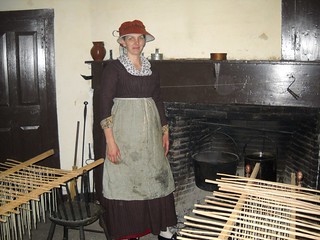
Yesterday, I made 290 candlewicks and draped them, with some help, over 50 sticks. My colleague and I managed to dip each stick of 6 wicks 2 or 3 times, though I had to trim the wicks after the first or second dip so they would match the depth of the kettle. Today, we got there late (thanks to my broken stay laces which had to be replaced…once replacements were found…annoying) so the fire was not hot, the wood not gathered, the tallow not melted—oh, it was not what this control freak wanted. I wanted to both make dinner and dip candles.

Well, we did manage both, in a way. Dinner was more of a snack of boiled chicken and root vegetables, followed by a snack of squash custard tart, and the candle dipping was managed only sporadically once the tallow was melted. First it was too cold, then too hot: it was a day of details. At some point I realized I was so tired that I could no longer think about a simple thing, and that what got in my way was simple lack of fluency. If I did this every day, I wouldn’t need to think about it. But I don’t. So while I can do these unfamiliar tasks, they are just a bit harder when I am cold, hungry, tired, or hurting.

Hot tip: sheepskin insoles. In wool stockings yesterday, my feet were freezing cold in the kitchen when I was not near the fire. With sheepskin insoles, my feet were warm today. Your mileage may vary, but well worth a try.

Share this:

  • Share on Facebook (Opens in new window) Facebook
  • Share on Pinterest (Opens in new window) Pinterest
  • Email a link to a friend (Opens in new window) Email
  • Share on X (Opens in new window) X
Like Loading...

Waistcoat Weekend

26 Monday Nov 2012

Posted by kittycalash in Clothing, Making Things

≈ Comments Off on Waistcoat Weekend

Tags

18th century clothes, Clothing, sewing

My clothes are finished, and there was just enough left from a petticoat to cut the fronts, welts, facings and collar of a waistcoat for the Young Mr. It will have to be backed with the grey broadcloth of his father’s coat, which was brought to the brink of buttonholes Sunday evening.

Tonight, trousers to cut out, and a progress check-in for Mr S’s waistcoat. Menswear has such different construction techniques, stay tape and diagonal basting, such structure! I was better at those techniques 20 years ago, and now I don’t know what I’ve done with the books on couture techniques.

It’s a great quantity of buttonholes, really, so better not to count (24 + 18 + 10= 52) on the way to the 1,000 that Henry Cooke prescribes for proficiency. Will I ever get there? I will at least get better at them, or so I hope. When these garments are done, I think I will have done 100 in the past 12 months.

No progress photos: just newly acquired mirrors (drive across CT and back as fast as you can!),  hung in place.

Share this:

  • Share on Facebook (Opens in new window) Facebook
  • Share on Pinterest (Opens in new window) Pinterest
  • Email a link to a friend (Opens in new window) Email
  • Share on X (Opens in new window) X
Like Loading...
← Older posts
Newer posts →

Archives

wordpress statistics

Creative Commons License
Kitty Calash blog by Kirsten Hammerstrom is licensed under a Creative Commons Attribution-NonCommercial-ShareAlike 4.0 International License.

Website Built with WordPress.com.

  • Subscribe Subscribed
    • Kitty Calash
    • Join 621 other subscribers
    • Already have a WordPress.com account? Log in now.
    • Kitty Calash
    • Subscribe Subscribed
    • Sign up
    • Log in
    • Report this content
    • View site in Reader
    • Manage subscriptions
    • Collapse this bar
 

Loading Comments...
 

    %d