• Home
  • Completed Costumes/Impressions
  • Emma and Her Dresses
  • Free Patterns and Instructions

Kitty Calash

~ Confessions of a Known Bonnet-Wearer

Kitty Calash

Tag Archives: 18th century

More on Pockets

18 Monday Mar 2013

Posted by kittycalash in Clothing, Museums

≈ Comments Off on More on Pockets

Tags

18th century, 18th century clothes, Clothing, Costume, dress, museum collections, Research, resources, Revolutionary War

If you think you don’t like military history, think again. A friend of mine is working on a French and Indian War 250th Anniversary project in Boston, and in the course of his research he got interested in a red velvet grenadier’s cap that I happen to be adjacent to from time to time.
UBM 2006-08-53

UBM 2006-08-53

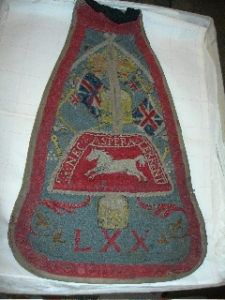
One thing led to another, fortunately for him and not me, and he ended up calling on the National Army Museum in London. There a curator after my own heart distracted him with one of the coolest things I have ever seen: A Lady’s Pocket made from the decorative panel of a mitre cap, or as they call it, Mitre Pocket.

Here’s their description:

“Front section of a mitre cap made into a ladies pocket, 1760 (c); wool and cotton; on front the emblems for the 70th Regiment of Foot, all sewn as for the period, 1760 (c); back is made of brown cloth; front is bound with red cloth binding.

Note: Hanoverian white horse and ‘Nec Aspera Terrent’ used by 8th (The King’s) Regiment of Foot, later King’s (Liverpool Regiment), which might make the L an initial not a numeral and the XX a company number rather than part of the regimental numeral.”

Grenadier’s cap, 1833.1.1, RIHS

One of the most charming things about the email is that the woman at the NAM sent my friend an image of a gown and pocket, just so he’d be clear about how it would have been worn. He knew anyway, but I thought that was a very nice thing to do.

The cap we’re looking into is this one, said to have been picked up at Bunker Hill. Not for nothin’ (as the locals say), but this cap would make a lovely pocket.

Share this:

  • Share on Facebook (Opens in new window) Facebook
  • Share on Pinterest (Opens in new window) Pinterest
  • Email a link to a friend (Opens in new window) Email
  • Share on X (Opens in new window) X
Like Loading...

What’s in your pocket?

01 Friday Mar 2013

Posted by kittycalash in Clothing, Historical Sew Fortnightly, Making Things

≈ 5 Comments

Tags

18th century, 18th century clothes, chamois, Clothing, common dress, living history, Making Things, menswear, pockets, sewing

A typical rough linen lining

My son’s pockets used to be full of acorns: he collected them at the bus stop, but I don’t know if it was because he planned to feed the squirrels, or if he thought he was a squirrel. Later, he moved on to rocks. Now, rocks, fish hooks, a pocket knife, change and a hankie fill the pockets of his 18th century breeches.

We’ve had some moments of unhappiness when things have gone missing from the pockets, though we’ve usually found them again. When you look at the contents list, you wonder how the linen stands up as well as it does.

There’s a clever way to upgrade pocket bags in menswear, and it’s authentic: leather bags, instead of linen. Original garments have leather bags, probably deerskin, and they’re deliciously soft and very durable. Stuff all the heavy, sharp things you want to in that pocket, and it will probably take it.

1895.4.3A-C

1895.4.3A-C

Based on a suit in the RIHS Collection, I decided to modify the pocket bags on the Young Mr’s new workman’s jacket-in-progress, which I plan to have finished by March 11 for HSF #5, Peasants and Pioneers.

Made of a heavy, rough-finished brown broadcloth (possibly manufactured in New England), both jacket and breeches pocket bags are made of deerskin.

Pocket bag in progress.

To recreate this, I took a trip to the auto parts store, and purchased a large chamois.  Instead of cutting the bags from linen, I cut them from the chamois and trimmed the seam allowances: chamois won’t ravel, so the seam won’t need to be folded over at the top.

A little fuzzy, but you get the idea

I backstitched the bag seam, and in general, I’m pleased with the way it has turned out. I think I’ll look into additional leather options, but otherwise, it seems like a fairly successful experiment.

The real test, of course, will be user testing. How many sharp, heavy things can the kid load in a pocket before it gives out?

Share this:

  • Share on Facebook (Opens in new window) Facebook
  • Share on Pinterest (Opens in new window) Pinterest
  • Email a link to a friend (Opens in new window) Email
  • Share on X (Opens in new window) X
Like Loading...

Eat, Not Just Meat

22 Friday Feb 2013

Posted by kittycalash in Food

≈ 1 Comment

Tags

18th century, food, history, vegetables

Good advice for every day, if you’re not t-rex

The Young Mr has been  unsupervised some of this week (he’s old enough but not always as mature as one might prefer) and I have left him notes to help him with some basics, as he does prefer to rise long after I’ve left for work. In the bathroom, BRUSH YOUR TEETH is affixed to the mirror (should’ve added + HAIR). In the kitchen, another note is taped to the Christmas Cactus above the sink.

My coworkers, many of whom have known the Young Mr since he was in a stroller and had nicknames like Possum Baby and Seal Monkey (he just shivered a small death when you read those names), found this note hilarious. The kid has a reputation as a one-human plague of locusts: he once ate a third of a pound of ham in a 20-minute span while his father and I went to the grocery store. He will eat a large head of lettuce in the hours between when he gets home from school and I get home from work. Entire tins of Altoids vanish suddenly, and all I get is a sulky, guilty look.

So I found this blog  post, What’s For Supper? very interesting, as I had been thinking of late, How would I feed the kid in the 18th century winter?

Fantastic Hairdress with Fruit & Vegetable Motif, 65.692.8, MMA

Fortunately, there would have been vegetables. And whether the beds were hot with manure or straw, there would have been some greens. At the farm we had salad in January; would it make it to February, or March? Don’t know, but I love the idea of spinach. Parsnips store well (scrub hard) and are delicious, and apples, too.

I think we forget we did not invent the larger world: it was big before we got here, with ships circumnavigating the globe and caravans crossing mountains long before container ships began losing sneakers on the ocean.

Share this:

  • Share on Facebook (Opens in new window) Facebook
  • Share on Pinterest (Opens in new window) Pinterest
  • Email a link to a friend (Opens in new window) Email
  • Share on X (Opens in new window) X
Like Loading...

Three sticks, two kettles, no matches

20 Wednesday Feb 2013

Posted by kittycalash in History, Living History, Reenacting

≈ 2 Comments

Tags

18th century, authenticity, living history, Reenacting, Research, resources, Revolutionary War

Soldiers Cooking, 1798 National Army Museum (UK), 1983-11-63-1

Here’s some visual evidence for why we travel with three sticks, two kettles, and no matches. (We bring the sticks as we suspect the sites where we camp & cook don’t want amateur logging on their grounds.)  I stumbled upon this at the National Army Museum in the UK. Here’s what they say about the image:

Soldiers from an unknown unit attend to their cooking pot on a break from their duties during the Wars of the French Revolution (1793-1802). They are accompanied by their womenfolk. Although only a few men from each unit were officially allowed to marry and have their wives and families accompany them, women would have been found in almost every British military camp. Some worked as cooks, laundry women and sutlers (camp followers who sold provisions), while others were prostitutes.

One of the things one learns when reading about women who followed the armies of the Revolutionary War is that prostitution–at least for those following the American army– was not high on the list of occupations for women.

Why not? Lack of ready cash, folks.

Working for the Army would get you rations, and that literal meal ticket was desirable in a time of shortages and want. If you’d been burned out of your home or farm (I’m looking at you, 54th Reg’t of Foot, Aquidneck Island torchers) what would you eat? What would you do? It depended, of course, but one thing to do would be to follow your husband if he had enlisted.

I know less about the women who followed the British Army, but for a Continental Army start, I recommend the following books:

Belonging to the Army. Mayer, Holly A. USC Press, 1996.

Liberty’s Daughters. Norton, Mary Beth. Cornell, 1980. (My edition, 1996)

Revolutionary Mothers. Berkin, Carol. Vintage Books, 2005.

In Pursuit of Liberty. Werner, Emmy. Potomac Books, 2009.

The last title is about children in the time of the Revolution, not women, but considering who was left home with the children, and in trying to understand what the time might have been like for the Young Mr, I’ve given it a read as well.

As for the camp gear? We keep it at a minimum based on period images. We don’t all sleep in one tent, but we pack as light as we can. It’s nice when authenticity and ease are the same.

Share this:

  • Share on Facebook (Opens in new window) Facebook
  • Share on Pinterest (Opens in new window) Pinterest
  • Email a link to a friend (Opens in new window) Email
  • Share on X (Opens in new window) X
Like Loading...

All that glitters…

13 Wednesday Feb 2013

Posted by kittycalash in History, Living History

≈ 4 Comments

Tags

18th century, cleaning, Hannah Glasse, housework, museum collections, pewter, polishing, silver

An Old Woman Cooking Eggs, Diego Velazquez, 1618. National Gallery of Scotland, NG 2180

An Old Woman Cooking Eggs, Diego Velazquez, 1618. National Gallery of Scotland, NG 2180

…could be pewter. Or do I mean tin? Carolina had excellent points about pewter being, yes, that shiny, though we think it is not. Our perception is probably based in large part upon the extant items in museum collections. And museums don’t polish their pewter–at least we don’t, and I don’t know anyone who does. Is it because we’re so unaccustomed to using pewter daily that we no longer know how to care for it?

Covered chalice, pewter, c. 1756-1780. Philadelphia Museum of Art, 2008-110-1a,b

Covered chalice, pewter, c. 1756-1780. Philadelphia Museum of Art, 2008-110-1a,b

I thought it could be interesting to experiment with polishing pewter (not in the collection) so I turned for advice to that touchstone of housework past, Hannah Glasse.  In The Servants Directory, Part V: The Scullion Mrs Glasse lays out To clean Pewter, Tin, and Copper.

Take a pail of wood-ashes (either from the baker’s dyer’s, or hot-pressers; the latter is the best) half a pail of unslack’d lime, and four pails of soft water; boil them all in a copper together, stirring them; when they have boiled about half an hour, take it all together out of the copper into a tub, and let it stand until cold, then pour off the clear, and bottle for use.

When you clean your pewter, lay a flannel on the dresser; set your dishes one on another by themselves, the plates to likewise; then heat liquor according to the quantity you have to clean, pour some on the uppermost plate and dish, and as you use them pour it on the other. Take a piece of tow to rub them with, then having two little basons of red sand, pour some of the liquor on each; with the first scour your plates well, and rince them in cold water; with the second clean them, rince them into two waters, set them to dry, and they will look like new. Thus you may clean them at any time with very little trouble.

Very little trouble for you, Hannah Glasse! The red sand is definitely something museums won’t do: we have this prejudice about not abrading the collections, or applying chemicals, so the lime/ash/soft water mix probably won’t appear in our workroom either.

Willem Claesz.Heda, Still life with gilt goblet, 1635. Rijksmuseum, Amsterdam

Willem Claesz.Heda, Still life with gilt goblet, 1635. Rijksmuseum, Amsterdam

I also took a look in my books for paintings that showed pewter with sheen, and for objects. I suspect that pewter’s softness will not allow it to achieve the high-gloss shine of tin, but that it can be brought to brightness. I do think the best way to find out is to start polishing, so I’m in the market for some wood-ashes from the hot-pressers, and a good place to lay a fire and boil some chemicals. Who wouldn’t volunteer for open-fire chemical boiling?

Share this:

  • Share on Facebook (Opens in new window) Facebook
  • Share on Pinterest (Opens in new window) Pinterest
  • Email a link to a friend (Opens in new window) Email
  • Share on X (Opens in new window) X
Like Loading...
← Older posts
Newer posts →

Archives

wordpress statistics

Creative Commons License
Kitty Calash blog by Kirsten Hammerstrom is licensed under a Creative Commons Attribution-NonCommercial-ShareAlike 4.0 International License.

Website Built with WordPress.com.

  • Subscribe Subscribed
    • Kitty Calash
    • Join 621 other subscribers
    • Already have a WordPress.com account? Log in now.
    • Kitty Calash
    • Subscribe Subscribed
    • Sign up
    • Log in
    • Report this content
    • View site in Reader
    • Manage subscriptions
    • Collapse this bar
 

Loading Comments...
 

    %d