• Home
  • Completed Costumes/Impressions
  • Emma and Her Dresses
  • Free Patterns and Instructions

Kitty Calash

~ Confessions of a Known Bonnet-Wearer

Kitty Calash

Tag Archives: Clothing

To Breakfast In

13 Thursday Apr 2017

Posted by kittycalash in Clothing, Living History, Making Things

≈ 2 Comments

Tags

19th century, 19th century clothing, authenticity, Clothing, Costume, dress, fashion, Federal style, museum collections, sewing
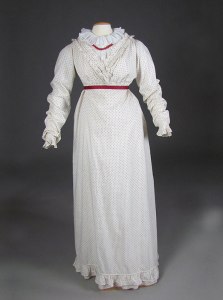
http://agreeabletyrant.dar.org/gallery/1810s/polka-dot-printed-dress/

Dress, cotton, United States, private collection; reproduction chemisette, private collection; coral necklace courtesy of Dames à la Mode.

I get ideas. And like a cat I once knew, once I have an idea, it’s hard to shake. Luckily for me, my judgement is better than the cat’s– he had a tendency to pounce without regard to results, and scars do show on furry white noses. But in this case, at least, there are no scars, just some pricked fingers.

Like so many of us early-Federal era obsessives, I fell in love with An Agreeable Tyrant, and demanded the book for Christmas. It’s not just the essays or images, it’s the patterns. Scaled patterns take at least some of the guess work out of recreating historic costumes, but not all of it. And never for me– if there’s something to mess up or guess wrong, I am right on top of it– which is to say, I learn to adapt my errors and adjust my methods to fit my materials.

Surplice-front gowns have teased and delighted me for years: My first foray was with the silk “Quaker” gown of three (!) years ago, a gown I based on digging into Quaker portraits and Nancy Bradford’s Costume in Detail. It worked well enough then– not brilliantly, but close enough for my purposes. But then the polka dot dream appears, and of course, I need one to fulfill my dream of living Persuasion and having a morning dress to breakfast in. Beats the heck out of what I eat breakfast in now, and perhaps the company would improve as well. (I’m looking at you,cats.)

Dolly Eyland, by Alexander Keith, 1808. (c) The New Art Gallery Walsall; Supplied by The Public Catalogue Foundation
Courtesy Newport Historical Society

Well, so, what to do? Attempt my own, of course, since I found some fabric that seemed plausible enough and matched the color my dried blood. It’s a sheer block print cotton from India, more sheer than the original fabric, but capturing the feel well enough– and better, I suspect, than the stiff quilting cottons one is likely to find with polka dot prints. Construction and patterning fun next time on “True Confessions of the Frivolously Fashion Obsessed.”

Share this:

  • Click to share on Facebook (Opens in new window) Facebook
  • Click to share on Pinterest (Opens in new window) Pinterest
  • Click to email a link to a friend (Opens in new window) Email
  • Click to share on X (Opens in new window) X
Like Loading...

Becoming an Exhibit Prop

21 Tuesday Mar 2017

Posted by kittycalash in Museums

≈ 5 Comments

Tags

19th century clothing, Clothing, dress, exhibits, fashion, Federal style, Museums, sewing

We all have those Hamlet-like moments, don’t we?
How weary, stale, flat, and unprofitable | Seem to me all the uses of this world!

But in this case, I can attest to being and not merely feeling flat: lo, I am cutout exhibition furniture.

Thanks to Mr B’s casting call on behalf of the New-York Historical Society, a number of friends and acquaintances and I are now part of the scenery of the new exhibition, Saving Washington, up through July 30.

The behind the scenes of being a prop is pretty entertaining.

Mr H
Mr H
Steaming my shawl
Steaming my shawl

The changeable green-red sari gown was made for this photo shoot; we were asked to wear strong colors, and since the exhibit was meant to represent one of Dolley Madison’s “squeezes,” dressing up was in order– and hard for me to do, since most of my gowns are day dresses at best.

I started this November 22, and carried it on airplanes several times.

November 22: the madness begins
Sleeve salvation
Sleeve salvation

The sleeves appeared to be a complete failure at first, until I figured out I could pleat the design to form a smaller, graphic band at the bottom. Sometimes I start without knowing how a thing will turn out…including most days when I get out of bed.

December 9 completion level: wearable.

At least it was finished enough to wear to the photoshoot, and it appeared again, with a real hem and a ribbon to keep it on, in Salem last month. I’m pleased enough with the color, and how well it doesn’t go with most things to call this a success– and finished!

In situ.

Share this:

  • Click to share on Facebook (Opens in new window) Facebook
  • Click to share on Pinterest (Opens in new window) Pinterest
  • Click to email a link to a friend (Opens in new window) Email
  • Click to share on X (Opens in new window) X
Like Loading...

Workshop Wednesday: Accessory to the Past in June!

22 Wednesday Feb 2017

Posted by kittycalash in Clothing, Living History, Making Things, Reenacting

≈ Comments Off on Workshop Wednesday: Accessory to the Past in June!

Tags

authenticity, Clothing, dress, fashion, sewing, workshops

Neck stocks: just so.

Neck stocks: just so.

Drunk Tailor and I will be up to more mischief this summer, and you can join us! We’re teaching a class this June at Historic Eastfield Village. Among the things you can learn to make are chemisettes, reticules, gaiters and neck stocks.

We plan to start with the basic question: who are you? And what does that mean for what you wear? What visual and extant sources can inform your choices? From John Lewis Krimmel to Sophie Du Pont, images help paint a picture of a distinctive early American style.

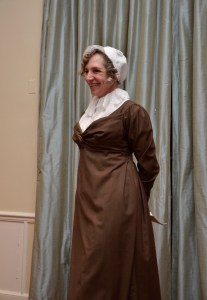
Mrs Pabodie attempts to remember when she was born (1771). Photo by J. D. Kay

Mrs Pabodie attempts to remember when she was born (1771). Photo by J. D. Kay

Collections from Rhode Island to New York contain examples of early garments that help us understand how people dressed in the early 19th century, as well as diaries that tell us how they lived. Fortune telling? Sewing for money? Bored with quilting? Church as a social experience? There’s much more to the early nineteenth century than Jane Austen. Come find out more this June.

Share this:

  • Click to share on Facebook (Opens in new window) Facebook
  • Click to share on Pinterest (Opens in new window) Pinterest
  • Click to email a link to a friend (Opens in new window) Email
  • Click to share on X (Opens in new window) X
Like Loading...

Whimsical Wednesday: Shoes.

25 Wednesday Jan 2017

Posted by kittycalash in Clothing, Making Things, Reenacting

≈ 1 Comment

Tags

19th century clothing, authenticity, Clothing, common dress, sewing, shoes

If you are a historic costumer, living history interpreter or enactor and tell me you don’t have a problem with shoes, and I will laugh at you. Even if you don’t have way too many shoes, chances are good you look at them in museum collections, even if you don’t order them. Shoes are basic to any impression.

I have history with shoes, myself. Not only have my feet always been generously proportioned, but my Grandmother possessed a singular fondness for, and an expansive collection of, shoes.

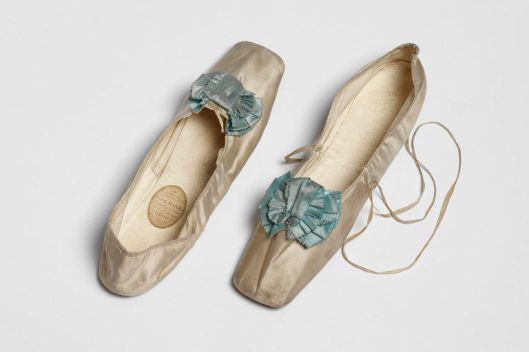
Shoes. Slippers.

Pair of slippers. 1825-1849. Paul Hase, Paris. V&A 1153&A-1901

Pair of slippers. 1825-1849. Paul Hase, Paris. V&A
1153&A-1901

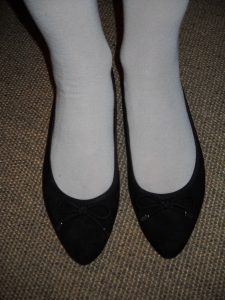
Call them what you will, when you hanker to dance, you need them. So, I find myself in the happily distracting position of needing (wanting) dance slippers for April. I thought my search might be fruitless, what with my pedal extremities, but reader: I was delighted and surprised. dscn4592

Yes: they fit! Now the tricky bit is to dye and decorate these slippers to achieve maximum eye-watering potential. There’s a length of silk headed my way that should provide plenty of inspiration.

For tamer times, classic black will always do. Whilst replacing my worn-out sneakers, I came upon a pair of slippers that seemed ready for alteration, so I bought them as a backup, in case the Brontes didn’t fit.

dscn4595

They were inexpensive enough that I didn’t mind taking them apart for modifications.

dscn4601
dscn4605

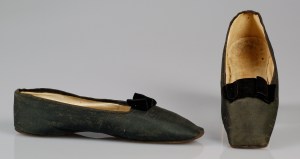
A grosgrain rosette and ribbon ties later, these will do well enough to extend the life of my irreplaceable Robert Land slippers. I looked at shoes last night, and drew inspiration from some examples through the first half of the 19th century. With the pointy toe, these clearly skew first decade of the 19th century, which is just right for most of what I do. The Brontes will work for later impressions– and I have those as well. All in all, a pleasant mid-week distraction.

Pair of women's shoes, 1801. Gift of Fred Taggart, 1986.31.1a-b. RIHS

Pair of women’s shoes, 1801. Gift of Fred Taggart, 1986.31.1a-b. RIHS

Women's slippers, 1790-1810. American. MFA Boston. 99.664.12a-b

Women’s slippers, 1790-1810. American. MFA Boston. 99.664.12a-b

Slippers, 1835-1850. American, wool, silk. Metropolitan Museum of Art. 66-20-1a-b

Slippers, 1835-1850. American, wool, silk. Metropolitan Museum of Art. 66-20-1a-b

Share this:

  • Click to share on Facebook (Opens in new window) Facebook
  • Click to share on Pinterest (Opens in new window) Pinterest
  • Click to email a link to a friend (Opens in new window) Email
  • Click to share on X (Opens in new window) X
Like Loading...

Criss Cross, or, My Checker’d Past

09 Monday May 2016

Posted by kittycalash in Clothing, Events, Living History, Making Things

≈ 1 Comment

Tags

19th century clothing, Clothing, Costume, dress, fashion, Federal style, Making Things, sewing

Every now and then I look up from what I’m doing (tiny stitches, usually, though sometimes budget math) and realize that Objects in Mirror are Closer Than They Appear. Oops. It was just yesterday I was daydreaming about miniatures, and now I shall want a paintbox and brushes in a mere six weeks– and those six weeks are punctuated by a courier trip, a couple of exhibits, not to mention shepherding The Young Giant through prom and finals.

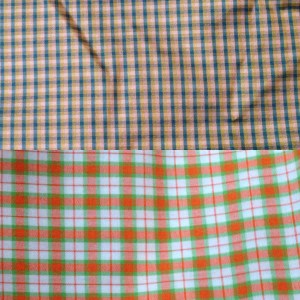
Top: check silk taffeta, Artee Fabrics Bottom: check cotton, Mood Fabrics

Top: check silk taffeta, Artee Fabrics
Bottom: check cotton, Mood Fabrics

This weekend, thanks to the SFR hunt for collar interfacing of an appropriate weight, I realized I’d better get a wiggle on my own sewing, and managed to hunt up the orange check from hell, pop it in the washer, and hunt up the pattern I intend to use.

Mrs Catherine Morey oil on canvas by Michael Keeling, 1817. (c) Walker Art Gallery; Supplied by The Public Catalogue Foundation

Mrs Catherine Morey oil on canvas by Michael Keeling, 1817. (c) Walker Art Gallery

I’m stuck on that 1817-1819 range because of someone’s eventual and particular Mode of Transportation, so I was super pleased to find this portrait while trolling the BBC’s Your Paintings site. Actually, I’m pretty over the moon about this image, since it places that cross-over front firmly in 1817. I’ve made a version of this form already, so I can but hope the next iteration will be even closer to correct for the period, once I tweak the pattern a bit.

The pattern: therein lie so many rubs, often going the wrong way. Still, I remain enamored of the check and of the cross-front gown. Any checkered doubts were dispelled when Alison for reminded me of the sort-of-cross front check gown at the Met, whose catalogers are hiding behind circa 1820 which allows leeway back to 1815. Behold, of course, the ruffled neck of the bodice (I do expect mine will fit a bit better since I am squishier than a mannequin, and possess appropriate infrastructure).

Morning dress ca. 1820. British, cotton.
Metropolitan Museum of Art, Purchase. 1979.385.1
Marcia Sand Bequest, in memory of her daughter, Tiger (Joan) Morse.

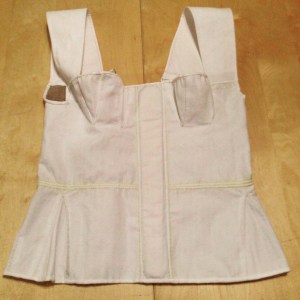
Speaking of infrastructure, the appropriate stays are finished, entirely hand-sewn, and ready for deployment in pattern fittings before they debut at Genesee.

File_000 (1)

Six weeks to Genesee: at least one 1817 dress, another sheet, a portfolio and paint box, followed immediately by 18th century stays, a front-closing gown, and a bucket repair. Surely that’s all manageable, right?

Share this:

  • Click to share on Facebook (Opens in new window) Facebook
  • Click to share on Pinterest (Opens in new window) Pinterest
  • Click to email a link to a friend (Opens in new window) Email
  • Click to share on X (Opens in new window) X
Like Loading...
← Older posts
Newer posts →

Archives

wordpress statistics

Creative Commons License
Kitty Calash blog by Kirsten Hammerstrom is licensed under a Creative Commons Attribution-NonCommercial-ShareAlike 4.0 International License.

Website Built with WordPress.com.

  • Subscribe Subscribed
    • Kitty Calash
    • Join 621 other subscribers
    • Already have a WordPress.com account? Log in now.
    • Kitty Calash
    • Subscribe Subscribed
    • Sign up
    • Log in
    • Report this content
    • View site in Reader
    • Manage subscriptions
    • Collapse this bar
 

Loading Comments...
 

    %d